If 2025 felt exhausting as an investor, you weren’t alone.
Flat indices. Stock-specific losses. Constant noise.
Here’s a slide-by-slide breakdown of what really shaped markets in 2025 👇
1/16
#StockMarket#Investing
Motilal Oswal group total AUM crosses ₹ 7 Lakh crores.
Motilal Oswal AMC crosses ₹2 Lakh Crores in AUM.
It's a proud milestone for all of us.
But more than the number itself, it's a reminder of the responsibility that comes with the confidence of every investor who has chosen us to be a part of their wealth creation journey.
To our Partners, Investors & well-wishers, *Thank you for believing in us* and growing with us.
We remain committed to doing what we've always set out to do: help create long-term wealth with conviction and discipline.
Here's to many more milestones, together.
*#MotilalOswal #7LakhCroreAUM #WealthCreation*
*#InvestmentJourney*
You know what truly scares large conpanies?
Not the stock price going down…. But the CDS going up.
CDS ( credit default swap) rising means a very simple thing… that cost of capital is going to rise and equity multiples are going to shrink.
I think lot of countries don’t have dollar borrowings at sovereign level for a reason ( India being one of them).. because then a CDS is created which can be used to manipulate a country’s currency, economy and its sovereignty… no different than reliance on global social media for reaching your domestic audience.
This is probably my most important post.
The FED stole your future and there is no going back
"The system is rigged. The deep state does not want us to be free. The American dream is dead."
Statements like these conjure images of deep pessimism, a worldview where you have no agency, where you are merely a puppet dancing for malignant powers you cannot see or touch. We are not people who live in that camp. But sometimes, certain data points are so damning that they leave us no choice but to admit: something is seriously wrong, and it needs to be laid out in the open.
Every time I visit India now, I find people agitated. Even those in the top 10% of the income bracket, earning anywhere from ₹50 lakhs to a crore per year, feel like they are running on a treadmill that keeps accelerating. No matter how fast they move, it is never enough. At the ground level, the situation is far worse. It is the same story everywhere. In Canada, both partners in a household work full time and still fall short each month. In Australia, young professionals earn well and own nothing. In Germany, the middle class quietly shrinks. The geography changes. The exhaustion does not.
And the origins of this mess are not in New Delhi or Ottawa or Berlin. They are in Washington D.C. All of us are paying the price for a policy disaster handed down from ivory towers, by people most of us never elected and, frankly, never even saw.
Consider this: the U.S. money supply (M2) grew by 40% in just 2 years
*The Federal Reserve United States Money Supply M2*
January 1, 2020: $15.4 trillion
January 1, 2022: $21.6 trillion
A staggering ~40% increase
As of Mar-26, $ 22.6 Tn
( so they never reversed the increased money supply although Covid got over)
Unprecedented in the history of the Federal Reserve post-World War 2 era. (Source: FRED) This massive injection of liquidity created asset bubbles across the economy. Wages stayed stagnant. Those who owned capital benefited enormously. Everyone else got the inflation.
Most people have not yet identified the cause of their frustration, but they have begun to feel its effects viscerally. And that feeling, that the system simply cannot deliver on their aspirations, has become the quiet tailwind driving a very dangerous behavioural shift.
The more people sense that conventional paths are closed off, the more they reach for asymmetric bets, even knowing the odds are stacked heavily against them. The explosion of betting apps and prediction markets, Kalshi, Polymarket, Dream11 and their many cousins, are not trends. They are symptoms of a broken economy. The feverish rise in F&O trading and the massive uptick in exchange volumes are different expressions of the same underlying truth: when people stop trusting the system to reward honest effort, they start gambling on outcomes instead.
Investing is for everyone—and so should be the conversations around it.
One of our unitholders, Mr. Rahul Gala, reached out with a simple request: make our Unitholders’ Meet accessible through sign language, so he—and others in the hearing-impaired community—can fully participate and engage.
We listened.
We’re glad to share that our 2025 Unitholders’ Meet with sign language interpretation—one small but meaningful step towards more inclusive communication.
Watch here: https://t.co/CC7YJvgMlt
Bull market ends when stocks stop going up on good news…
Bear market ends when stocks stop going down on Bad news.
This is the reason that you should act contrary to the advice given on magazine covers.
India is home to nearly 18% of the world's population, yet has only about 2.4% of the world's land area and around 4% of global freshwater resources.
Supporting one fifth of humanity with limited natural resources is both India's greatest challenge and one of its greatest achievements.
The question is not whether India has enough resources.
The question is whether we can use our resources, talent, technology and institutions efficiently enough to support one fifth of humanity.
Productivity, not population, will determine India's future.
⛏️ When the real economy becomes a rounding error… 💣
For more than a century, the mining industry’s share of global equity market capitalization has mirrored the great economic cycles of modern history:
📉 1915–1930: mining fell from 9% to 6% as post-WWI financial markets boomed till the Great Depression arrived
🆙 1940s–1960s: WWII and the post-war industrial expansion pushed mining back to 11%
💻 Since the mid-1960s: a relentless decline alongside the rise of finance and technology
Fast forward to 2025, the entire mining industry represents just 1% of global equity market cap. 🔬
That means the sector supplying the world’s:
🔋 copper
🥈 silver
⚙️ rare earths
🏗️ steel inputs
⚡ electrification metals
…has effectively become an afterthought in global portfolios.
🧩 Ironically, the modern digital economy could not exist without mining. AI, semiconductors, EVs, data centers, power grids, robotics all depend on enormous quantities of mined materials.
Nevertheless, markets continue to value the physical backbone of civilization as if it barely matters. 💤
⏳ History suggests these kinds of extremes rarely last forever.
#MiningIndustry #Commodities #StockMarket #BaseMetals #CriticalMinerals #TechStocks #EnergyTransition #AIBoom #Digitalization #MacroTrends #InvestorCofidence #MarketExpectations #RealEconomy #ResourceInvesting
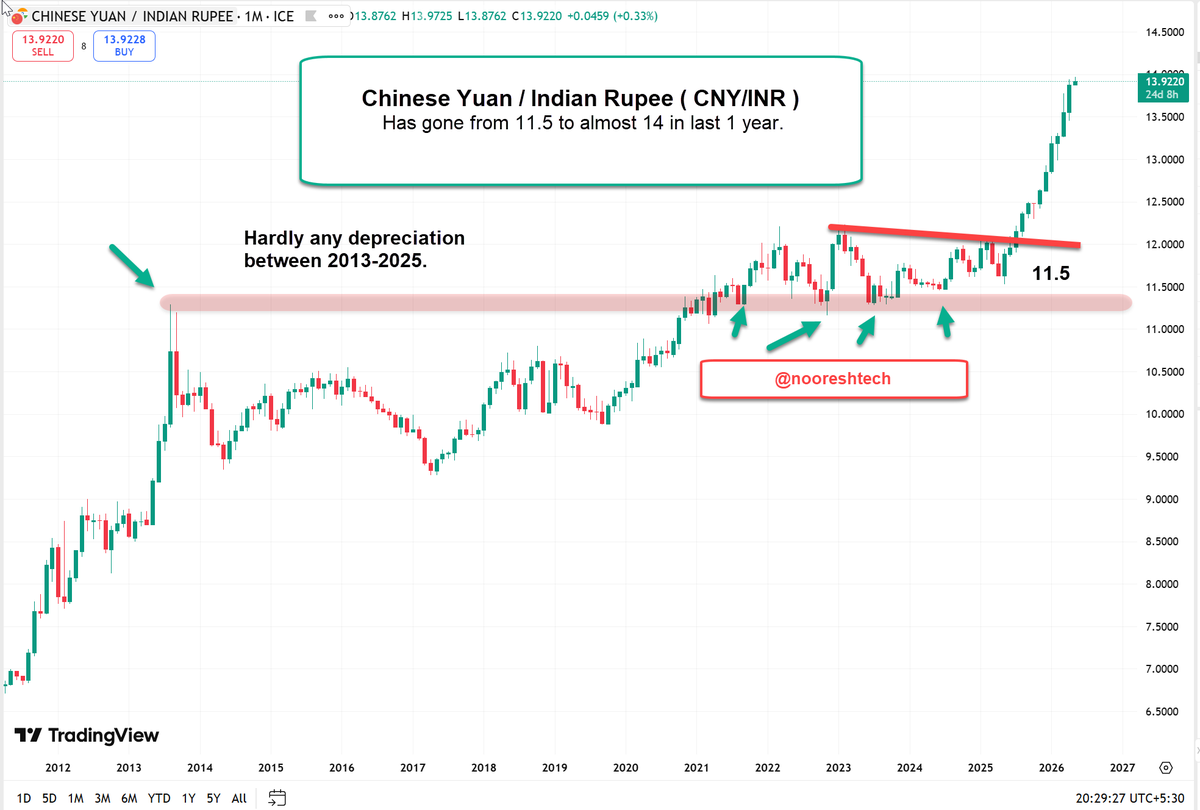
Chinese Yuan/ Indian Rupee ( CNY/INR )
Has gone from 11.5 to almost 14 in last 1 year.
This depreciation is more than what INR has done against USD
First time post 2013.
Should have implications for Export, Commodities, Inflation, Less Dumping, etc.
Any Beneficiaries?
The Brazilian central bank quietly returned to the gold market in 2025 after a four-year pause.
In just three months, Brazil bought 43 metric tons of gold.
That increased Brazil's total gold reserves by 33%, from 129.6 tons to 172.4 tons.
Brazil is now the third-largest central bank gold buyer in the world for 2025, behind only Poland and Kazakhstan.
The market value of Brazil's gold holdings nearly doubled in 2025, from 11.7 billion dollars in January to 23.3 billion dollars in November.
Gold is now the second-largest reserve asset held by the Brazilian central bank, after only the U.S. dollar.
Most U.S. macro investors did not notice this happen.
Brazil is also quietly diversifying away from the U.S. dollar.
The dollar's share of Brazilian reserves dropped from 86.77% in 2019 to 72% by the end of 2025.
Brazil is not alone in this move…
Poland added 102 tons in 2025 to reach 550 tons of gold, the most aggressive central bank buyer of the year.
Turkey added 27 tons in 2025 to reach 644 tons.
China officially added 27 tons in 2025 to reach 2,306 tons, with some analysts estimating the real number is more than double that figure.
The pattern is clear and global.
Sophisticated central banks are buying gold and selling dollars at the fastest pace in modern history.
Central banks bought more than 1,000 tons of gold annually in 2022, 2023, and 2024.
That was more than double the 2010-2021 average of 473 tons.
The world is reorganizing its reserve assets in real time.
Most U.S. allocators are still measuring everything in dollars.
The smartest capital is already positioning for the new monetary order.
When the world's tenth largest economy quietly buys 43 tons of gold in 90 days after a four-year pause, it pays to ask why.
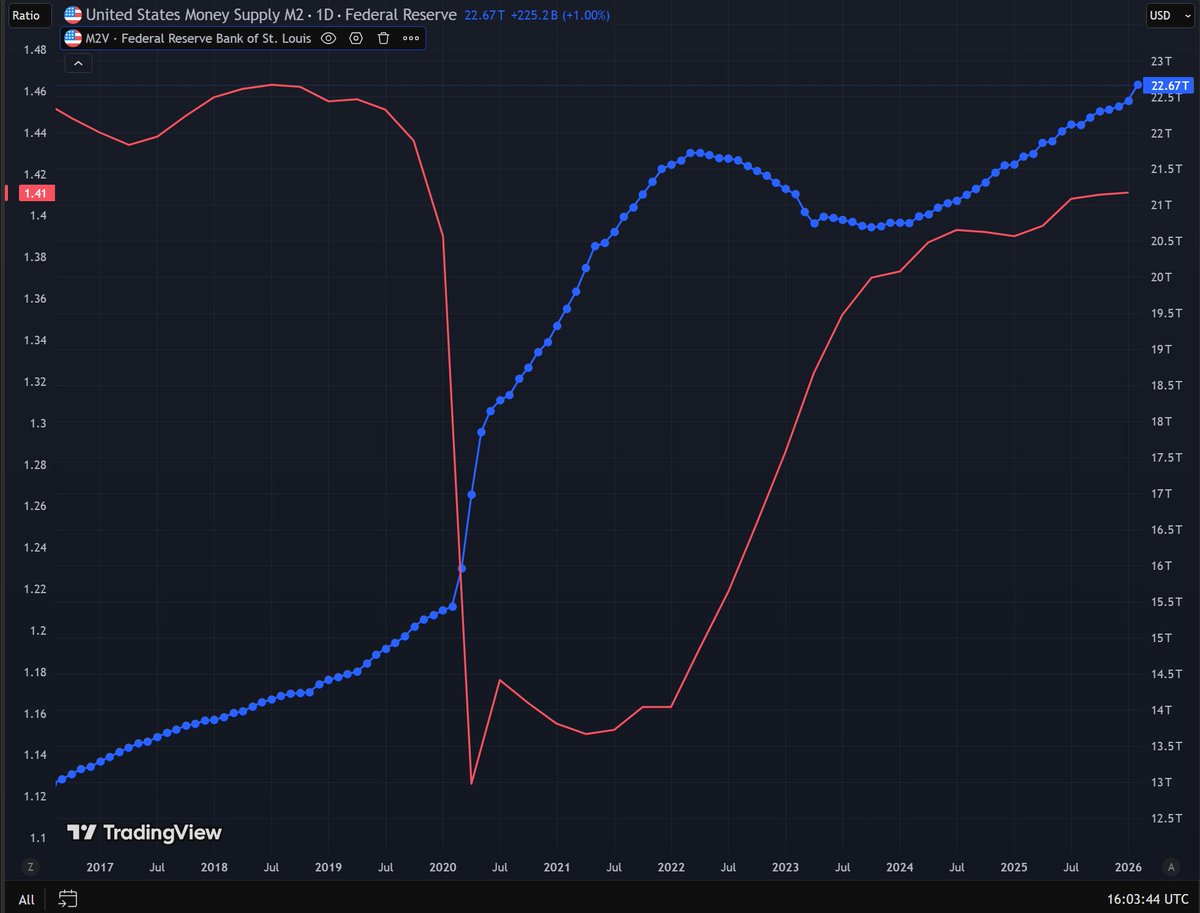
Much better chart.
In blue is US M2 (all-time highs)
In Red is M2 velocity.
This is the first time in last 10 years when US m2 is rising along with rising M2 money velocity.
M2 velocity cannot be easily controlled but M2 can be influenced by Fed.
if Fed does not influence M2 then expect falling dollar and rising inflation and asset prices.... beast (money velocity) is getting unchained here.
Making money in market has become easier than running companies since printing of this money.
This has led to young generation preferring to run family offices than family businesses.
This is on you ….. Fed.
China activated a law this morning that it passed in 2021 and quietly shelved. Until today.
Here is what most people are missing about why this matters.
China imports about 73% of its oil. For years, a big chunk of that has come from Iran at heavily discounted prices, around 1.5 million barrels a day. Iran has no bargaining power under sanctions, so China buys cheap. That cheap energy has been one of the silent engines behind its manufacturing competitiveness. Not many people talk about it, but the Trump administration clearly noticed.
Rather than confronting China directly, the US went after the supply line. Blockade Iran's main export hub, let storage fill up, let production stall, and you quietly raise China's input costs without ever having to say you're targeting China. Treasury Secretary Bessent used the phrase "permanent damage." He was not talking about Iran.
Then came the sanctions on Hengli, a private Chinese refinery, bundled with 40 connected companies and tankers. Private, not state-owned. Deliberately soft enough to avoid a formal state response. The message: stop buying Iranian oil or face consequences. Timed weeks before the Trump-Xi summit.
China's answer arrived this morning. The Anti-Foreign Sanctions Law is now active. US sanctions on Chinese companies are legally void on Chinese soil. Any bank, insurer, or tanker operator that complies with those sanctions is now breaking Chinese law and can be sued in Chinese courts.
Every global player now has to choose a side. That is not a small thing.
40 years ago, Japan faced a version of this pressure and backed down. It cost them three decades. China has been studying that mistake ever since. Today was the proof that they learned from it.
The Trump-Xi summit is still on the calendar. Both sides will show up with much harder positions than anyone expected a month ago.
Whenever I post something suggesting that the Chinese economy is not much different from other (aging) economies, a lot of people feel the need to explain to me that China is super productive and is a true growth miracle.
The straightforward reality is that China is not super productive nor a GDP growth wonder.
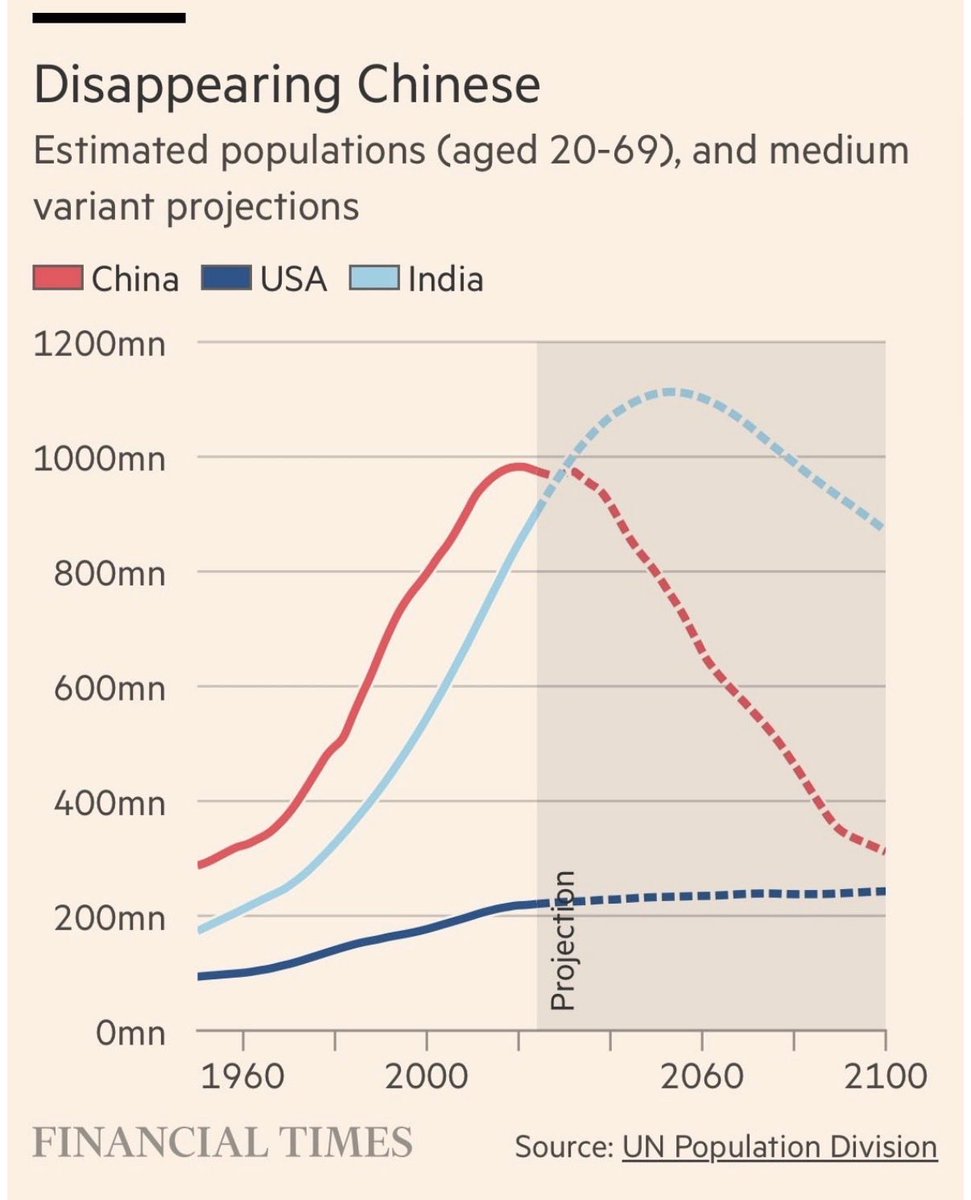
China’s population is aging and shrinking like no other. In the coming decades, the Chinese population will shrink by hundreds of millions. More importantly, so will China’s labor force, meaning China's primary source of GDP growth is outright negative.
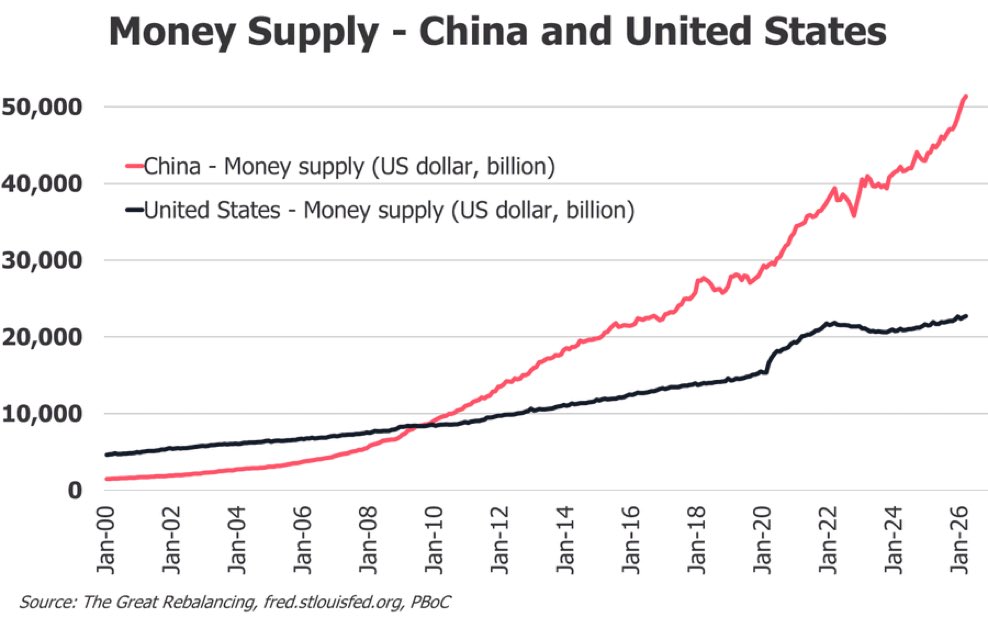
Connecting the dots: China’s debt accumulation is way above that of the United States and other aging countries, while its money supply has exploded. With a total unrealistic GDP growth target of 5% per year, China is a debt economy on steroids. And since debt and money supply are increasingly the same, China’s extraordinary money supply growth is easily explained. No productivity boom, no miracle.
Final piece of the puzzle. This is why China has no alternative but to keep buying unprecedented amounts of gold if it wants a shot at ditching US dollar hegemony.