The final word on grey-market peptides.
More than 100,000 third-party COAs, parsed and graded.
If it's not in our data, your vendor is hoping you won't ask.
This peptide stuff is getting out of hand. Not even the Empire State Building is safe.
If Big Pharma doesn't beat us enough, leave it to the price-gouging American resellers. If you see anybody selling GLP-1s for more than $1/mg - you're getting ripped off.
We priced six of the most bought research peptides at the source. Retatrutide runs $0.78/mg, one hop below the US reseller.
The same compound carries a $10.00/mg vendor median at the storefront layer. That is a 12.9x markup on a vial that often ships from the same factory line, sometimes with the same lab report stapled to it.
The gap between the vial and the label is exactly what TitrateLab tracks. We connect observed prices to vendor histories and 80,000+ lab records so people can see what’s behind the markup. David, I think our projects should work together. DMs are closed—what’s the best way to reach you?
Three major names in China’s grey-market peptide supply chain lead back to one connected operation.
The clue was hiding in plain sight: the exact same Google Ads identifier baked into two supposedly separate vendor websites.
ERP, WBS and JKL are prominent Chinese peptide suppliers operating behind the domestic reseller layer. They have been publicly active since 2025, with 251 published COAs attributed across the three names.
There had been suspicion that they were connected, but never concrete evidence.
Using OSINT, we found ERP and WBS exposing the same Google Ads identifier: AW-17876666502.
Then everything else started lining up: byte-identical SKU keys, shared product codes, matching delivery evidence and a price ladder repeated across 27 of 31 products. JKL’s identifiers and pricing closed the triangle.
Three names. One connected supply network.
But why operate under different identities?
Our biggest concern is reputation insulation. A bad COA can damage one name, shipping complaints another and refund disputes a third. Buyers never see one complete history—and may believe they are changing suppliers when they are only changing identities.
This is OSINT and data research, not a vendor promotion. It shows what a lab report alone cannot.
Full investigation:
https://t.co/Cw179idRIp
@BigPeptideGuy Important context: the 44% figure is about label accuracy not widespread underfilling.
54% measured over label, 44.23% within 10%, and only 1.62% under.
Overfill still affects dosing accuracy, but it’s a very different problem from being shorted.
Is the peptide grey market becoming better tested than parts of the regulated market?
We analyzed 12,870 public Retatrutide lab reports (COAs). Of 12,209 records reporting purity, 96.0% of them were between 99% and 100% purity. Among 7,241 label-comparable amount tests, only 1.62% measured more than 10% under label.
Adding to it, the last 12-month window improved on both measures, while independent labs, public COAs and community testing continue to expand.
Now consider the regulated compounding system.
In one limited FDA survey, 10 of 29 sampled compounded products failed at least one quality test. Nine contained only 59–89% of expected potency.
More recently, FDA cited a pharmacy for distributing semaglutide at 79.876% potency and tirzepatide at 86.779% and 89.13%.
This raises the question: is the most transparent part of the grey market developing a stronger testing culture than parts of the regulated compounding market? Who do you trust more, China or Big Pharma?
Data, trends and sources: https://t.co/KIPSAoHCOl
Peptide Grey Market Summed Up:
American domestic resellers are buying Retatrutide from China, slapping a 10¢ NIIMBOT holographic label on it and charging $70 for a 10 mg vial.
And even while people are getting ripped off, they may STILL feel like they got their money’s worth.
Because the results are that dramatic.
In TRIUMPH-1 (Lilly’s 80-week Phase 3 obesity trial), the 4 mg, 9 mg and 12 mg target-dose groups lost an average of 47.2, 64.4 and 70.3 lb.
At the ridiculous reseller price of $70 per 10 mg vial, the trial’s actual dose-escalation schedules work out to roughly:
→ $2,184–$5,964 of product
→ $46–$85 per average pound lost
For 47–70 pounds of average weight loss in the trial, plenty of people will look at that number and say: worth it.
And that doesn’t even count the food savings.
People taking GLP-1 medicines commonly report eating less, ordering less takeout, going out less, buying fewer snacks and simply feeling less urge to spend money on food.
A recent study found grocery spending fell 5.3% within six months of starting a GLP-1, while spending at fast-food, coffee and other limited-service restaurants fell 8.0%.
For some people, the money they stop spending on food can offset part, or even all, of what they spend on the peptide.
That’s why the markup works.
Now, compare purchasing intelligently.
TitrateLab’s June 29 snapshot found a median source-layer asking price of $0.78/mg across 125 in-stock rows... about $7.80 for that same 10 mg vial.
At the Chinese Vendor price, the same trial exposure falls to roughly:
→ $243–$665 total
→ $5–$9 per average pound lost
The molecule can be an extraordinary value.
The reseller can be extracting an extraordinary margin.
Both things can be true.
Retatrutide remains investigational and is legally available only in Lilly clinical trials. These are market benchmarks, not a claim that grey-market material is equivalent to trial-grade drug. Upstream means observed asking price, not manufacturing cost; shipping, testing, waste and clinical care are excluded.
https://t.co/vlbDRAK8bl
Florida should become America’s peptide state.
@j_fishback, I’d love to hear you address peptide research and access in Florida. Leadership here could be monumental. Florida should become America’s peptide hub and build a real identity around fitness, freedom, and family.
At TitrateLab, I track much of the grey-market research community—vendors, laboratory testing, activity, and demand. From what I see, Florida is consistently at or near the top in buyers, sellers, and interest. Only California really competes.
The numbers show this is no longer fringe.
Nearly one in five American adults has used a GLP-1 drug, and one in eight is taking one now. Among users, 17% obtained one from an online provider and 9% from a med spa.
That includes legitimate medicine and is not a count of the grey market—but it demonstrates the extraordinary public demand driving the wider peptide movement.
The grey market itself is becoming measurable. Chainalysis identified $32 million in peptide-related cryptocurrency flows during the first quarter of 2026—up 159% in a single quarter—and estimates that the visible on-chain market is now running above $100 million annually.
That captures only cryptocurrency transactions attributed to known peptide vendors. It is a measurable slice of the market, not the entire thing.
This industry is exploding because Americans have spent years trapped in an extreme, profit-driven, exploitative healthcare system. People are exhausted by endless referrals, unaffordable treatments, rushed appointments, painkillers, and invasive procedures. They are looking elsewhere because the system they were told to trust has failed them.
I’m watching my own parents get lost in endless referrals and a healthcare system that eats away at their limited time.
Now Americans are experimenting with peptides for nearly everything. They are importing compounds from overseas, injecting them, and paying independent laboratories to determine whether the vial contains what its label claims.
The obese people woke up and smelled the coffee. Wait until the world finds out about peptides like BPC-157, TB-500, and mitochondrial peptides like SS-31 and MOTS-c.
No more shilling people painkillers and surgeries they may not need while potentially useful peptides are strangled before we can even study them properly.
A small JAMA test-buy study shows the danger of leaving this underground. Three of six no-prescription semaglutide sellers took payment but delivered nothing. The products that arrived measured only 7%–14% purity despite advertising 99%, while containing 29%–39% more semaglutide than their labels claimed.
Why does it have to be this way in America?
Why are we trusting China with compounds Americans desperately want and believe they need? Why are Americans fleeing to Chinese factories from the supposed safety of their own government? Why are ordinary people building their own testing and verification networks because they trust them more than the supposed safety of their own healthcare system?
Something is deeply wrong.
The answer is not to pretend this market does not exist or force it further underground. Florida should bring it into the light through legitimate research, physician involvement, domestic manufacturing, transparent laboratory testing, and enforceable standards for identity, purity, dosage, sterility, and endotoxins.
Florida is filled with the extremes: young people and old people.
Young people need to be fitter, healthier, and smarter. Older people need to be comfortable, stable, mobile, and put together.
We live in an ecosystem. All boats rise with the tide. Older Floridians are more than retirees simply existing. They are parents, grandparents, mentors, business owners, and leaders of families and communities. They are paramount.
The FDA should protect Americans from dangerous products. But it is un-American to let big bully agencies strangulate opportunities for Americans to live healthier, happier lives. When Washington moves too slowly, protects entrenched interests, or allows Big Pharma’s profit-driven lobbying and regulatory capture to smother promising research, Florida should step forward.
Demand safety. Fund the research. Build trusted domestic supply. Give doctors and patients honest information. Protect Floridians when Washington won’t.
Florida can lead before everyone else catches up.
Be the peptide candidate. Be a peptide bro. It’s American.
Grey-market peptides are better than you’ve been led to believe.
One academic study produced a "41% to 71% peptide failure” headline from one voluntary testing program.
We reanalyzed 64,787 public laboratory reports.
Here’s what the larger record shows:
→ 99.31% contained the peptide named on the label.
→ 93.08% were no more than 10% below the labelled dose—or were at/above it.
→ 98.99% were not severely short-filled, meaning 40% or more below the labelled dose.
And the failures were heavily concentrated.
Depending on the problem measured, just 0.53%–2.43% of vendors accounted for half of the results where:
• the labelled peptide was not found
• purity was below 95%
• the vial contained 40%+ less than labelled
That does not look like one uniformly unsafe market.
It looks like a largely high-performing market with a small, identifiable tail of poor suppliers.
The grey market’s greatest strength is community testing:
Buyers fund independent laboratory tests.
COAs are shared publicly.
Bad batches become visible.
Vendors can be compared.
Communities can react in real time.
In major testing sources, low-purity and underfill rates fell as this surveillance network expanded.
Pharma has mandatory manufacturing controls.
The grey market has a different strength: public, sample-level evidence that buyers can actually inspect.
The answer is more testing, more shared reports and faster visibility into the vendors that fail.
See the complete 64,787-record analysis:
https://t.co/xfb2N09om8
TitrateLab now has 1,000 subscribers.
1,000 paid subscribers trusted us. It might not be nearly as many as similar services out there, and we weren't the first of our kind, but we will be the last. We're proud of our progress and the current trajectory and know 10,000 will be a breeze.
We are deeply humbled and truly grateful for all the support.
Every certificate. Every price change. Every restock. Parsed, attributed, timestamped, filed with intention.
No vendor has ever paid us. Several have tried; some spam our support lines with baseless empty legal threats.
Every peptide tier list in this space is bought. You know it, we know it, the vendors definitely know it. The result that would cost someone a sponsorship just never gets posted and the consumer carries all of the burden.
We post all reports.
100,000+ COAs collected. 70,000 processed, scored, ranked.
50+ Chinese factories tracked.
4,000+ reviews with photos, order dates, real handles. No anonymous five stars.
Live price and stock across the whole market.
Everyone else here is running a group chat and a spreadsheet. We run ingest pipelines against every vendor channel on the market. Every certificate gets parsed, attributed to a manufacturer, and checked against its label claim. Every vendor name gets resolved across a dozen spellings so one factory doesn't show up as four. Every price change gets written as an event with a timestamp.
We didn't win this on marketing. We won it on engineering and listening to what people needed.
That fight is over. Time to go up a level.
So let this be your sign to stop vibe coding that tier list. Kill the inventory tracker that's been at 60% since March. You are not going to finish it, and you should not have to. We already did.
Come work with us instead.
API access. Full export. Real-time alerts - inventory, pricing, potential scams.
You don't want to build this yourself. Building it means anti-automation bypasses that break every other week. Academia-tier OCR on lab reports somebody photographed at an angle in bad lighting. Parsing "price lists" that are screenshots of screenshots, hand-typed in a dozen incompatible formats, half of them genuinely cursed. Then tracking 50+ grey market vendors across forums, Telegram, Discord and whatever platform they migrate to next week after the last one bans them.
We already did all of it. Now it's a REST endpoint ready to integrate with your business, even the 10x resellers out there - our platform will enable cost reduction and increase safety. All boats rise with the tide.
Wholesale pricing and inventory across every major Chinese factory, accurate to the second. The complete price history. The entire certificate database. Export the whole dataset or pull the slice you need, JSON or CSV.
And alerts that actually matter: the moment a compound you track drops in price or comes back in stock, at the cheapest factory carrying it. You find out when it happens, not when you next remember to check, and you don't need to do that either, our automation framework can facilitate everything end to end. Plug and print.
This is the layer the market runs on next.
https://t.co/R0zyN7aSbd
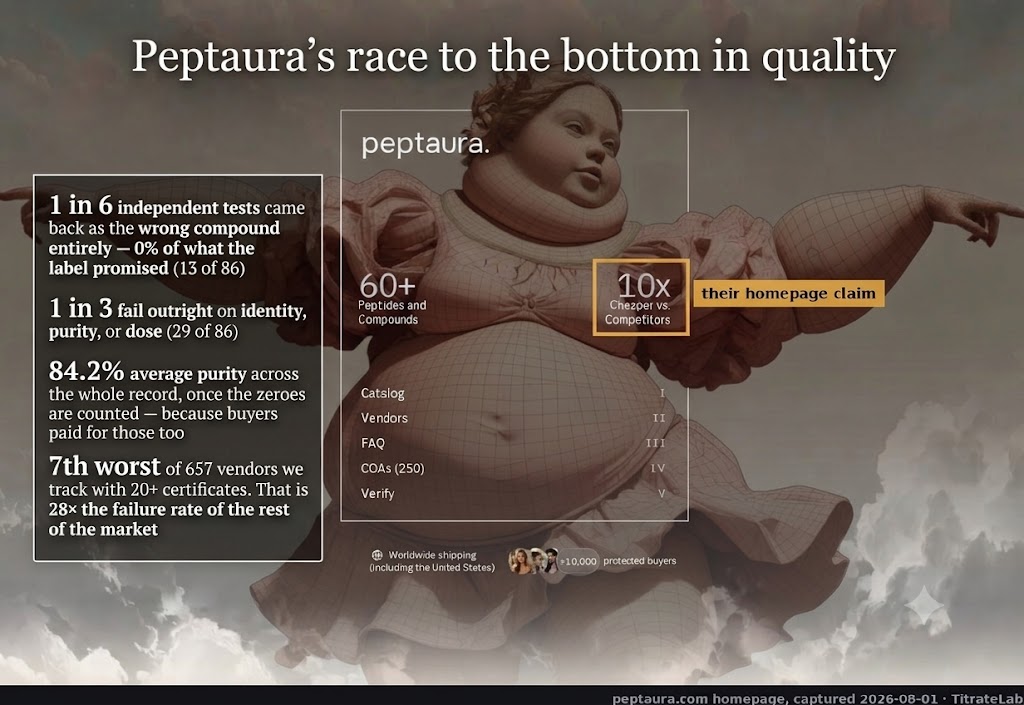
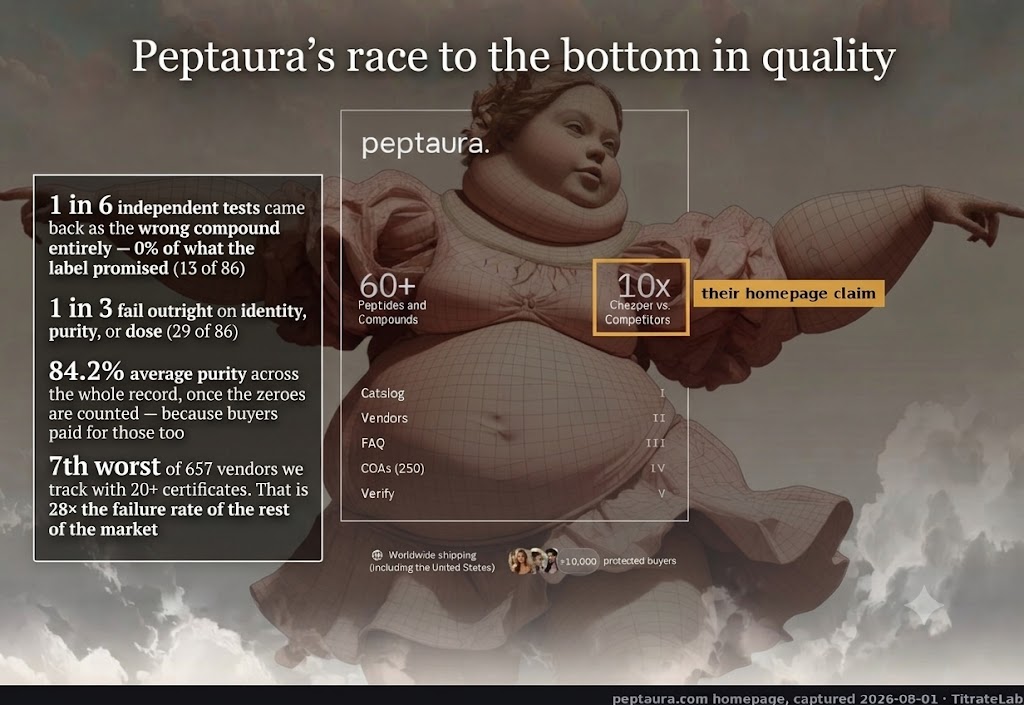
Peptaura promised a race to the bottom on price.
1 in 6 of their flagship vials contained zero percent of the drug on the label.
They won a different race.
We pulled all 86 independent lab tests on Lumira, the brand they push hardest. The numbers:
- Average purity: 84.2%. Market average: 98.7%.
- Average fill: 79.5% of label. The market slightly overfills, at 108%.
- Identity failure rate: 15.1%. Rest of the market: 0.54%.
That is 28 times the failure rate of every other vendor we track with 20 or more tests. Seventh worst out of 657.
Their own verify page shows a green PASS on a batch their own lab failed. 76.3mg of active in a vial sold as 100mg. Still on sale at $70.80.
Now the price, since that was the entire promise. Divide by what the lab actually found in the vial:
Lumira: $2.75 per mg of real drug. An ordinary domestic vendor: $1.53
80% more expensive. 12 to 15 days instead of 4 to 7, and there's a good chance you receive nothing from Peptaura.
Every cheaper brand on their shelf has never been independently tested. Not one test, ever. Untested is not the same as passed.
We asked how they stop people buying Lumira directly.
Founder: "how would they do it? lumira websites you see online are fake lmao"
Us: so it's only possible to order through peptaura?
Founder: "yeah"
They brand it, test it, certify it, and are the only seller. Nobody behind it is named. Do not trust Peptaura.
Every failing certificate and the receipts:
https://t.co/l5sctyMJ09