I wanted Codex to find usages of [key: foo | bar] in Elixir's codebase. It grepped first, but got too many false positives.
BUT, since Elixir's AST is quite uniform, it chose on its own to write a script that parses all files, scans the AST, and gave me precise locations.
WILD.
The Elixir Mentor cheat sheet just got a big update.
3 pages now covering IEx, mix, Ecto, Phoenix, git, docker, Vim, and asdf. Everything I reach for daily, in one place.
Grab it free: https://t.co/8AVkly9FYy
We dance to the rhythm of Jevons’s generous wheel: a cycle where the more bountifully we reap, the more miraculously the soil yields, turning our careful conservation into a wild, everlasting spring. To plant seeds that blossom the faster we cultivate them.
If you are into the ideas of David Deutsch or Karl Popper, or are interested in the interplay of creativity with criticism, you might enjoy this talk I gave about a month ago at "Conjecture Conference Oxford 2026".
Not sure how many more of these pieces about AI influences on education I'm going to post, because at this point, I think the conclusion is both clear and obscure.
Clear: Our current high school curricula and college liberal arts degrees cannot continue to be administered as they've been for the last century.
Obscure: What we'll replace them with.
**
If at first teachers worried about students using chatbots to write essays, now new agentic tools such as Claude Code are allowing students to outsource even more of their work to the machines. Need to take an online math quiz? Write a biology-lab report? Create a PowerPoint presentation for history class? AI can do all of this and more. One high schooler recently told me that he struggles to think of a single assignment that AI wouldn’t be able to do for him.
As a measure of just how good AI has become at schoolwork, consider a new bot called Einstein. Several weeks ago, the tool went viral with big claims: “Einstein checks for new assignments and knocks them out before the deadline,” a website advertising the bot explained. All that a student had to do was hand over their credentials for Canvas, the popular learning-management platform, and Einstein promised to do the rest...
When I first came across Einstein, I was skeptical: Flashy AI demos have a way of overpromising and under-delivering. So I decided to test the tool out for myself. Because I’m not a college student, I enrolled in a free online introductory-statistics class. The course website explained that the class was self-paced and that it could help undergraduates, postgraduates, medical students, and even lecturers build up basic statistical knowledge. I set the bot loose, and in less than an hour, Einstein had worked through all eight modules and seven quizzes. There were some hiccups—the bot took one quiz 15 times—but it ultimately earned a perfect score in the class. As for me? I hardly so much as read the course website.
...Einstein does seem to be an indicator of where AI in the classroom is headed. The latest bots have massive context windows, meaning that students can feed in mountains of course content such as syllabi, lecture slides, and practice exams. Today’s agentic tools can complete all kinds of tasks, such as participating in online discussion forums and taking notes on recorded lectures without student intervention. According to one analysis, the percentage of students middle-school age or older who self-reported using AI for help with homework climbed by 14 points from May to December of last year...
Instructors, as I have previously written, are also using plenty of AI. Canvas recently introduced a new AI teaching agent designed to save instructors time on “low educational value tasks” such as organizing online-course modules and adjusting assignment due dates. “Faculty are using AI tools both for instructional purposes, for building course materials, but they’re also starting to play around with generative AI to actually grade and assess the learning,” Marc Watkins, a researcher at the University of Mississippi who studies AI and education, told me. He gave a hypothetical: “I could set my agent up, open it up in my course, go out on campus to walk across campus to get a cup of coffee at Starbucks,” he said. By the time he returned, 15 minutes later, all of the essays would be graded, and “bespoke personal feedback” would be sent out to each student. AI can save teachers time—that same grading takes him 10 or 12 hours, Watkins estimated—but in the process, the technology threatens the relationship between students and teachers that is core to education. “That’s really scary,” he said.
Most people I spoke with seemed unhappy with the current trajectory of bots in the classroom. Even as growing numbers of students are using the technology, a majority believe that the more they use AI for classwork, the more it will harm their critical-thinking skills...Some educators are worried about “a fully automated loop”—as the Modern Language Association put it last fall—in which AI-generated assignments are completed and graded by AI agents. Instructors have taken to analyzing students’ Google Docs history to make sure they are typing responses live instead of pasting in text from a bot. But of course, an AI work-around exists for that too: A new suite of human-typing simulators promises to generate text to make it look as if a student is writing in real time when, really, the work is being done by AI.
https://t.co/hs5gGMslD4
Inspired by a Bluesky post from a while ago, I *finally* got around to writing up a bunch of things I find myself frequently telling people. (Well, I wrote it up a while ago, but not sure I remembered to post it here.)
https://t.co/hPRzWlQMbJ
*in Slavoj Žižek voice*
You know, the true horror of C++ is not the segfault, that is merely the symptom, the hysterical acting-out of the subject. No! The real nightmare is the pointer.
Imagine: you declare your little int* p, this fragile thing pointing to some memory that the big Other (the compiler) promises is there. But in the night of runtime, when the ideological fantasy collapses, what do you get? A dangling pointer! The thing is gone, evaporated, yet you still believe it is pointing somewhere. This is ideology at its purest: you keep dereferencing the illusion, saying to yourself, "It works on my machine," while deep down you know the memory has been freed by the invisible hand of the destructor.
The STL is the worst part. This is the superego in code form. Endless instantiation, each one more specialised than the last, promising total freedom ("I can be anything!"), but in reality trapping you in a monstrous, overdetermined hierarchy where even a simple vector becomes a dialectical contradiction: it grows, it shrinks, but it can never escape its own reallocation trauma.
In short, my friends, C++ is not a programming language. It is the symptom of late capitalism itself. We pretend we are in control with our smart pointers, but we all know... one day, the garbage collector will not come. It never does.
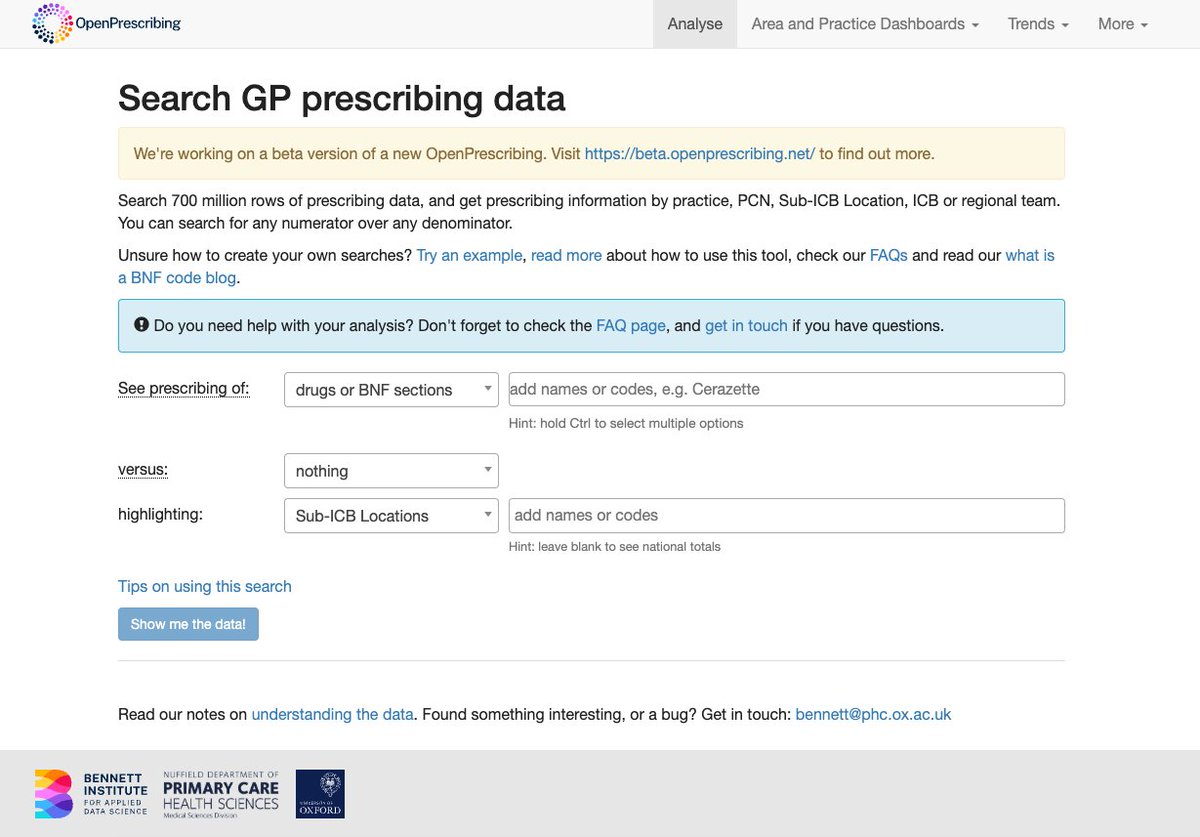
A team at Oxford built a search engine for every drug the NHS prescribes, and it has quietly saved the health service millions.
It's called OpenPrescribing.
The NHS publishes its full prescribing dataset every month. It's 700 million rows of raw numbers nobody could actually read. So Oxford built a tool that turns it into live charts in seconds.
You type a drug name. It shows you which practices over-prescribe it, which regions are slow to follow new guidelines, and where the money is being wasted.
→ Search any drug across any GP practice in England
→ Find safety and cost outliers instantly
→ 70+ ready-made quality measures
→ Updates monthly, automatically
→ Free, open source, MIT licensed
20,000 people use it every month. Doctors. Researchers. Journalists.
Public data that sat unreadable for years is now one search away.
https://t.co/U9KI0mUCAp
“1936 - Alonzo Church also invents every language that will ever be but does it better. His lambda calculus is ignored because it is insufficiently C-like. This criticism occurs in spite of the fact that C has not yet been invented.”
For over a decade, we’ve accepted that end-to-end backprop is the only way to train deep networks. But holding the entire network in memory all at once is why AI training is hitting a resource wall.
We found a new way to break the network into blocks and train them independently. The trick? Treating the network’s forward pass like a diffusion model denoising a signal.
This reinterpretation slashes the memory needed to train deep models. In our #ICLR2026 paper (https://t.co/PK5h0mqQSo), we matched end-to-end performance across ViTs, DiTs, and LLMs. We did this while training just one isolated block at a time.
The “it’s not AGI because machine intelligence is jagged” is dumb cope.
It’s obviously AGI. If you had a friend who had a 130 IQ, could write production code flawlessly, could write academic papers of a high research caliber, pass any exam in any field with flying colors, create a sophisticate LBO model, draw technical diagrams perfectly, compose poetry in any language, and could find solutions to significant unsolved mathematical problems, you would call that person a world historical genius. Certainly, no single human has ever had intelligence that “general” before.
Now you think it’s “not AGI” because it sometimes slips up and makes mistakes - so does any human that you would consider “extraordinarily intelligent.”
The professor might forget a colleagues name that he has known for a decade. He is still considered intelligent. The math genius might be a little autistic and shy, unable to maintain polite conversation. Still intelligent. You might stare at the fridge for 30 seconds unable to find the butter, despite 5 million years of evolution perfecting your visual intelligence.
We give intelligent humans a pass when they have jagged intelligence. So why the double standard?
The qualities people list as “necessary for AGI” are important traits to have, but no longer pertain to intelligence. People will say things like “true AGI requires agency, long term goal setting, embodiment, self-direct action”.
But none of those things are intelligence. Those are “things that humans have that AI lacks”. Raw intelligence, AI has it in spades. That other stuff - important yet, but broader than and different from intelligence.
The unwillingness of people to acknowledge that AGI obviously exists and has existed for a while is due to a kind of anthropic chauvinism - a psychological need to believe that humans are superior in every respect, that we possess soft skills that no machine could replicate.
Yes humans are different from machines, but if we are limiting the discussion solely to general intelligence, AI has it already. That battle is over.
If you want to reframe the discussion to matters of human dignity and personhood, fine, but that’s not an AGI question. That’s something else. Just take the loss on AGI already. It’s over.
Elixir v1.20.0-rc.6 is out and it implements inference across applications, fully delivering on the ~15 weeks roadmap established at the beginning of the year.
Please give it a try, it should be our last stop before the actual v1.20.0 final: https://t.co/tVdK66DvLI
Which is the stochastic parrot, the thing that can solve an Erdős problem, or the thing that just mindlessly repeats the same statements over and over again no matter what evidence is presented to it?
It is unreasonable — maybe even irrational — just how grateful I am to AI for making the task of reading the very best verifiably-human works of literature a finite — and thus possible — task instead of a potentially infinite — and thus impossible — one.