Statement on IDP Registration and Return Plans in Western Tigray
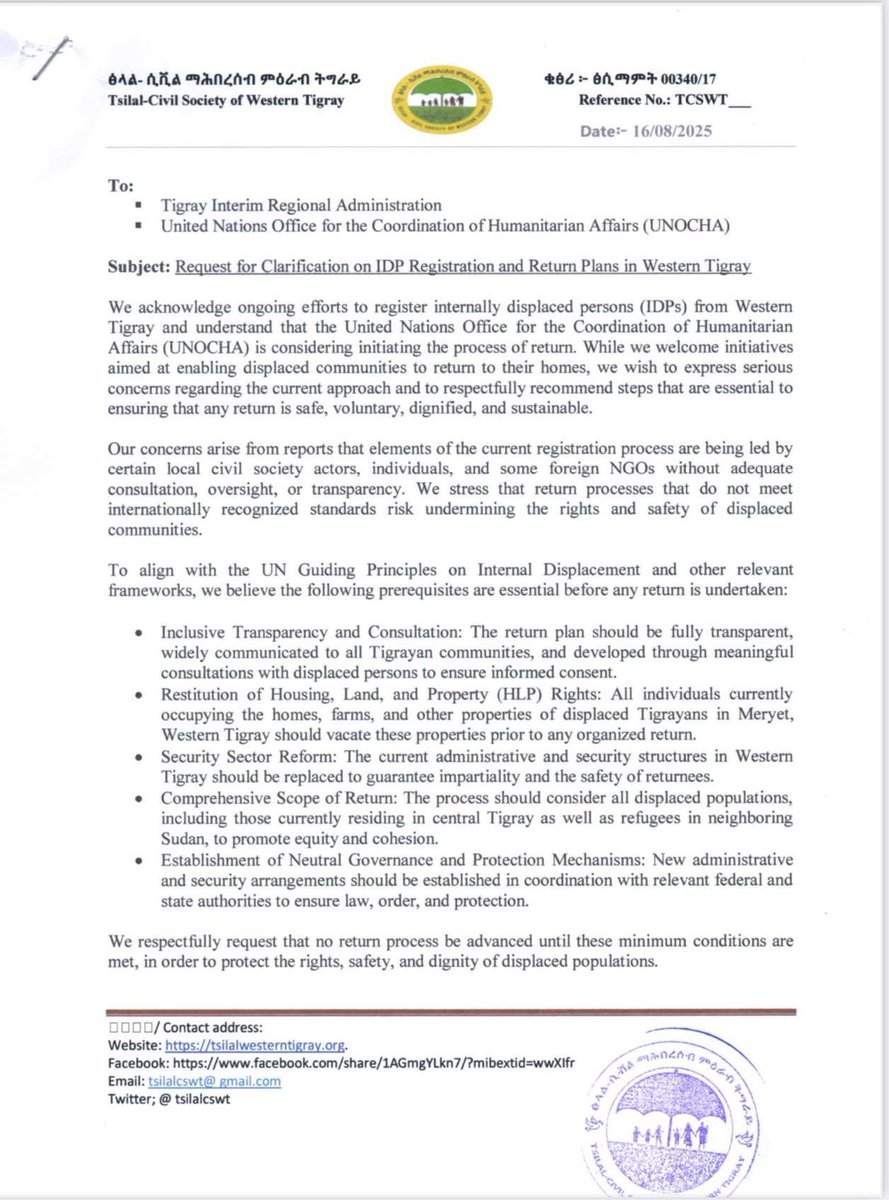
Tsilal–Civil Society of Western Tigray has issued a formal letter to the Tigray Interim Regional Administration and UNOCHA regarding the ongoing registration of internally displaced persons (IDPs) and the proposed return process.
While welcoming initiatives that support displaced communities in returning to their homes, we have expressed serious concerns about the current approach and emphasized that any return must be safe, voluntary, dignified, and sustainable.
We urge that key conditions—such as transparency, restitution of property, security reform, and inclusive consultation—be met before any return process is advanced.
Read the full statement here:
To:
Tigray Interim Regional Administration
United Nations Office for the Coordination of Humanitarian Affairs (UNOCHA)
Subject: Request for Clarification on IDP Registration and Return Plans in Western Tigray
We acknowledge ongoing efforts to register internally displaced persons (IDPs) from Western Tigray and understand that the United Nations Office for the Coordination of Humanitarian Affairs (UNOCHA) is considering initiating the process of return. While we welcome initiatives aimed at enabling displaced communities to return to their homes, we wish to express serious concerns regarding the current approach and to respectfully recommend steps that are essential to ensuring that any return is safe, voluntary, dignified, and sustainable.
Our concerns arise from reports that elements of the current registration process are being led by certain local civil society actors, individuals, and some foreign NGOs without adequate consultation, oversight, or transparency. We stress that return processes that do not meet internationally recognized standards risk undermining the rights and safety of displaced communities.
To align with the UN Guiding Principles on Internal Displacement and other relevant frameworks, we believe the following prerequisites are essential before any return is undertaken:
• Inclusive Transparency and Consultation: The return plan should be fully transparent, widely communicated to all Tigrayan communities, and developed through meaningful consultations with displaced persons to ensure informed consent.
• Restitution of Housing, Land, and Property (HLP) Rights: All individuals currently occupying the homes, farms, and other properties of displaced Tigrayans in Meryet, Western Tigray should vacate these properties prior to any organized return.
• Security Sector Reform: The current administrative and security structures in Western Tigray should be replaced to guarantee impartiality and the safety of returnees.
• Comprehensive Scope of Return: The process should consider all displaced populations, including those currently residing in central Tigray as well as refugees in neighboring Sudan, to promote equity and cohesion.
• Establishment of Neutral Governance and Protection Mechanisms: New administrative and security arrangements should be established in coordination with relevant federal and state authorities to ensure law, order, and protection.
We respectfully request that no return process be advanced until these minimum conditions are met, in order to protect the rights, safety, and dignity of displaced populations.
We also request a written clarification from both the Tigray Interim Regional Administration and UNOCHA to clarify the scope, objectives, and safeguards of the current registration and planned return process.
Our aim is to ensure that any return process reflects international standards, prevents further harm, and fosters durable peace and reintegration.
OCHA Ethiopia’s Misguided Move Risks Western Tigray Stability
The Ethiopian state is facing one of its deepest crises in decades — political instability, a failing economy, and a government desperate for foreign currency to stay afloat. Observers warn that this desperation is pushing Addis Ababa’s leadership toward risky and destabilizing decisions, including renewed military ambitions toward Eritrea.
Against this backdrop, the UN Office @OCHA_Ethiopia for the Coordination of Humanitarian Affairs (OCHA) in Ethiopia appears to be entangling itself in dangerous political waters. Instead of acting as a neutral humanitarian actor, OCHA Ethiopia is increasingly viewed as a tool that could enable Prime Minister Abiy Ahmed’s administration to secure international aid under the banner of helping displaced refugees, while sidestepping the real cause of their displacement.
Western Tigray: Land and People Under Occupation
Western Tigray is, by history and identity, Tigrian land — home to Tigrian communities for generations. Yet since the outbreak of the war in Tigray genocide, the area has been subjected to what Us state department, rights groups and survivors describe as ethnic cleansing, with systematic displacement and atrocities committed by Ethiopian forces and their allies.
The people of western Tigray have been living in harsh conditions in displacement camps, deprived of their homes, farms, and livelihoods. While international agencies acknowledge the displacement crisis, there is growing concern that humanitarian interventions are being shaped to suit political convenience rather than justice and restoration of rights.
Getachew Reda’s Push for Return — and the Missing Red Line
Recently, Tigray’s Interim President, Ato Getachew Reda, voiced his commitment to returning Tigrian IDPs to their homes “as soon as possible.” His urgency reflects the dire suffering in the camps overcrowding, disease, and economic deprivation.
However, there is a glaring gap: there is no equally forceful demand for the removal of those responsible for the displacement — the forces and administrators currently controlling western Tigray. For the people of western Tigray, this is the non-negotiable red line. Any return must be preceded by the withdrawal of occupying forces and the restoration of Tigrian administration.
The Tadesse Werede Factor: Power Before Justice
Equally troubling is the role of General Tadesse Werede and the interim government he leads. Surrounded by a tight circle of loyalist advisors often described by critics as a cult-like inner circle — Tadesse’s administration is seen as more focused on consolidating political control than on securing the return of displaced Tigrians to their rightful homes.
Rather than pressing the federal government to implement the safe and unconditional return of IDPs, Tadesse and his team are accused of “milking Tigray” — exploiting the humanitarian crisis as political leverage while consolidating their grip on power. Many Tigrians express growing concern that the interim leadership fears losing its position should the TPLF reach an arrangement with the federal government or if genuine restitution and meaningful political reform were to take place.
A Dangerous Precedent in the Making
If OCHA Ethiopia attempts to facilitate the return of displaced Tigrians without first ensuring the removal of the perpetrators of atrocities, it is clear that those in IDP camps will not return to their homeland without guarantees for their safety. However, OCHA Ethiopia, in alignment with the Ethiopian government, appears more focused on securing funding and political leverage through the plight of the IDPs. Such actions risk legitimizing the very displacement and ethnic cleansing that occurred. This approach would not only betray the victims but also set a dangerous precedent in which demographic changes imposed by force are accepted as “facts on the ground.”
By aiding a process that ignores justice and accountability, OCHA Ethiopia could end up enabling further instability, deepening distrust in international agencies, and fueling tensions that could reignite violence.
The Way Forward
Humanitarian aid must not be weaponized for political gain. The safe, dignified, and voluntary return of western Tigray’s displaced people requires more than logistical planning — it requires justice, security guarantees, and the removal of occupying forces. Anything less would be a betrayal to the victims of one of Africa’s gravest recent atrocities.
The people of Tigray, both at home and in the diaspora must apply consistent and coordinated pressure to ensure that displaced Tigrians in IDP centers are returned to their homes without delay and with full guarantees for their safety. This must be the top priority for every Tigrian, above all political calculations, if justice and survival for western Tigray’s people are to be secured.
U.S. Report Details Ethnic Cleansing, Sexual Violence, and Famine Conditions in Tigray
Washington D.C., — The 2024 Country Reports on Human Rights Practices released by the U.S. Department of State reveals harrowing accounts of ongoing atrocities in Ethiopia’s Tigray region, nearly two years after the Pretoria Agreement was signed to end the devastating conflict.
Ethnic Cleansing in Western Tigray
According to the report:
“There were reports of widespread killings of civilians, mass forced displacement, ethnic cleansing, rape and other forms of violence against women and girls, looting, and destruction of property by Amhara militias and affiliated groups in western #Tigray.”
Survivor testimonies and investigations indicate a systematic campaign to permanently remove Tigrayans from the region.
Dedebit Airstrike: One of the Deadliest Incidents
In January 2025, an armed drone struck an internally displaced persons (IDP) camp at Dedebit Elementary School, killing at least 108 civilians and injuring 75 others. Most victims were women, children, and elderly people who had fled previous waves of violence.
Sexual Violence as a Weapon of War
A July 2025 joint investigation by Physicians for Human Rights and the Organization for Justice and Accountability confirmed that Ethiopian and Eritrean forces committed mass rape, forced pregnancy, sexual slavery, and sexual torture in Tigray.
•Researchers interviewed over 600 survivors and health workers.
•The acts were found to be systematic and targeted, amounting to crimes against humanity and possibly genocide.
Famine and Aid Blockade
The report warns that famine-like conditions persist in parts of Tigray, fueled by deliberate obstruction of humanitarian aid. Food, medical supplies, and other essentials were reportedly withheld as a method of warfare, in clear violation of international law.
Mass Graves and Displacement
Human rights groups have documented mass graves in occupied areas, particularly in western Tigray. Tens of thousands remain displaced, living in overcrowded camps with limited access to health care, education, and adequate shelter.
Lack of Justice and Global Calls for Accountability
The U.S. State Department criticized Ethiopia’s failure to hold perpetrators accountable. No senior commanders or political leaders implicated in Tigray atrocities have faced meaningful prosecution.
International human rights organizations are calling for:
•Independent international investigations into all reported abuses.
•Prosecution of those responsible for war crimes and crimes against humanity.
•Full restoration of humanitarian access to affected communities.
Read the full report: 2024 U.S. State Department Human Rights Report – Ethiopia https://t.co/6e7Z6hifV6
#Ethiopia #Tigray #HumanRights #WarCrimes #Justice
🇪🇹 OP-ED | Birhanu Jula Does Not Speak for Ethiopia
"When the guardians of the state become the voice of repression, the people must become the voice of the Constitution."
General Birhanu Jula, the highest-ranking military officer in Ethiopia, recently made disturbing remarks suggesting that Tigrians—an indigenous people and founding nation within Ethiopia—should “leave the country” if they demand their constitutional rights. His words, uttered without remorse or legal foundation, are not only dangerous, they are a direct attack on the multiethnic foundation of Ethiopia and an insult to all who believe in justice, federalism, and peace.
Let us respond clearly. Tigray is not a guest in Ethiopia. Tigray is a co-founder of the state. Tigrians are not foreigners. They are Ethiopian citizens whose blood, sacrifice, and resilience shaped the very republic that now threatens to exile them.
Article 39 of the Ethiopian Federal Constitution clearly enshrines the right to self-determination, including the right to secession, for all Nations, Nationalities, and Peoples. The Tigrian people—like the Oromo, Sidama, and other constituent groups—are not recipients of the state’s mercy, but rather equal stakeholders with constitutionally guaranteed rights. If the people of Tigray choose to exercise those rights, neither General Birhanu Jula nor any military authority has the legal or moral power to prevent them.
When Birhanu Jula mocks or threatens those who invoke the Constitution, he is not defending Ethiopia—he is dismantling it. His job is not to interpret political grievances, much less punish them. His duty, like that of all public servants, is to uphold the Constitution. If he cannot do that, then he has no business wearing the uniform of a national force.
Let’s speak honestly: The current Ethiopian military is no longer a neutral national army. It functions as an enforcement wing of the ruling Prosperity Party (PP)—targeting dissenting regions, enabling ethnic cleansing, and shielding itself from accountability.
What Birhanu Jula represents is not the Ethiopian National Defense Force (ENDF) of constitutional order, but a PP-aligned paramilitary structure—a force that uses state resources to silence constitutional demands, suppress ethnic identity, and erase historical memory.
When a military general publicly tells citizens to “get out” of their own country for seeking rights, the message is clear: You are either ruled or expelled.
That’s not federalism. That’s fascism.
Tigray is still reeling from war, siege, displacement, and the denial of return for hundreds of thousands of internally displaced people (IDPs). Western Tigray remains occupied. War criminals walk free. And yet, it is the Tigrian people who are asked to stay silent?
General Birhanu should understand: Tigray is not begging for charity. Tigray is demanding justice, and doing so within the legal framework of the Ethiopian federation. That demand is not only legitimate—it is unavoidable.
If the price for asking to return home is to be told to “leave Ethiopia,” then it is not Tigray that is breaking away from the country, but the state that is breaking away from its citizens.
This is not just a Tigrian issue. Any Ethiopian who believes in the dignity of the Constitution should be alarmed. If Tigray’s rights can be denied today, so can Oromia’s tomorrow. So can the rights of Gambella, Sidama, or Benishangul. When the state becomes a club wielded against lawful demands, no region is safe.
Birhanu Jula’s speech is not simply dangerous because of what it says about Tigray. It’s dangerous because of what it says about the future of Ethiopia. Will this country be ruled by guns and threats, or by laws and dialogue?
The Road Forward
We, the people of Tigray and all federalist Ethiopians, offer not provocation—but principle. We believe in:
The return of all IDPs, immediately and unconditionally.
The restoration of territories, especially Western Tigray, to their rightful administrative owners.
The accountability of war criminals, regardless of uniform or title.
The right of every Nation and Nationality to self-determination, as codified in law.
A peaceful, constitutional dialogue for the future of Ethiopia, not threats from generals in fatigues.
Ethiopia does not belong to one party, one ethnicity, or one military. It belongs to its people, in all their diversity and dignity. Tigrians are not going anywhere. What must go, instead, is the notion that power excuses lawlessness.
General Birhanu, you may command guns, but you do not command legitimacy. The Constitution does.
Field Marshal Birhanu Jula: "Tigray Can Constitutionally Secede" A Message Interpreted as a Threat by Many
Addis Ababa | In a controversial statement that is sparking renewed debate about Ethiopia’s federal structure and the future of Tigray, Field Marshal Birhanu Jula, the Chief of Staff of the Ethiopian National Defense Forces, declared that "if the people of Tigray want to separate from Ethiopia, they can do so through constitutional means."
The remark, made during a recent public address, echoes earlier comments by Addis Ababa Mayor Adanech Abebe during the height of the war in Tigray, who also suggested on national television that secession is a constitutional right. While these statements may appear to affirm the federal constitution's Article 39, which provides nations and nationalities the right to self-determination, many Tigrians see them as veiled threats rather than genuine acknowledgments of legal rights.
Critics argue that such comments are not extended with goodwill but used as tools of coercion. "The message is loud and clear," said one observer. "If you dare invoke your constitutional rights, the government will treat you as an enemy. You’re expected to live not as free citizens but according to directives handed down from the center."
This rhetoric, combined with the devastating toll of the Tigray war — widely recognized by international observers as involving war crimes, including ethnic cleansing and acts of genocide — has fueled mistrust and disillusionment. While many hoped for a path of justice, accountability, and reconciliation after the war, the official tone remains defiant and, to many, dismissive of the trauma experienced by the Tigrian people.
Rather than addressing the underlying grievances in Tigray or meaningfully engaging in peacebuilding, critics say Ethiopian federal authorities have resorted to intimidation and nationalist rhetoric. This, they warn, may further entrench divisions and drive the region toward renewed instability.
Calls are growing from both inside and outside Tigray for international mediation, justice for war crimes, and an honest national dialogue about Ethiopia’s future — one rooted in consent, rights, and respect for all peoples, not threats disguised as legal clarity.
Tigrayan Refugees Protest Dire Conditions in Sudan’s Tenedba Camp
July 17, 2025 |Thousands of displaced Tigrayan refugees staged a peaceful protest today in the Tenedba refugee camp, decrying worsening living conditions and demanding urgent humanitarian aid. Protesters cited lack of food and medical support, with over 400 reported deaths in Tenedba alone, and more than 770 across camps since the Pretoria Peace Agreement. They urged international organizations to intervene and called for their safe repatriation as promised in the accord. Protesters say continued neglect threatens to deepen the humanitarian crisis.
It has been 100 days since Gen. Tadesse Werede assumed leadership of the Tigray Interim Administration.
How would you assess his performance so far?
We welcome your reflections on governance, peace efforts, IDP return, and regional stability.
#Tigray#Leadership#Governance
Tigray Interim Government Refutes Claims of Military Escalation, Reaffirms Focus on Peace and Recovery
Mekelle, Tigray – July 17, 2025
Despite recent reports by Africa Intelligence suggesting renewed military preparations in Tigray, officials within the Tigray Interim Administration have strongly denied any plans for renewed conflict. Instead, they emphasize that the region’s leadership remains fully committed to peace, stabilization, and the implementation of the 2022 Pretoria Peace Agreement.
Contrary to the narrative promoted by some Western media outlets, the Interim Administration states that no military mobilization is being carried out for offensive purposes. The focus, according to officials, is squarely on the safe return of internally displaced persons (IDPs), regional reconstruction, political normalization, and preparations for democratic elections to transition from interim governance.
While Africa Intelligence reported that Tigray's leadership has "quietly reinstated" a centralized military command—named the Central Command—amid rising tensions between Ethiopia and Eritrea, sources within the administration clarified that this body’s formation is part of internal restructuring and coordination, not preparation for war.
Responding to concerns raised in the report, a senior official from the Interim Administration stated:
“There is no military buildup in Tigray. Any restructuring of defense coordination is aimed at internal discipline and readiness. Our priority remains resettling displaced families, rebuilding essential infrastructure, and preparing for democratic transition.”
Amid growing tensions between the federal government in Addis Ababa and the Eritrean regime, Tigrayan leaders have voiced concern about regional instability but reiterated their firm commitment to peaceful means and diplomacy.
Local observers and civic groups have warned against mischaracterizations of Tigray’s internal affairs, especially when presented without context or direct verification from the ground. Many see the Africa Intelligence article as potentially contributing to a misleading narrative that could fuel unnecessary tensions.
The Tigray Interim Administration urges international partners, journalists, and analysts to seek facts directly from the region and to support the ongoing peacebuilding and recovery efforts that remain under strain due to humanitarian and economic challenges.
Tigray Interim President and UNHCR Director Discuss Escalating Displacement Crisis in Northern Ethiopia
Mekelle, Tigray – July 17, 2025
In a high-level meeting held in Mekelle this week, General Tadesse Werede, President of the Tigray Interim Administration, met with the UNHCR Country Director for Ethiopia to address the deepening humanitarian crisis facing displaced populations in northern Ethiopia.
According to UN reports, the region is grappling with over 2.6 million internally displaced persons (IDPs) and approximately 97,000 refugees—numbers that have continued to rise since the outbreak of the conflict in late 2020. Gen. Tadesse described the situation as "dire," citing acute shortages of food, water, medical care, and shelter among displaced communities, particularly those who fled Western Tigray due to what he termed as "systematic ethnic cleansing."
His remarks align with a 2022 report by Omna Tigray @OmnaTigray , which documented the forcible displacement of over 1.2 million people from Western Tigray. The U.S. State Department @StateDept has also publicly stated that ethnic cleansing occurred in that region.
Tadesse criticized the Ethiopian federal government’s response, stating that it has failed to provide adequate aid or infrastructure to facilitate safe returns. “Displaced families continue to live in harsh, inhumane conditions, while federal institutions claim the situation is under control. That is far from the reality on the ground,” he said.
The UNHCR director echoed concerns over the growing funding gap and appealed to the international community for urgent support. “Our resources are stretched thin, and without sustained international engagement, we cannot meet the basic needs of the affected population,” the director noted.
The meeting also challenged the federal government's narrative that the humanitarian response has been sufficient. Tadesse called for an independent assessment of federal aid delivery and emphasized the importance of international oversight to ensure that displaced people are not abandoned.
This is not the first time such concerns have been raised. Several aid organizations and international observers have repeatedly warned that displaced populations in Tigray and other conflict-affected regions remain vulnerable and neglected, often without access to basic services.
As the political and humanitarian crisis continues, both the Tigray Interim Administration and UNHCR urged for a renewed commitment to humanitarian principles, safe voluntary returns, and accountability for the causes of displacement. The international community, they stressed, must remain vigilant and proactive to prevent a deepening of the crisis.
Photo Creator: ASHRAF SHAZLY | Credit: AFP via Getty Images
OPINION | The War That Won’t End: How Abiy Ahmed’s Ethiopia Is Trapped in a Cycle of Conflict
July 16, 2025
There is a war in Ethiopia that refuses to end—not because it must go on, but because those in power won’t let it stop.
The latest developments—military buildups in western Tigray, renewed Eritrean activity near Bure, and orchestrated religious delegations to Mekelle are not signs of peacebuilding. They are symptoms of a regime that sees war not as a last resort, but as a governing principle. Prime Minister Abiy Ahmed’s administration has normalized a state of conflict as the status quo, not the exception.
Abiy Outside of War Is Unthinkable
Abiy's leadership has been defined by crisis. But more critically, it appears to depend on it. He does not seem to know how to lead a nation at peace. War gives him control: it suspends dissent, dissolves opposition, justifies emergency rule, and lets him silence both critics and the press. Through war, the government bypasses accountability and consolidates unchecked power.
The Prime Minister often invokes national security to rally support. But in doing so, he’s essentially fused patriotism with militarism. Any criticism becomes betrayal. Any demand for justice is treated as destabilization. The reality is: Abiy governs better in chaos—not because he manages it well, but because it gives him cover.
Addis Ababa: Fortress in the Fog
In this narrative of conflict, Addis Ababa sits like an island. Shielded from the flames engulfing the rest of the country, it enjoys a curated calm—boulevards swept clean, investment summits staged, influencers flown in. Yet, just outside its borders, Ethiopia is unraveling.
In Tigray, the pain of war lingers, and fears of a renewed assault are justified. In Amhara, resistance has evolved into rebellion. In Oromia, the government remains unable to quell the OLA. Even in Afar, once seen as loyal, cracks have begun to show.
Yet in the capital, war feels distant. The government continues to project illusions of normalcy—economic growth, strategic corridors, pan-African ambitions—while the reality for millions is hunger, displacement, and loss. The disconnect is not just moral; it’s dangerous.
The Politics of Perpetual Emergency
Abiy's use of "State of Emergency" declarations is not about security—it is about erasing political alternatives. These declarations enable mass arrests, media blackouts, and the criminalization of assembly. The parliament rubber-stamps. The judiciary stays silent. Ethiopia, for all practical purposes, is no longer a functioning democracy.
Rather than disband militias, the government empowers them. Rather than open dialogue, it stages religious visits to conflict zones. Rather than negotiate a durable peace, it provokes a new war.
What’s worse, the Prosperity Party appears to be creating a mythos of national revival through conflict—a dangerous echo of regimes that confuse martial might with moral authority.
The Gas That Won’t Save Ethiopia
Then there’s the gas. The much-hyped discovery is being marketed as a national breakthrough. But there is no pipeline, no infrastructure, and no plan—only the promise. And promises are a familiar substitute for policy in Abiy’s Ethiopia.
The government suggests this gas find will stabilize the economy, solve inflation, and restore public morale. It won’t. The people know it. They’ve heard it all before—sugar factories, corridors, dams. But when workers take to the streets with empty pockets and nothing to lose, it’s not for gas. It’s for justice.
Who Will Fight This War?
In past years, the government relied on patriotic fervor. But today, that fire is fading. Youth conscripted from villages are disillusioned. Many don’t understand what they’re fighting for. Some defect. Others surrender. And across the regions, even former allies have turned cold. The myth of national unity under Abiy is collapsing.
The Tigrayans will not surrender. The Amhara will not fall in line. The Oromos will not remain silent. And the country’s economic backbone—the farmers, traders, teachers, and youth—have no more illusions.
The War Is the Strategy
This is the painful truth: war is not a side effect of failed policy. It is the policy. It is the strategy to extend political life, suppress dissent, and avoid reform. It is a substitute for legitimacy.
As one Tigrayan civil society activist told me privately, “In this country, peace is not the absence of war—it’s the absence of resistance. And that’s why war never ends.”
And the danger is that it will consume everything. Ethiopia cannot survive another round of total war. Not economically, not socially, not morally.
But unless the people force change—unless resistance becomes civic, organized, and national—this cycle may never break.
Because to this government, peace is a threat. And as long as that remains true, Ethiopia’s war will never end.
Ethiopian Airlines Aircraft ET-AUZ Makes Emergency Landing in Mekelle Amid Rising Concerns
Ethiopian Airlines Aircraft ET-AUZ Makes Emergency Landing in Mekelle Amid Renewed Safety Concerns
Mekelle, Tigray – July 16, 2025
An Ethiopian Airlines aircraft bearing the registration number ET-AUZ made an emergency landing today at Alula Aba Nega International Airport in Mekelle, following a sudden technical malfunction during its descent. The flight, originating from Addis Ababa, was carrying 49 individuals, including two children and two crew members. All passengers were safely evacuated, and no injuries have been reported.
The incident occurred at approximately 1:52 PM local time, when the aircraft experienced a significant technical issue shortly before landing. Pilots promptly initiated emergency protocols, and the aircraft was successfully brought down under high operational stress. Airport emergency teams responded swiftly, securing the aircraft and providing necessary support to disembarking passengers.
The emergency landing has reignited longstanding concerns among Tigrian, regarding the quality and safety of aircraft frequently assigned to flights servicing Mekelle and surrounding areas. Many passengers and observers allege that older, less comfortable, and poorly maintained aircraft are disproportionately routed to Tigray.
Criticism has intensified in the wake of today’s event, which marks the second such technical emergency involving a Tigray in a short span of time. Sources close to the matter have alleged that airline management and aviation authorities may be deliberately assigning substandard aircraft to the region, raising concerns of systemic negligence and potential institutional bias.
These allegations have not yet been officially addressed by Ethiopian Airlines or the Ethiopian Civil Aviation Authority. However, calls are mounting for both institutions to launch a transparent investigation into fleet allocation practices and to ensure that all routes, regardless of region, are served with equal safety standards and operational integrity.
Photos and videos from the scene show emergency response units positioned around the aircraft as passengers calmly disembarked.
As public concern deepens, civil society groups and aviation safety advocates are urging greater accountability and oversight to prevent future incidents and restore public confidence in the nation’s air transport system particularly for underserved regions such as Tigray.
IMF Warns Ethiopia’s $3.4 Billion Reform Agenda Faces Setbacks Amid Donor Fatigue and Economic Risks
July 15, 2025 |Ethiopia’s $3.4B reform agenda is at serious risk, says the IMF. Key challenges:
🔻 Foreign aid has dropped from 12% → <4% of GDP
💸 Birr has lost 170% of its value since 2024
💱 Parallel market premium hits 15%
⚠️ Security threats + stalled privatization slowing progress
📉 One in 5 Ethiopians need food/humanitarian aid
🏥 Education & health services are deteriorating under austerity
The IMF says “downside risks remain high” due to donor fatigue, fragile security, and currency volatility.
The International Monetary Fund (IMF) has issued a stark warning to Ethiopia, cautioning that its $3.4 billion Home Grown Economic Reform Program is under mounting pressure due to declining foreign aid, fragile security conditions, and renewed instability in the foreign exchange market.
In its latest country report, the IMF praised the Ethiopian government for achieving key milestones—such as subsidy cuts, tax restructuring, and tightening of monetary policy—but emphasized that the reform agenda remains vulnerable. Deputy Managing Director Nigel Clarke stated, “The outlook remains subject to downside risks given security challenges and declining donor support.”
Ethiopia has seen a drastic reduction in donor funding, with aid falling from 12% of GDP a decade ago to below 4% today. Further cuts are expected as agencies such as USAID scale back their programs. The IMF highlighted that one in five Ethiopians is currently in need of food or humanitarian assistance, yet the UN’s response remains severely underfunded and reliant on temporary waivers.
The report expresses serious concern over the rise of a resurgent parallel foreign exchange market, driven by widening gaps between official and black market rates. The Ethiopian Birr has depreciated over 170% since the IMF-supported reforms began in July 2024. Key structural problems include:
A 2.5% central bank commission on FX transactions
Limited liquidity in the interbank market
High transaction costs
These factors have pushed the parallel market premium to 15%, creating uncertainty and reducing investor confidence.
Although Ethiopia committed to large-scale economic liberalization, progress on privatization has stalled. Foreign direct investment (FDI) is weaker than projected, complicating efforts to rebuild currency reserves and narrow the balance of payments gap. The IMF called on the government to accelerate privatization and implement a modern, policy-rate-based monetary framework.
Local institutions, including the Ethiopian Policy Institute, have criticized IMF-mandated austerity measures for their toll on public services. Budget cuts have led to deteriorating education and health services, decreased real wages for teachers and health workers, and increased workloads. These effects, they argue, deepen poverty and inequality and threaten long-term development outcomes.
Ethiopia remains in sovereign default and is negotiating with private bondholders after reaching an agreement in principle with official creditors earlier this year. The IMF warns that ongoing instability could further delay or jeopardize restructuring efforts.
While inflation has declined more rapidly than anticipated, and exports are forecast to rise to 12% of GDP in FY 2024/25 (up from 9.6%), the broader reform landscape remains uncertain. The IMF reiterated the need for Ethiopia to strengthen communication, build economic credibility, and regain international trust.
The IMF's latest assessment makes clear that Ethiopia’s economic recovery is far from secure. With waning donor support, rising macroeconomic pressures, and fragile security, the country must act decisively to stabilize its economy, protect its most vulnerable citizens, and restore investor and donor confidence.
#Ethiopia #IMF #EconomicReform #ForeignAid #DebtRelief #HumanitarianCrisis #Birr #Privatization #FDI #NigelClarke
Tigray: A People Betrayed, A Peace Deferred
The Federal Government Must Stop Being the Obstacle and Start Being the Leader
This morning, a joint delegation of religious leaders from Addis Abeba arrived in Mekelle and held discussions with Lieutenant General Tadesse Worede, President of the Tigray Interim Administration. This visit, prompted by Prime Minister Abiy Ahmed’s call for early mediation, comes at a time when peace feels more like a performance than a promise. The Prime Minister warns that once war resumes, mediation will be “futile.” But what he fails to acknowledge is this: Tigray and Tigrians are not instigators—they are victims.
For years, Tigray has endured not just a devastating war, but also a deliberate blockade of aid, communications, and basic services. Entire communities have been displaced, and many still live in camps while their ancestral lands especially Western Tigray remain under occupation. These actions are not just morally indefensible they are unconstitutional.
Western Tigray is not a "contested area." It is legally and historically part of the Tigray Region, recognized under Ethiopia’s own federal constitution. And yet, it remains under the control of Amhara regional forces and Federal troops, in blatant violation of both the law and the Pretoria Peace Agreement signed in November 2022. This agreement called for the withdrawal of foreign and non-ENDF forces and the restoration of constitutional governance. That has not happened.
Instead, the federal government has stood by or worse, facilitated the continued displacement, suffering, and silencing of Tigrians. It demands disarmament from Tigray while failing to remove the forces occupying Tigrayan land. It calls for peace while denying the basic constitutional rights of millions of its own citizens.
Let’s be clear:
Tigray has not been granted peace. It has been forced into silence.
Tigrians are not stakeholders in negotiations—they are the casualties of broken promises.
And while religious delegations may bring words of reconciliation, they cannot undo years of betrayal.
To the religious leaders: your presence must not serve as a smokescreen. You are welcome to pray and preach but do not pretend both sides bear equal responsibility. Tigray did not starve its own people. Tigray did not occupy others’ land.
To the leaders of Tigray: Yes, these men may represent institutions that once turned their backs on our suffering. But speak to them wisely. Use this moment to remind them that justice cannot come from selective memory. Treat them with respect but never forget what they helped normalize.
To the federal government: Peace will not come from speeches in Addis or symbolic tours. It will come from:
Withdrawing all non-ENDF forces from Western Tigray and returning the land to its rightful administration.
Ensuring the safe and dignified return of all displaced Tigrians.
Restoring basic services and rebuilding trust through lawful, accountable governance.
Delivering justice for the war crimes committed—not just by rebels, but by federal and allied forces.
Until then, peace will remain a slogan, not a solution.
Tigray and Tigrians have suffered enough. They do not need more visits. They need justice. They need dignity.
And they need a government that acts not as a tormentor—but as a protector.
Inter-Religious Council Delegation Arrives in Mekelle Amid Calls for Genuine Peace and Federal Action
Mekelle, Tigray | July 16, 2025 — Members of Ethiopia’s Inter-Religious Council arrived this morning in Mekelle, the capital of the Tigray region, marking the start of a high-profile visit aimed at promoting national reconciliation and interfaith dialogue.
The delegation is currently in closed-door discussions with the Interim Administration of Tigray, led by President Lieutenant General Tadesse Werede and his cabinet. According to official sources, the religious leaders also plan to meet with Tigrayan religious figures, elders, and community representatives for further talks.
However, many Tigrayan citizens have voiced skepticism about the delegation’s visit, emphasizing that symbolic gestures and political theatrics are no substitute for meaningful action. For a growing number of Tigrayans, the path to peace remains straightforward: the federal government must fully implement the Pretoria Agreement and restore the rights and dignity of the Tigrayan people.
“This is not about dialogue for the sake of headlines. If the federal government truly wants peace, it must lift the ongoing siege on Tigray, return refugees from displacement camps, and restore the region’s full territorial integrity—including the return of Western Tigray to its rightful residents,” said one observer.
Tigray has endured a devastating humanitarian crisis and a prolonged blockade. Although the intensity of active conflict has subsided, the effects of the siege continue to manifest in various forms. Critics argue that the federal government employs indirect mechanisms to sustain restrictions on humanitarian aid, economic development, and essential services. A significant portion of the population remains in internally displaced persons (IDP) centers, facing acute shortages of fuel and other basic necessities. Furthermore, international visitors are frequently denied access to the region, and Tigrayans across the country continue to experience limitations on their freedom of movement.
The federal government must recognize that the return of displaced people to their homes in Western Tigray is not a matter for negotiation it is a moral and political imperative. Lasting peace cannot be achieved through delegations and symbolic gestures alone; it requires justice, accountability, and a genuine commitment to truth.
While the Inter-Religious Council’s visit is seen by some as a goodwill mission, many observers and locals alike insist that without concrete steps to address the root causes of the conflict and uphold the Pretoria Agreement in full, peace will remain elusive.
Most people in Tigray believe that real peace cannot be achieved through symbolic meetings or visits. True peace must be built on justice, trust, and real action—not on empty words or promises.
Tigrayan Independence Movement Argues Democracy Is Not a Precondition for Self-Determination
Washington,DC — July 13, 2025
The Voice for an Independent Tigray (VIT), a political advocacy group pushing for Tigray’s self-determination, has issued a bold statement asserting that democracy should not be considered a prerequisite for independence. The statement, released this week, challenges widely held assumptions about the sequence of democratic development and national liberation.
At the heart of VIT’s message is a rejection of the claim that Tigray must first build a functioning democratic state before seeking independence from Ethiopia. Instead, the organization contends that Ethiopia’s failure to establish genuine democratic governance, along with persistent repression, systemic exclusion, and cultural erasure, has already made the case for independence both rational and necessary.
“In truly democratic environments, there would be little reason to seek independence,” the statement reads. “But in Ethiopia, where democratic principles have either failed or never existed, the demand for independence becomes a survival imperative.”
The VIT argues that Tigray’s current situation reflects decades of structural injustices, including mass atrocities, territorial aggression, and state-sponsored repression. The group cites attempts to erase the Tigrayan language and history, economic blockades, and repeated military campaigns as evidence of a long-standing campaign against the region’s autonomy.
According to the statement, the Ethiopian government’s actions—past and present—have transformed Tigray’s desire for independence from a political option into an existential necessity. “It is not a pursuit of impatience or political immaturity,” VIT claims, “but rather a response to betrayal, violent suppression, and the refusal to be erased.”
The group also criticized the current Ethiopian federal system, claiming it has devolved into a centralized apparatus manipulated by ruling elites to maintain control over marginalized ethnic groups. They argue that constitutional promises of self-rule and secession have proven meaningless in practice.
“Democracy has not failed because of the call for independence,” the VIT statement said. “Rather, the call for independence exists because democracy has failed.”
The advocacy group pointed to international law to support its claims, referencing Article 1 of both the International Covenant on Civil and Political Rights (ICCPR) and the International Covenant on Economic, Social, and Cultural Rights (ICESCR), which enshrine the right of all peoples to self-determination. “There is no international legal requirement that independence must follow democracy,” the group stated.
VIT concluded its message by asserting that Tigray’s quest for independence is about reclaiming dignity, ensuring survival, and securing a peaceful future free from domination—not political convenience. “Our struggle is not about breaking away from democracy—it is about creating the conditions where democracy, justice, and peace can finally take root.”
The group’s statement comes amid heightened tensions between Tigrayan leaders and the Ethiopian federal government, as well as continued debate over the future political structure of the country.
Ethiopian National Defence Force (ENDF) Accused of Executing MSF Aid Workers in Tigray: Report
Medical charity Médecins Sans Frontières says staff were shot at close range by Ethiopian soldiers during 2021 humanitarian mission
July 15, 2025 — Medical charity Médecins Sans Frontières (MSF) has released a damning report implicating Ethiopian National Defence Force (ENDF) troops in the 2021 execution-style killing of three humanitarian workers during the genocide war in Tigray.
The victims — Spanish national María Hernández Matas (35), and Ethiopians Yohannes Halefom Reda (32) and Tedros Gebremariam (31) — were killed on June 24, 2021, while conducting a medical assessment in central Tigray. MSF says they were clearly identified as aid workers, wearing branded vests and traveling in a marked vehicle.
“They were executed… shot at close range, several times,” said MSF Spain’s director, Raquel Ayora.
The report cites satellite imagery and eyewitness accounts confirming a convoy of retreating Ethiopian soldiers was present at the site. One witness reportedly overheard a commander order an attack on the MSF vehicle.
Despite more than 20 meetings with the Ethiopian government, MSF says no credible explanation has been provided in the four years since the killings. The organization made its findings public due to the lack of accountability.
The deaths occurred during a period of heightened hostility toward humanitarian workers in the Tigray war, which erupted in 2020 and ended with a peace deal in late 2022. An estimated 600,000 people died during the conflict, according to African Union envoy Olusegun Obasanjo.
MSF is calling for full accountability and protection for aid workers operating in conflict zones. The Ethiopian government has yet to respond to the latest allegations.
🇺🇸 U.S. to Resume Humanitarian Aid in Tigray via JEOP Consortium Instead of USAID
Mekelle, Tigray — July 15, 2025
The U.S. Government has announced a shift in its humanitarian aid strategy in Ethiopia’s Tigray region, confirming that future assistance will be delivered through the Joint Emergency Operations Program (JEOP) consortium rather than directly via USAID.
This adjustment comes amid growing humanitarian needs in Tigray, where 1.9 million people face food insecurity. The Tigray Disaster Risk Management Commission revealed that the decision signals a resumption—not a withdrawal—of U.S. humanitarian aid, though it will now flow through JEOP’s coordinated network of NGOs.
JEOP comprises seven key humanitarian partners:
•Catholic Relief Services (CRS)
•World Vision Ethiopia
•CARE Ethiopia
•Food for the Hungry (FH)
•Relief Society of Tigray (REST)
•GOAL Ethiopia
•ADCS
According to CRS Ethiopia Director, Mr. Zemede Zewde, the JEOP partners are prepared to deliver over $53 million worth of food and nutrition assistance in 2025 alone, distributed across three implementation rounds targeting vulnerable populations.
WFP’s Country Director, Mr. Robert Aktia, emphasized that while USAID’s direct channel may be reduced, U.S.-funded humanitarian aid will continue through JEOP and WFP coordination, with a strong focus on assisting conflict-affected populations, particularly women and children.
Dr. Gebrehiwot Gebregziabher, Commissioner of the Tigray Disaster Risk Management Commission, confirmed that more than 2.4 million people across the region remain in critical need of assistance. He stressed the urgency of accelerating JEOP-led delivery to prevent a worsening humanitarian crisis.
The Commissioner also noted that while the funding transition might cause short-term distribution delays, the JEOP model offers a more locally coordinated and targeted approach—critical for reaching the most affected communities.
In remarks from the U.S. Embassy in Ethiopia, Deputy Chief of Mission Mr. Tim Stein reiterated America’s commitment to supporting Tigray’s recovery. He acknowledged the urgent need for justice for survivors of gender-based violence and war-related trauma, pledging continued engagement in addressing post-conflict challenges.
Dr. Gebrehiwot concluded by extending appreciation to the U.S. Government, WFP, and all participating NGOs, stating:
“The people of Tigray will not forget the lifesaving solidarity of those who stood with them in times of darkness.”
UK Parliament Spotlight: Questions Raised Over Atrocities in Ethiopia and DRC
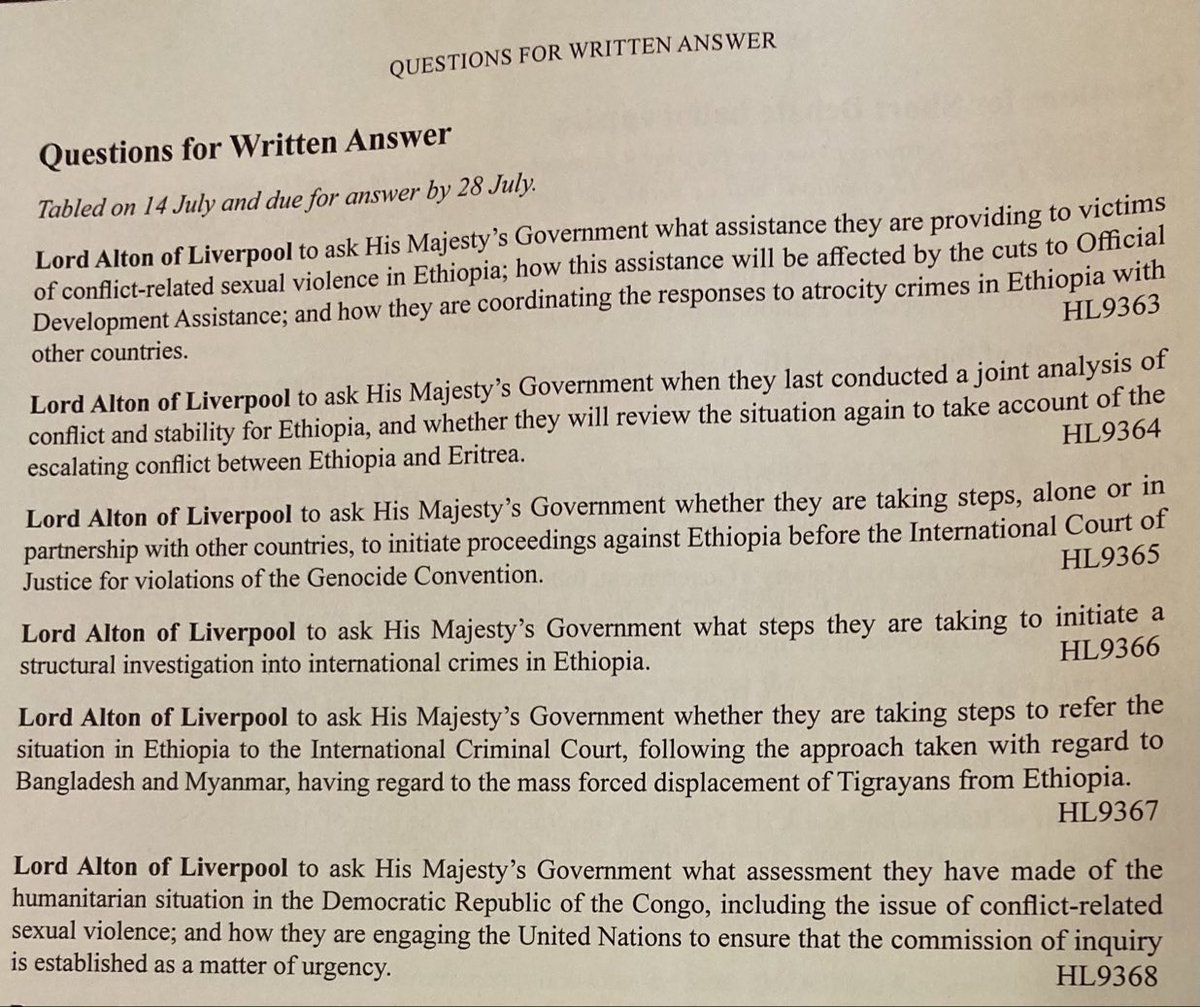
London, July 14, 2025 — Lord Alton of Liverpool has submitted a series of urgent and pointed questions to His Majesty’s Government concerning the failure to hold perpetrators of atrocities in Ethiopia and the Democratic Republic of the Congo (DRC) accountable. The written questions, tabled in the House of Lords, demand clarity on the UK Government’s actions regarding mass atrocities, particularly those involving conflict-related sexual violence and forced displacement.
Citing the UK’s reduced Official Development Assistance budget, Lord Alton questioned how aid to survivors of sexual violence in Ethiopia is being coordinated and sustained, especially in light of severe cuts. He also pressed for answers on when the UK last conducted a joint assessment of conflict stability in Ethiopia, and whether renewed analysis is planned given the escalating tensions between Ethiopia and Eritrea.
Further intensifying scrutiny, Lord Alton asked whether the UK Government is taking or planning any steps—unilaterally or in partnership—to pursue Ethiopia at the International Court of Justice for violations of the Genocide Convention. He also questioned whether a structural investigation into international crimes in Ethiopia is underway or being considered.
A notable question also referenced potential UK-led efforts to refer Ethiopia’s situation to the International Criminal Court (ICC), drawing parallels with the UK’s support for referrals involving Bangladesh and Myanmar. This comes amid ongoing international concern over the mass forced displacement of Tigrayans during the genocide war in Tigray .
In a related query, Lord Alton turned attention to the DRC, asking what assessments the UK Government has made of the humanitarian and conflict-related sexual violence crisis there, and how it is engaging the United Nations to expedite a commission of inquiry.
The series of questions reflect increasing international pressure on Western governments, particularly the UK, to respond more assertively to unresolved conflicts and large-scale human rights violations in Africa.
These questions are due for written response by July 28 and are listed under HL9363 through HL9368.
“Tigray and the DRC continue to suffer under appalling atrocities. Justice delayed is justice denied. The UK must not turn away,” Lord Alton emphasized in a statement shared on social media.
Stay tuned as the UK Government’s responses are awaited responses that could determine how seriously the UK is committed to international justice and accountability.
Tigray Trade and Export Agency Urges Urgent Fuel Supply Solution
Mekelle, Tigray | July 15, 2025 — The Tigray Trade and Export Agency has issued a formal appeal to federal authorities, calling for immediate intervention to address a worsening fuel supply crisis in the region.
In a letter sent to Ethiopia’s Ministry of Trade and Regional Integration, the Ministry of Mines and Energy, and the Ethiopian Petroleum Supply Enterprise, the agency highlighted the increasingly dire situation in Tigray, stating that the region is being supplied with fuel equivalent to only two fuel trucks (locally known as bote) — a level far below the region’s needs.
The agency expressed deep concern that such limitations have placed the region in a state of severe hardship. It reported that Tigray has received just 8.9 million liters of fuel at a time when national supply has otherwise remained stable, leading to questions about equitable distribution.
“The limited and irregular dispatch of fuel to Tigray is not in line with the national supply conditions,” the letter read. “The amount allocated is disproportionately low compared to other regions, pushing the people of Tigray — especially those involved in reconstruction and recovery — into an unsustainable crisis.”
The agency emphasized that the shortage not only undermines daily economic activity but also endangers the ongoing efforts to rebuild Tigray’s infrastructure and support its population after years of conflict and isolation. It further urged the federal authorities and responsible agencies to provide a clear justification for the disparity and called for an immediate and lasting solution to restore fair fuel access to the region.
“This is not just a logistical matter,” the statement concluded, “but a humanitarian and developmental concern that demands urgent attention and equitable action.”
The fuel crisis adds another layer of difficulty to Tigray’s post-conflict recovery, affecting transportation, health services, and humanitarian aid delivery across the region. Observers warn that if the issue remains unresolved, it could trigger wider socio-economic disruptions.