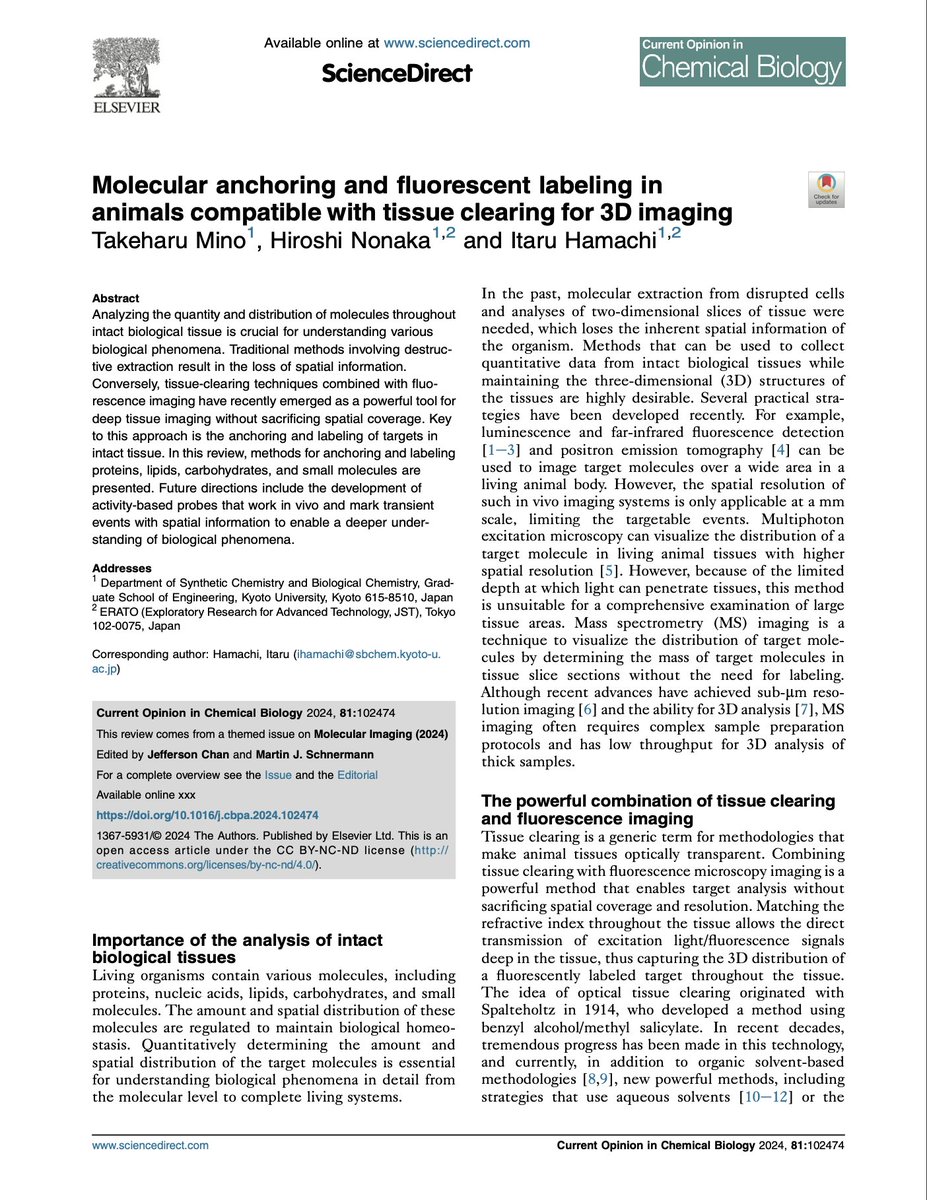
Excited to share our new review: “Molecular anchoring and fluorescent labeling in animals compatible with tissue clearing for 3D imaging.” 🔬 This review explores anchoring and labeling various molecules in intact tissues, key for deep-tissue imaging. 👉https://t.co/UQ8zbfhp7M
Happy about our new paper in Nature:
The GluA3 AMPA receptor homomer provides a framework to study this disease-prone glutamate receptor. https://t.co/ymmwQXxZa7
Happy to share our new paper in @NatureSynthesis !!
"In-brain synthesis of receptor-based protease sensors by coupling ligand-directed chemistry and click chemistry"
https://t.co/ezdtP5s67a
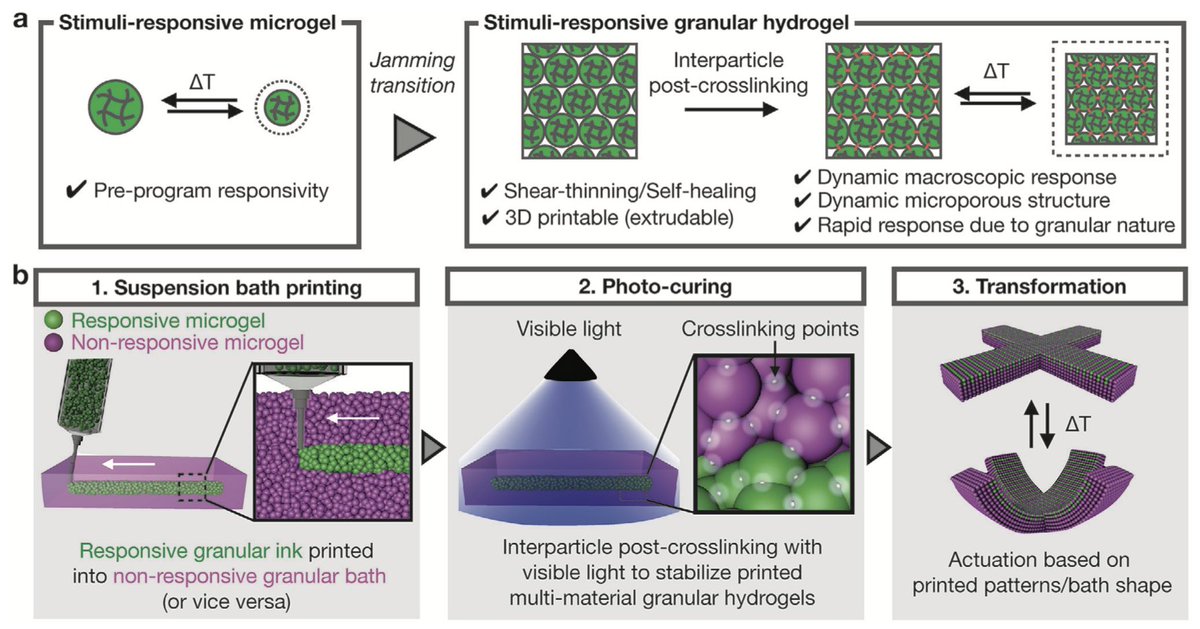
Congrats to Postdoctoral Fellow, @KeisukeNak678, on his recent work developing stimuli-responsive granular hydrogels, now out in Advanced Materials!
Link: https://t.co/gDTdN6sRaR
Co-authors: @CaprioNiko@BurdickLab
A spot-on review paper on the latest techniques for labeling and anchoring biological targets within tissue samples for tissue-clearing imaging, written by my friend @TMino12 and behind-the-scenes Assoc Prof Nonaka from an esteemed chemical biology lab in Japan @HamachiLabKyoto
We have developed a Pimonidazole-alkyne conjugate named Pimo-yne, enabling sensitive detection of in vivo hypoxia. Congratulations to my colleague Iori! The true potential of Pimo-yne will be revealed soon.
https://t.co/ClJsX38Quh
We used bacterial tyrosinase to achieve H2O2-free, fast, and low-background proximity labeling.
This is my first @J_A_C_S paper as a co-author!
Tyrosinase-Based Proximity Labeling in Living Cells and In Vivo | Journal of the American Chemical Society https://t.co/3aUxvDZXYL
Happy to share our new paper in @J_A_C_S !
Emergence of Dynamic Instability by Hybridizing Synthetic Self-Assembled Dipeptide Fibers with Surfactant Micelles | Journal of the American Chemical Society https://t.co/t5150UAD63
Happy to share our new paper in PNAS (@PNASNews)!
Bioorthogonal chemical labeling of endogenous neurotransmitter receptors in living mouse brains | PNAS https://t.co/WohNFuR9BZ
Scientists have discovered a pattern of rhythmic brain activity that is much slower than most other known types of brain rhythm, such as alpha and theta waves — a result that raises many exciting questions for the field of neuroscience. https://t.co/GgtE68l82V