Founder of @balancedwheel. I love learning | I believe that I can change the world one thought at a time | I am Passionate about creating sustainable solutions.
Rules no one remembers writing still run your business.
"We tried that once" is an old scar disguised as wisdom. If you can’t name the specific failure that created a rule, the rule is obsolete.
Stop paying legacy debt on dead logic. Reclaim your velocity.
The "Valley of Despair" isn't a sign to pivot. It’s a sign that you’ve finally stopped guessing.
Most founders "re-start" because Stage 1 feels like progress. It’s not. It’s just an expensive way to avoid solving Stage 3 problems.
Solve the complexity. Own the moat.
If "sensible" decisions are stalling in your biz, your constraints are invisible.
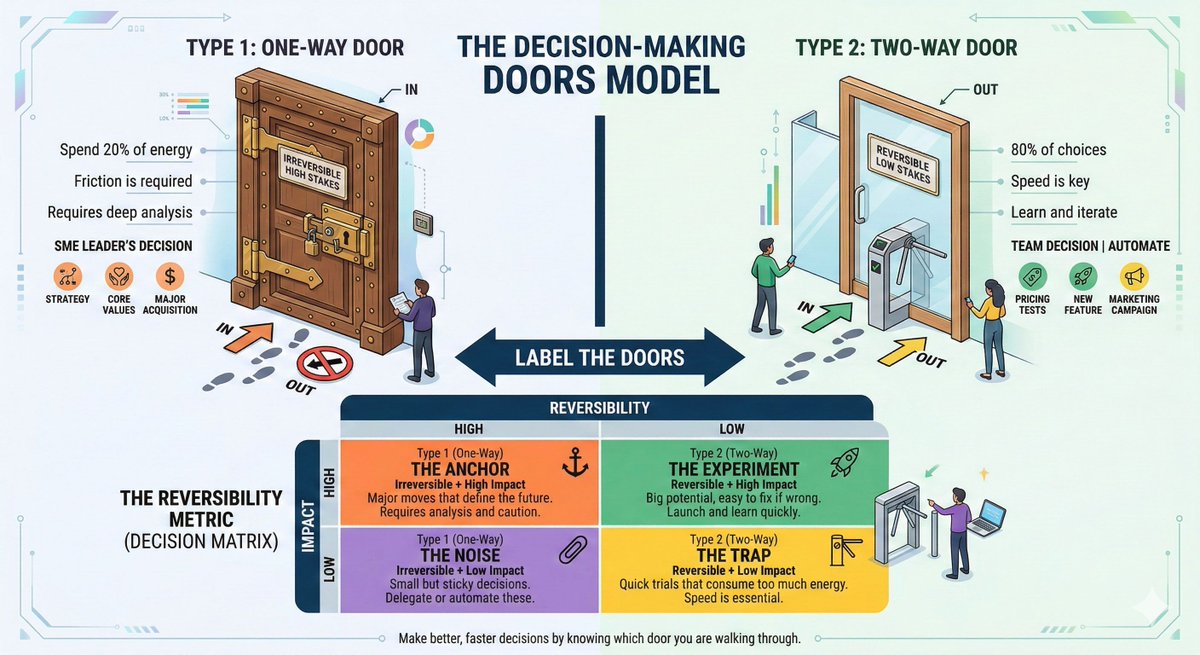
Use the Reversibility Metric:
Type 1: One-way door (High stakes/Permanent).
Type 2: Two-way door (Low stakes/Reversible).
If it's Type 2, don't let it hit your desk.
I’ve seen SME leaders spend 80% of their energy managing risk perception.
Instead of making the 20% move that actually scales.
Pricing adjustments stall.
Hiring takes months.
Investment choices circle.
The issue isn't judgment.
The issue is that your "Type" is invisible.
Stop being the Gardener of your business. Start being the Architect of the Ecosystem.
If your results depend on you "watering" every project personally, you'll never scale.
Build the Irrigation System, not the hustle.
The goal isn't to be needed. It's to be redundant.
Most SME leaders mistake "frantic activity" for progress.
The elite build "boring" businesses.
No drama. No charismatic dependency. Just a high-velocity Operating System that makes results feel inevitable.
If your business is "exciting," it's likely unpredictable.
SME growth feels heavy because we scale people, not systems.
If your "Capabilities" (what you do) don't align with your "Value Streams" (how you make money), your team will spend 80% of their energy just navigating the internal friction.
Stop selling "expertise." Start selling Certainty.
If a client is haggling over your fee, it’s because you’ve allowed them to anchor on your "time."
Price is the conversation people have in the absence of value.
Lead with the Cost of Inaction, not your day rate.
Scaling is only "messy" if you’re growing a business that still relies on your personal intervention.
I’ve seen £10M expansions fail because the founder was the only one allowed to make a decision.
Don't build a "buzz." Build a structure that stays quiet under pressure.
Scaling isn't about doing more. It's about becoming less relevant.
If your business needs your "heroics" to survive a growth spurt, you're the bottleneck.
Transferability isn't an exit strategy. It’s a growth strategy. Build an asset that travels.
https://t.co/CbAceS9ATf
Profitability is not a proxy for value.
The top 1% of SME owners know that "Value Accumulation" is temporary. "Value Embedding" is permanent.
If your business requires a 20-min explanation to justify its results, you don't own an asset. You own a job with a board of directors.
Most founders think external scrutiny is an attack on their ambition.
It’s actually a stress test of their architecture.
If you have to explain why a result happened, your design hasn't caught up with your reality.
Build a machine, not a personality cult.
We love to talk about "overnight success," but we rarely discuss the isolation of the struggle.
True leadership isn't just about managing the team; it is about managing the version of yourself that wants to quit when no one is watching.
Independence is not delegation.
The business looks less dependent.
But it isn’t.
Delegation reduces workload.
Independence reduces risk.
Most businesses confuse the two.
If outcomes still rely on reassurance, independence hasn’t been designed.
The business grew.
Its value didn’t travel.
This company had expanded quickly.
New customers.
New markets.
A broader leadership team.
Yet every time responsibility shifted, performance dipped.
Projects slowed when ownership moved.
Decisions required re-explaining.
For most small to mid-cap owners, the biggest fear in an exit isn't the price, it's the 'after.'
Will the culture survive?
Will the customers be looked after?
Will the 'building' you constructed stay standing?
Performance does not follow talent; it follows power.
In many small to mid-market businesses:
• responsibility is delegated
• authority is not
• escalation fills the gap
This limits scale, succession and confidence, long before numbers change.
Accountability without authority creates friction.
This is how performance degrades quietly, even in capable teams.
If accountability feels heavy, check whether authority actually sits with it.