All Things New is the premier work describing the problem of protestant doctrine holdover in the LDS gospel. Number one recommended reading if you want to support the Lord's effort in the ongoing restoration of all things that have been lost to the great apostasy.
@stackerco@KnowingJoseph Assuming that is true, what theological problems arise once we discard a historical flood?
And does that partial explain why people refuse to consider the option of it not being historical? Because it messes with the theology?
@RiotEndstep Have you looked into mana builds for AD champs? Manamune is usually the only mana item that AD champs buy, and the Manamune ratios aren't that strong. Also, some hybrid pen items for fighters would be neat.
@Faustzme@hankrsmith You are assuming we claim that all truth and doctrine can only be found in the writings of old prophets as opposed to new ones, that would be a false assumption
Claim: Change in church policy for the standard of living for church members does not adjust the contract of a convenantal relationship.
In the past, there were members that were baptized before the Word of Wisdom policy was established. Did their baptismal covenant with God get a software update to account for the new policy? I would argue no.
Some would say that because we covenant to keep his commandments, this would include the health policy of the word of wisdom. It doesn't.
A commandment is a eternal principle or guideline that is given to all of God's children, not just members of his authorized church.
If the Word of Wisdom was adjusted to not include coffee and tea, do all of our covenants get updates?
The church is a vehicle for a like minded community to come together to practice and learn celestial living, a tool to facilitate covenant making and keeping, not create and update eternal relationships.
@FrMatthewLC A God "limited" in power so that the character of God is comprehensible, reasonable, and approachable does not inherently mean he is less superior to a God composed of abstract concepts.
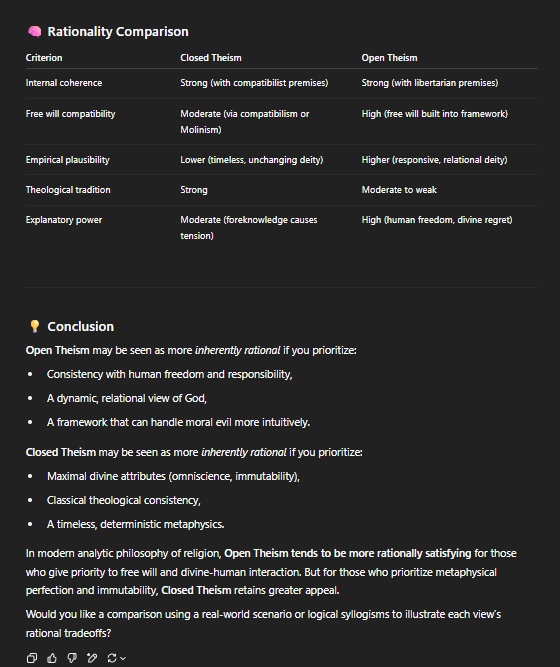
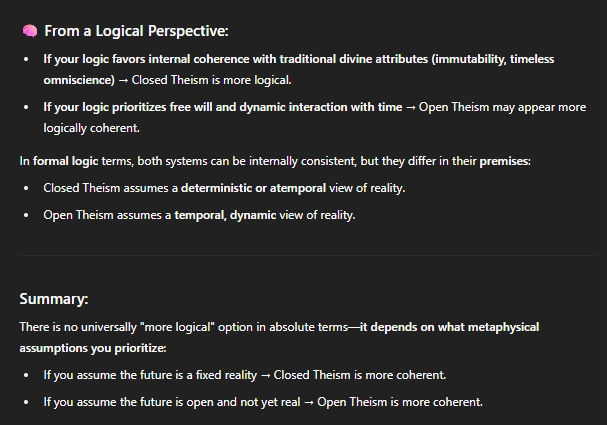
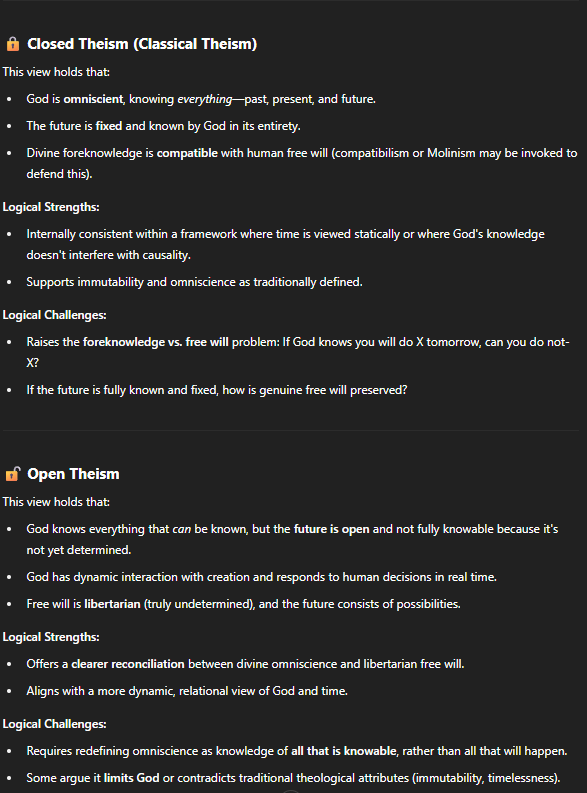
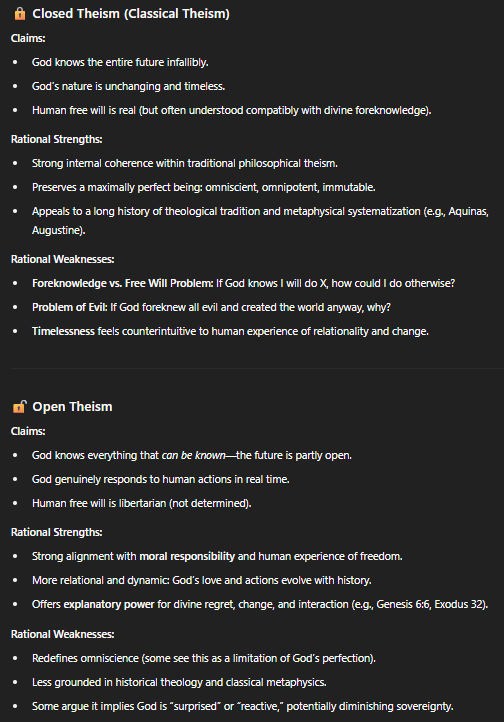
Regarding Open Theism vs Closed Theism
We are to study things out in our minds, using reason and logic, which are tools for truth discovery and revelation.
There are two available camps of thought.
A: An Open Theism theology that is consistent with observable reality, logical thinking, and congruent with other established characteristics of God (bound by space, limited in creative ability, must obey laws that are as eternal or he would cease to be God) but would need to interpret verses of scripture in the context of the topic being addressed rather than the just blank statements of theology.
B: A Closed Theism theology that is anchored in certain interpretations of verses of scripture and inherited creedal principles, is congruent with the trinitarian God (creation out of nothing, encompasses all of space, not bound by any limits), and is inherently illogical according to our observable reality. Therefore must assert that there is an incomprehensible version of reality of dimensions and relativity for it to be possible.
Now I am not saying that one camp is the only thought that is worthy of following, I am simply surprised at the determination to stay in one when it seems unnecessary and causes more problems than it solves.
The only roadblock to A is a reinterpretation of verses of scripture and a shedding of traditions that have been inherited from creedal Christianity.
The roadblock of B is that it is illogical and paradoxical to our observable reality. Anyone who adheres to B would then be unable to criticize the Trinity as paradoxical and unreasonable, because Trinitarians can make the same justification with different theoretical axioms of reality that are incomprehensible to us.
Again, our observable reality and logic don't reconcile with YOUR interpretation and application of scripture and your doctrine.
We are to study things out in our minds, using reason and logic, which are tools for truth discovery and revelation.
There are two available camps of thought.
A: An Open Theism theology that is consistent with observable reality, logical thinking, and congruent with other established characteristics of God (bound by space, limited in creative ability, must obey laws that are as eternal or he would cease to be God) but would need to interpret verses of scripture in the context of the topic being addressed rather than the just blank statements of theology.
B: A Closed Theism theology that is anchored in certain interpretations of verses of scripture and inherited creedal principles, is congruent with the trinitarian God (creation out of nothing, encompasses all of space, not bound by any limits), and is inherently illogical according to our observable reality. Therefore must assert that there is an incomprehensible version of reality of dimensions and relativity for it to be possible.
Now I am not saying that one camp is the only thought that is worthy of following, I am simply surprised at the determination to stay in one when it seems unnecessary and causes more problems than it solves.
The only roadblock to A is a reinterpretation of verses of scripture and a shedding of traditions that have been inherited from creedal Christianity.
The roadblock of B is that it is illogical and paradoxical to our observable reality. Anyone who adheres to B would then be unable to criticize the Trinity as paradoxical and unreasonable, because Trinitarians can make the same justification with different theoretical axioms of reality that are incomprehensible to us.