Becca Tarnas is Assistant Professor in the Philosophy, Cosmology, and Consciousness program at the California Institute of Integral Studies. Today, we talk about the uncanny intersection between Jung and Tolkien. It’s a wild ride covering psychedelics, consciousness, the “internal world”, psychoanalysis, and symbols. Link in reply
This is a careful lecture that can be followed with zero background knowledge. Einstein thought he'd caught quantum mechanics in an act of spookiness — this podcast asks whether he was even worried about the right thing. Tim Maudlin, professor of philosophy at NYU and a leading philosopher of physics, delivers a rare full lecture tracing Einstein, EPR, and the road to Bell's theorem. The central claim: Einstein's real objection was never determinism — "God does not play dice" is a red herring — but non-locality, which he inferred rather than assumed. Maudlin traces the argument from Einstein's overlooked 1927 Solvay objection through the EPR paper's criterion of reality, showing why Bohr's famous reply never actually answered it.
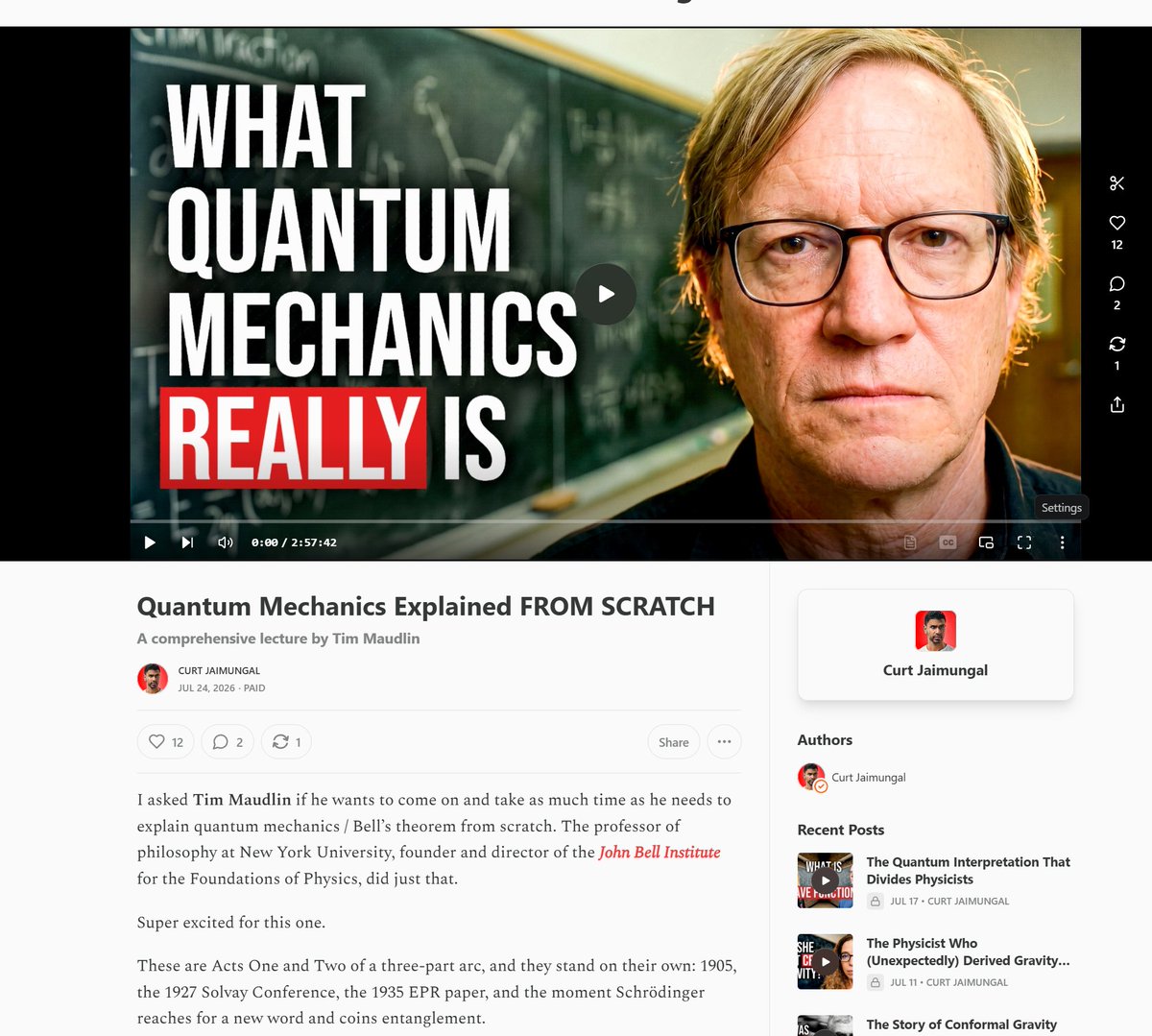
This is a huge one, ladies and gents. I asked Tim Maudlin whether he wanted to come on and take as much time as he needed to explain quantum mechanics / Bell’s theorem from scratch. He didn’t disappoint. This is a careful lecture that can be followed with zero background knowledge. Thank you, Prof. Tim Maudlin, for the wonderful exposition. LINK IN REPLY
Looking for Fael is pretty good. It's frustratingly tedious at times, but most games of this genre are. I was surprised by how much it leaned into certain mechanics. I don't want to spoil much, so I'll leave it at that. It's worth a try if you like games like Myst.
Just released. If it’s right, it says that the Standard Model’s internal representation structure (internal symmetries and particle content) largely come from the nested embeddings of R subset C subset H subset O. From the one and only Cohl Furey. Take a look here: https://t.co/3VSJmsdd4T
This is a podcast all about parallel universes, and whether we have any right to believe in them. David Wallace, professor of philosophy of science at the University of Pittsburgh and a leading defender of the Many Worlds Interpretation, joins Professor Emily Adlam, his former student, for a rare joint conversation. The central fault line: Adlam argues no one living inside a many-worlds universe could ever rationally confirm the theory describing it, since Everettian probability may undermine the evidence used to support quantum mechanics itself. Wallace disagrees, but takes the challenge seriously. From there they range across the nature of the wave function, relational quantum mechanics, QBism, and scientific intersubjectivity — two sharp, collegial minds disagreeing productively about what kind of universe we actually live in.
In this piece I pick the simplest term of the standard model, and explain it piece by piece, so that the rest of the terms make sense. I think that's a useful way of going about learning mostly anything complicated. A great question to ask yourself in philosophy / math / physics is, “what is the smallest amount that you need to know such that when you understand this one case, you understand the majority of the rest?” In other words, for which relatively elementary case do you get the largest bang for your comprehension-buck?
LINK IN REPLY
Brand‑new podcast with Emily Adlam and David Wallace on the interpretations of quantum mechanics. The measurement problem, relational approach and many‑worlds interpretations are heavily covered. LINK IN REPLY