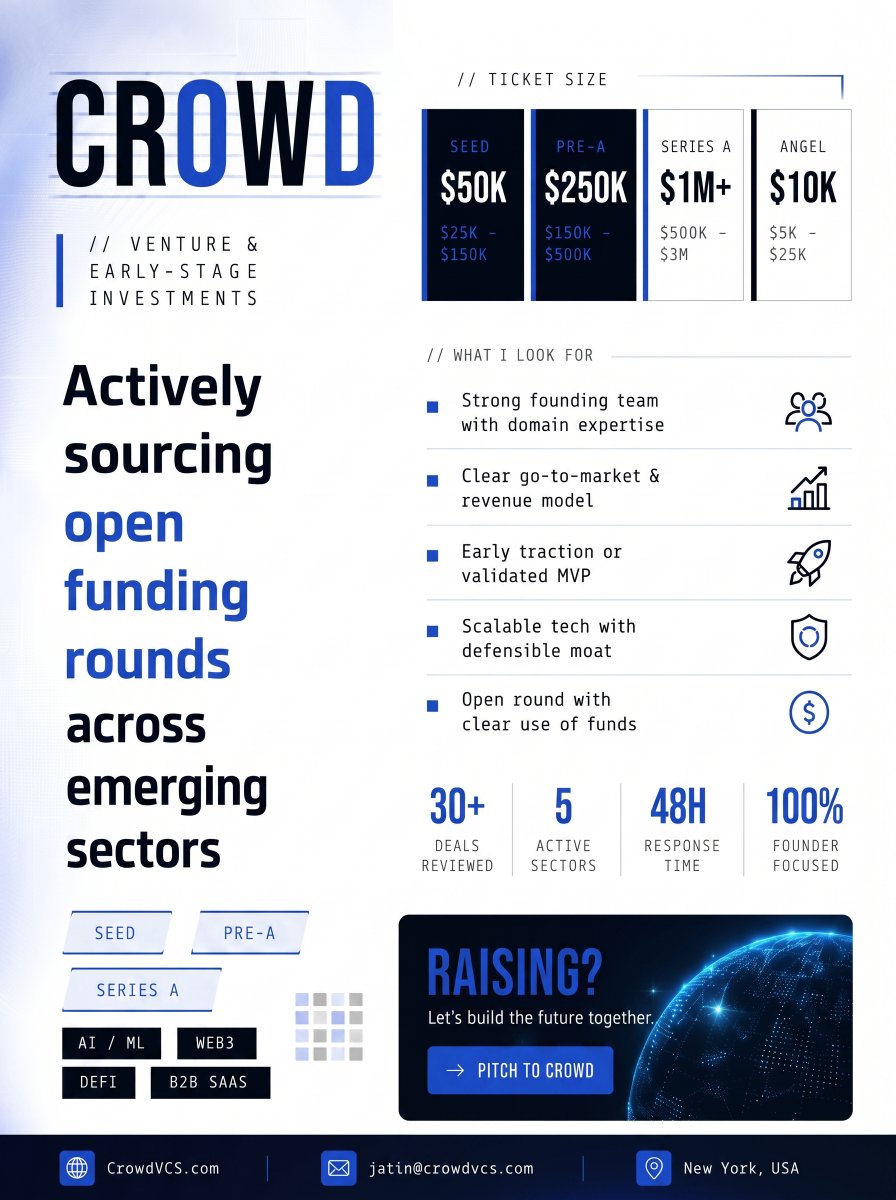
The next unicorn is being built right now - and I’m looking to back it early.
Strong traction or exceptional founding teams
AI/ML · Web3 · SaaS · Fintech · Climate Tech
If you’re building something ambitious, let’s connect
#VentureCapital#Startups#EarlyStage#Investing
“I will not vote for CLARITY until we address ethics.”
On this week's Policy Protocol, @Sen_Alsobrooks joins @RebeccaRettig1 and @renato_mariotti to defend the yield compromise, respond to Jamie Dimon's criticism, and explain the ethics, illicit finance, and Agriculture Committee issues she says must be resolved before she can support the bill on the Senate floor.
Plus: Why former Rep. George Santos is named Person of the Week.
Timecodes:
00:00 Sen. Alsobrooks on Ethics
00:26 Welcome to The Policy Protocol
00:56 CFTC Greenlights Perps in 24 Hours
02:33 OFAC Sanctions Iran's Nobitex
05:56 Offshore Exchanges Coming Onshore
07:05 Senator Angela Alsobrooks Joins
07:45 Defending the Yield Compromise Against Jamie Dimon
10:21 What's Needed for an Ethics Compromise
12:17 How ClarityHelps Underbanked Constituents
15:03 Why More Democrats Aren't on Board
16:25 What It Takes to Get Clarity Across the Line
17:13 Sen. Alsobrooks's Approach
18:33 Why Clarity Is the World's Only DeFi Legislation
21:27 Senator Lummis Pushes Back on Jamie Dimon
22:31 George Santos Named Person of the Week
Tom Lee’s Ether treasury bet swings to a multibillion-dollar unrealized loss, SpaceX’s massive IPO could pull capital away from crypto markets, and Goldman Sachs launches a blockchain-based real estate fund.
@JennSanasie has what you need to know.
“I think it's definitely about sending a message, right? He has levers. Ultimately, at the end of the day, in terms of how he manages his treasury versus the bitcoin that he has and increasing his USD treasury, and like we would expect him to use them. So I don't think this is surprising at all. I think it would be way, way more concerning if Michael Saylor was unwilling to do this.”
Lygos Finance’s Francis Corvino weighs in on Strategy selling bitcoin, and why the story is really a nothingburger, on the latest Blockspace Live.
🎧Catch the latest episode of 'The Blockspace Pod,’ in partnership with @blockspace Media!
🎧 Spotify: https://t.co/LQnucXRDe8
🎧 Apple: https://t.co/yT6OcDj39K
📺 Watch: https://t.co/kXxAoqepJP
Bitcoin ETFs hit a record $3.45B outflow streak as BTC falls below $69K, Tom Lee says Strategy’s recent sale is typical market behavior, and Mt. Gox moves $739M worth of Bitcoin ahead of creditor repayments.
@SamEwen has what you need to know.
GEN C: @garyvee, Chairman of @vayner_x and CEO and Creator of @veefriends, joins Gen C to discuss why we are living through the most consequential technological moment since electricity.
Watch @SamEwen's conversation with Gary Vaynerchuk now out on all CoinDesk platforms.
00:00 Blockchain Meets AI
00:45 Managing Chaos in 2026
02:07 Maybe Culture Mindset
04:43 AI Opportunity for Have Nots
06:44 AI Bigger Than Internet
08:21 Innovation Mount Rushmore
10:00 Entrepreneurs and AI Leverage
12:21 Understanding Blockchain Ownership
14:53 NFTs as Collectibles
18:51 VeeFriends and Calling the Top
20:36 Speculation and Junk Wax Era
21:30 Stimulus and Collectibles
22:09 Big Dreams Roadmaps
22:33 Jets vs VeeFriends
24:45 Garage Sale Arbitrage
27:05 Consistency and Positivity
28:35 Trading Culture Shift
30:45 AI Exposes People
32:50 Marketing to AI Agents
37:35 Return of IRL
40:46 Optimism About Humanity
🎧 Catch the latest episode of 'Blockspace,’ in partnership with @blockspace!
BLOCKSPACE: Anthropic's IPO, IREN’s $3.65B GPU Financing, Strategy Sells BTC, DMG’s 50 MW AI Data Center
⚡️ Antrhopic is going public with a $47 billion ARR
⚡️DMG ($DMGI) inks 50 MW AI colocation deal for its site in BC, Canada
⚡️ $IREN finalizes $3.65B GPU financing for its $MSFT deal
📺 Watch: https://t.co/kXxAoqepJP
🎧 Spotify: https://t.co/LQnucXRDe8
🎧 Apple: https://t.co/yT6OcDj39K
Strategy sells Bitcoin for the first time in four years, Jamie Dimon escalates the fight over stablecoin yield, and Citigroup says tokenized assets could reach $5.5T by 2030.
@SamEwen has what you need to know.
And it's just the same thing that happened in Bitcoin too. If [the Ethereum community] can smooth over that period somehow then maybe the future could be promising. But yeah right now it looks pretty grim
“We've got the Ethereum Foundation saying everybody's leaving. We've got podcasters rage quitting. But those are things that need to happen. So the fact that it happened is not necessarily bad. I guess the question is what happens next?”
Does Ethereum need new faces to hoist its banner, or does it need a facelift entirely? @udiwertheimer weighs in on the state of Ethereum on the latest Blockspace Live.
🎧Catch the latest episode of Blockspace in partnership with @blockspace!
🎧 Spotify: https://t.co/LQnucXRDe8
🎧 Apple: https://t.co/yT6OcDj39K
📺 Watch: https://t.co/kXxAoqepJP
🎧 Catch the latest episode of 'Blockspace,’ in partnership with @blockspace!
BLOCKSPACE: Semiconductor Smugglers, Google’s 200 MW Solar Deal, Iran War’s Energy Market Impact, Debunking Data Center Water Myths
⚡️ Taiwanese officials bust smuggler ring which snuck $15M of NVIDIA chips to China
⚡️ Google inks deal for 200 MW of solar power in OK
⚡️ Almond farms use 60-75x more water than data centers in the US
📺 Watch: https://t.co/kXxAoqepJP
🎧 Spotify: https://t.co/LQnucXRDe8
🎧 Apple: https://t.co/yT6OcDj39K
Intercontinental Exchange CEO Jeffrey Sprecher says Hyperliquid is bigger than Nasdaq in daily perpetual futures volume, Paxos wins SEC approval to clear U.S. stocks on blockchain rails, and Kalshi sues Minnesota over its prediction market ban.
@SamEwen has what you need to know.
Is the CFTC ready to oversee crypto and prediction markets?
Brookings senior fellow @Aarondklein joins @RebeccaRettig1 and @renato_mariotti on The Policy Protocol. Plus, @congressmanGT and @RepAngieCraig named people of the week.
00:00 Welcome to The Policy Protocol
00:43 All Roads Lead to the CFTC
01:22 Unpacking the NYT's CFTC Investigation
05:11 Why the CFTC Needs Funding and Personnel
06:52 Aaron Klein Joins the Show
07:30 The History of the CFTC and the Great Salad Oil Swindle
08:10 'Independent Regulators as White House Subsidiaries'
09:39 Dodd-Frank Lessons for the CLARITY Era
11:47 The Case for Merging the SEC and CFTC
13:21 Is the Administration Soft on Financial Crime?
15:06 Should the SEC-CFTC Share an Office?
18:16 Renato and Rebecca Debrief on the CFTC's Future
21:45 Trump on Prediction Markets and Expanded Jurisdiction
22:30 People of the Week: GT Thompson and Angie Craig
24:26 Remembering Ondo Finance CEO Nathan Allman
1/12 Ethereum's consensus layer relies heavily on BLS signature aggregation, but BLS is vulnerable to quantum attacks.
Enter leanSig: a hash-based, post-quantum multi-signature scheme.
Decryption of the last @zeroknowledgefm session with @nico_mnbl, @Khovr and Benedikt 🧵👇
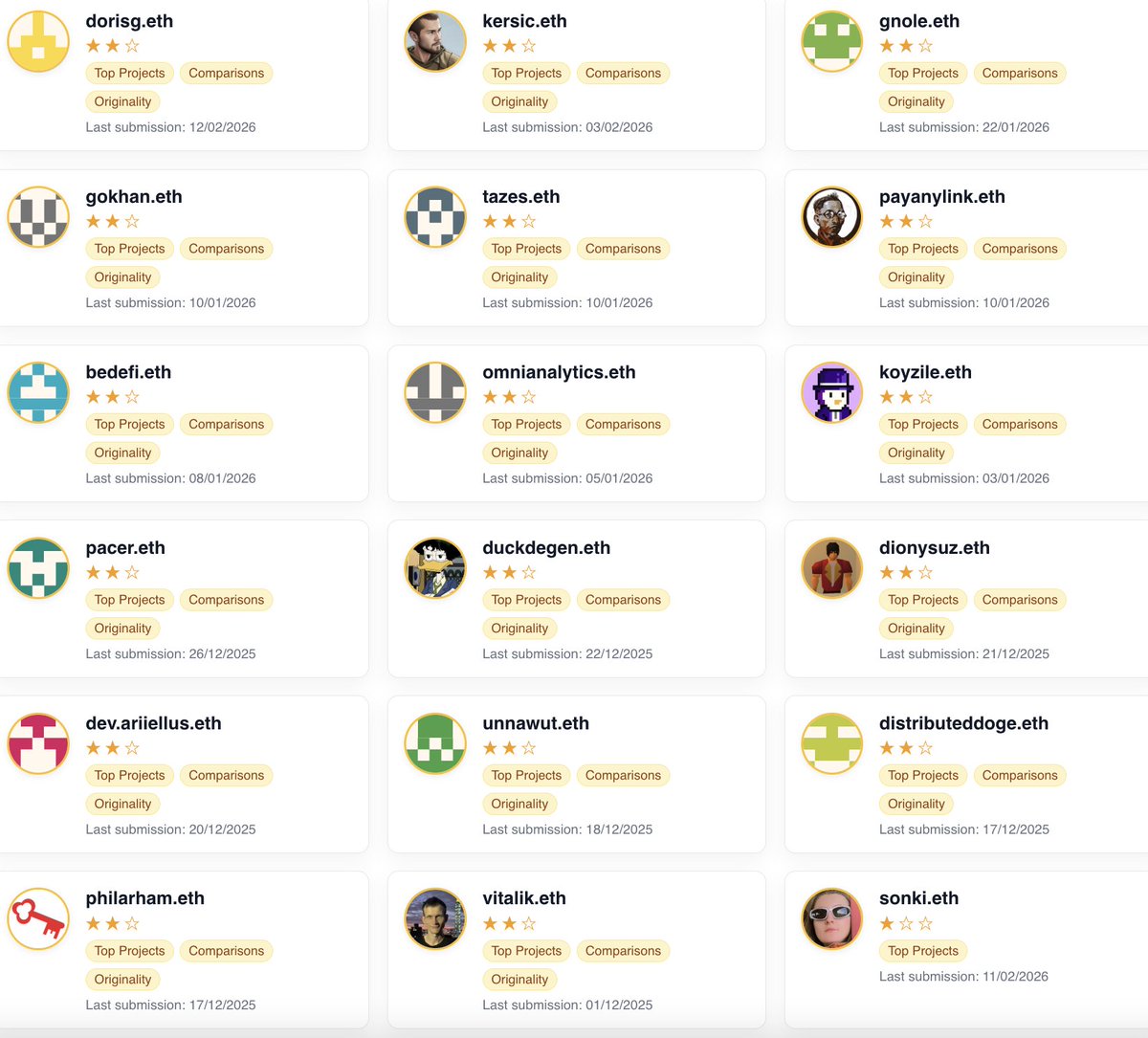
we just launched a dashboard showing who has completed deep funding jury duty!
pick 10 out of 98 OS repos impactful to ethereum, make judgments b/w them & get yourself up on the wall of honor!
this data is used to train & test AI models in @JoinPond & @seer_pm , link in QT
This is a good post on the impact of surveillance in Iran:
https://t.co/1kT3SrsCyO
It's worth reading.
IMO one mistake that freedom advocates often make is that we talk about privacy violation and surveillance as "dystopian", using the word as a semantic stop sign: we know it means "bad", we nod along, and don't really go further to clarify why it's bad. I worry that this approach is long-run unhealthy: when we criticize various companies and countries for being "dystopian" and stop there, then to someone who's not already in the same memeplex, it sounds like we're basically criticizing companies and countries for not complying with our culture's aesthetic preferences. Which is ... duh, companies and countries are *supposed* to not comply with each other's aesthetic preferences, that's the whole point of the "pluralism" thing.
What the above article makes clear so well is that "dystopian" surveillance is not bad because it's "dystopian", it's bad because it makes a concrete property of the world worse: the power balance between individual and state. Surveillance enables an outcome where basically everyone other than police and security forces has no opportunity whatsoever to challenge the political status quo without being punished. This means an outcome where a political regime can remain in power forever, without satisfying more than a very small coalition of people who have the eyes and the guns (now drones).
The Dictator's Handbook talks about "large coalition" and "small coalition" governments; large coalition governments are the ones that are more pro-human, because they, well, have to keep a large coalition happy. Small coalition ones are the really nasty ones. Here is the near-term dark outcome of dictatorship + automated warfare + surveillance: a regime can literally survive with a coalition of size 1, because an army of all-seeing eyes and robots can defeat the entire populace in battle if needed. In Iran, we see what *just* dictatorship with surveillance can do, once you add automated police, you get to the unholy trifecta.
I don't know of a good solution to this. Privacy technology, as well as more work on censorship-resistant internet (I think we should strive for at least basic-quality internet, eg. 1 Mbps, being a global human right outside the domain of nation-state sovereignty), can help somewhat to reduce the possibility of total government control. But what else?
---
BTW one implicit frame in the article I take some issue with is framing Iran + Russia + China as the unique antagonists (both in surveillance they do internally, and in the technology they export to other countries). They do a lot of dystopian shit of both types. However, Israeli and US tech companies, and undoubtedly tech companies from other Western nations, also do a lot of dystopian shit.
Perhaps one key difference between the surveillance described above, and the Western type, is:
* The surveillance in the above article is about exercising *great control over a medium area*: you can see everything, but it requires active participation of the government of the territory being surveilled.
* The Israeli / US / Western flavor is about exercising *medium control over a great area*: there are more limits to how much they can do, but their surveillance is global: they know what people are doing even in countries and territories they have no presence in.
The distinction is not absolute: Israeli surveillance backstops a lot of its human rights abuse in Palestine, US surveillance reinforces ICE abuses (see the recent article about Homeland Security demanding social media firms reveal names of anti-ICE protesters), etc, and "transnational repression" is done by anti-Western countries. But *on average*, the above seems to be the pattern.
The two are differently scary. The former for the reasons I described above. The latter because it allows global projection of power: a politician or civil servant in one country now has to worry about being blackmailed, droned or otherwise attacked from other countries. The USA has shown willingness to go after individual EU officials, ICC officials (see recent articles on both), and others. Ultimately, I suspect that even democratic governments will want more privacy to protect themselves, and we will have to have deep conversations about what "democratic accountability" means: how can a civil servant be accountable to the people, but not accountable to foreign spooks?
My high-level frame is: privacy generally helps whoever is weaker. "Weaker" does not mean "moral": sometimes the weaker side is criminal. But in the 21st century, we are at serious risk of stronger factions using modern technologies to establish unbreakable lock-in to power. And so on average, reducing the gradient of power, giving the weak a fighting chance, is something that the world desperately needs.