Coding is basically the pinnacle of what you could reasonably automate with AI, and yet we still need human engineers to oversee agents for them to be effective.
The AI models are trained on an incredible amount of sophisticated code. The users are highly technical and can use the latest tools quickly. The work is “verifiable” because you can test an app. The outcomes are often removed from the quality of the code (you can have sloppy code but the app can still work). And the context for the agent is often already digitized and sitting in the codebase.
That’s an incredible amount of benefits that AI coding agents get to work with. Some of those apply to knowledge work, but most don’t in areas where the work needs to be fully reviewed to be useful, or where data isn’t as abundantly digitized. This makes the job for agents in knowledge work more complicated.
So if with all of that, engineers still remain in very high demand, the risks are going to be less than what’s perceived for other areas of knowledge work. Agents will let people do far more than they did before, but the people don’t go away.
I am starting to have trouble paying attention to even interesting information if it is written in Claude or ChatGPT house style. I think some is the sameness of the rhythm rather than obvious tics: Claude is always so staccato. ChatGPT loves short sentences as kickers. Boring.
Is there something about Claude Code having your conversation on the same side of the screen (rather than the alternating left right) that makes it feel more collaborative.
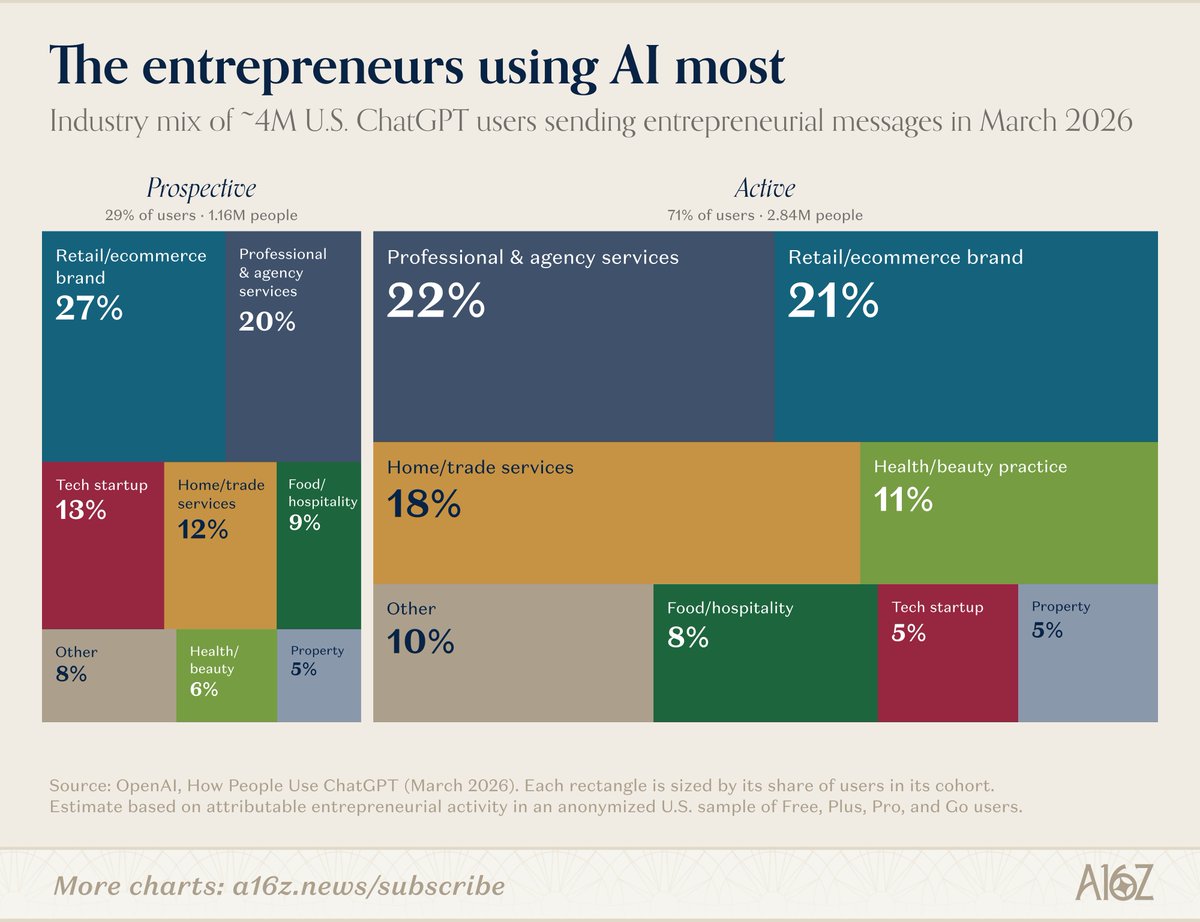
The businesses getting the most out of AI right now aren't tech companies.
They’re plumbers, agency owners, dentists, Etsy sellers.
New data from @OpenAI (cc @RonnieChatterji) makes the pattern clear: tech startups account for about 5% of ~active~ U.S. users doing entrepreneurial work with ChatGPT.
The other 95% are spread across services, retail, healthcare, and trades.
AI adoption for entrepreneurship isn’t concentrated in tech. It’s happening inside everyday businesses, folding into routine work that used to be slower or outsourced or entirely overlooked.
If you think AI replaces software engineers, here’s a quick thought experiment.
Imagine you’re a life sciences company. 10 years ago you want to invest heavily in lab automation, processing data at scale, and other software. You look at the cost of doing so and realize you can’t compete with tech for as many engineers as you need, so you pare down your goals and do what you can. Every new software project has a fixed cost of a certain sized team, so you can only do so much given budgets, ability to compete for talent, and other trade offs.
Now, AI comes along. And all of a sudden you have the *exact same* output tokens as the best tech companies in the world. Your engineers are using the same AI models as the tech industry, which means you have just boosted your engineering team by a some meaningful amount, while also neutralizing your differences with tech.
Do you continue with your pared down approach, or do you start to hire more engineers because each engineer is 2X or 5X more capable than before? In almost every company I’m talking to, they’re doing the latter.
Now extrapolate this to every bank, manufacturer, industrial company, retailer, and on and on. And extrapolate it not to just large enterprises, but also every SMB up and down the stack of these value chains. Oh, and also extrapolate this to other job functions, not just engineers. Resource scarce domains in marketing, legal, finance, design, and so on.
If you’re wondering why new jobs show up because of AI this is the reason. Any other view of what happens doesn’t contemplate the variety of unmet needs there are in the economy.
The jump from working with a chatbot to having an agent that actually helps automate a process requires a real amount of work.
Most companies will need to have dedicated people that are responsible for bringing automation to their teams, instead of leaving this up to every individual employee. Partly because the work is more technical than we imagine today, and partly because it’s just hard to do this as a side project.
The job spec is to map out new workflows with agents, implement new systems to deploy agents, make sure the agent has all the right (up to date) context to work with, wiring up internal systems to connect to the agents, creating evals for the agents, figuring out where the human is in the loop, managing the system when there are new upgrades, helping with the change management of the existing business process, and so on.
These jobs may come from IT or engineering, or live directly in the business function itself. They’ll be called different things depending on the company, and in some sense it’s the future of software engineering that you’ll see a huge growth of in non-tech companies.
Most companies will have to be hiring for this now or in the future, and it’s another example of the kind of new jobs that will be created in AI.
Now that Artemis II has launched we have 10 days to get everyone on Earth a Planet of the Apes costume so we can do something hilarious when the astronauts return 😁
We invited Claude users to share how they use AI, what they dream it could make possible, and what they fear it might do.
Nearly 81,000 people responded in one week—the largest qualitative study of its kind.
Read more: https://t.co/tmp2RnZxRm
There’s a fundamental difference between taking an existing process and applying AI agents to it vs. taking a process from scratch and designing it from the ground up for AI agents. The gap we’re going to see will widen between the teams and companies that are able to do the latter instead of just the former.
In theory it would have been ideal for all the gains of AI to have come “for free”, but there are both clear constraints of AI (like getting the context right) and clear upsides (like being able to execute code and run in parallel) that the workflows themselves must be redesigned to take full advantage of this technology.
One of the biggest implications that will come into focus is that agents that can write and run code, and interact with any API, will lead to agents effectively being expert engineers applied to your business process.
So to some extent one of the biggest ways of reengineering a workflow is to ask yourself: what would you do if you had an infinite number of capable engineers write software for this process. What if those engineers wrote code to connect your disparate data sources, comb thorough any amount of unstructured data, automate your repeated tasks, connect your various systems together specific to your process, and so on.
Not every process has that upside, but there tons of tasks that we do every day across marketing, finance, operations, and even sales, where a programmer with infinite code writing and API access would be able to make something go far faster or produce way more output. The teams that start to think this way will start to operate entirely differently.