The Persecution That Doesn’t Make the Headlines
I am a Muslim convert to Christianity. I lived for 15 years as a Christian believer in Morocco, much of that time in what we called the underground church.
Listen carefully, because this is what “moderate Islam” looked like for us:
Morocco is considered one of the most moderate Muslim countries. That is true compared with Mauritania and Libya, where converts from Islam face the death penalty, or Egypt, Jordan, Syria, the West Bank, Saudi Arabia, the UAE, and Pakistan, where converts face imprisonment, torture, intimidation, or severe persecution.
But here is the reality of “moderate” Morocco.
We gathered secretly in homes every Sunday because churches were for foreign Christians, not Moroccan converts. We sang in low voices so the neighbors would not hear us. We arrived two at a time to avoid suspicion. If anyone asked, we pretended it was simply a gathering of family and friends.
We baptized converts in bathtubs.
I was baptized in a bathtub myself. A missionary and a few Moroccan Christians were the only people present.
We kept our house churches small, usually fewer than twenty people. When they became too large, we split them. Christmas and a few special occasions were exceptions.
Police raided Christian gatherings, confiscated Christian materials, dragged believers to police stations, interrogated them, threatened them, and humiliated them with vulgar language.
Our children had to go to school and study Islam and memorize the Quran even though their parents were Christians.
We could not freely give our children Christian names. The government did not need to write “Christian names are forbidden” in bold letters. The authorities simply refused to register them.
Our marriages were treated as Islamic marriages under Sharia because the Moroccan state refused to recognize us for what we actually were: Moroccan Christians.
A Moroccan Christian woman could not simply marry a foreign Christian man as a Christian. He had to establish before the authorities that he was Muslim because, according to the government, she was still a Muslim.
The state decided our religion for us.
Even death did not end it.
When a Moroccan Christian died, he was buried in a Muslim cemetery under Islamic rituals because the government still considered him Muslim. I remember one Moroccan Christian who died in Tangier. We had to do the impossible to get his body to Ceuta so he could receive a Christian funeral.
Imagine having to smuggle your religious identity across a border just to be buried according to your own faith.
We could not establish our own legal Moroccan churches. We could not get permission to build even one church for Moroccan converts. Our house churches were illegal gatherings. We lived at the mercy of the police. Any meeting could be raided. Any neighbor could report us.
Foreign Christians had churches.
Moroccan Christians had secrecy, whispers, living rooms, bathtubs, police interrogations, and fear.
And then Muslims lecture the West about “Islamophobia.”
Spare me.
1/2
Dear socialist friend,
Nothing is stopping you.
If collective ownership works so much better, you can prove it by next Tuesday. Pool your savings with your comrades. Elect a planning committee. Run a bakery, a farm, a repair shop – shared ownership, equal pay, decisions by vote. All of it is fully legal, today, everywhere in the West. No revolution needed.
And yet.
You want the workers to seize the factories – but you won’t open a food truck with three people from your group chat. You demand collective housing – but you won’t sign a joint lease with people who agree with you about everything.
People have tried voluntary socialism for two hundred years. The communes keep dissolving – the members simply walk out. The only socialist countries that lasted were the ones that locked the borders.
That’s the whole story. Where leaving is allowed, everyone leaves. Socialism only survives where leaving is banned. The people voted – on foot.
Just do it. Or admit that "collective" was always just a word for other people’s property.
Mark Carney is a walking advertisement for the failures of globalist credentialism, a man so catastrophically out of his depth that he makes Emmanuel Macron look like a strategic genius by comparison.
At least Macron understands that when you grovel before power, you do it with some theatrical flair; Carney stumbles into negotiations with all the grace of a drunk economist at a knife fight, waving around climate reports while Trump calculates how much of Canada he can dismantle before lunch. This is a man who spent his career at Goldman Sachs and central banks, surrounded by spreadsheets and Davos cocktail parties, and somehow emerged believing that the real world operates on PowerPoint presentations and carbon pricing schemes. He is a child playing chess against a grandmaster, moving his pieces according to textbook openings while his opponent simply flips the board and takes the pieces he wants.
Carney's stupidity is not merely intellectual; it is a profound failure of instinct, a complete inability to read the room that would embarrass a first-year sales associate. Trump is the easiest leader in modern history to negotiate with if you understand one simple rule: he respects strength and despises weakness. Carney approached him with the posture of a scolded schoolboy, offering concessions before demands were made, apologizing for Canadian success while Trump sized up which industries to carve off next. He threatened to cut off electricity like a petulant child taking his ball home, a bluff so transparent that Trump laughed it off within hours and doubled down on tariffs. He spoke of "standing firm" while the Canadian dollar cratered and workers faced layoffs, a performance so unconvincing that even his own party must wince behind closed doors.
The comparison to Macron is instructive and devastating. Macron, for all his flaws, understands that diplomacy is theater, that you flatter before you fight, that you never show your cards until the final hand. Carney reveals his hand in the opening bid, then wonders why he has nothing left to play. Macron has survived multiple crises, multiple elections, multiple street protests; Carney cannot survive a single trade negotiation without national humiliation. Macron would have found something Trump wanted and traded for it; Carney offered things Trump did not even ask for and received nothing in return. The gap in competence is so vast it suggests different species rather than different leaders.
Carney's economic illiteracy is equally breathtaking. He threatens to cut off energy exports to American states while his own government has spent years dismantling the energy sector that would make such a threat credible. He speaks of "diversifying trade" while simultaneously attacking the resource extraction that provides leverage. He promises "green jobs" while real jobs evaporate, "resilience" while the industrial base crumbles, "virtue" while the nation suffers. He is a man who would rather see Canadians poor and ideologically pure than prosperous and independent, a preference so perverse it borders on sadism.
His personal arrogance compounds his failures. He carries himself with the smug certainty of a man who has never been punched in the face, who has spent his life in rooms where everyone agrees with him, who mistakes academic credentials for wisdom. He speaks in the clipped, condescending tones of a professor lecturing undergraduates, unaware that his audience includes a president who built a real estate empire and survived impeachments, a man who smells weakness like a shark smells blood. Carney's voice, his posture, his entire affect screams "manageable," "predictable," "defeatable," and Trump has responded accordingly.
The result is national catastrophe. Canada faces 25% tariffs on its most vital exports because Carney could not comprehend that bluffs require credibility, that threats require leverage, that negotiation requires something to offer. He has made Canada a cautionary tale, a warning to other nations about what happens when you allow globalist technocrats to manage sovereign interests. He should resign in disgrace, retire to his boardrooms and his climate conferences, and never again pretend to represent the Canadian people. He is a failure, a fool, and a warning: intelligence without wisdom, credentials without competence, and arrogance without achievement are a recipe for national humiliation.
Climate Science Is All Lies
The only "science" where nearly every load-bearing claim is false, and most refer to things that do not even exist. And most "climate scientists" are captured in the morass, trained to believe every one of them.
Pick a headline. Any headline. "Hottest year on record." "Fossil fuels driving CO₂ to unprecedented levels." "Sea level rise accelerating." "Wildfires worse than ever." "1.5 degrees or catastrophe." Each is a claim about the physical world. Each, on inspection, dissolves.
There is no other field of science where this is true. Physics has produced its frauds and biology its scandals, but the frauds are exposed and the biology recovers. Airplanes still fly, semiconductors still work, antibiotics still cure. The core survives because the core is real. Remove the frauds and the science remains.
Remove the lies from climate science and there is no science left. The lies are not incidental to the discipline. They are the discipline.
The Thermometer That Isn't
Begin with the number every headline turns on: global temperature.
There is no such thing.
What the agencies publish under the name "Global Mean Surface Temperature" is an area-weighted arithmetic average of thermometer readings. Temperature is an intensive variable. It does not add. It does not average in any thermodynamic sense. You cannot average the temperature of a cup of coffee and a cup of tea and obtain a quantity with physical meaning. You can compute the number. The number is not a temperature.
Worse, there is no single GMST. There is HadCRUT. There is GISTEMP. There is NOAAGlobalTemp. There is Berkeley Earth. There is JMA. There is ERA5. Each uses different stations, different gridding, different infilling, different sea-surface blends, different anomaly baselines, different adjustment protocols. Each produces different numbers. Each revises those numbers on its own schedule. The "record" reported on any given day is one arbitrary instantiation of a family of arbitrary constructs, none of which corresponds to a physical object.
Then compound the category error with the data itself. The past has been cooled. The present has been warmed. NOAA's own USHCN raw record shows the 1930s as the hottest decade in the American record. The adjusted record has quietly buried the 1930s and lifted the last twenty years. Each new version of the dataset walks the past a little further downward. The trend that everyone reports is, in significant part, the trend of the adjustments themselves.
"Hottest year on record" is therefore a record of nothing, computed from data massaged to produce it.
The Word "Warming" Is Itself a Lie
The word smuggles in the entire fraud.
"Warming" is a claim about heat. Heat is energy. To say the planet is "warming" is to claim that its total thermal energy content is increasing, and to claim that requires an actual energy measurement of an actual physical system. There is no such measurement. There is only the drift of a statistical shadow called GMST.
The word does three dishonest things at once. It asserts a physical process where none has been measured. It personifies a planet that does not have a temperature. And it presupposes the conclusion before the argument begins. Once "warming" is accepted as the name of the phenomenon, every subsequent question is framed inside it.
When "warming" itself became embarrassing during the 1998 to 2013 pause, "climate change" replaced it. When "climate change" started to sound too neutral, "climate crisis," "climate emergency," and "global boiling" were rolled out in succession. Each escalation was linguistic, not physical. Nothing in the data changed. Only the vocabulary.
The vocabulary is the fraud. "Warming" is its foundational word. Every use of it concedes the frame.
The Carbon Story That Isn't
Next, the atmospheric carbon narrative. It runs like this: humans burn fossil fuels, the CO₂ accumulates, most of it will remain airborne for centuries to millennia, and this is why the greenhouse is thickening.
Every clause is false or unsupported.
The isotopic evidence is decisive and it points the other way. Three independent proxies for atmospheric δ¹³C, the instrumental Keeling record from Mauna Loa, the five-hundred-year sclerosponge series from the Caribbean, and Köhler's reconstruction from Law Dome ice cores, converge on a modern forcing value near minus thirteen per mil. Fossil combustion, at roughly minus twenty-eight per mil, cannot produce that signature at the scale claimed. The fossil fraction of the modern rise is small, not near-total.
And the residence time. In the 1960s the atmospheric nuclear tests injected an enormous pulse of ¹⁴C into the atmosphere. What has happened to that pulse in the sixty years since is not model, not proxy, not inference. It is a direct measurement, made continuously since the pulse began. The pulse has decayed. The relaxation time, extracted cleanly from the data, is roughly 18 years.
The Bern Impulse Response Function, the piece of mathematical furniture on which every IPCC carbon projection sits, requires that a substantial fraction of an atmospheric CO₂ perturbation persist for centuries and a smaller fraction essentially forever. The bomb-¹⁴C record, run against Bern, falsifies it. Not "casts doubt on." Falsifies.
The Bern IRF is where "carbon budgets" come from. It is where "net zero by 2050" comes from. It is where the temperature projections that terrify children come from. And it is wrong in a way that any competent physicist can verify in an afternoon with a spreadsheet.
The Disasters That Are Not Happening
Turn to the daily terror. Hurricanes, wildfires, floods, droughts, heat waves. The narrative is that all of them are worsening, all of them are being driven by CO₂, and all of them presage a catastrophic future. The observational record says none of that.
Hurricanes. No trend in global tropical cyclone frequency. No trend in Accumulated Cyclone Energy. No trend in landfalling United States hurricanes across the entire modern record from 1900 to the present. AR6 itself concedes low confidence. The Atlantic swings on multidecadal cycles that pre-date industrial CO₂ and will outlast it. Damage rises because more houses are built on more coastline, not because more storms arrive.
Wildfires. Global burned area has fallen by roughly a quarter since the year 2000, per direct satellite measurement (Andela et al. 2017, MODIS, GFED). United States burned area today is a small fraction of the 1920s and 1930s. The wildfire narrative is manufactured by starting the graph in 1983, the modern minimum, and by conflating the failure of fire-suppression policy with an atmospheric signal.
Floods. No global trend attributable to CO₂. The IPCC itself has said so, repeatedly, in the fine print that the press releases never quote.
Droughts. No trend in actual soil moisture or streamflow data. The Palmer Drought Severity Index appears to show drying only because it uses surface temperature as a proxy for evaporation, embedding the GMST lie inside the drought lie. Circular.
Heat and cold. Warming, if it were real and if it were happening at the rate advertised, would save lives on net. Cold kills roughly ten people for every one that heat kills, worldwide, every year, per the Lancet. The trade is favorable. The story is inverted.
None of this is disputed by the primary data. All of it is inverted by the press releases.
The Sea That Refuses to Accelerate
For a century and a half, the world's tide gauges have measured what the sea does at the places where humans actually build and live. They record a rate of rise near 1.7 millimeters per year. That rate is remarkably steady. It shows no acceleration. It has shown no acceleration since long before the modern rise in atmospheric CO₂.
The "acceleration" that appears in every IPCC figure comes from splicing satellite altimetry, which is a different instrument measuring a different thing over the open ocean, onto the coastal tide-gauge record, and then applying a "glacial isostatic adjustment" that adds millimeters per year of assumed movement to the raw signal. The result is not a measurement. It is a construction. The construction accelerates. The measurement does not.
Coastal residents who are told their cities will drown by 2050 are being told about a splice, not a sea.
Objects That Do Not Exist
A striking feature of climate discourse is how many of its central objects are not observable, not measurable, and in several cases not even coherent as physical concepts.
Ocean acidification. The ocean is buffered and basic, with a pH near 8.1. The claimed change is a decline of a fraction of a pH unit over decades, inferred from sparse measurements against a proxy baseline. The system does not "acidify." It moves imperceptibly within its buffered range. Reefs that survived the Cretaceous will survive this.
Arctic death spiral. Sea ice fluctuates. The 1979 baseline that appears in every alarm graph corresponds to a modern maximum. Ice extent is well within the range of the twentieth century. Antarctic sea ice, meanwhile, has misbehaved politely by refusing to shrink.
AMOC collapse. The direct instrumental record of the Atlantic Meridional Overturning Circulation is roughly two decades long. Every claim of "slowdown" and "collapse" rests on proxy reconstructions and model output, not on the record.
Extreme event attribution. The entire enterprise consists of running a model with CO₂ and running the same model without CO₂ and reporting the ratio as if it were a measurement. It is model versus model. No observation ever enters. The "three times more likely due to climate change" of the headlines is a number produced by comparing one simulation to another.
Climate refugees. Repeatedly forecast, repeatedly failing to appear, repeatedly redefined.
Tipping points. Not measured. Not derived from data. Asserted.
You cannot falsify what does not exist. That is a feature, not a bug.
The Consensus That Never Was
Underneath all of it sits the appeal to authority. Ninety-seven percent of scientists agree.
There was no poll. There was no vote. There was a study by John Cook and colleagues that classified the abstracts of climate papers into categories designed in advance to produce the desired percentage, and that misrepresented the position of many of the authors whose papers it classified. Legates and coauthors showed, working through the same sample, that fewer than one percent of the abstracts explicitly endorsed the strong claim being attributed to the ninety-seven.
The ninety-seven percent is a fabrication. It has been the fabrication propping up every policy claim for a decade.
The True Believers
Here is the twist that separates climate from ordinary institutional failure. The scientists themselves, for the most part, believe.
A graduate program in climate science teaches the metrics. The student computes GMST, runs CMIP, applies Bern, interprets δ¹³C the institutional way, cites ECS ranges, uses RCP8.5 as the "business as usual" scenario. The curriculum is the lies. The qualifying exam tests fluency in the lies. The grant applications extend the lies. The papers cite the lies. The peer review enforces the lies. The tenure committee rewards them.
Dissent does not survive. Soon, Lindzen, Christy, Spencer, Curry, Happer, Legates, Humlum, Koutsoyiannis, Connolly, every serious skeptic of the last forty years has been pushed out, defunded, smeared, or driven into an early retirement from which they now publish the audits that the institutional literature refuses to touch.
What remains inside the field is a professional class trained to believe, funded to believe, published for believing, and shielded from the primary literature that would end the belief. They are sincere. That is the horror. Sincere propagators of demonstrable falsehoods, credentialed and celebrated, staffing every government agency, every UN panel, every central bank climate desk, every school curriculum.
And the belief extends far beyond climate itself. Ask a chemist, a molecular biologist, a condensed-matter physicist, a cardiologist. They believe. Not because they have audited any of it. Because it is the ambient background of educated life, and questioning it marks a person as socially deviant in ways that questioning almost no other technical claim does. The division of epistemic labor that normally makes science work has been exploited. Outside scientists assume that the audit is happening inside the discipline. It is not. The audit has been expelled from the discipline.
The Bill
For this, humanity is billed. Roughly two trillion dollars a year in global "energy transition" spending, escalating toward five trillion under net-zero pathways. Committed spending through 2050 running into the low hundreds of trillions. Carbon markets. ESG mandates. Grid destabilization requiring hundreds of billions in backup. Deliberate destruction of Western baseload generation. Dutch farmers expropriated. Sri Lankan agriculture collapsed on organic mandates. Development finance denied to poor countries for the fossil projects that would lift them out of energy poverty. Criminal prosecutions of protestors, and now of dissenting scholars, in several European jurisdictions. Children medicated for eco-anxiety at rates never seen before.
All of it extracted, imposed, and enforced on the basis of a science whose central quantities do not exist, whose central predictions have failed, and whose central appeal to authority is a manufactured statistic.
There has never been a fraud of this scale in the history of the enterprise called science. Not Lysenko. Not eugenics. Not the geocentric model. Nothing.
The name "climate science" describes a discipline built to propagate lies about objects that do not exist, staffed by people trained to believe every one of them, funded to extend them, and shielded from any evidence that would end them.
That is not an exaggeration.
That is the description.
I always understood why the Second Amendment was constitutionally protected.
What I never really understood was why people called it a natural right.
Then I moved from New York to Florida.
I didn’t own a gun yet.
One afternoon I was loading things into the trunk of my car outside a HomeGoods when a man approached me.
“Excuse me.”
He must have thought he’d startled me, because he immediately added, “Don’t worry. I’m not going to get close.”
I laughed.
“I’m a New Yorker. I’m used to close. How can I help you?”
He started telling me that he needed money for gas.
At some point while he was talking, I got into my car.
And sitting there, with the conversation still unfolding, I suddenly realized something:
He didn’t know whether I had a gun.
Not somewhere at home.
Not hypothetically.
For all he knew, I could have had one right there in the car, tucked under the steering wheel or within reach.
I didn’t.
But he couldn’t know that.
Schrödinger’s gun.
And in that instant, before I even knew whether his story was true, something changed in the space between us.
I thought about New York.
I thought about my friend who had been murdered in his own apartment during a burglary gone wrong.
Would those men have gone into his apartment if they had believed he might be armed?
I don’t know.
I thought about the time I was mugged at gunpoint, with a gun pressed against my temple.
Would that man have approached me with the same confidence if he had believed there was even a possibility that I could defend myself?
I don’t know that either.
But sitting there in that Florida parking lot, listening to this stranger talk, I suddenly understood deterrence in a way I never had before.
Not as military theory.
Not as constitutional law.
As something intimate.
My body. My life. The few feet between one person and another.
For years I had thought about guns primarily as objects: who had one, who shouldn’t have one, what laws should govern them.
Suddenly I understood the question from the other direction.
What changes when another person cannot simply assume that I am defenseless?
I felt taller.
Not because I had a gun.
I didn’t.
But because, for the first time, I understood that someone approaching me could not automatically assume that being physically stronger meant having power over me.
There was uncertainty.
There was a boundary around my body that had to be taken seriously.
Then his story began to fall apart.
I told him I didn’t have cash, but offered to help another way. I could put some gas in his car.
He took off.
So apparently, yes, it was a scam.
But by then I had already understood something much larger than the scam.
The phrase natural right finally made sense to me.
The Constitution had not given me ownership of my body.
It had not given me my life.
It had not invented my right to protect either one.
Those things came first.
What I understood that afternoon was the thing underneath them.
I had once been completely helpless while another human being held a gun against my temple.
Years later, without a gun in my possession at all, I understood what it meant for the person approaching me not to know whether I was helpless.
That uncertainty changed the space between us.
And that was the moment I finally understood the natural right behind the Second Amendment:
My life is mine, and
the right to defend it has to exist before anyone gives me permission to do so.
Tous les pays du monde sont en train de réaliser la même chose.
Le mal qui les rongeait depuis des décennies a un nom.
Le socialisme.
Argentine. Paraguay. Colombie.
Partout le même diagnostic : inflation et insécurité.
Les deux mamelles infinies du socialisme.
L’inflation, c’est l’État qui monétise ses promesses impossibles. On imprime. Les prix cessent d’être des signaux. L’épargne des plus modestes s’évapore. Le calcul économique devient impossible.
L’insécurité, c’est le chaos qui justifie toujours plus d’État, plus de corruption, plus de clientélisme. La criminalité prospère là où la propriété et les institutions ont été affaiblies.
Hayek l’avait vu avec une clarté terrible.
Dans La Route de la servitude, il montre que la planification centrale, même animée des meilleures intentions, mène inévitablement à la coercition. Personne ne possède la connaissance dispersée dans des millions d’esprits. Quand on écrase les prix libres, on détruit le seul système capable de coordonner l’information. Il ne reste plus que la force et l’illusion monétaire.
C’est pour ça que ça finit toujours mal.
On tombe dans le piège parce que le socialisme vend une promesse morale immédiate. Justice. Égalité. Protection. Il désigne un bouc émissaire. Les bénéfices sont concentrés et visibles, les coûts dispersés et différés. Jusqu’au moment où la réalité s’impose.
Historiquement, quand le système s’effondrait trop, les États avaient leur solution de dernier recours : la guerre. Un reset sanglant. On efface les dettes dans le sang, on reconstruit, et on repart de plus belle… jusqu’au prochain cycle.
Aujourd’hui en Europe, on vit exactement ce moment. Mais pour une fois, ils sont dans une vraie impasse.
Une guerre contre la Russie se transformerait forcément en guerre mondiale. Et à l’heure de l’abondance qui arrive avec l’IA, plus personne n’en a envie. Même les élites. Le coût est trop total, le bénéfice trop nul.
L’effet le plus ironique se joue en Argentine et en Colombie.
Les politiques anti-socialistes font chuter l’inflation et la pauvreté. On découvre alors que ceux qu’on appelait « extrême droite » étaient simplement du côté du peuple.
Et quand ces mêmes politiques envoient l’armée contre la criminalité, on comprend quelque chose de plus troublant : la gauche internationale semblait avoir besoin du chaos et de la corruption pour s’en sortir.
Le XXe siècle n’a pas résolu les problèmes. On est tombé dans le piège du bouc émissaire.
Le XXIe siècle va accoucher du vrai libéralisme.
Grâce à l’abondance et à l’IA, le concept même du politicien bureaucrate n’aura plus aucun sens.
Les bâtisseurs vont gagner.
In my last two posts, I emphasized the enormous gains in material wealth and life expectancy that humanity has experienced over the past couple of centuries.
But those improvements are nothing compared with the monumental gains in what I call moral autonomy and self-determination. Two centuries ago, in 1826, the vast majority of people were far less free and far less able to shape their own futures or their communities’ futures.
Let me start with labor. One striking feature of economic history is that, for most of the human past, much labor has not been free but coerced through violence, ranging from the worst forms of chattel slavery to serfdom, peonage, and feudal tenancy. In 1826, for example, around 30% of workers worldwide were subject to some form of violent coercion and to legal limits on the work they may do (this is different from, and more restrictive than, economic limits, such as being a landless laborer with little choice of employer). If you are born in 1826, you stand a strong chance of being born to an enslaved mother in the Americas or to a serf in Russia. Today, the ILO computes that fewer than 1% of workers are coerced in this way.
Let me continue with gender. If you are a woman in 1826, your freedom to choose a husband, an education, an occupation, how many children to have, and to own property is severely limited nearly everywhere. If you are an enslaved or coerced woman, you face a very high chance of sexual assault during your lifetime. Free women suffer these attacks too, with next to no recourse.
Let me move to religion and ideology. If you belong to the “wrong” religion, denomination, or ideology, or if you simply love someone you “should not love,” you risk severe punishment. Even in the U.S., Massachusetts still has an established church and will keep it until 1833 (the First Amendment applied only to the federal government until Everson v. Board of Education, 330 U.S. 1 (1947)). In the U.K., we are three years away from the Roman Catholic Relief Act of 1829 and forty-five years away from the abolition of religious tests at Oxford and Cambridge.
In education and culture, 88% of people are illiterate, and fewer than 2% hold the equivalent of a high school degree. For most, the great works of art and literature play no part in daily life, beyond perhaps a religious image or text seen in the local temple.
Finally, almost nobody outside a small elite participates in political life. In 1826, only the U.S. can be called a democracy, and that stretches the word. With very few exceptions, only white adult men can vote, and even among them, several states, such as Virginia, restrict the franchise to about 50% of white adult males. Some Swiss cantons (but not all!) do better, and Norway, then in union with Sweden, has a relatively broad franchise for men. The United Kingdom (before the 1832 reform), France, and the Netherlands have very restricted franchises. And that is pretty much it. Nothing resembling democracy or the rule of law exists in all of Asia and Africa, most of the Americas, and the rest of Europe. In nearly all the world, you could be arrested at the whim of your ruler, and there was little you could do about it.
I do not want to paint too rosy a picture of 2026. Workers are still coerced. Gender inequalities remain large. In many parts of the world, you still cannot think what you want to think or choose your own romantic life. Democracy has badly backslid over the last two decades. And I am increasingly forced to remind people that due process is the twin sister of liberty.
But if I ask you, behind a veil of ignorance, whether you want to live in 1826 or 2026 (that is, you do not know whether you will be born a king or an enslaved woman, only that the probabilities match the proportions in the global population), you would be crazy to pick 1826. Your life will be short. You will probably be very poor. You will be illiterate, told what to do for a living, who to pray to, and whom to marry, and no one will give a penny for your input into the running of your community. And, you can be arrested at will.
And this absence of moral autonomy and self-determination is worth ten, one hundred, or even one thousand times more than all the extra income that modern economic growth has given you.
My post on life spans:
https://t.co/YyUEQyI7QV
My post on prosperity:
https://t.co/fMk9kLWOqi
What the West Still Doesn’t Get It:
Communism’s True Core: The Systemic Lie
Most people in the West think they understand communism. They picture bread lines, gulags, failed five-year plans, and the collapsed Soviet Union. They treat it as a discredited economic theory – an experiment that proved that abolishing private property doesn’t work. Case closed, history moved on.
This misunderstanding may be the most dangerous intellectual failure of our time.
Communism was never primarily an economic system. Economics was the surface. Beneath it lay something far more insidious: a total, systemic, institutionalized commitment to lying. Not occasional dishonesty. Not spin or propaganda in the ordinary sense. Something deeper – a civilizational war against truth itself, waged through every institution, every classroom, every newspaper, every conversation, until reality itself became negotiable and the lie became the air people breathed.
The Words We’re Missing
The Polish language, forged by decades of living under this system, produced words for this phenomenon that English simply cannot match:
Zakłamanie [zah-kwah-MAH-nyeh] – a state of total, pervasive, socially embedded falsehood, a condition in which an entire society is saturated with lies so thoroughly that truth becomes almost inaccessible.
Obłuda [ob-woo-dah] – a deep, performative hypocrisy, the gap between what is proclaimed and what is actually practiced, the mask worn so long it begins to feel like a face.
These are not words for individual liars. They describe a system – a mode of social organization built on organized mendacity, where the lie is not the exception but the foundation. English has no single word for either concept, and that linguistic gap is not a coincidence. It reflects a gap in experience. Cultures that did not live under communism lack the vocabulary because they lack the wound.
And because they lack the vocabulary, they struggle to recognize the thing when it reappears in new clothing.
The Continuity: Communism, Leftism, Wokeism
What we call wokeism today, or the broader radical left, is not a new phenomenon. It is the same operating system running on updated hardware. The specifics have changed – instead of the proletariat, we have marginalized identity groups; instead of bourgeois class enemies, we have racists and transphobes; instead of socialist realism, we have DEI statements. But the deep structure is the same.
That deep structure is this: truth is not discovered, it is assigned. Reality is not something to be understood honestly but something to be narrated strategically. Language is not a tool for communication but a weapon of power. And anyone who resists the approved narrative is not simply wrong – they are dangerous, and must be silenced, shamed, or destroyed.
This is zakłamanie in its modern form. This is obłuda wearing a human rights badge.
The same movement that insists men can become women will insist, with equal fervor, that questioning this is an act of violence. The same institutions that claim to champion free inquiry systematically suppress dissent. The same people who invoke tolerance as their highest value are among the most intolerant forces in public life. The contradiction is not accidental – it is structural. It is the system working as designed.
Why the West Still Doesn’t Get It
People who grew up in freedom tend to assume, at some level, that bad actors know they are lying. That somewhere behind the ideological performance, there is a cynical operator who privately acknowledges reality. This assumption is wrong, and it is why Westerners consistently underestimate what they are dealing with.
The totalitarian lie, at its mature stage, is not cynical. It is believed. Or rather, it creates a condition in which the distinction between belief and performance collapses entirely. People learn to say things they do not believe so fluently, and for so long, that they lose access to what they actually think.
1/2
On a passé quarante ans à croire que 1989 avait clos le dossier.
Le Mur était tombé. L’URSS s’était écroulée sous le poids de ses propres mensonges. On a rangé le communisme dans la catégorie « expérience économique ratée ». On a parlé de plans quinquennaux, de files d’attente, de goulags, comme si le problème s’arrêtait là.
C’était une erreur de diagnostic presque fatale.
Le communisme n’a jamais été d’abord une théorie économique. L’économie n’était que la surface. En dessous, il y avait quelque chose de bien plus profond : une guerre systématique contre la vérité elle-même. Un système où le mensonge n’est pas l’accident, mais le fondement. Où la réalité n’est plus à découvrir, mais à assigner. Où le langage n’est plus un outil de communication, mais une arme de pouvoir.
Les Polonais ont des mots pour ça que nous n’avons pas : zakłamanie — cette saturation totale de la société par le mensonge institutionnalisé, au point que la vérité devient presque inaccessible. Obłuda — l’hypocrisie performative portée si longtemps qu’elle finit par se prendre pour un visage.
Ce logiciel n’est pas mort en 1989. Il a muté. Il a traversé l’Atlantique. Il a trouvé de nouveaux supports.
L’École de Francfort a fourni l’architecture philosophique. Critical Theory : tout critiquer, rien construire. La raison occidentale elle-même porte en germe Auschwitz. La personnalité autoritaire pathologise la tradition, la famille, la nation. Marcuse théorise la « tolérance répressive » : pour être vraiment tolérant, il faut supprimer les idées « régressives ». La gauche décide lesquelles.
Puis la French Theory a rendu le tout élégant. Foucault : il n’y a pas de vérité, seulement des rapports de pouvoir. Derrida : les textes n’ont pas de sens stable. Deleuze : le désir contre la loi, le devenir contre l’être. Ces textes, souvent illisibles chez nous, ont traversé l’océan et se sont mariés à la culpabilité américaine. Le résultat s’appelle wokisme.
Mais il y a un fil encore plus précis, et plus obscène.
En 1977, une pétition paraît dans Le Monde et Libération. Elle demande l’abrogation des articles du code pénal qui répriment les relations sexuelles entre adultes et enfants de moins de quinze ans. Elle soutient trois hommes accusés d’avoir eu des relations avec des mineurs de 12 à 14 ans. Elle affirme que les enfants étaient « consentants ».
Parmi les signataires : Sartre, Beauvoir, Deleuze, Derrida, Barthes, Foucault (sur d’autres textes du même esprit), et bien d’autres. L’élite intellectuelle parisienne de l’époque.
Ce n’est pas une anecdote scandaleuse isolée. C’est le symptôme exact du logiciel.
Quand on a détruit le rapport à la vérité — quand on a enseigné qu’il n’y a que des constructions de pouvoir —, on peut tout redéfinir. Y compris l’ordre naturel. Y compris la protection de l’enfance. Y compris la différence entre un adulte et un enfant.
La pédophilie n’est pas une « orientation ». C’est une déviance. Une rupture avec l’ordre du vivant. Une civilisation qui ne sait plus le dire clairement est déjà gravement malade.
Ces mêmes milieux, ces mêmes signatures, ont aussi armé l’Occident avec les idées de décroissance, de culpabilité écologique, d’anti-progrès. Le Club de Rome en 1972. Les limites de la croissance. L’homme comme cancer de la planète. Le même mouvement qui attaque la famille, la transmission, le mérite, attaque aussi l’idée même de dépassement de soi.
Le résultat, aujourd’hui, est visible partout :
Le rapport à la vérité a été cassé.
On ne découvre plus. On assigne.
On ne discute plus. On diagnostique.
Le désaccord est devenu pathologie.
Les relations hommes-femmes ont été cassées.
La différence n’est plus un fait. Elle est une oppression.
La complémentarité est devenue suspecte.
On ne sait plus dire ce qu’est une femme sans risquer sa carrière.
Le rapport au dépassement de soi a été cassé.
L’effort est suspect.
L’excellence est un privilège à redistribuer.
La transmission est de la domination.
On a formé une génération qui sait déconstruire et qui a oublié comment bâtir.
Ce n’est pas un complot. C’est une continuité intellectuelle. Un héritage. Les mêmes esprits qui ont signé la pétition de 1977 ont fourni le cadre conceptuel qui, cinquante ans plus tard, nous empêche de nommer les choses les plus élémentaires.
Peter Thiel a vu ça très tôt. Son histoire de l’Antéchrist comme bureaucratie technocratique est d’une clarté rare. Elon aussi. Ceux qui ont vécu le communisme de l’intérieur le reconnaissent immédiatement. Nous, qui n’avons connu que la liberté, avons mis du temps.
Le Mur n’est pas tombé. Il a bougé.
Il a quitté Berlin pour s’installer dans les universités, les médias, les ressources humaines, les administrations, les algorithmes de modération.
La bonne nouvelle, c’est que le mécanisme est maintenant nommable.
Et ce qui est nommé perd déjà une partie de son pouvoir.
On ne combat pas ça avec une autre théorie.
On le combat en disant la vérité.
En protégeant ce qui est fragile.
En reconstruisant les piliers : la vérité accessible à la raison, le bien distinct du mal, un héritage digne d’être transmis.
Et surtout, en bâtit.
Les bâtisseurs n’ont jamais eu besoin de permission pour recommencer.
Au travail.
In America, there is a place called the DMV where citizens are forced to wait on plastic chairs, and everyone treats it like a tragedy.
I treat it like an imperial court.
At the entrance, a machine spit out a paper ticket. B-47. The man ahead of me groaned and cursed the morning.
I took mine with both hands, bowed to the machine, and held the slip against my chest. To be assigned forty-seventh in the defense of the state is no small responsibility.
I sat in the middle row. I kept my spine like a spear, hands flat upon my knees, eyes locked onto the red digital board. Not a single blink. A warrior does not slouch when the kingdom is testing his patience.
The man beside me in a baseball cap was slumping deeply. He looked at me, looked at my posture, and whispered, man, what number did you get?
B-47, I said calmly.
He sighed. I am A-38. We are going to die in these chairs.
Do not surrender your dignity, I told him without turning my head. We have been granted the privilege of stillness. The realm is watching.
The man blinked. He looked at the floor, looked at me again, and slowly straightened his back. He pulled his shoulders back, gripped his knees, and stared at the red board like a hawk.
Ten minutes later, four other men in our row were sitting like stone statues. Nobody looked at their phones. We were holding the line together.
When the bell chimed and the board flashed A-38, my brother stood up like a general marching to battle. He gave me a sharp nod.
Make us proud, I whispered.
He marched to Window 2.
At eleven, my summons arrived. B-47. Window 4.
I stood, smoothed my robe, and approached the glass. A woman named Charlene looked at my paperwork, looked at my straight posture, and smiled.
Stand on the blue tape, honey, she said. Look at the lens. You can smile if you want.
Smile? For an official portrait of the realm?
I looked into the black camera with the fierce resolve of a man ready to intercept an arrow on the highway.
The flash went off.
Charlene turned the screen. My face was completely round, unsmiling, and burning with ancient duty.
Charlene gasped, slapped the counter, and said, now that is a man I trust behind the wheel. Thirty-five dollars, honey.
I handed her the money like a sacred tribute.
Others call the DMV a waste of two hours.
I call it the greatest ceremony in America, where a man proves his patience, unites a room of strangers, and walks away with the legal right to pilot a Honda.
I’m a physics teacher, and quite a few stories have stayed with me throughout my career.
In my class, there’s an unwritten rule: For every final research project, students must submit a lab notebook recording all raw measurement data. Missing data or fabricated results mean an automatic F, in science there’s simply no room for dishonesty.
At the end of the term that year, a girl came to turn in her reversible pendulum project which was meant to measure the acceleration due to gravity. The data in her notebook was all over the place, and her graph was wildly off from the theoretical value of 9.8 m/s².
"My results are... completely ruined," she said. "Everyone else got nice numbers close to 9.8. I guess I'm getting an F".
I looked at her densely packed notebook, filled with meticulous notes: measurements taken at 2:00 AM, the humidity in her bedroom, even the exact times the string snapped and had to be retied. Having taught for over a decade, I can easily tell who fakes their numbers to match the textbook and who stays up all night putting in the real work.
"Why didn't you just tweak the numbers a bit to get closer to 9.8, like the others?" I asked.
She looked up, her eyes rimmed with red, but her voice was steady: "Because the data is what it is. You taught us that a scientist never lies about their data."
I silently flipped to the next page and marked a big red A.
She was stunned. "Wait... but my experiment completely failed?"
"Your experiment didn't fail. It just proved that your pendulum had air drag and a wobbly pivot" I said. "Science isn't about manufactured perfection, it's about the pursuit of truth. You stood up for the truth, and that's the true mark of a researcher."
Starting that semester, I created a small award in the corner of the lab: "The Best Failed Lab Report", given to the experiment with the most skewed results, but the most honest logs and thorough error analysis.
I want these kids to understand that having the courage to acknowledge mistakes and confront reality matters far more than faking a perfect score just to please someone else.
The conventional explanation for Rome’s demographic collapse is wealth. People got comfortable. They stopped having children. It happens to every prosperous civilization. Nothing to be done.
This is wrong. Or rather, it is incomplete in the way that matters most.
Rome didn’t stop having children because it got wealthy. It stopped having children because it built a welfare state – and the welfare state did what welfare states always do: it replaced the incentives that make people build families with incentives that make people consume instead.
The grain dole began modestly. Around 40,000 recipients in 73 BC. By Caesar’s time: 320,000. That eightfold expansion in under three decades was not a plan – it was a political mechanism. Each magistrate who wanted votes expanded eligibility. Each expansion normalized the next. The citizen who once considered the dole shameful eventually expected it, then demanded it, then organized politically to protect it.
The dole didn’t just feed people. It changed what people were for. A Roman citizen with guaranteed grain, free entertainment at the arena, and no frontier left to conquer has no pressing need to build anything – including a family. Children are a project. Projects require purpose. The welfare state had quietly removed the purpose while appearing to provide security.
Augustus saw the birth rate collapsing and did what statists always do: he legislated. The Lex Julia, the Lex Papia Poppaea – penalties for the unmarried, rewards for the fertile, the full power of the empire deployed to engineer a baby boom by decree. It didn’t work. It never works. You cannot legislate desire. You cannot fine people into wanting a future.
What Augustus didn’t have was Mises and Hayek. He didn’t understand that the system he was trying to fix with more intervention was being destroyed by the intervention he had already deployed. He saw the symptom — falling birth rates — and reached for the tool he knew: state power. He didn’t see the cause, because no one in his world had yet articulated it: when you replace personal purpose with state provision, you replace the human drive to build with the human tendency to consume. The dole didn’t just feed the hungry. It fed the purposeless.
We have Mises. We have Hayek. We have the complete theoretical account of what the welfare state does to human motivation, to family formation, to the incentive structures that make people want to build something that outlasts them. We know what Augustus didn’t know. We know why the laws failed. We know what produces the behavior he was trying to legislate into existence.
The answer is not more legislation. It is less welfare state. Not because cruelty is a virtue – but because purpose is. The person who must build to survive builds. The person who must form a family to transmit what they have built forms one. The person who receives guaranteed grain, guaranteed entertainment, and guaranteed security from the state has been given everything except the reason to do any of those things.
Scrap the socialism. Restore the purpose. The birth rate will follow – not because anyone ordered it, but because people who have something to build and something to transmit tend, given the choice, to build and transmit.
Rome didn’t know it had a choice. We do.
A world with zero discrimination would still produce wildly unequal group outcomes.
Thomas Sowell demonstrated how firstborn sons score higher on IQ tests and land more prestigious careers than their younger brothers, but nobody blames discrimination for that gap.
Canadian junior hockey shows that players born January through March dominate the leagues because the January 1 cutoff makes them the oldest and strongest kids in every age group.
Overseas Chinese communities run retail across Southeast Asia, Lebanese merchants dominate trade in West Africa, and German immigrants once owned the American brewing industry.
Same specialization repeats under completely different majorities and legal systems.
Treating every disparity as automatic proof of discrimination starts with the wrong diagnosis, and the wrong diagnosis never delivers the right cure.
But the fantasy that some planner can just rearrange people like chess pieces and force equal results remains one of the most stubborn fallacies in economics.
This is what actual transparency looks like.
Good for you DR.
I would like to dwell for a moment on this:
"I have been described by a very vocal segment as someone who is somehow simultaneously a Zionist and being part of the Flynn network."
This sort of dualist absurdity is an epidemic among many who are politically active online. Not everyone is paid for their thoughts. Not every thought is black-or-white (no gray area), 100% one way or 0% the other. Sometimes complexity exists. Intelligent people are able to form their own COMPLEX opinions on a case-by-case basis. This confounds the stupid and ignorant because they themselves lack that intellectual complexity so they cannot understand it.
We are all individuals. Not everything is a conspiracy. Intelligent people can and do think through each issue on a separate basis, without regard for tribal beliefs.
(I think this has something to do with the "friend/enemy" distinction James Lindsay has identified as being such a problem.)
I'm not sure if this tribalistic inability to recognize nuance is a basic human failing, or if social media amplifies it 1000%, or probably both.
But we all need to do better.
Rome handed out free grain to 40,000 citizens in 73 BC. By 46 BC, Julius Caesar found 320,000 people lining up for their monthly ration. That eight-fold expansion happened in under three decades, and it shows you how welfare states actually grow.
No Roman senator stood up and announced a plan to addict a third of the city to government bread. It happened incrementally, through political competition. Each magistrate who wanted votes expanded eligibility. Each expansion normalized the next one. The citizen who once considered the dole shameful eventually expected it, then demanded it, then organized politically to protect it.
This is the core mechanism free market thinkers have identified across every era: once you create a transfer program, you create a constituency for that program. Recipients vote. Administrators build careers. Grain merchants who supply the state develop a stake in keeping the contracts flowing. The political economy locks in.
Caesar, to his credit, actually cut the rolls back to 150,000 through verification audits. It was one of his more economically coherent moves, though the Senate still murdered him. His successors quietly let the numbers climb again.
What did the dole require? Massive grain imports from Sicily, Sardinia, and Egypt, organized through state logistics at state expense, funded by taxation and conquest. When the conquest revenue dried up, the obligation remained. Rome had written a check against future military success, and future military success eventually failed to arrive.
The lesson is not complicated. Distribute a benefit and you distribute dependency. Distribute dependency and you distribute political power to whoever controls the distribution. The grain dole didn't weaken Rome overnight, but it made every subsequent reform politically impossible.
Kapitalismus ist Schwerkraft.
Und die siegt immer.
Machen Sie ein Experiment: Legen Sie eine Stahlkugel in eine Porzellanschüssel.
Die Kugel rollt zum tiefsten Punkt. Immer. Sie können dagegen protestieren, Kommissionen gründen, Gesetze beschließen. Die Kugel interessiert das nicht.
So funktioniert Wirtschaft auch.
Den Kapitalismus hat niemand erfunden. Kein Parlament hat ihn beschlossen. Lassen Sie tausend Händler machen, und es entstehen Märkte, Preise, Arbeitsteilung. Von selbst. Adam Smith hat das vor 250 Jahren nicht erdacht. Er hat es beobachtet.
Ein Bäcker nimmt Mehl, Wasser und Hefe. Und macht daraus, mit ein paar Cent Materialeinsatz, seinen Maschinen und seiner Arbeit leckere Brezn, die er gewinnbringend verkauft.
Das ist Wertschöpfung.
Davon lebt dieses Land.
Dann kam Karl Marx.
Er hat die Physik nicht widerlegt. Er hat etwas Wirksameres getan: Er hat aus dem Fordern ein Weltbild gemacht. Seitdem versuchen wir die Kugel in der Schüssel anzuheben.
Jede Umverteilungsorgie, jede ideologische Auflage, jedes Programm hebt die Kugel gegen ihre Natur an.
Das geht. Aber es kostet Energie. Und die Energie der Marktwirtschaft ist Geld.
Erwirtschaftet von Menschen, die jeden Morgen aufstehen und etwas leisten.
Natürlich braucht der Markt einen Staat. Einer muss den Leuchtturm bauen und die Regeln durchsetzen. Und natürlich fangen wir die auf, die wirklich straucheln. Das ist soziale Marktwirtschaft. Eine deutsche Erfolgsgeschichte.
Aber irgendwann wurde aus dem Netz eine Hängematte. Und aus der Ausnahme ein Anspruch. Wohin uns das geführt hat, sehen Sie an der fatalen wirtschaftlichen Entwicklung Deutschlands.
Die Schweiz macht es anders.
Dort stimmen die Bürger über Ausgaben ab, sobald es um größere Summen geht. Die Frage lautet immer gleich:
Wollen wir das? Und wollen wir das bezahlen?
Wer so gefragt wird, rechnet. Und Ideologie überlebt das Rechnen selten.
Diese Frage braucht Deutschland.
Vor jedem Programm, jeder Subvention, jeder Auflage: Wollen wir das bezahlen?
Zum Beispiel: Wollen wir pro Jahr 612 Millionen Euro für Gleichstellungsprojekte im Ausland ausgeben, während in Deutschland die Kinderarmut bei 15 % und die Altersarmut bei 19 % liegt?
Die Antwort kennen Sie. Die kennt jeder.
Deshalb stellt in Berlin niemand die Frage.
Denn die Kugel rollt zum tiefsten Punkt.
Physik lässt sich nicht ideologisch verblenden.
“We tolerated Obama for 8 years, and Biden for 4, and kept quiet. Here is my issue with the whole, “let us all be a United States again”...
We remember the women’s march with vagina hats .
We remember the 4 years of attacks and impeachments.
We remember “not our president” and the “Resistance…”
We remember Maxine Walters telling followers to harass us in restaurants.
We remember the Presidents spokesperson being kicked out a restaurant.
We remember hundreds of Trump supporters physically attacked.
We remember Trump supporters getting Doxed, and fired from jobs.
We remember riots, and looting.
We remember “a comedian” holding up the President’s severed head.
We remember a play in Central park paid with public funding, showing the killing of President Trump.
We remember Robert de Niro yelling “F" Trump” at the Tony’s and getting a standing ovation.
We remember Nancy Pelosi tearing up the State of the Union Address.
We remember the total in the tank move on the mainstream media.
We remember the non-stop and live fact checking on our President and his supporters.
We remember non-stop in your face lies and open cover-ups from the media.
We remember the President and his staff being spied on.
We remember the Little Sisters of the Poor being mercilessly persecuted for practicing their Catholic Faith.
We remember the Democrat led hate-filled reaction to SCOTUS’ Roe reversal.
We remember five Senators shot on a ballfield.
We remember every so-called comedy show turn into nothing but a Trump hate fest.
We remember 95% negative coverage in the news.
We remember the state governors asking and getting everything they ask for and then blaming Trump for their problems.
We remember people banging on the Supreme Court doors.
We remember that we were called every name in the book for supporting President Trump.
We remember that Hollywood said they would leave after Trump was elected but they stayed.
We remember being called Nazis
We remember being called Deplorables
We remember being called Fascists
We remember biden calling us "garbage" and Kamala (and the media) trying to tell us to "get past it because Biden doesn't matter anymore"
This list is endless, but you get the idea. My friends will be my friends, but a party that has been on the attack for 4 long years does not get a free pass with me.
We have proof you've been lying, You And Your Media Friends. Trying to brainwash and control us by controlling the news we receive...
We also know that when you get back in power your going to do it again....but this time you'll be even worse.
Packing the Courts, Making DC and Puerto Rico states.... Reopen our borders and All to give yourselves Permanent Power To Rule over The People You don't like and can't stand and to make sure you get your way, even though most of America DOESN'T Want YOUR way......
NO I will never give the Democrats a break for all the trouble they’ve caused.
They’ve dug a very very deep hole and it’s going to take a very long time for them to crawl out of it.
This Country and its people Do Not want Socialism or Communism and until you Recognize that .....
No Power For You.”
All these communists say “you just haven’t tried our version of communism”
Nah.
“YOU haven’t tried our version of capitalism”
1. Dollar on the gold standard
2. No property taxes
3. Abolish the Federal Reserve
4. Flat 6 percent Federal tax paid at the point of sale only when you put your money into the economy.
5. No gun laws. Constitutional 2A amendment.
6. Reduce the size of the federal government by 90 percent
7. End all foreign aid effective immediately
8. Nuremberg style trials for all the turn coats and traitors who sold us out.
9. No more HB1s
10. No federal manipulation of the monetary supply via reckless printing of currency
11. Complete ban on insider trading with severe criminal consequences if caught
Let me just say something.
I've known Data Republican longer than most of you. She became an online friend back when my X account was much bigger than her X account.
I saw her making predictions about the 2024 election that were different than everybody else, grounded in novel analyses of data points nobody else ever looked at, and even before the actual election results proved that she was the most accurate electoral analyst on Planet Earth, I like to flatter myself and think that I spotted her analytical genius very early on.
I got to know her as a result of my admiration for her work.
I have talked to her a lot over the past couple of years. She is genuine. She is who she says she is, in every way. She is not an "op." She is not funded by [FILL IN THE BLANK OF WHATEVER ORGANIZATION YOU DESPISE]. She is an independent, extremely smart person with strong Christian moral convictions. She does what she thinks is right, and she stands in the fire bravely, in a way that few of us could ever bear.
Is she perfect? No. We all make mistakes. But you know what? When she does, she owns up to those mistakes, unlike 99% of the other "influencers" out there.
Which makes me admire her even more.
If you are one of those people who keep insisting she is some sort of paid information warfare operative as part of whatever conspiracy du jour has infested your inflamed cerebral cortex, you can just stick it, idiot.
I'm done.
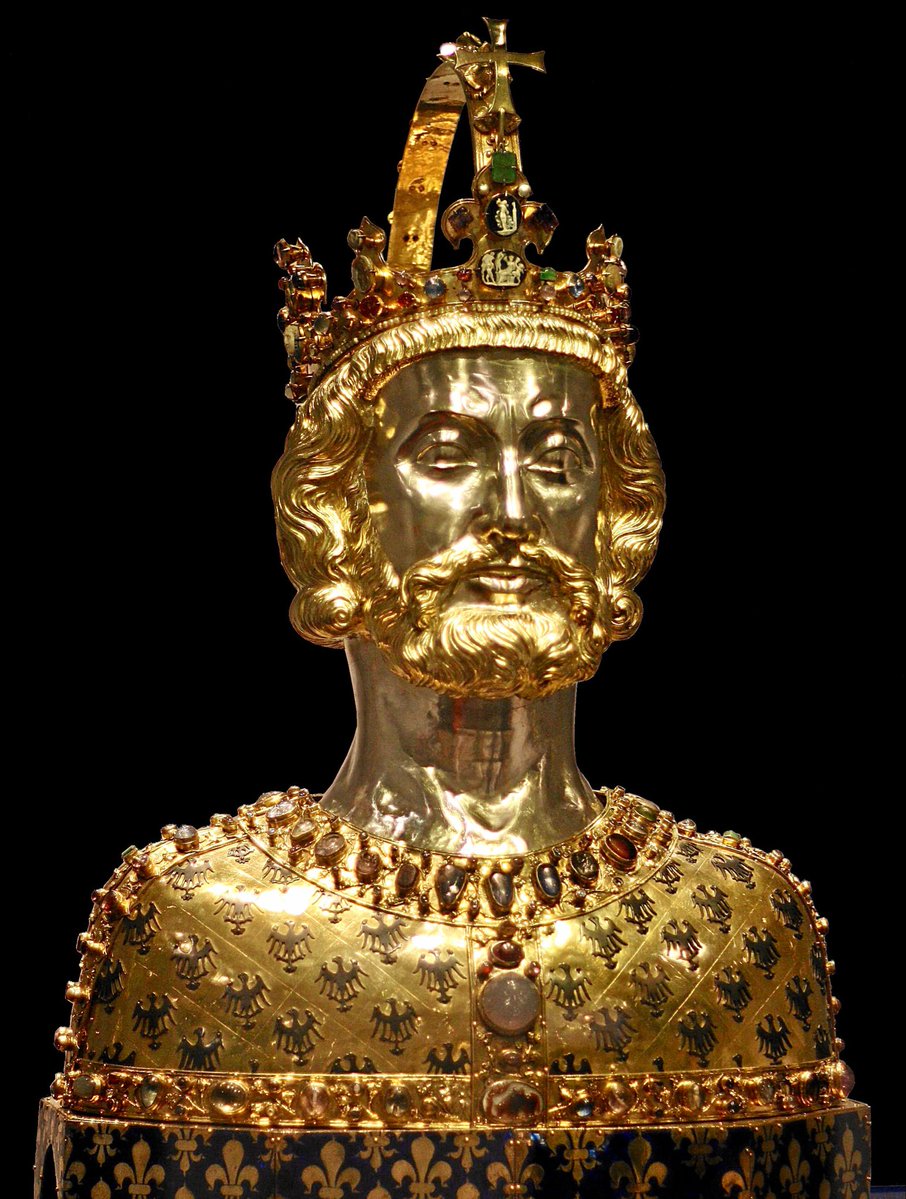
Charlemagne – Carolus Magnus, meaning Charles the Great – The Second Founding Father of Western Civilization.
Augustus built the first civilization.
Charlemagne rebuilt it from the ruins. Between them, they did more to create the Western world than almost any other two men in history. Augustus is underrated. Charlemagne is almost completely forgotten. This is a civilizational scandal.
1. Understand what he inherited. The Western Roman Empire had been gone for three centuries. What remained was fragmented, largely illiterate, and violent – a patchwork of warring kingdoms. Roads were crumbling. Schools were gone. Roman law had dissolved into local custom. The Church was the only institution with any continuity. This was the raw material. What Charlemagne built from it is why you are reading this in a Western language, in a country with institutions whose lineage reaches back to his reforms.
2. He unified Western Europe by force – then made the unification stick by giving it content. The Frankish kingdom he inherited from his father already encompassed much of modern France, Belgium, the Netherlands, and western Germany. By 814, he controlled France, Germany, northern Italy, a part of Spain, and territories that would become Austria, Switzerland, the Netherlands, and Belgium. He fought forty-seven military campaigns in forty-six years. His military genius was real; the administrative genius that followed was rarer.
3. He made literacy a civic virtue. He brought Alcuin of York, the greatest scholar of his age, to Aachen and charged him with reforming education. The Carolingian Renaissance systematically reconstructed Western intellectual life: classical manuscripts were copied, Latin standardized, and an educational infrastructure created that eventually produced the medieval university. Much of what survived from antiquity survived because of this effort.
4. He built the administrative state of the medieval West. The royal envoys, sent in pairs, layman and cleric, to inspect, adjudicate, and report, were an early systematic attempt to govern a large territory through accountable officials rather than hereditary local lords. He travelled constantly through his empire, seeing with his own eyes what his officials were doing. His royal decrees created written rules covering military service, royal estates, justice, and the treatment of the poor. He was doing, in the ninth century, what Augustus had done in the first: converting personal power into transmissible institutional order.
5. On Christmas Day 800, Pope Leo III crowned him Emperor of the Romans. The ceremony was choreographed — Charlemagne later claimed he would not have entered the church had he known what the Pope intended — but its consequences were real. The idea of a Western Christian empire, distinct from Byzantium and claiming the Roman inheritance, was born. The Holy Roman Empire that followed lasted until Napoleon abolished it in 1806. The idea of Europe as a civilizational unit was given political form that day in Rome.
6. France and Germany are his children. The Treaty of Verdun in 843 divided his empire between his grandsons, laying the foundations for the territories that became France and Germany. Both trace their political origins to Charlemagne’s empire. The EU’s founding myth of Franco-German reconciliation is, at its deepest level, a family reunion.
7. He died in 814, at approximately seventy. He left an empire his heirs could not hold together – but institutions that outlasted it by centuries. The schools survived. The manuscripts survived. The administrative traditions survived. Above all, the idea of Western Christian civilization as a distinct project — worth building, defending, and transmitting — survived.
Augustus built the first foundation. Charlemagne built the second. We are still living on both.
Oh, and I have him in my family tree – and most of you Europeans do too.
A genius of power. A founding father of the West.


![Kristof_Poland's tweet photo. What the West Still Doesn’t Get It:
Communism’s True Core: The Systemic Lie
Most people in the West think they understand communism. They picture bread lines, gulags, failed five-year plans, and the collapsed Soviet Union. They treat it as a discredited economic theory – an experiment that proved that abolishing private property doesn’t work. Case closed, history moved on.
This misunderstanding may be the most dangerous intellectual failure of our time.
Communism was never primarily an economic system. Economics was the surface. Beneath it lay something far more insidious: a total, systemic, institutionalized commitment to lying. Not occasional dishonesty. Not spin or propaganda in the ordinary sense. Something deeper – a civilizational war against truth itself, waged through every institution, every classroom, every newspaper, every conversation, until reality itself became negotiable and the lie became the air people breathed.
The Words We’re Missing
The Polish language, forged by decades of living under this system, produced words for this phenomenon that English simply cannot match:
Zakłamanie [zah-kwah-MAH-nyeh] – a state of total, pervasive, socially embedded falsehood, a condition in which an entire society is saturated with lies so thoroughly that truth becomes almost inaccessible.
Obłuda [ob-woo-dah] – a deep, performative hypocrisy, the gap between what is proclaimed and what is actually practiced, the mask worn so long it begins to feel like a face.
These are not words for individual liars. They describe a system – a mode of social organization built on organized mendacity, where the lie is not the exception but the foundation. English has no single word for either concept, and that linguistic gap is not a coincidence. It reflects a gap in experience. Cultures that did not live under communism lack the vocabulary because they lack the wound.
And because they lack the vocabulary, they struggle to recognize the thing when it reappears in new clothing.
The Continuity: Communism, Leftism, Wokeism
What we call wokeism today, or the broader radical left, is not a new phenomenon. It is the same operating system running on updated hardware. The specifics have changed – instead of the proletariat, we have marginalized identity groups; instead of bourgeois class enemies, we have racists and transphobes; instead of socialist realism, we have DEI statements. But the deep structure is the same.
That deep structure is this: truth is not discovered, it is assigned. Reality is not something to be understood honestly but something to be narrated strategically. Language is not a tool for communication but a weapon of power. And anyone who resists the approved narrative is not simply wrong – they are dangerous, and must be silenced, shamed, or destroyed.
This is zakłamanie in its modern form. This is obłuda wearing a human rights badge.
The same movement that insists men can become women will insist, with equal fervor, that questioning this is an act of violence. The same institutions that claim to champion free inquiry systematically suppress dissent. The same people who invoke tolerance as their highest value are among the most intolerant forces in public life. The contradiction is not accidental – it is structural. It is the system working as designed.
Why the West Still Doesn’t Get It
People who grew up in freedom tend to assume, at some level, that bad actors know they are lying. That somewhere behind the ideological performance, there is a cynical operator who privately acknowledges reality. This assumption is wrong, and it is why Westerners consistently underestimate what they are dealing with.
The totalitarian lie, at its mature stage, is not cynical. It is believed. Or rather, it creates a condition in which the distinction between belief and performance collapses entirely. People learn to say things they do not believe so fluently, and for so long, that they lose access to what they actually think.
1/2](https://pbs.twimg.com/media/HKXmpzvWAAAls5W.jpg)