Lots of people in the world.
Some we'll like. Some we won't
Some will like us. Some won't.
That's OK, it's just stats.
The real trick is to not waste a lot of time hanging out with people you don't like (both online and IRL)
Life's too short for that.
The important thing to realize...
Some days the main objective is NOT to add fitness.
Some days the main objective is to recover as quickly as possible so that *tomorrow* you can add fitness.
Athletes struggle mentally with this distinction.
But it is essential for long-term improvement.
Heavy (3-5RM) strength training is just as effective as light (20-25RM) strength training when doing the same number of sets to failure and the same rests between sets, despite massive differences in volume load. The idea that volume load has anything to do with hypertrophy needs to be retired.
My entire philosophy of training 👇
1. Above and beyond performance level/performance goals, first and foremost, movement is medicine.
It needs to be taken over the lifespan and is most important in the latter years. If you don't 'take your medicine' regularly, at some point you're going to experience significant pain. As such, our #1 responsibility & first priority, as coaches, should always be to facilitate a healthy, long-term relationship with physical activity & "do no harm".
2. A serious commitment to endurance sports training provides an outlet (and some societal legitimacy) for us, as adults in the modern, 'developed' (non paleolithic) world, to move the amount necessary to preserve health and function over time &, beyond that, the amount that we (as humans) are designed to!
3. As in medicine, when prescribed the right 'dose' at the right time, ALL healthy athletes will get better (though at different rates). As in medicine, when the wrong dose is prescribed, ALL athletes will fail to respond to 'treatment' & eventually get sick. As in medicine, when no organized 'treatment plan' is prescribed, the athlete will progressively deteriorate over time. In other words, plan first and foremost for *consistency* & #TakeYourMedicine
4. It follows that, a large part of 'good coaching' comes down to prescribing the right dose of the right medicine for a given athlete at the right time (In my opinion, not quantifying the dosages that you're prescribing amounts to irresponsible medicine & bad coaching).
5. The 'right dosage' that amounts to an athlete getting better, not sick, overtrained or injured, varies greatly among individual athletes (according to training background, gender, age and genetics) . The 'right dose' is also very strongly related to other (non-training) stressors in their life. Therefore, good coaches (& athletes) monitor non-training stressors & adjust the training accordingly.
6. Athletes who can handle truly competitive 'big doses' tend to be generally 'robust' - strong, supple, muscularly balanced with good general health and constitution, i.e. they lay a foundation of moving well in a variety of ways, at a variety of speeds, with a variety of loads. Even then, big doses can only be sustained for short periods of time and by going out of their way to facilitate recovery (sleep, nutrition etc). This includes actively minimizing/managing other sources of stress, i.e. they eat nutritious foods and live a simple, stable, low-stress life.
7. When it comes to the 'medicine of choice', intensity is no substitute for aerobic volume. The effects don't last and high intensity training has significant negative 'side effects'. If the goal is continued athletic development over the long term, there is simply no substitute for a strong aerobic base.
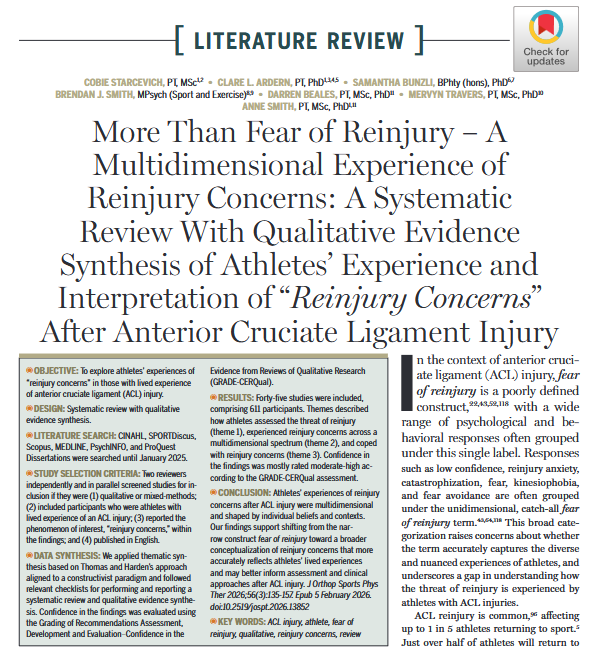
How well does the Fear Avoidance Model capture concerns about re-injury following an #ACL injury 🤔
It turns out not very well
Our #QualitativeEvidenceSynthesis summarizes the multi-faceted nature of #ReinjuryConcerns athletes experience ➡️ https://t.co/9k3a8AZufR
#yourJOSPT
True.
Two ways to overreach...
1/ Parasympathetic
2/ Sympathetic
Parasympathetic is functional, provided you pay attention - you get sleepy, you have trouble elevating your heart rate, motivation starts to wane. You're just plain tired. Your body is doing what it should do - shutting you down. Everything is flattened. For those who run a little anxious, honestly, not a horrible place to be.
Sympathetic is dysfunctional - you're 'tired but wired', you can't sleep, appetite decreases, you're in 24-7 battle mode. Your body is doing what it needs to do in *a survival situation*. And, eventually, it can no longer keep up this response.
Number 2 is far more worrisome than number 1.
Number 2 comes from excessive... prolonged... intensity.
Through my quest for high levels of fitness & endurance performance, I've...
- Ridden my bike all over the U.S., Australia, and New Zealand, experiencing these places on a level that the car-confined will never know. 🚴
- Hiked through some of the most beautiful places on the planet - the Grand Canyon, Costa Rica's jungles... 🌲🚶
- Swum in the most beautiful turquoise-blue, crystal clear water in the world, throughout the Greek Islands 🏊
Even on a smaller level - I've broken up thousands of ordinary days with a swim in the sun, a run on the trails, or an hour away from my desk communing with nature.
Yes, I've built and maintained a high level of health and fitness along the way.
But that's secondary.
The experiences - the way of life - are the real prize.
I wouldn't trade them for anything.
Certainly not a pill. 💊
I like this a lot.
Personally I am for:
- 2-3h of lifting a week spread over 3 sessions
- 90-120 min avg movement time every day
Some days that's just a 45 minute lift.
Some days that's a 5 hour MTB ride.
Week in. Week out.
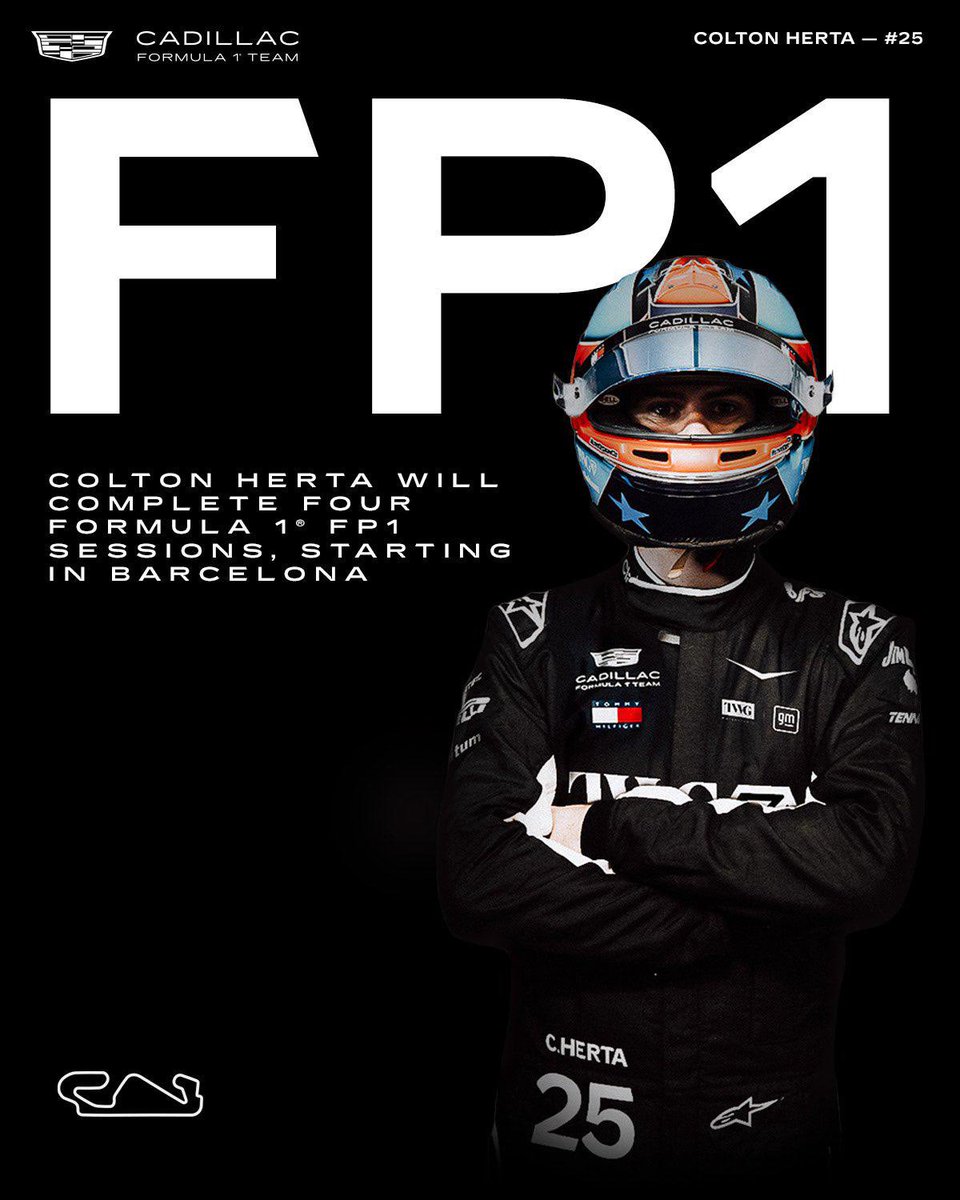
Colton Herta says there are areas he is finding similarities with IndyCar when he drives a Formula 1 car, after another FP1 outing for Cadillac at the Hungarian Grand Prix. https://t.co/z36sKApCN9
🚨 Colton Herta sustituirá a Valtteri Bottas en los Libres 1 del Gran Premio de Hungría
➡️ Será la segunda sesión del estadounidense tras su debut en Barcelona
#F1#HungarianGP
Your regular reminder:
People respond very differently to training.
Some are genetically blessed and get great results from modest training loads.
Congratulations if that’s you.
I’ve coached athletes who qualified for Kona on fewer than 10 hours per week.
I could use that as a marketing line - proof of the superiority of my training methods.
But I'd rather be honest...
For most people, achieving high levels of fitness takes time.
It takes consistency.
And it takes a lot of work.
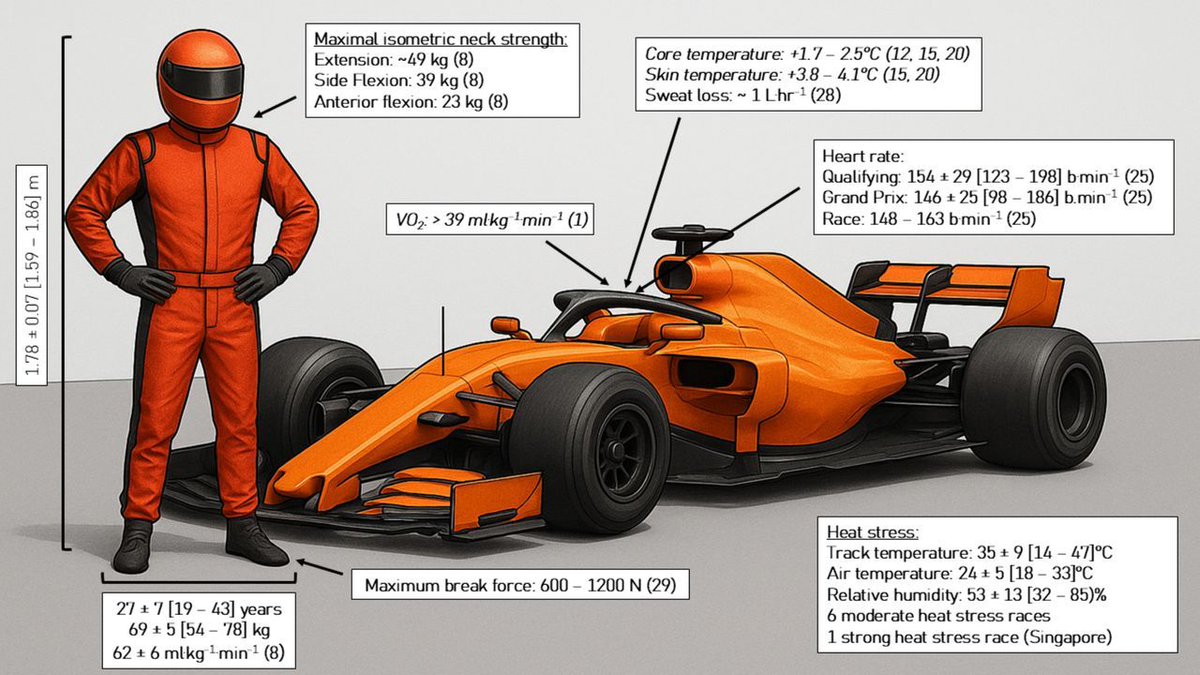
Physiological and health demands of Formula 1 motor racing 🏎
A comprehensive review with driver performance coach insight 🤔
Read here ➡️ https://t.co/DwJdBDfmSk
The answer to the question - "How easy should easy runs be?" - can be found in another question...
What is an "easy run"? 👇
All training sessions can be broadly classified into 2 categories...
1. Hard (lots of benefit, high cost)
2. Easy (some benefit, minimal cost)
"Cost" here encompasses a few things, but the big one is glycogen.
Easy runs don't cost very much glycogen (so they allow you to keep recovering glycogen between the harder runs) *but* they still offer cardiovascular and (especially) metabolic benefit.
Very low/no cost + Some benefit = Good deal! 💰
Now, the big benefit to easy runs is, the more of them you do, the lower their relative cost becomes!
That is, you use less and less glycogen as your fat burning improves 🔥
This is the whole concept of building the base.
However, if all of your runs are hard (glycogen-dependent) runs, your fat-burning will never improve!
Therefore, truly "easy" intensity begins with where you currently burn a good amount of fat.
This can be hinted at by lactate, but is best assessed via a metabolic test 🥼
The results can be humbling! Even for relatively fit folks, this could be a walk! 🚶
But, only by going truly eazzzzy do we expand our range of what easy is and how much of it we can do.
So, when it comes to the intensity of your easy runs, when in doubt...
Seriously, there is a lot to what Brian is saying here.
Athletes who do a lot of low-intensity movement are some of the calmest folks I know.
Because they reach a point where they literally don't have the energy for B.S.!
Their body learns not to waste kcals on it.
OTOH, folks who don't move a lot have all of this latent energy built up, and it has to go somewhere, so guess where it goes?
B.S.
Stressing over everything - a lot of stuff that doesn't matter at all, just to burn that latent energy off.
And we're not even aware of it. That's why, in the moment, stuff seems so concerning, and you look back & you're like, why was I so stressed out about *that*?
It wasn't rational. It was energy.
I've often thought, if you're a naturally anxious person, forget "mental health retreats", just go on a training camp & burn 20,000 kcal...
By Day 3, you won't have the energy to waste on anxiety!
🚨 ÚLTIMA HORA 🚨
💥 Paul Monahghan, ingeniero jefe de Red Bull, abandonará la escudería y se marcha a Cadillac
🟩 Se dice que Monaghan recibió una oferta de Aston Martin para un cargo clave de liderazgo en el mismo departamento
📰 Racing News 365 🇳🇱
In our world, #HRV is a good example...
What John Q Consumer wants:
Certainty.
“My HRV is low, therefore I should take a day off.”
But that’s not how biology works.
How he should be looking at the problem:
“If my HRV is low, there may be a ~10% greater chance that I’ll have a shitty workout, and a ~20% greater chance that I won’t respond as well to the workout.”
Further...
"If I’m already having a shitty workout, and my gait, mechanics, motivation, or coordination are not what they should be, there's also x% additional injury risk"
But what happens instead?
“This stuff doesn’t work. 9/10 times when my HRV is low, I feel great. It’s garbage.”
No.
That’s not the data failing.
That’s your brain demanding certainty from a probabilistic signal.
The value of HRV is not that it tells you exactly what to do every day.
The value is that it gives you a little bit of additional information that you didn’t have before.
And in coaching, a little bit of additional information - used well - compounds.
The problem isn’t the data...
The problem is your statistically lazy brain!
A busy day in Barcelona, but a key one for @ColtonHerta 🔑
The US driver made his @F1 race weekend debut with @Cadillac_F1 in between F2 Free Practice and Qualifying 🐝
#F2#BarcelonaGP
Colton Herta speaking ahead of his FP1 run in Barcelona:
“I’m excited for Barcelona,I feel ready to get out there. I’ve had time in the simulator at Charlotte, learning the track and the procedures to follow during the session. I’ve also been working with the team at Silverstone and at the track over the past few races, following how they work so I can get up to speed as quickly as possible. The aim is to have a clean session and help the team gather the data it needs, as well as getting used to the F1 car. It’s going to be a busy weekend as I’m competing in F2 at the same time, but pressure is a privilege so I’m looking forward to it.”