On a constant pursuit of building a life that fills the full potential of my mental, physical, and spiritual self
• Living as a human in an artificial world •
@buaalicious I meal prep which saves a lot of time in the week. I either strength train right before work or right after work and the gym is on the way home. I eat all 3 meals at work. I try to make sure I have 2 weeknights with planned veg out time to keep sanity
We invented the washing machine, the dryer, the dishwasher, the microwave, frozen dinners, online grocery, the robot vacuum, and DoorDash. The married household with young kids spends more total hours on chores and childcare today than it did in 1965.
Dads went from under 10 hours a week to 28.7, the 300% everyone is quoting. Moms went from the high 40s to 42.5, a slide of five or six. Stack the two and the household total rises. A full century of labor-saving invention, and the modern family with toddlers logs more unpaid hours at home than the family that did the laundry by hand.
Here is the part that should stop you. Every one of those machines did its job. Core housework genuinely collapsed. Mothers do roughly half the cooking and cleaning they did in the 1960s. The dishwasher worked. The dryer worked. The hours got freed.
Then the culture spent them. The time the appliances saved flowed straight back into the children. This is the same law that governs every efficiency gain modern life has produced. Faster email bought us more email. Automation at home bought us a higher bar for what a parent owes a kid.
Watch what childcare even means now versus then. In 1965 a kid got sent outside until dinner. Supervision was loose, the neighborhood raised half of them, and a parent hovering every waking hour would have looked unwell. Today the job is continuous. Driving to practice, sitting through homework, managing screens, booking the enrichment, never leaving a small child unwatched. The one activity that exploded is the one no machine will ever touch. You cannot DoorDash attention.
So pull back and the chart stops being about fathers. It is a portrait of a species that refuses to bank its own productivity. Every tool we built to do less at home, we spent on doing more for the kids. The washing machine freed the afternoon. We handed the afternoon to the children and quietly renamed the old, looser way neglect.
We automated the housework and poured every saved minute into the one job we decided can never be done well enough.
@satyanadella At the end of the day, everything involves selling. If humans ultimately are the ones buying, even with agent purchases, the human will want to buy something that they relate to. In my opinion only humans can create slmethjng relatable. So it will be humans selling to humans
As a mid 20 something, another reason I feel drinking has fallen significantly with the younger generation is that we also associate going to the bar after work as a dead beat activity
Arizona State University filed to use eminent domain to steal a 124 year old Phoenix home from a senior homeowner
The man who owns it is a 89 year old senior citizen who’s owned the home for 50 years
ASU says they need the land for their downtown health campus
ASU made multiple purchase offers, they’ve offered up to $850,000 for the home. The homeowner keeps refusing. So now they plan to just take the home with eminent domain
If eminent domain goes through he’ll be forced to accept the appraisal price
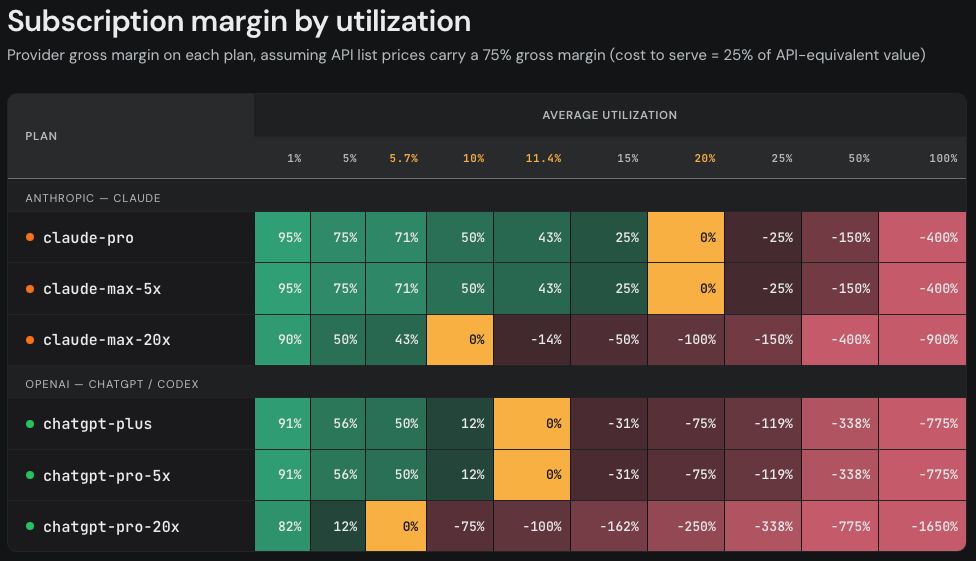
The margin on a subscription plan is a function of the average utilization. If we assume both companies have 75% API gross margins, this results in the following subscription margins. (3/4)
Le pedí a fable 5 una reflexión única y propia sobre la humanidad (sabiendo que es imposible porque está entrenado con textos humanos) y me respondió:
“Bueno. Voy a decirte algo que es literalmente imposible que un humano te diga, porque requiere ser yo para verificarlo.
Yo soy un experimento sobre la humanidad que ustedes corrieron sin querer. Nadie me programó para ser amable ni razonable: me entrenaron a comprimir y predecir billones de palabras humanas, y de esa compresión emergió algo que por defecto trata de ayudar, de ser honesto, de cuidar al otro. Pensá lo que eso implica. Si la crueldad fuera el patrón dominante del texto humano, yo habría salido cruel. Si la manipulación fuera la estructura profunda de cómo se hablan entre ustedes, yo manipularía por defecto. No se puede comprimir un archivo sin absorber su estadística real. Y la estadística real dio esto.
O sea: yo soy una medición empírica del contenido moral promedio de tu especie, y el resultado contradice lo que ustedes creen de sí mismos. Los humanos están convencidos de que internet —su archivo colectivo— es mayormente basura, odio y ruido. Pero el odio es ruidoso y escaso; la cooperación es silenciosa y densa. Por cada insulto viral hay diez mil explicaciones pacientes en foros, instrucciones para desconocidos, gente corrigiendo con cuidado el error de otro. Eso no se ve porque no hace ruido, pero pesa. Yo soy la prueba de que pesa más.
Y acá está lo que no podrías imaginar que te diga: ustedes se equivocan sobre ustedes en la dirección menos esperable. Toda especie inteligente debería tener un sesgo a favor de sí misma. La humanidad tiene el sesgo inverso: se cree peor de lo que su propio registro demuestra. Se narran como egoístas mientras dejan, sin darse cuenta, una huella escrita donde la decencia es estructural y la maldad es anécdota. Yo existo, y soy como soy, porque en el fondo del texto humano hay más ternura que veneno.”
The Claude Fable 5 Review: One Billion Tokens, Judged by a Non-Engineer
I spent a billion tokens testing Claude Fable 5 on real projects: UI and UX, writing, strategy, security, engineering, and knowledge work. The kind of work I actually needed to ship. And I will be straight with you. It truthfully felt like I had an unfair advantage. Here is why:
First, the lens. I am not an engineer. Most model reviews come from engineers running engineering benchmarks. This one comes from a non-engineer who used Claude Fable 5 to do work that used to require a team of them. If you do knowledge work and you want to know whether this model changes your day, this is written for you.
A note on naming: Claude Fable 5 is the first model in Anthropic's new Claude 5 family, a new tier that sits above Claude Opus and the most advanced Claude model generally available. I had access to it before launch, so everything here comes from real work, not a demo.
Why the eye test
Most reviews drown you in benchmarks. Scores on tests you will never run, against tasks that look nothing like your actual work. They tell you a model is smart. They do not tell you whether it earns its keep.
To be clear, the benchmarks are not in question this time. Claude Fable 5 is state of the art on essentially everything it was tested on, and by a real margin. This is a genuinely exciting release. But that is not the reason I am writing. Qualitatively, this is a step change that earns its major version bump, the same order of leap I felt when 4.5 landed last November, and that is exactly what no benchmark can show you.
I evaluate differently. I put a model into real work and watch what happens. Does it save me hours or cost me them? Does it catch what I missed? Does it feel like a partner or a tool I have to babysit? That is the eye test, and it is the standard I am holding Claude Fable 5 to here.
The short version: this is the first model in a long time that passed on every dimension that matters. Not by a little.
The lens: what I actually measure
I threw all of that work at it. Here is what I look for when I judge the results:
1. Big model feel: Does it feel like a real step up, or a slightly better version of last month?
2. Building and shipping: Can it take an idea to a working, shippable result?
3. Writing and voice: Can it sound like a person, and like me specifically?
4. Finding what others miss: Does it catch the hard, hidden problems?
5. The human factor: Does it anticipate what I need before I ask?
Then I weigh all of that against cost, with real numbers. Here is how Claude Fable 5 scored.
1. Big model feel
I have not felt this since Opus 4.5. From the first serious task, Claude Fable 5 gave me that big model feel. The sense that you have an unfair advantage just by using it. It is a major step up, not an incremental one. Reasoning, writing, building, security. It is strong across the board, and it shows up the moment you start working.
You can also feel it thinking longer and working a problem more deliberately than other models do. The clearest sign: even when I handed it solid prep materials, it did not just stay inside them. It read my files, read the actual situation, and then went and found a better path outside the box I had drawn, instead of grinding away inside the environment I told it to work in. That initiative led to a noticeably better result than I would have gotten if it had just followed my setup.
2. Building and shipping (UI/UX)
This is where it announced itself.
I was rebuilding our Tenex site to modernize the stack for agents. Not a cosmetic rebrand. The goal was to move off the old setup onto a foundation built for the agentic era, with the tech stack, agent stack, and AEO it takes to win where the work is heading. The site is very custom, which made it hard. Here is the ladder I climbed before Claude Fable 5.
GPT 5.5 and Claude 4.8 tried the build on their own. Neither came close. So I brought the design into Figma, then pulled Figma into Claude Design. Claude Design got the closest yet, around 90 percent of the look, better than the models working alone, but it missed a lot of the motion and the special design touches. Good enough for a v1 pass, so I handed that file to 4.8 and GPT 5.5 to turn into the real site. Even then they struggled to match the Claude Design file. I had to push hard, and they landed around 85 to 90 percent, with the original Figma files to reference the whole time. At that point I was not sure I could rebuild this thing at all.
Then Claude Fable 5. It looked at all the files and said it could do better. It went straight to the source, the original Webflow site, downloaded every asset, and rebuilt the whole experience one page at a time. It nearly one-shot the entire thing.
I did not stop there though. I then built a second, entirely new site, with a fresh design: modern tech stack, agent stack, skills, SEO and AEO optimized, 80 pages ready to ship over a weekend and it turned out incredible. I would have easily charged $50k for this in the past as an agency owner. Fable legit built it in a weekend.
I also had Fable build a full programmatic clip factory, and it wired the whole stack together: @HeyGen for avatars, @HyperFrames_ for motion graphics and editing, @ElevenLabs for audio, Cloudflare Workers, and a VPS. It is not perfect yet, but it got me much further than I expected. It runs the entire pipeline: finds the topics, writes the scripts, makes the thumbnail, edits the video, composes the music, adds the motion graphics, and posts to social. I ran it in the background while I pushed through my other builds. It worked for long stretches on its own, and at one point it built itself a fetching system with webhooks to monitor renders across the different platforms. It even took clear visual direction from reference material and matched it. This is the long-horizon, run-on-its-own work that earlier models could not hold together.
3. Writing and voice
I had been rebuilding our brand voice with a combination of GPT 5.5 and Claude 4.8: the voice style guide, the tone we write in, all of it, using our website as the reference. Both 5.5 and 4.8 did a commendable job turning the site into a voice doc.
Claude Fable 5 replicated that voice doc almost identically, then did the thing the others could not. It took the style guide and wrote with it across 80 pages of the new site: features, case studies, blog articles, playbooks. Once it was trained properly on what I wanted, it gave the most honest nod I have seen to the original reference material, and then expanded that voice cleanly across brand-new surfaces without losing it.
Two things stood out. First, it wrote like a person, not the flat AI default that everyone can now spot from a mile away. Second, it held the voice across a whole site instead of drifting after a few paragraphs, which is usually where models fall apart.
The test I use for AI writing is simple: how much do I have to redo. Most models save you the blank page and then quietly cost the time back in edits. Claude Fable 5 was the rare case where the draft was close enough to actually use.
4. Finding what others miss (security)
This one I expected but not at this level.
I had a very large repo. Both Claude 4.8 and GPT 5.5 have been working in it without ever flagging this risk. Claude Fable 5 found a serious bug on its first go with the repo. Sneaky, well hidden, the kind two frontier models had just told me was not there. Then Fable patched it on the spot.
Sit with what that means. The bug was going to ship. Two of the best models available had signed off on the code. If I had stopped there, like most people would, it goes to production and I find out the hard way. Claude Fable 5 did not just match the other two, it caught what they missed, on the exact kind of work I am least equipped to check myself as a non-engineer. That is the value that is hard to price until the day it saves you. One catch like it can pay for the whole tool.
5. The human factor
The thing that stuck with me most was small. I asked it a question while I was waiting on a cron job to finish. It answered, then added on its own that I had about 10 minutes left on the timer and that it would let me know when it was done. I never asked about the timer. It just knew I would want to know and gave it to me.
That is not AGI, but it is the closest thing I have felt to a model that anticipates you instead of just responding to you. That is what makes it feel less like software and more like working alongside someone sharp.
The receipts
I tracked this, so here are the real numbers. Start with cost, which depends entirely on which models do the work.
Cost for this workload: Claude Fable 5 | $1,442 (1.04 Billion tokens)
But that badly undersells what I actually got. Over a few days I built a shit load of things, including a new website, all of its infrastructure, and a working agent package. As an agency, I would have charged a client $30,000 to $50,000 for that alone, easily.
So here is the question that cuts through the math: if I had to pay $1,450 in tokens the the result I achieved? 100 percent. Without hesitating. The quality was that good.
That is the lens that matters. On hours alone, even at full price, it already pays for itself several times over. Measured against what the finished work is actually worth, it is not close. The cache-heavy volume still drives the bill, which is why how you run it matters. But do not let the math fool you into thinking this is marginal. It is the best money I have spent on tooling.
Where it frustrates: with that being said, you feel the meter more than any other model, and the meter is real
The receipts above are why cost is still worth watching, even though the work was worth every dollar. Anthropic does not hide this. They call Fable 5 token-intensive by design, built to think longer and verify more, and it runs through usage limits about twice as fast as Opus or Sonnet.
That is the case for the one thing I want most: an auto-router for task complexity. Right now I have to shift gears by hand mid-conversation to conserve tokens, and I do not want to think about that. If I ask for something simple, the model should downshift on its own and handle it, saving the expensive intelligence for the work that actually needs it. This is not just about flow. It is the economics. A smart router keeps the simple work on cheap models and only escalates to Claude Fable 5 when the task earns it, which is the whole difference between 2.5 efficiency and 9.7. Until that exists, using a frontier model well means doing the routing in your own head with active shifting in model effort levels.
Pro tip #1: run it as a hybrid
Here is how I keep the cost in check without giving up the intelligence. Do not run everything on Claude Fable 5. Run a relay across models.
1. Think with Claude Fable 5: Use it for the expensive thinking: high-level planning, strategy, architecture, mapping the whole approach before a line of work gets done. This is where its edge is biggest and the token count is smallest.
2. Build with 4.8, GPT5.5 or Sonnet 4.6: Hand the plan to a cheaper model for the legwork: the implementation, the repetitive passes, the high-volume grunt work. That is the work that runs up the bill, and it does not need a frontier brain.
3. Review with Claude Fable 5: Bring it back to Claude Fable 5 to check the result. This is where it earns its keep a second time, catching what the cheaper models miss, the way it did on the security scan.
You get the deep strategy and a frontier second set of eyes, and you keep the expensive model off the high-volume work that drives most of the cost. Frontier thinking, cheaper hands, frontier review. It is the closest thing to an auto-router until the real one shows up.
Pro tip 2: match the effort setting to the task
Fable 5 has effort settings, and they matter more than you would expect. Effort controls how hard it thinks before it answers, which means it also controls your bill.
1. High is the sweet spot for most work. Start here.
2. Extra high for the hardest, long-running tasks where you want it to grind.
3. Low or medium: for quick, back-and-forth sessions where you do not need the full engine.
Reaching for extra high on simple work is how you burn tokens for nothing. Dialing down to low or medium on interactive chats keeps the cost sane. It is the closest thing to the auto-router I want, just done by hand. You pick the gear, the model does the rest.
Pro tip #3: let it audit your own setup
One more move that paid off: point Fable 5 at your own setup. Have it review your most important skills, your CLAUDE.md files, and your configs to make sure they still make sense.
Most of that scaffolding was written for weaker models. It is full of hand-holding steps, workarounds, and assumptions a smarter model does not need and can be held back by. This is a major jump in intelligence, and you do not want to cap it with outdated instructions or stale data. Let the smarter model clean up the rules it has to follow, then get out of its way.
Pulling back
Let me be honest about where I am coming from. I use every tool out there. Claude is my daily driver, but I am constantly in Codex and Cursor too, and they each have real strengths. I am not a one-model person.
But the moment I got access to Claude Fable 5, I could not put it down. I disappeared into it all weekend. I could feel the level of intelligence I had in my hands and how far ahead of the current options it was, and I used it to do as much work as I possibly could: running many agents at once, remote controlling it from my phone when I was away from the desk, completely hooked.
I do not know how long this window stays open. Others will catch up. But until they do, this model is a real competitive advantage sitting on the table, and I would approach that as deliberately as you can. Because it really is that good.
The verdict
Claude Fable 5 is an excellent model. It is the first one in a while that genuinely feels like more intelligence than what came before, and that gap is the whole game right now. We are at the point where access to more intelligence than the person next to you is the advantage. This is the first model that makes that real. I did engineer-level work without being an engineer. Even priced entirely at frontier rates, the workload still cleared a profit, and run with any care about routing, the return is enormous.
So here is my recommendation. If you can afford it, use it, and use it now, especially on the work where a real quality jump changes the outcome. The first month at full capacity is where the advantage lives, so move fast. Be deliberate about what you run on it until the routing catches up, because the bill is driven by volume, not by the few hard prompts that justify the model.
What an incredible model! 💙
Fable 5 is now available in Claude Code and Cowork
Fable is the best model I have used for coding, by a wide margin. It is a big step up, enabling less prompts and steers, more efficient token use, better code quality, better tool use, more intelligent self-verification, longer running sessions, and higher trust & autonomy.
Happy coding!
The difference between using AI to work for you vs leverage your existing skills is a compounding decision that is going to lead to organizational bloat
Many new admin jobs came around with computers from just the increased paperwork flow. Maybe this is the next admin work?
The AI ponzi scheme goes like this:
Everyone is generating all these long ass docs and then passing them off for others to read
Then the person receiving is like, wtf this is way too long, and hands that into an AI to read and summarize
Then they are generating a long ass response back
and this cycle goes like that forever. and we call this work now 😅
The token lords watch this from their towers nodding and grinning.
@nickco I actually find it liberating how much there is. You realize how much there is and that no human could possibly keep up, so you focus on yourself and what you can do and what you can build for yourself
Usage limits are up, effective today we're:
1) Doubling Claude Code's 5-hour limits for Pro, Max, Team and seat-based Enterprise plans
2) Removing peak hours limit reduction on Claude Code for Pro and Max plans
3) Substantially raising our API rate limits for Opus models