BOOM 🚨 @elonmusk just explained exactly how Tesla Reality View works, and his comments are a jargon-packed gold mine 🔥
Here's what it all means in plain English for everyday fans like you and me, plus every number techies love to dig into 👇
Behind terms like mean-flow models, UVE features, and softmax emulation is the story of how Tesla turned a car computer into a live video generator, running on a tiny slice of chip.
👉 It starts with something much bigger than the screen.
🌍 Reality View is a mini version of Tesla's world model
Tesla has had a world model since last year that Elon describes as nearly pixel-perfect, and he says it's critical for generating synthetic data.
A world model is an AI that has learned how the world looks and moves, well enough to create realistic driving footage of moments that never happened. That synthetic footage gives FSD extra practice and testing scenarios without waiting for rare situations to show up on real roads.
Tesla showed what that looks like at the ICCV conference in October 2025. A driver steered, braked, and accelerated through a world generated entirely by AI, in real time, while the simulator produced all eight camera feeds at 24 frames per second, with generated drives running past six minutes.
Reality View is a much smaller version of that world model, running live in the car.
🧠 One vision encoder feeds two AI models: the driver and the painter
Everything starts with the Tesla Universal Vision Encoder, or UVE. It's the shared vision system that turns raw camera video into "features", a compact digital summary of the scene that the rest of the AI can work with.
Tesla's v15 release notes say this encoder is shared across FSD, Robotaxi, and Optimus, and trained on millions of internet videos.
It's also the upgrade Tesla credits for a 25x better critical intervention rate, and when some readers took that as 25%, Elon stepped in to clarify that Tesla means 25 times.
Those UVE features feed a model with 3 billion parameters, the adjustable dials an AI learns with, and that model produces the driving actions.
Tesla then forks the very same features into a separate diffusion model with about 1 billion parameters, roughly a third the size of the driving model in parameter count, and painting Reality View is its only job.
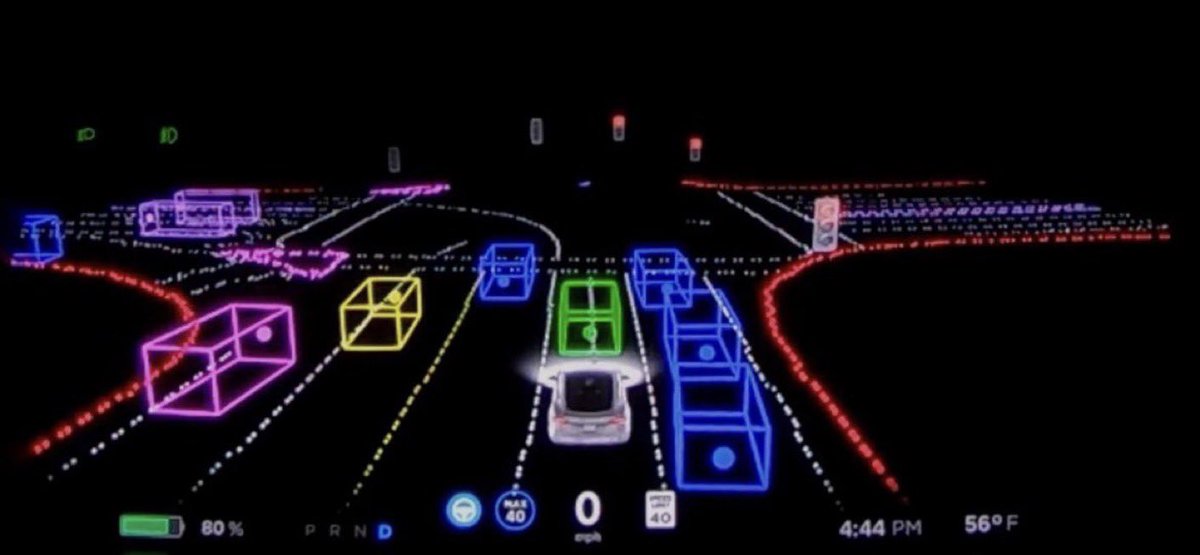
That's the live view from a virtual camera above your car, complete with arrows for upcoming turns and pins where FSD plans to park.
Because of that fork, the painter reuses all the camera processing the driving side already needs, instead of running a vision system of its own.
It also means the screen and the steering wheel see the world through exactly the same eyes.
🎨 Painting each frame from the last one
Diffusion models normally start from pure static and "denoise" it, cleaning it up step by step until a picture appears. That's how many AI image generators work.
Reality View's painter gets a head start. It begins with its own previous output, adds a layer of noise, then denoises it into the current view, guided by the most recent stretch of UVE features.
That helps the picture stay steady, since each new chunk only has to change as much as the road actually did.
The car's version is a conditional mean-flow model. "Conditional" means it's guided by what the cameras see, and "mean-flow" points to one of the newest ideas in AI image generation.
Standard models travel from static to a clean image through dozens of tiny steps. MeanFlow, a technique introduced by researchers at CMU and MIT last year, teaches the model the average direction of that whole trip, so it can make the jump in as little as one step.
It's the difference between following every bend of a winding trail and walking straight across the field. Tesla hasn't said how many steps its version takes, and an approach built to need so few is a natural fit for a tiny compute budget.
One correction to the earlier breakdown: the idea that Reality View reuses what the driving side already sees held up, and the painter itself is a diffusion model. Tesla did demo generative Gaussian splatting at ICCV, just not as the engine behind this view.
⏱️ How the painter hits 36 frames per second, and the lag Tesla plans to cut
The UVE takes a fresh look at the cameras 18 times a second, and the painter spreads the work on each video chunk over 4 of those cycles.
Four cycles at 18 per second is about 0.22 seconds. Each chunk holds 8 images, and 8 images every 0.22 seconds comes out to 36 frames per second, the exact rate Elon gave, at the full resolution of the car's screen.
In other words, the painter delivers a short burst of 8 frames, a bit like a tiny GIF, about four and a half times a second.
On paper, half a TRIP tops out around 20 trillion operations per second, based on teardown figures, which sets a theoretical ceiling of roughly half a trillion operations per frame.
There's one catch, and Elon is upfront about it: compute limits make the latency a bit high for now. Since the work on each chunk is spread across about 0.22 seconds, the view likely trails real life by a beat.
A fix is already in the works. The painter is a diffusion transformer that works through its layers one after another, and Tesla plans to feed fresher UVE features into those layers while it's still painting, so the picture reflects a more recent moment. Elon expects that to cut roughly 35% of the latency, about a third.
🔧 Half a TRIP that only does 8-bit whole-number math
Those compute limits come straight from the hardware. SoC B, the second of AI4's two chips, has three TRIP accelerators. Tesla moved a tiny decoder into SRAM, the chip's small but lightning-fast built-in memory, and after that, half of one TRIP was all that was left for Reality View.
Tesla had to make every bit of that compute count, and the release notes say the new view uses less total compute than the old visualization it replaced.
TRIP itself basically only handles 8-bit integers, whole numbers from -128 to 127. That works well for most neural network math, which runs fine on small whole numbers.
The tricky part is softmax, a step that transformers like Reality View's painter use constantly. It turns raw scores into percentages that add up to 100%, and it relies on exponentials, e raised to the power of each score, which TRIP has no direct way to compute.
So Tesla emulates softmax in 28 steps every time it's needed, a bit like working out powers on a calculator with no exponent button.
Squeezing 36 frames per second of generated video out of half a TRIP, under those limits, is wild.
🚀 What AI5's 12x more compute could change
That's where AI5 comes in. Elon says the next-gen chip packs roughly 12 times more compute, a gigantic leap over the AI4 computer in today's cars.
Today's view runs on leftovers, half a TRIP fitted in after everything else. That kind of headroom could go toward less lag and richer detail.
All of this traces back to that world model. The system that helps teach FSD how the world looks now has a smaller sibling riding along on every v15 drive, painting the road live on half of one TRIP.
FSD v15 now starting to roll out – upgrading every part of the end-to-end driving network
Safety
25x better handling of safety critical cases
Tesla Reality View
Adds a live visualization of the drive that lets you see & control what FSD is planning to do
Navigation for start & end of the trip now learns end-to-end from fleet route preferences. Later v15 releases will expand this to the entire route.
You also should notice better detection of signs, animals, debris, potholes and standing water, plus more natural speed handling in school zones and inclement weather.
Lastly, FSD can now slow for speed cameras & Bike Rack Mode lets you enable FSD w/ bike racks or similar hitch accessories