An Israeli TV channel interviewed people in Dublin, Ireland. Watch the video until the end and listen to the responses of the Irish people to the Israeli channel. ❤️🇮🇪
All my love and respect to the best people in the world… the Irish people. 🇮🇪❤️🇵🇸
An offshore company controlled by Roman Abramovich paid £6m to Eden Hazard's agent, and the Club paid £1m that was undisclosed.
According to both the Premier League and the FA, there was no sporting advantage to a career at Chelsea for Hazard (who did not benefit financially from these payments).
Purchase price £32m
Sale price £130m
Appearances 352
Goals 110
Assists 92
During that time
2 x Premier League titles
1 x FA Cup
1 x League Cup
2 x Europa League
There is no clearer image of British politics than this: the camera shows you the man, the wider frame shows you the machine.
In Orwell’s Britain, the lie was printed. In ours, it is lit, framed and carefully edited.
Some guy broke into my house and set up residence in the study room. He says his grandparents used to live in this house and now he won't leave.
My family and I tried to kick him out but he got very violent. He brings in his friends and they help beat us up if we ever try to make him leave.
They keep saying I hate the guy because of his religion. I don't even care about his religion, I just don't like sharing my house with some random outsider who broke in here out of nowhere and took my stuff.
"The poor guy just wants one room to call his own," his friends say in his defense. "You and your family have all the surrounding rooms in the house, and yet you have a problem with the guy having sovereignty over ONE room? That's kind of bigoted and evil."
He keeps throwing stuff at me and my family if we get too close to his door, saying we make him feel afraid. His friends say it's understandable because his room is surrounded by enemies who hate him just for existing, but we don't hate him for existing, we hate him because he forcibly inserted himself into our home and keeps throwing stuff at us.
And what's weird is whenever I explain my situation to normal people they completely understand where I'm coming from and agree the guy is being a dick, but if I talk to the police or the local paper they always side with the guy. Almost everyone in town hates this guy now because of how he's been acting, but everyone in power does everything they can to protect him. It's like there's a total disconnect between the authorities and the will of the public on this particular issue.
It's having a nastier and nastier effect on the community at large all across town. The police have been showing up to arrest anyone who says they think the guy's being an asshole. The paper keeps printing these obnoxious lies telling everyone that me and my family are the real criminals and the guy is actually sweet and awesome. It's really unfair.
Things have been so tense and hostile ever since this guy showed up. I honestly think it would be better if he'd never moved in here at all, but whenever I say that his friends claim I'm saying the guy should be exterminated and try to get me in trouble.
It's a real mess, man.
That guy sucks.
There's nothing "offensive" about comparing the actions and mentality of Israel to those of the Nazis. What is offensive is demanding that one country and only it -- Israel -- be exempt from those comparisons because it hurts people's feelings, or because it seems "bigoted" to compare them.
The whole point of the Nuremberg Trials was that the precedents set there would only have meaning -- i.e., be something beyond mere "victor's justice" -- if those principles applied to the actions of **all countries** in the future. Israel doesn't have some special, unique exemption from the imperative.
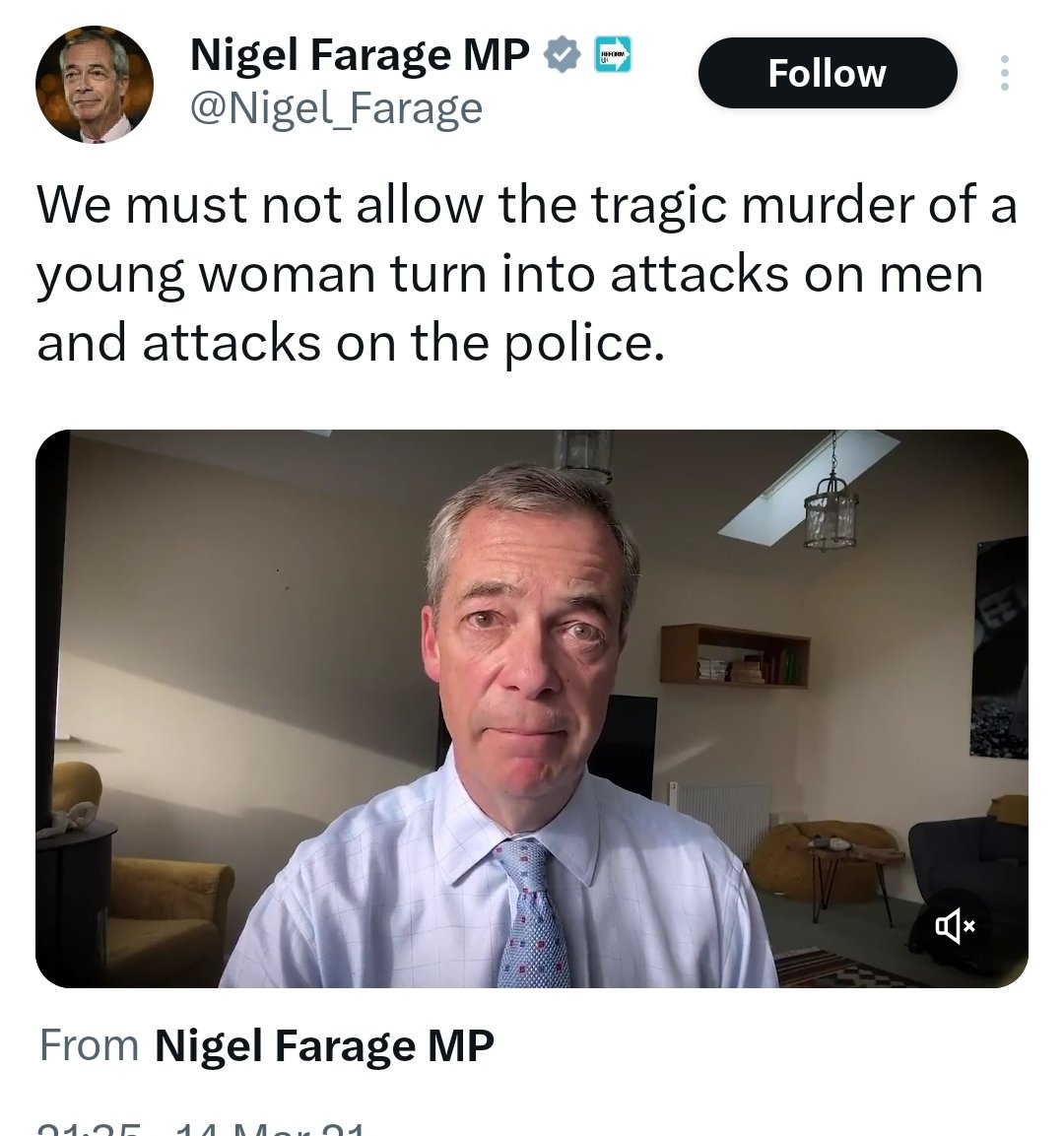
When Metropolitan Police officer Wayne Couzens kidnapped and murdered Sarah Everard, Nigel Farage released a five-minute video urging people not to attack men or the police.
Today, in response to the murder of Henry Nowak, he called for "pure cold rage."
Richie Sadlier👏🏻👏🏻👏🏻
"It's baffling to me, how...it is controversial or contentious or objectionable that someone suggests...do you know what maybe let's not play football against them.
Maybe instead of playing a match against them, maybe let's not play a match."
‘You have done a better job than any cabinet minister of telling us the story of Keir Starmer’s successes.��
As Wes Streeting resigns, Caller Martin reminds @TomSwarbrick1 of what the PM has delivered.
Westminster may finally be about to have the argument it has spent 40 years avoiding.
If Andy Burnham returns to Parliament, the political class will know how to cover it. A leadership drama. Who is up, who is down, whether Keir Starmer can survive, whether Labour is once again turning inward. The familiar machinery of Westminster psychodrama will whirr into life.
That framing misses the larger point. Burnham’s possible return matters not because of what it says about Labour’s leadership, but because of what it reveals about the British state: what it can still do, what it has forgotten how to do, and what kind of country it must become if it is serious about resilience.
Britain is finally having a more serious conversation about national security. The Strategic Defence Review, the pivot back towards Europe, the recognition that hybrid warfare turns citizens, infrastructure and civic institutions into part of the front line: all of it marks a real shift in how the state thinks about its own survival.
But at the centre of that conversation lies a question that the defence establishment, and most of Westminster, still does not want to answer. What kind of society do you need to be before resilience is possible?
Finland is now the model everyone cites. Comprehensive security. Whole-of-society defence. Civilian preparedness woven into military planning. British strategists admire the Finnish system and ask how it might be copied. But the admiration stops short of the uncomfortable question: why does it work there?
The answer is not geography or history or some mysterious quality of Finnish national character. It is structural. Nearly 80% of Finns say they would defend their country if attacked. In Britain, the figure is closer to 33%. That gap is not an accident. It exists because Finland has spent decades building a society in which people have a genuine stake in what they are being asked to defend. Energy is affordable. Housing is available. Public services function. Institutions command trust. The Nordic welfare state is not a sentimental add-on to Finnish security policy. It is the foundation of it. You cannot ask people to defend a country that does not work for them.
Britain has spent 40 years building the opposite. The privatisation of essentials – energy, water, transport, housing – transferred wealth upwards from households to shareholders while making the basics of everyday life more expensive. The state, stripped of the tools to control costs at source, has been reduced to compensating after the fact.
Out of every pound the Government spends on housing, 88p goes to subsidising private rents. Just 12p goes to building homes. When energy prices spiked in 2022, the Government spent £40bn in a single winter cushioning the blow, not because it had a resilient energy system but because it lacked one. Debt interest now consumes more than £100bn a year. Britain has the highest debt servicing costs in the G7: the compounding price of financing failure rather than eliminating it at source.
This is what bond market dependency actually looks like. It is not an abstract fiscal condition. It is the consequence of a state that has been stripped of the supply-side tools that would let it cure the problems it now pays, indefinitely, to manage. And here is the paradox the Treasury refuses to confront. The countries that borrow most cheaply are often those that have retained the public investment model Britain abandoned. The spread between UK and Dutch borrowing costs has widened sharply not because markets fear public investment, but because they have lost confidence in a model that borrows to subsidise private failure while never addressing its causes.
This is the connection Britain’s defence debate is missing. The familiar framing, that social spending is what must be sacrificed to meet the NATO target, is not merely politically toxic. It is strategically illiterate. Cutting the foundations of social cohesion to fund the hardware of national defence is self-defeating. You end up with planes and no pilots, submarines and no crew, an army that cannot recruit because the society it is meant to protect has stopped believing in itself.
I think Burnham understands this. That is why his programme is more interesting than the leadership gossip suggests. What he has been building in Greater Manchester – public control of transport, expanded social housing, investment in the productive foundations of the city economy – is not a nostalgic rerun of postwar nationalisation. It is a proof of concept for a different kind of state.
The Bee Network is the most visible example, but the argument behind it travels. A state that can shape markets is not condemned to subsidise their failures. A state that produces affordable energy through public generation does not need to spend tens of billions cushioning every price shock. A state with a serious public housebuilding programme does not need housing benefit to rise endlessly in line with private rents. A state that builds institutions people can see, use and trust begins to restore the civic confidence on which resilience depends.
The real constraint on Britain is not money. It is capacity: the workers, institutions, supply chains and public purpose needed to turn national will into national renewal. Britain’s tragedy is not that it has run out of money. It is that after 40 years of hollowing out the state, it has made itself less able to act.
Burnham’s critics will reach for the familiar warning. Borrow more, spend more, spook the gilt markets, repeat the Truss disaster. But this misunderstands both the problem and the opportunity.
Bond markets do not have ideological preferences. They have functional ones. They prefer clarity, credible revenue streams, productive investment, and a state with a plan. What they punish is not public ambition but incoherence. A properly designed productive state programme would not be a leap into fiscal fantasy. It would be an attempt to end the much costlier fantasy that Britain can keep borrowing to compensate for broken markets while refusing to repair them.
The defence conversation and the economic conversation need to become the same conversation. Finland did not build national resilience by choosing between welfare and security. It built resilience by understanding that they are inseparable: that a country in which the basics work, where people trust one another and the institutions around them, is one that can face danger with something more than anxiety.
That is the deeper argument Burnham represents. Westminster will be tempted to treat him as a leadership story. It should resist the temptation. The question is not whether Burnham can return to parliament. It is whether Britain can return to the idea that the state should make life work. Because a country that cannot command the confidence of its people cannot truly defend itself.
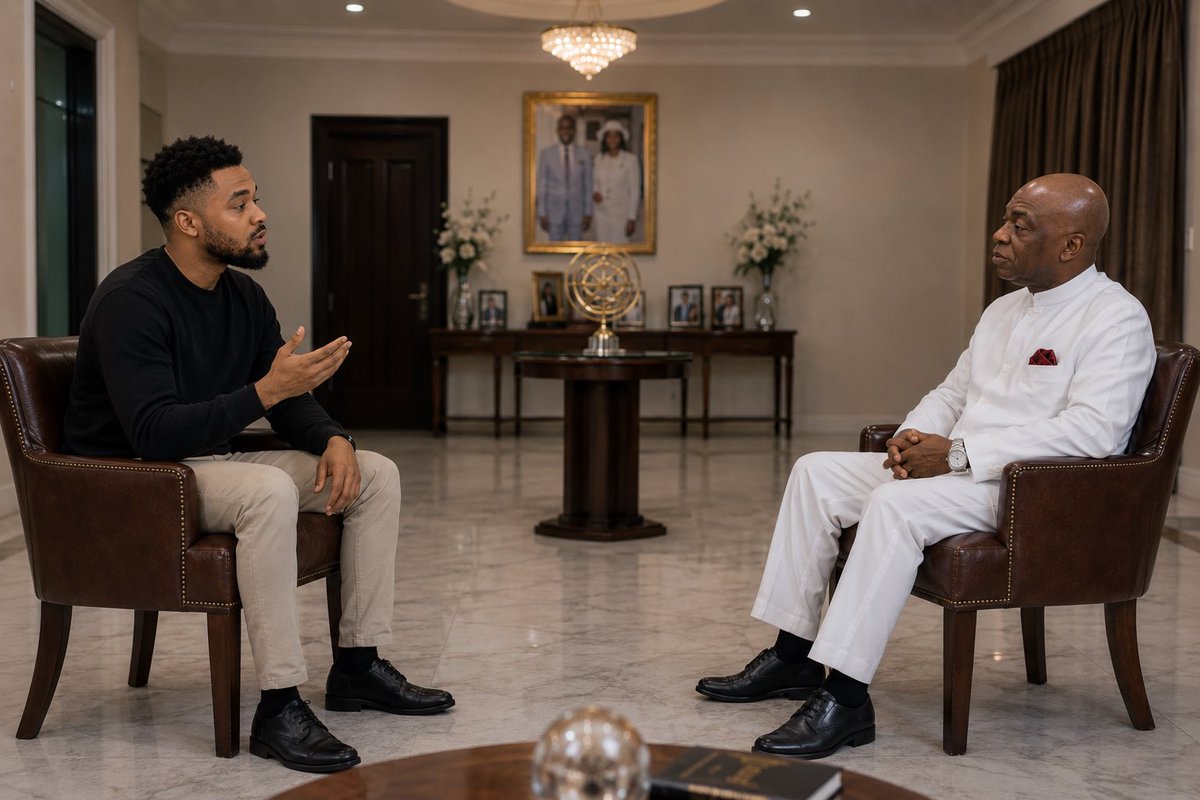
Proper Christian dilemma.
Kelvin: Pastor, according to the Bible, people are saved by accepting Jesus into their hearts, right?
David Oyedepo: Yes. Salvation comes through Christ alone.
Kelvin: Then I have a question. What happened to all the indigenous peoples of the Americas and Africa before European colonization? Entire civilizations existed for centuries without ever hearing about Jesus.
Oyedepo: God is merciful, kelvin.
Kelvin: But were they saved or not?
Oyedepo: The Bible says Christ is the only way to the Father.
Kelvin: Exactly. So were the Aztecs, Maya, Inca, and countless native tribes in Africa condemned simply because nobody reached them with the gospel of Jesus?
Oyedepo: We cannot fully understand the mysteries of God’s judgment.
Kelvin: But surely there are only two possibilities.
Oyedepo: Go on.
Kelvin: Either people who never heard of Jesus can still be saved…
Oyedepo: God may judge people according to how well they lived their lives, their works … or light available to them
Kelvin: Okay, but if that’s true, then Christianity becomes unnecessary for salvation.
Oyedepo: How do you mean?
Kelvin: Because if isolated people can be saved without hearing about Jesus, then humanity doesn’t actually need Christianity. We could simply live our lives and be judged by our actions and conscience…just like those indigenous people supposedly would be.
Oyedepo: Evangelism is still important.
Kelvin: But not necessary for salvation in that case. If people can reach heaven without Christianity, then Christianity is irrelevant as a requirement for salvation.
Oyedepo: Hmm.
Kelvin: But the other option is worse.
Oyedepo: Which is?
Kelvin: That people who never heard the gospel are automatically condemned.
Oyedepo: but The wages of sin is death.
Kelvin: But they never rejected Jesus. They were simply born in the wrong place and time. They were ignorant through no fault of their own.
Oyedepo: God’s ways are higher than ours.
Kelvin: Then that would mean Christianity describes a being willing to punish billions of people eternally for circumstances completely outside their control. It could even be argued that evangelizing to people is more likely to take them to hell than heaven since if they could live their lives without learning about Christianity and still make heaven , learning about the gospel but rejecting it because they were not convinced would take them to hell regardless of how they lived their life. Which makes evangelism a net negative for salvation.
Oyedepo: …
Kelvin: So either people can be saved without Christianity…. making Christianity irrelevant for salvation…or they cannot, which makes the Christian system evil because innocent ignorance becomes grounds for eternal punishment.
Oyedepo: Kelvin…
Kelvin: Either Christianity is unnecessary, or it is morally monstrous.
Oyedepo: We will be praying for you.