NHRA Hall of Famer Darrell Gwynn’s new photo book.
“FORTUNATE SON” The Darrell Gwynn story! My life in photos $30.00 Autographed.
AVAILABLE September 4th at https://t.co/mZnT8G6McB
Motorsports Hall Of Famer @TonyStewart said…..
"I'm excited for Darrell and this project. It is a fantastic photo book. I think it's a book that every race fan will enjoy; seeing and understanding the photos of his past.
This is a project that has been a labor of love. Those pictures tell one hell of a story of his life and career in motorsports."
Book Signings:
➡️@BassProShops
Dania Oct. 3rd @ 2pm
JOIN US FOR THE LAUNCH PARTY🎉🎉➡️@101.Ocean
Restaurant and Bar, Lauderdale By The Sea Oct.3@ 6pm
Food & Beverages available for purchase
Uber encouraged (parking is limited)
Also available @NHRA Trackside
US Nationals👍
Rockingham 👍
@bounicontifund
@quickiewheels@sunrisemedical@bassproshops@trackerboats@tracker_offroad
#Greatread
#Racinghistory
#Fatherson
#Dragracing
#TopFuel
#Nitro
#CureParalysis
#GreatOutdoors
My top drivers / teammates in motorsports (not souly based on skill but personality and maybe a bit skill) ik jesse and connor arent teammates i wish but you can only put 4 pictures so I did that so I didnt have to make a thread :/
I feel like @TeamTrackhouse should sell the 88 Charter and put the money into the 1 and 97 cars as well as the organization as a whole. Hire @RodneyChilders4 in some capacity. SVG is good enough to be winning on short flat ovals now if the equipment were up to par.
8.18
From his restarts to his race craft, he was always the one I studied, learned from, and measured myself against. Every time I had the opportunity to race side by side and battle with him was a privilege I’ll never forget.
Gone far too soon.
#ForeverRowdy
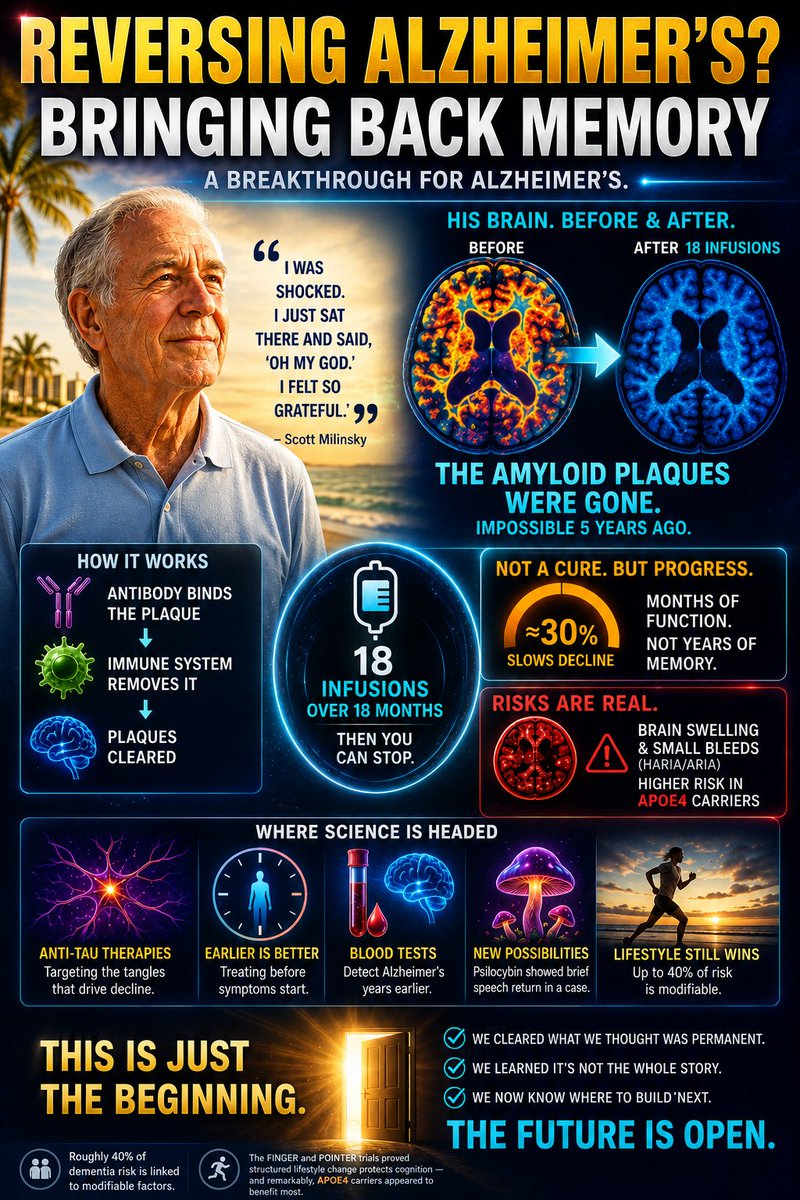
I'm a cardiologist. A 79-year-old grandfather in Pompano Beach just had something happen that was impossible five years ago.
Scott Milinsky watched Alzheimer's take his father — the memories, then the man. When he got his own diagnosis, his first thought was: I'm going to be like my father. It's terrifying to die that way, not knowing who you are.
He enrolled in treatment with Kisunla. Eighteen infusions over a year and a half.
Then they scanned his brain.
The amyloid plaques were gone.
"I was shocked," he said. "I just sat there and said, 'Oh my God.' I felt so grateful. It was overwhelming."
I want to sit with how extraordinary that is — and then tell you the truth about what it does and doesn't mean, because you deserve both and almost no one gives you both.
What actually happened in that brain.
For over a century, amyloid plaque was the defining pathology of Alzheimer's — the thing you found on autopsy that confirmed the diagnosis. We could see it. We could not touch it.
These drugs are monoclonal antibodies that cross into the brain, bind the plaque, and recruit the immune system to remove it. In the pivotal trial, most patients achieved amyloid clearance within 18 months — and donanemab is unusual in that once your plaques are cleared, you can stop the infusions. You finish. Very few treatments in chronic neurologic disease work that way.
Twenty years ago, clearing amyloid from a living human brain was a theoretical goal in grant applications. It is now something a community hospital in Broward County does to more than sixty patients.
Now the honest part, and his own doctor said it plainly.
This is not a cure, and it is not reversal.
Removing the plaque slows the decline — roughly 30% in the trials, meaning the disease still advances, just more slowly. Patients gain months of function, not years of restored memory. Nobody in these trials got their old mind back.
And here is the deep puzzle at the center of the field: amyloid clearance and cognitive benefit don't track as tightly as we expected. Plaque was cleared almost completely, and the clinical benefit was real but modest. Which tells us amyloid is part of the story and not the whole story.
The other half is tau — the tangles that form inside neurons and correlate far more closely with actual cognitive decline. These drugs don't touch tau. That's precisely why the entire field is now racing toward anti-tau therapies and combination approaches.
And the risks are real. ARIA — amyloid-related imaging abnormalities, meaning brain swelling and small bleeds — occurs in a meaningful minority. Most cases are asymptomatic and resolve, but serious events happen and there were deaths in the trials. APOE4 carriers, especially those with two copies, face substantially higher risk — which is why genetic testing before treatment now matters enormously.
This requires MRI monitoring, careful patient selection, and honest counseling. It is not for everyone with memory complaints.
So where does that leave us?
Somewhere genuinely important, and I say this as a physician who has watched families destroyed by this disease.
For twenty years we had nothing that touched the biology. We had drugs that mildly buffed the symptoms while the disease proceeded exactly as it would have anyway. Every trial failed. The field was written off.
Now we can remove the defining lesion from a living brain — and we've learned that doing so alone isn't enough. That is not a failure. That is how science actually works. You get the first tool, you find its ceiling, and the ceiling tells you where to build next.
Anti-tau agents are in trials. Earlier intervention — treating people who have plaque but no symptoms yet — is being tested right now, on the theory that we're arriving decades too late. Blood tests can now detect Alzheimer's pathology years before memory fails. And a case report this year described psilocybin briefly restoring speech in a woman who hadn't spoken in years, suggesting some capacity may be disconnected rather than destroyed.
And the intervention with the best evidence available today remains unglamorous and free: exercise, sleep and treating sleep apnea, blood pressure control, metabolic health, hearing aids, and social connection. Roughly 40% of dementia risk is linked to modifiable factors. The FINGER and POINTER trials proved structured lifestyle change protects cognition — and remarkably, APOE4 carriers appeared to benefit most.
Milinsky's own words were the wisest thing in the article:
"This is a game changer, and there's going to be more game changers. This is just the beginning."
He's right on both counts.
We have not reversed Alzheimer's. But for the first time in the history of medicine, we changed something inside a living brain that everyone assumed was permanent.
That's not the finish line.
It's the first time the door moved
Seagulls racing the sun for home ... Cecille Kennedy in Depoe Bay, Oregon, saw these 5 #seagulls at #sunset flying north to Pirate Cove. Thank you, Cecille! 🐦🌅
https://t.co/b5rxIgaLAf
See more great photos, and submit yours:
https://t.co/ImHOoAxVCI