Some food for thought on $UP @uponrh because I genuinely don’t understand this valuation.
Forget the memes for a second. Let’s compare it to an actual established native liquidity layer:
$AERO on Base
~$500M market cap
~$320M TVL
$12.8B 30d DEX volume
**$4.84M 30d revenue**
$UP on Robinhood Chain
~$13–15M market cap
~$11M TVL
$579M 30d DEX volume
**$1.20M 30d revenue**
Read that again.
Aerodrome is generating roughly 4× UP’s monthly revenue…
Yet $AERO is valued at roughly 30–37× UP’s circulating market cap.
Obviously Aerodrome deserves a significant premium. It has years of history, much deeper liquidity, far more TVL and volume, Base dominance and an established ecosystem.
But does that explain the entire valuation gap?
UP has barely begun.
It’s positioning itself as a native liquidity marketplace on Robinhood Chain, and it is already generating meaningful fees, volume and protocol revenue at only ~$13–15M circulating MC.
And now here’s where it gets even stranger.
On September 4, Binance Alpha 1.0 added three Robinhood Chain tokens at the same time:
$CASHCAT
$UP
$AI (Artificial Inu)
Same ecosystem.
Same Binance Alpha catalyst.
Yet the valuations are in completely different universes.
$AI Artificial Inu: ~$252M MC.
$UP: ~$13–15M MC.
That’s roughly a 17–19× valuation difference.
$CASHCAT has also traded at a valuation many multiples above UP.
And unlike those meme-driven assets, UP is infrastructure actually facilitating liquidity, generating fees and producing protocol revenue.
Then there’s $PONS — another Robinhood Chain project that reached Binance Alpha and has traded in the hundreds of millions in market cap.
So what exactly is the market pricing?
Narrative? Attention? Memes?
Because if we’re talking fundamentals, the discrepancy becomes difficult to ignore.
If Robinhood Chain continues growing, liquidity has to live somewhere. Swaps have to happen somewhere. New assets need markets.
@base has Aerodrome.
What happens if UP becomes that liquidity layer for Robinhood Chain?
That’s the asymmetric part of the thesis that interests me.
To be fair, there are legitimate reasons for UP’s discount.
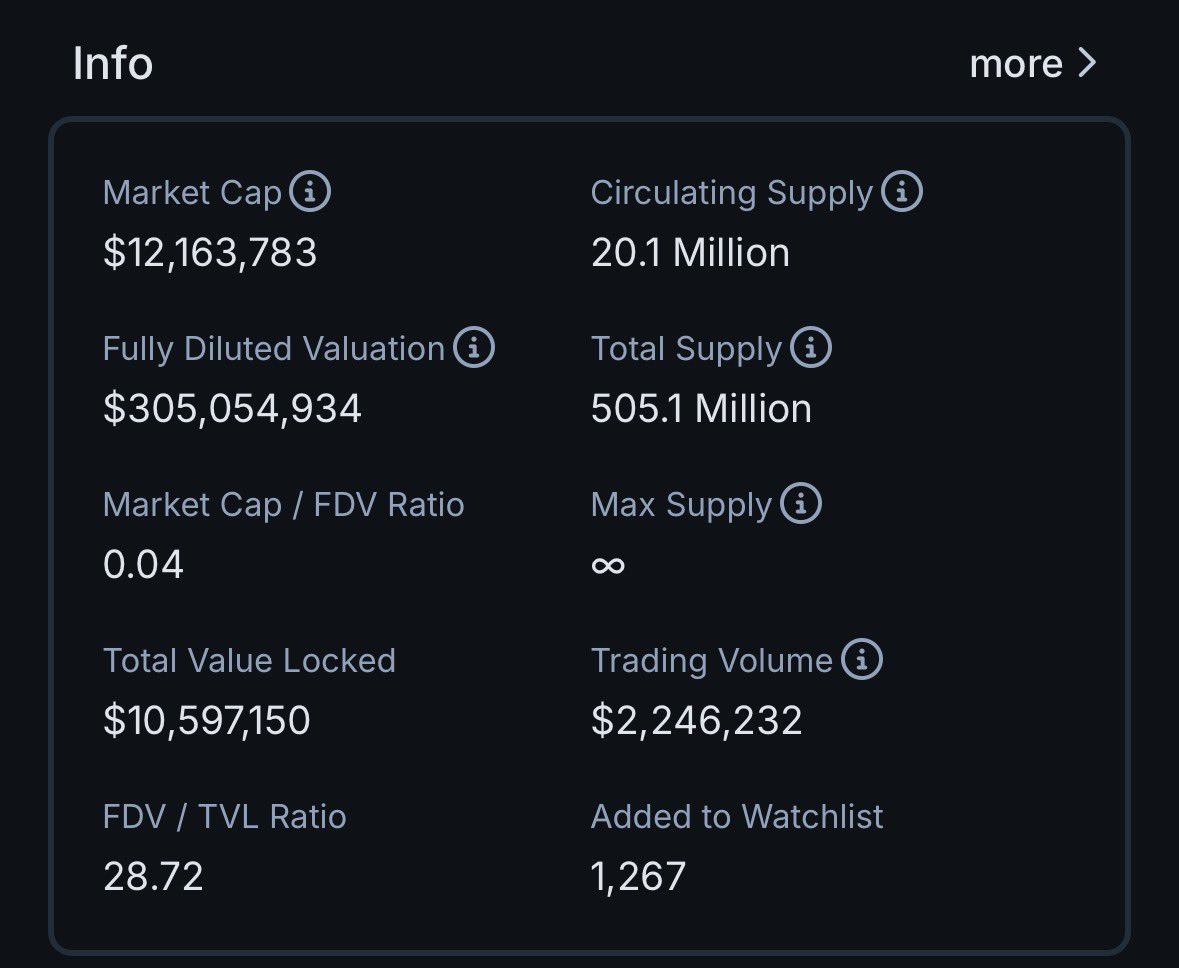
Its FDV is substantially higher than its circulating MC. Emissions/incentives are aggressive. And the big question is whether today’s volume and revenue remain sustainable once incentives normalize.
Those risks matter.
But even accounting for them:
~$1.2M monthly revenue.
~$579M monthly DEX volume.
~$13–15M circulating MC.
Binance Alpha.
Native exposure to a rapidly growing Robinhood Chain ecosystem.
Meanwhile $AI alone is ~$252M.
At some point you have to ask:
What am I missing?
Is $UP cheap because the market sees a fundamental problem that isn’t obvious in the headline numbers?
Or has capital simply been chasing memes and attention while the infrastructure underneath them has been ignored?
Because if UP can prove that this revenue and activity are sustainable…
this valuation starts looking very, very strange.
$UP
This actually makes the base:0x940181a94a35a4569e4529a3cdfb74e38fd98631 comparison even more interesting.
People see up-2:native ’s FDV + emissions and stop there.
But if only ~999K of ~12.3M scheduled emissions were actually released this epoch because emissions are capped against pool fees, headline dilution ≠ actual dilution.
Meanwhile:
~$13–15M circulating MC
~$1.2M 30d revenue
~$579M 30d volume
AERO showed what native liquidity infrastructure can become on Base.
If UP becomes that layer for Robinhood Chain while tying emissions to real economic activity…
what exactly is the market pricing in at $13–15M?
That’s the part I can’t get past.
Many people reach this quick conclusion because they try to compare $UP to $PONS. They are two very different pieces of infra, and require very different tokenomics.
AERO is the better comparison here. UP is building liquidity infrastructure, so it needs an ongoing incentive budget to attract and retain liquidity providers while the ecosystem grows.
You cannot assess that the same way as PONS, which is a “mere” launchpad that doesn’t need to incentivise TVL growth, and where revenues fund buybacks and burns.
The interesting improvement over the original AERO model is that UP caps each pool’s emissions against the trading fees it generates. Anything above that cap gets burned instead of paid out. That ties dilution to actual usage rather than blindly following an emissions schedule.
As an example, for the current epoch, the dashboard shows about 999k released against 12.3m scheduled. So over 90% of the scheduled emission was taken off the circulation because revenues didn’t justify releasing more.
$UP lockers are getting absolutely ridiculous APY on the popular LPs, and this will soon become better known.
Finally, 200m tokens included in the headline supply have been permanently retired, taking it from roughly 500m to 300m. Only around 20m are circulating.
Whether it is cheap depends on execution, but IMO that is a much more thoughtful token model than the headline FDV suggests.
Don’t take my word for it, official dashboard in the replies 👇
For the 100th time, $UP’s circulating supply isn’t 300M tokens.
At 20M, its market cap stands at $12M while generating top 5 DEX revenues on the fastest growing chain.
And ongoing emitted supply is capped as a function of revenues, so it never gets out of control.
DYOR
For the 100th time, $UP’s circulating supply isn’t 300M tokens.
At 20M, its market cap stands at $12M while generating top 5 DEX revenues on the fastest growing chain.
And ongoing emitted supply is capped as a function of revenues, so it never gets out of control.
DYOR
Some food for thought on $UP @uponrh because I genuinely don’t understand this valuation.
Forget the memes for a second. Let’s compare it to an actual established native liquidity layer:
$AERO on Base
~$500M market cap
~$320M TVL
$12.8B 30d DEX volume
**$4.84M 30d revenue**
$UP on Robinhood Chain
~$13–15M market cap
~$11M TVL
$579M 30d DEX volume
**$1.20M 30d revenue**
Read that again.
Aerodrome is generating roughly 4× UP’s monthly revenue…
Yet $AERO is valued at roughly 30–37× UP’s circulating market cap.
Obviously Aerodrome deserves a significant premium. It has years of history, much deeper liquidity, far more TVL and volume, Base dominance and an established ecosystem.
But does that explain the entire valuation gap?
UP has barely begun.
It’s positioning itself as a native liquidity marketplace on Robinhood Chain, and it is already generating meaningful fees, volume and protocol revenue at only ~$13–15M circulating MC.
And now here’s where it gets even stranger.
On September 4, Binance Alpha 1.0 added three Robinhood Chain tokens at the same time:
$CASHCAT
$UP
$AI (Artificial Inu)
Same ecosystem.
Same Binance Alpha catalyst.
Yet the valuations are in completely different universes.
$AI Artificial Inu: ~$252M MC.
$UP: ~$13–15M MC.
That’s roughly a 17–19× valuation difference.
$CASHCAT has also traded at a valuation many multiples above UP.
And unlike those meme-driven assets, UP is infrastructure actually facilitating liquidity, generating fees and producing protocol revenue.
Then there’s $PONS — another Robinhood Chain project that reached Binance Alpha and has traded in the hundreds of millions in market cap.
So what exactly is the market pricing?
Narrative? Attention? Memes?
Because if we’re talking fundamentals, the discrepancy becomes difficult to ignore.
If Robinhood Chain continues growing, liquidity has to live somewhere. Swaps have to happen somewhere. New assets need markets.
@base has Aerodrome.
What happens if UP becomes that liquidity layer for Robinhood Chain?
That’s the asymmetric part of the thesis that interests me.
To be fair, there are legitimate reasons for UP’s discount.
Its FDV is substantially higher than its circulating MC. Emissions/incentives are aggressive. And the big question is whether today’s volume and revenue remain sustainable once incentives normalize.
Those risks matter.
But even accounting for them:
~$1.2M monthly revenue.
~$579M monthly DEX volume.
~$13–15M circulating MC.
Binance Alpha.
Native exposure to a rapidly growing Robinhood Chain ecosystem.
Meanwhile $AI alone is ~$252M.
At some point you have to ask:
What am I missing?
Is $UP cheap because the market sees a fundamental problem that isn’t obvious in the headline numbers?
Or has capital simply been chasing memes and attention while the infrastructure underneath them has been ignored?
Because if UP can prove that this revenue and activity are sustainable…
this valuation starts looking very, very strange.
$UP