The Theodore Roosevelt Center is dedicated to preserving the legacy of America’s 26th president. Visit our digital library for over 100,000 primary sources!
Sometimes three emojis say it all. We pulled a few of our favorite photographs from Theodore Roosevelt’s life and summed them up with three emojis each.
Can you identify these important places in Roosevelt’s life just by the three emojis? Let us know in the comments below!
#EmojiChallenge #HistoryTrivia #TheodoreRoosevelt
#OnThisDay in 1904, President Roosevelt delivered a brief toast to France and the French president at the Louisiana Purchase Exposition in St. Louis, Missouri.
Roosevelt had avoided attending the event before the elections so as not to appear to be using it for political purposes. His appearance was later described in an official history of the fair as “a ‘live exhibit’ of strenuous life and enjoyment; always in motion; noting everything in sight; breaking away from his party here and there for a special scrutiny of this or that; bubbling over with intelligent and admiring comments…”
Just as the French are known for, we know many of you are probably making use of copious amounts of butter in your cooking and baking today - did you know there were not just one, but *two* butter sculptures of Roosevelt on display at the Louisiana Purchase Exposition?
From all of us at the Theodore Roosevelt Center, we wish a happy #Thanksgiving to all who celebrate!
In this image, President Roosevelt is signing his annual Thanksgiving Proclamation n 1902. Roosevelt, ever a man of action, wanted Americans not just to say they were thankful, but to behave thankfully.
"Rarely has any people enjoyed greater prosperity than we are now enjoying," wrote the president. "For this we render heartfelt and solemn thanks to the Giver of Good; and we seek to praise Him not by words only but by deeds, by the way in which we do our duty to ourselves and to our fellow men."
Read the full address in our digital library: https://t.co/JilmtVgrCQ
Since tomorrow is Thanksgiving in the United States, we thought it would be appropriate to devote today’s #WednesdayWisdom to a quotation from Theodore Roosevelt focused on gratitude.
Last year, we selected a quotation from Roosevelt’s 1902 Thanksgiving Proclamation. This year, we are drawing from his 1906 Thanksgiving Proclamation.
“We should be both reverently thankful for what we have received, and earnestly bent upon turning it into a means of grace and not of destruction.”
As Roosevelt communicated earlier in the proclamation, he realized that the United States as a whole experienced material prosperity in the previous year, a significant blessing. He believed the appropriate response was not one of entitlement but of gratitude.
But beyond gratitude, Roosevelt believed an appropriate response also focused on using any material prosperity for good, not ill. To use a Rooseveltian phrase, what counted was a life lived well and material blessings used for the benefit of the community.
To all those who celebrate, we wish you a happy Thanksgiving and invite you to read Roosevelt’s entire 1906 Thanksgiving Proclamation found here in the digital library at your Thanksgiving dinner!
If you’d like to share, what are you most thankful for this year? Let us know in the comments below.
#ThanksgivingProclamation #ThanksgivingReflection
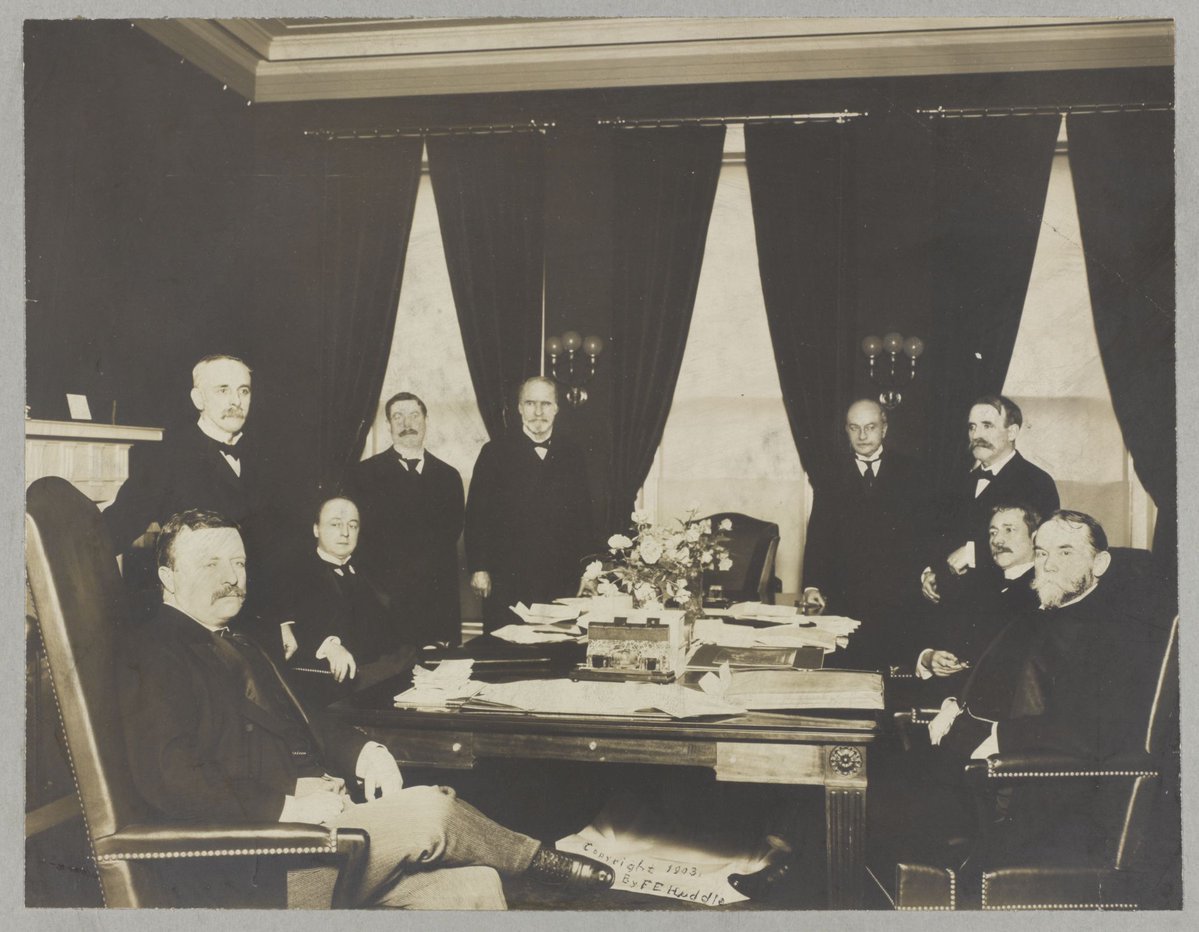
In honor of the convening of the first presidential cabinet 235 years ago this month, we wanted to share a few interesting facts about Theodore Roosevelt’s cabinet.
-Secretary of Agriculture James Wilson (1901-1909) was the longest serving member in Roosevelt’s cabinet, serving throughout his entire administration. In fact, Wilson served nearly sixteen years as secretary of agriculture under three presidents William McKinley, Roosevelt, and William H. Taft, earning the record of the longest serving cabinet member in any administration.
-Secretary of State Robert Bacon (1909) served only during the final few weeks of Roosevelt’s presidency after the previous secretary Elihu Root resigned to take a Senate seat. Bacon was the shortest serving cabinet member in Roosevelt’s administration.
-Secretary of the Interior James R. Garfield (1907-1909), son of the late president James A. Garfield, was one of Roosevelt’s favorites. He put him on the same level as Gifford Pinchot with whom Roosevelt was quite close. Garfield was also the last surviving member of Roosevelt’s cabinet when he died in 1950.
-Secretary of Commerce and Labor Oscar S. Straus (1906-1909) was the first Jewish cabinet secretary. Unsurprisingly, Roosevelt regularly turned to Straus for advice about Jewish matters domestically and internationally and even wrote about political issues more broadly to Straus until the end of his life.
All in all, twenty-nine men served in Roosevelt’s cabinet. If you’d like to learn more about them, we invite you to read our recent Substack post about the cabinet here: https://t.co/0VQbSfUXRr
What member of Roosevelt’s cabinet do you find the most interesting? Here at the Center we especially enjoy the biting wit of Elihu Root, and it’s hard not to love “Billy Possum”! Let us know in the comments below.
#PresidentialCabinet #CabinetMembers #TheodoreRoosevelt
The TR Center will be CLOSED to the public the remainder of this week, November 25th, 26th, and 27th in observance of the Thanksgiving holiday. We hope to see you another day!
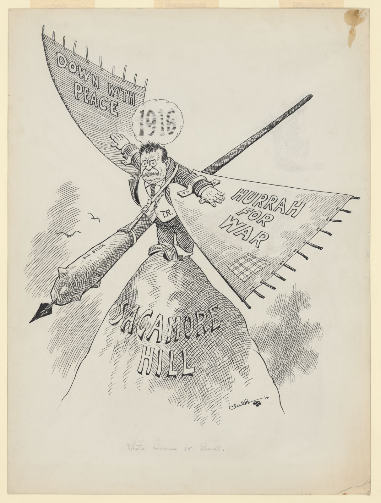
Learn more about this artwork and the artist in our digital library: https://t.co/r7vikO9aT1
For today’s Sunday Short, we’re dee-lighted to highlight how Dr. Lindsay Chervinsky approaches biography. For people like Theodore Roosevelt and other presidents, biographers have a serious challenge since there is so much material available. Listen to Dr. Chervinsky share how she addresses that!
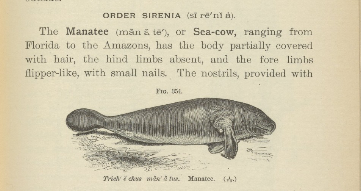
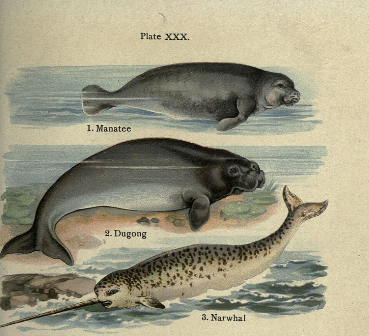
For #ManateeAwarenessMonth, we’re excited to highlight the connection between Theodore Roosevelt and manatees. Did you know that he saw manatees in the wild in 1916 and told ecologist William Beebe he was willing to stand waiting to see them two days if he needed to?
Fortunately, he didn’t have to wait that long. As Beebe describes the encounter in an essay entitled, “The Naturalist and the Book-Lover: An Appreciation,” “[O]ne after another, four great backs slowly heaved up; then an ill-formed head and an impossible mouth with the unbelievable harelip, and before our eyes the sea-cows snorted and gambolled.”
As for Roosevelt, after seeing the manatees in person, he wasn’t quite as impressed when he described them in A Book-lover’s Holidays in the Open: “[The manatee] does not lend itself to spectacular attraction!”
But even if he wasn’t particularly awed by manatees in real life, Roosevelt strongly supported their protection, much like the bison. (And yes, for those wondering, he did really use that word, not just buffalo! See this letter here, for example: https://t.co/aoSXG13EAD.)
When Roosevelt listed some of the highlights of his accomplishments while president in his autobiography, including the establishment of fifty-one bird reservations (now wildlife refuges), he mentioned the manatee.
“Among these reservations are the celebrated Pelican Island rookery in Indian River, Florida [and] the Mosquito Inlet Reservation, Florida, the northernmost home of the manatee . . .”
Roosevelt is known more today for his preservation of the bison, but we also can thank him for doing his part to help save the manatee.
Have you ever seen a manatee in the wild? Were you willing to stand there waiting for two days like Roosevelt? Let us know in the comments below.
#ManateeProtection #WildlifeConservation #SaveTheManatees
Military preparedness was something Roosevelt championed his entire career. Sometimes people see this as warmongering, but that’s not how Roosevelt saw it. He thought it was important to be ready to act if needed.
As he told Kermit in a 1908 letter, one of his friends sent him a translation of a “Hindustani proverb” which the friend believed expressed Roosevelt’s “views about the need of preparing in advance for possible war” in a nutshell.
“The sword is the olive leaf’s brother; One blade in its sheath keeps another.”
Although Roosevelt wasn’t referencing World War I specifically when he included this line since it was over six years before war broke out in Europe, we think it is a concise and clear description of his views on preparedness.
And it’s something he championed until he died in early 1919. One of the last pieces he wrote used the phrase “permanent preparedness.” He believed President Woodrow Wilson hadn’t prepared early enough and couldn’t use the League of Nations as a substitute for military readiness.
As Roosevelt wrote, “I will gladly back any wise and honest effort to create a league of nations, but only on condition that it is treated as an addition to, and not as a substitute for, the full preparedness of our own strength for our defense.”
#MilitaryPreparedness #PeaceAndStrength #LeagueOfNations
Today is Quentin Roosevelt’s 129th birthday. The youngest child of Theodore and Edith, Quentin was beloved by his family, his friends, and the American public. When he was just three years old (about to turn four), he was thrust into the public eye when his father became president.
And he quickly captivated the press, which could not get enough of Quentin and his childhood antics, leading to him being a name known nationwide, particularly for his involvement in the “White House Gang,” a group headed by Quentin that included several of his classmates from the Force School in Washington. The White House Gang roamed the White House throughout Theodore Roosevelt’s presidency, often getting up to such antics as shooting spitballs at Andrew Jackson’s official portrait, carving a baseball diamond into the White House Lawn, or even slashing each other with sabers.
As Quentin got older, he would attend Groton School like the rest of his brothers. After graduating from Groton, Quentin attended Harvard College, also like his brothers and his father. It was during this time of young adulthood that Quentin deepened his interest in both machinery and journalism.
Although the exact details are unknown, Quentin met Flora Payne Whitney around this time. Although their relationship was at first difficult due to their families’ different backgrounds, they eventually grew close to one another, and the Roosevelts came to see her as a member of their family. Before going overseas after the United States entered World War I, Quentin proposed to Flora Whitney with a plan to marry after he returned from the war.
Unfortunately for Quentin, after he made it to Europe, he still had to wait several months to go to the front, finally getting his opportunity to be involved in the action in June 1918 when he joined the 95th Aero Squadron. Quentin was an eager pilot and was able to report home on his success when he downed a German aircraft in a dog fight early in July.
Unfortunately, Quentin’s success was short-lived. On July 14, 1918, Quentin Roosevelt was shot down by a German fighter plane during an engagement on the German side of the front line.
Initially, he was buried where he fell, but after World War II, Quentin was reinterred at the Normandy American Cemetery alongside his brother Theodore “Ted” Roosevelt Jr. where he remains to this day. He is the only World War I veteran to be buried at Normandy.
Read more about Quentin’s White House Gang in our digital encyclopedia here: https://t.co/Jloj1lJWtZ
#QuentinRoosevelt #WhiteHouseGang #NormandyAmericanCemetery #GrotonSchool
Today’s #WednesdayWisdom comes from a letter Theodore Roosevelt wrote to William Howard Taft when the latter indicated he would be willing to succeed Elihu Root as secretary of war. As Roosevelt wrote Taft in that June 9, 1903 letter, “You don’t know what a weight you have taken off my mind.”
Then after expressing how glad he was that Taft would be willing to become the next secretary of war, Roosevelt tried to reassure Taft about living a simpler life in Washington, DC. It’s in this section that today’s #WednesdayWisdom falls.
“The thing in connection with the Presidency which has given me the most satisfaction has been my ability to live up to certain ideals.”
And Roosevelt explained what some of those ideals were. He believed it was important to interact with all different types of people from the powerful and rich to what Abraham Lincoln called the “plain people.” He even gave a detailed example of the more common folk he visited with during his 1903 trip out west.
“For instance, on my recent trip out instead of having nothing but politicians and contractors with me I had at different times men as diverse as John Burroughs, John Muir, President Butler of Columbia University, President Wheeler of University of California, Stuart White the author, Seth Bullock, the former Deadwood sheriff, etc., — because I think them all first rate types of American citizens of the kind which ought to be close to and in touch with the President.”
Roosevelt concluded the letter by talking about his own simplicity even as the head of state: “When I leave the Presidency I shall not mind in the least going back to the utmost simplicity of life, and I wish to live simply as President . . .”
Read Roosevelt's entire letter to Taft in the digital library here: https://t.co/3z4rIn870Q
#PresidentialQuotes #RooseveltAndTaft #USPresidents
Today is the 141st anniversary of Theodore and Edith Roosevelt’s secret engagement. But close family members wouldn’t know about their engagement until months later.
Roosevelt’s sister Anna “Bamie” found out in the late summer of 1886 when the news was leaked to the papers, and she asked her brother about it. He wrote from the Elkhorn Ranch on September 20, 1886 that it was indeed true: “I am engaged to Edith and before Christmas I shall cross the ocean and marry her.” Followed by: “You are the first person to whom I have breathed one word on the subject . . .” (You can find this letter in the digital library!)
How do we know November 17 was the day they got engaged? Ironically, a November 17, 1917 letter from Roosevelt to his youngest son Quentin: “This is the 32d anniversary of Mother’s and my engagement day! And I really think I am just as much in love with her now as I was then — she is so wise and good and pretty and charming.”
Read Roosevelt’s entire letter written on the thirty-second anniversary of his engagement here in the digital library: https://t.co/vXHnTgSYSz
#EdithRoosevelt #RooseveltFamily #TheodoreRoosevelt
Today Mars and Jupiter appeared just before dawn about 1.2 degrees apart in a rare Mars-Jupiter meetup, so we felt it was a fitting day to share a bit about Theodore Roosevelt and astronomy.
In fact, Roosevelt himself said when he was a US Civil Service Commissioner that candidates for the government position of assistant astronomer “can naturally be expected to know about the planet Mars . . .”
Roosevelt didn’t write as much about planets himself, but he did regularly stargaze when he spent time outside. You’ll find a plethora of beautiful prose in Roosevelt’s writings about looking up at the night sky, some of which we’re sharing here.
“[W]hen night fell, stars new to Northern eyes flashed glorious in the sky. Above the horizon hung the Southern Cross, and directly opposite in the heavens was our old familiar friend the Wain, the Great Bear, upside down and pointing to a North Star so low behind a hill that would could not see it.” ~African Game Trails
“This evening at sunset the view across the broad river, from our camp where the two rivers joined, was very lovely; and for the first time we had an open space in front of and above us, so that after nightfall the stars, and the great waxing moon, were glorious overhead, and against the rocks in midstream the broken water gleamed like tossing silver.” ~Through the Brazilian Wilderness
“It was in the cool and pleasant month of September; and long after going to bed we [Wilmot “Will” Dow and Roosevelt] lay awake under the blankets watching the stars that on clear nights always shine with such intense brightness over the lonely Western plains.” ~Hunting Trips of a Ranchman
“I have ordered dinner out on the back porch, for it is so warm and lovely, and there is a full moon, and I thought we could be so quiet there. I have so much to tell you. All sorts of political things have happened during your absence [on a trip to Porto Rico], and besides that I have learned several new poems of Kipling and Swinburne, and I feel like reciting them to you in the moonlight!” ~Corinne Roosevelt Robinson’s remembrance of a moonlit dinner with her brother included in My Brother, Theodore Roosevelt
What’s your favorite thing to watch out for in the night sky? And did any of our followers get to see Mars and Jupiter early this morning?
#Stargazing #NightSky #CelestialEvents
For this week’s Sunday Short, we are sharing a more entertaining snippet from Karl Rove’s keynote address at TeddyCon about Theodore Roosevelt and the 1896 presidential election campaign.
Like Roosevelt who came up with countless memorable descriptions like “malefactors of great wealth”, Rove used an apt turn-of-phrase to describe Roosevelt’s political ambition in 1896. But you’ll have to listen to it to find out what it is!
How would you describe Roosevelt in 1896? Let us know in the comments below.
#KarlRove #SundayShort #1896Election
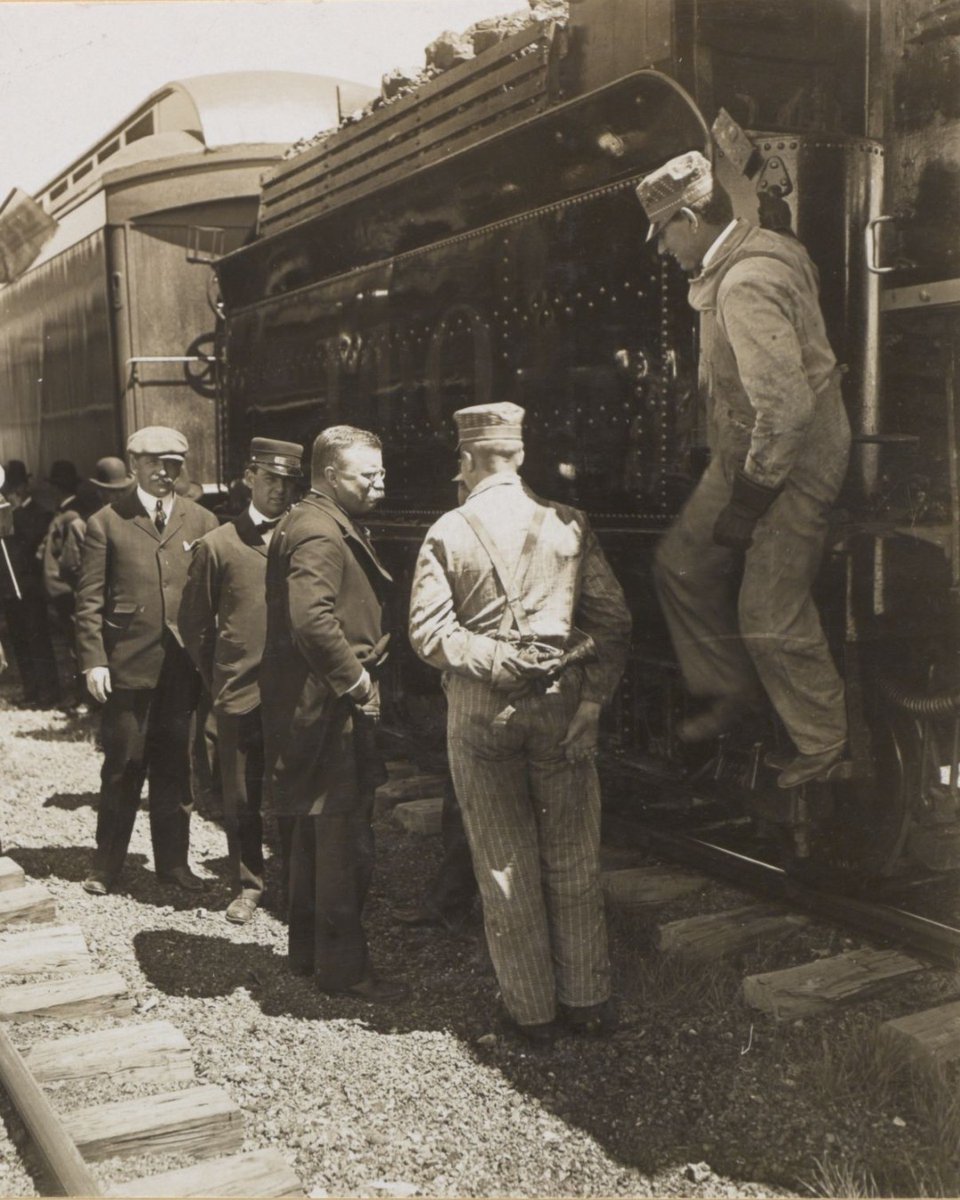
#OnThisDay in 1905, President Roosevelt addressed a delegation of railroad employees at the White House.
Roosevelt was pleased to see the laborers, and told them he would work in labor's best interest. "The interests of the wage-worker and the interests of the tiller of the soil must be peculiarly close to all American public men," he said, "among other reasons for the reason that if they prosper all other classes will prosper likewise as a matter of course." On the other hand, he also made it clear that he would work in the best interest of capital when he felt it was morally right and beneficial. "I would be false to your interest if I failed to do justice to the capitalist as much as to the wage-worker," he said.
He specifically addressed the issue of shipping rates being discriminatory, and of the need for strong federal regulatory power over the railroads. In June 1906, he would sign into law the Hepburn Act, giving the Interstate Commerce Commission the authority to regulate railroad shipping rates and to investigate their finances. The Act was later expanded to cover most methods of transporting commercial goods, regulating everything from ferries to oil pipelines.
Roosevelt is pictured here with railroad workers at an unknown station in 1906.
Read the full address as published in Roosevelt's state papers: https://t.co/ZltEYjLFeK
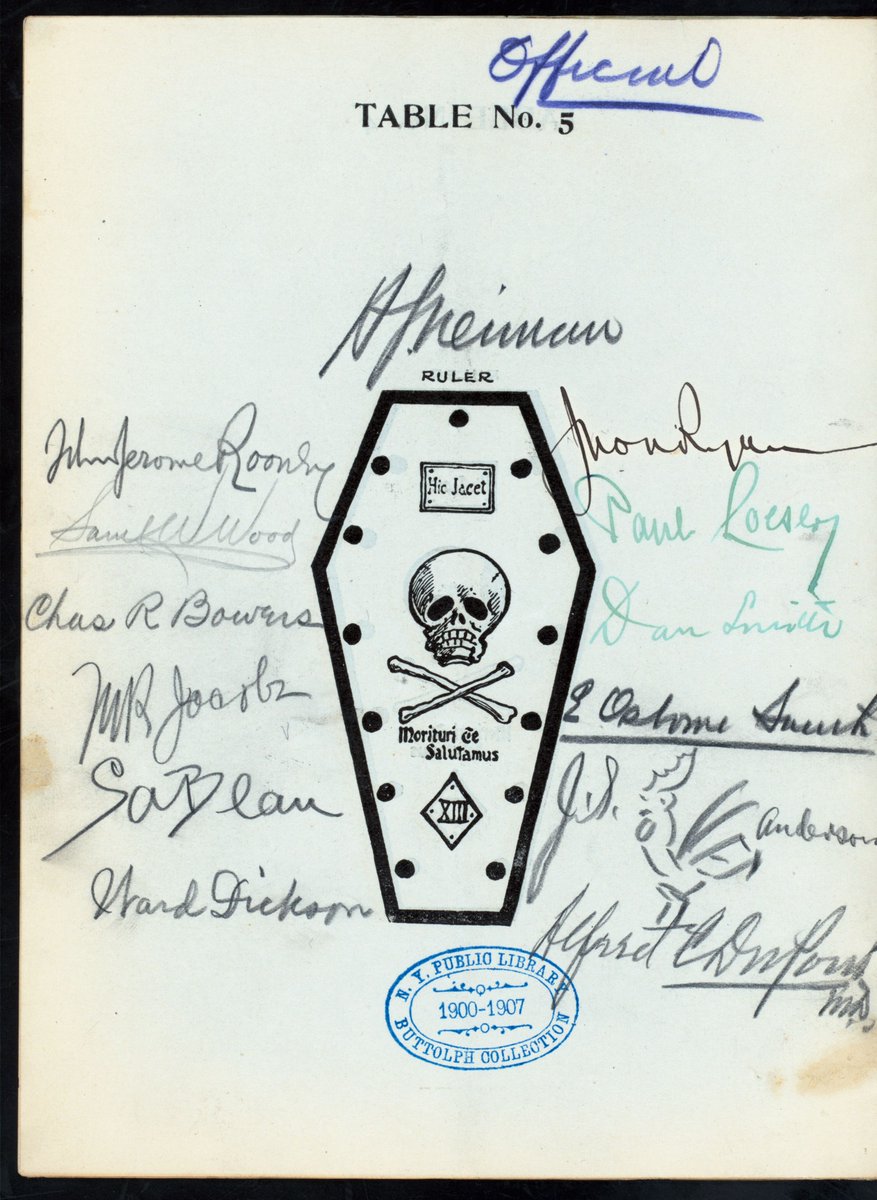
Today is #Fridaythe13th! Theodore Roosevelt was not particularly frightened of the number 13 - in fact, when his friend Jacob Abarbanell invited him, Roosevelt accepted honorary membership in the Thirteen Club, a social club founded in 1881 that played at debunking superstitions. They sat thirteen to a table while wearing all black, they ate thirteen courses and gave thirteen toasts, they walked under ladders to their seats, and they spilled salt and crossed their forks at their coffin-shaped tables.
Roosevelt enjoyed socially engaging with the superstitious, however. When prizefighter John L. Sullivan gave him a rabbit's foot charm, he put it on a watch chain and carried it on his African safari. Democratic statesman James W. Gerard sent him a knife to use in Africa and asked for a bad penny in return because of the superstition that gifting a knife could sever a friendship, and Roosevelt obliged. (He displayed the knife among his trophies and did not take it to Africa.)
(This image is not in our library, and comes from the collections of the New York Public Library: https://t.co/ufepkhXF0r)
#OnThisDay in 1898, Governor-elect of New York Theodore Roosevelt spoke at a dinner held in his honor by the New York Republican Club.
To a packed house - many members of the club were unable to get tickets - Roosevelt first proposed two toasts. He toasted voters in rural areas and smaller cities, who he saw as crucial to the Republican victory. He also toasted Democrats and Independents who supported his campaign. He went on to praise veterans in the Grand Army of the Republic, whom he saw at nearly every campaign stop, and leaders of organized labor who supported his campaign.
"... this victory ...was won, as every victory in American politics worth of the name must be won, by men acting together as Americans. There is nothing else, as Americans; but as Americans of every creed, of every race and origin, we won because, as Protestant and Catholic, Jew and Gentile, wage-worker and employer, manufacturer, merchant, and farmer - men of all conditions of life - came together as American citizens, and as nothing else, to work for the welfare of the common State and common Nation," he said.
He went on to defend himself and Republicans at large against criticism of America's territorial expansion as imperialistic. He closed by calling for greater unity within the party machine, and acknowledge the heavy responsibilities he would be tasked with as Governor.
The full speech can be found in the New York Tribune, published November 13, 1898: https://t.co/Jdg8s7YeVY
In honor of November 11 falling on a Wednesday, we thought it would only be fitting to dedicate today’s #WednesdayWisdom post to veterans and current members of the US Armed Forces.
Although we had a lot of choices because Roosevelt talked about veterans and military service frequently, we finally settled on a quotation from an address Theodore Roosevelt gave in San Jose, California, on May 11, 1903.
“I have been greeted here as I have been greeted throughout California by the men of the great Civil War, the veterans to whom we owe it to that there is a country for you and me to be proud of today. They, by their lives, by the record of their deeds, teach us in more practical fashion than it can be taught by any preaching, for they teach us by practice, that in the ultimate analysis the greatness of a nation is to be measured not by the output of its industrial products, not by its material prosperity, not by the products of the farm, factory, business house, but by the products of its citizenship, by the men and women that that nation produces.”
That’s a rather long quotation so we decided to shorten it for today’s #WednesdayWisdom: “[Veterans], by their lives, by the record of their deeds, teach us in more practical fashion than it can be taught by any preaching, for they teach us by practice . . .”
As Roosevelt would convey in countless other written work, what he valued most about soldiers, sailors, aviators, and Marines was their willingness to act. A veteran himself, Roosevelt regularly supported veterans and mentioned them in speeches. He was incredibly proud of the military service of his four sons in World War I even though he himself didn’t have the opportunity to serve.
Just as Roosevelt would have wanted, we express our appreciation to all our readers who have served in the US military and put their lives on the line. If you’d like, you can comment below with the branch in which you served. We would be delighted to recognize you in that way.
Read Roosevelt’s full speech in the digital library here: https://t.co/31mIuBZ9tp
#VeteransDay #MilitaryService #USArmedForces #ServiceAndSacrifice #VeteranAppreciation
#OnThisDay in 1914, President Roosevelt delivered an address in Buenos Aires to the members of the Museo Social Argentina titled "Truths and Half Truths."
Roosevelt argued that idealism and common sense must both be used in order for a free society to grow and prosper. Throughout the speech, he used the framework of truths and half-truths to build his arguments. Of particular importance to him were issues of wealth and poverty, of capital and labor, and even more fundamentally, of collectivism versus individualism. He stressed the need to find solutions that would stave off revolution or anarchy.
"The citizen must be so trained that he shall be able in time of need to defend his rights with a strong hand. This is a truth, but only a half truth. Its vitally necessary complement is that there is no surer nor more fatal sign of weakness than facile readiness to resort to arms in foreign, and above all in civil and domestic, affairs; for a state which acquires the revolutionary habit, and is unable to secure the needed governmental growth and transformation without violence is doomed," he said.
One of Roosevelt's many honorary doctorate degrees was conferred upon him that day. At the ceremony, Argentina's Foreign Minister, Estanislas Zeballos, declared that Argentina did not care for paternalistic protections under the Monroe Doctrine, but would pursue a policy of Pan-Americanism, and welcome the United States' contributions in that regard.
Read the full story as published in the New York Times: https://t.co/LOqNxZOKBU
This week in 1906, President Roosevelt became the first sitting US President to journey abroad, traveling to the Panama Canal Zone to personally inspect the construction project.
There was notable public opposition to the trip. Some came from those who saw it as violating traditions and norms related to foreign diplomacy. Some were concerned about the logistics and chain of command in the president's absence. And still others feared his health and life would be in danger.
Despite these (not unfounded) concerns, Roosevelt felt strongly that the trip was necessary. If he and First Lady Edith Roosevelt traveled to Panama personally, they could boost the morale of the workers, prove that the place was "safe as a health resort," as he later put it, and make a personal inspection of progress and conditions. He found himself overwhelmed by the magnitude of the project. "It is an epic feat, and one of immense significance," he wrote home to his son Kermit.
TR believed that the work he did in making the Panama Canal possible was likely the most significant work he did as President, saying so many times over the course of his life. But he also recognized that the work of the men and women in the Zone was the real achievement.
"A finer body of men has never been gathered by any nation than the men who have done the work of building the Panama Canal; the conditions under which they have lived and have done their work have been better than in any similar work ever undertaken in the tropics; they have all felt an eager pride in their work; and they have made not only America but the whole world their debtors by what they have accomplished," he wrote in his 1913 Autobiography.