🔥 JMIA: THE HARDEST POST I'VE WRITTEN 🔥
I've been trading Jumia since Covid. Built a core position over the last couple of years whenever opportunity showed up. I've also lost money on it — immature stuff, buying and selling options like I knew what I was doing.
I still believe in the business. Numbers keep improving — GMV up, losses shrinking, breakeven targeted Q4 this year.
But the stock doesn't care. ~$6.70, down 46% this year. Every good quarter gets sold.
Maybe investors just don't care about the ecommerce business model. And maybe "we solved ecommerce in Africa" isn't an interesting story to them, no matter how real the turnaround is.
At some point the question stops being "is the business good" and becomes "is my capital working." Opportunity cost is real.
Thinking about cutting and redeploying. Q3 earnings in ~6 weeks — talk me out of it.
What would you do? 🤔
$JMIA
🔥 WHY MICRON COULD DOUBLE FROM HERE 🔥
Memory is tight. And every report I read says it stays tight through 2030.
MU closed at $1065 yesterday. Earnings today after close.
Honestly? It should be ripping 🤔
The only bear case: this is just another memory cycle and the earnings surge fades. If it's structural — if AI demand is real and durable — this is a 2x.
But here's the thing. Nobody knows boom or bust, because nobody knows the AI buildout. MU is just the cleanest way to ask the question.
I'm bullish. Initiating.
$1400 by year-end. 90 days.
$MU
30Y Treasury at 5.6% — highest since 2004 📈
10Y above 5.2% — levels last seen before the financial crisis.
And stocks won't crack.
Normally this would crush equities, especially long-duration tech. Higher yields mean a higher risk-free return, a higher discount rate on future earnings, and higher borrowing costs across the economy.
So why hasn't the market broken? $SPY $QQQ $AAPL
It's in the WHY behind rising yields. This isn't the bond market pricing a recession. It's pricing an economy that can sustain higher rates than anyone believed — strong nominal growth, expanding earnings, and an AI capex supercycle ⚡ pouring money into compute, chips, power, and data centers.
That's the entire game right now: can earnings growth outrun the rising discount rate? As long as the answer is yes — especially in the AI buildout names — the bull market survives 5%+ yields.
But don't be fooled by the index. Breadth is weak. A large part of the market is already buckling under higher rates while a concentrated group of mega-cap AI and semiconductor names holds everything up. Resilient, but fragile.
Three forces fighting it out:
1. Earnings growth supporting equities
2. The AI investment supercycle
3. The highest long-term rates in 20+ years
Right now 1 and 2 are beating 3. That can't be taken for granted.
The real risk is a regime shift: from "yields rising because growth is strong" to "yields rising because inflation and fiscal risk are climbing while growth slows." That's a different world — and that's when the correction comes.
I'm watching earnings revisions, not the 10-year 👀 $TNX $NVDA $SPX $TSM $TLT
📈 10-yr treasury: 5.26% — $1M pays ~$52.6k/yr 💰
🚫 no tenants, no repairs, no 2am calls
🗽 exempt from NY state + city tax
🏙️ a $1M nyc condo nets ~3% after charges, taxes, vacancy 😩
✅ 5.26% guaranteed vs 3% with headaches. not close.
If you are serious about options trading, this 1-hour Yale lecture is non-negotiable.
60 minutes lecture can teach you more about options trading than 99% of options trading courses.
Save this and watch it without distractions. 📌
Overthinking feeds depression. Action - whether it’s errands, the gym, or simple routines—is what starves it.
The greatest weapon against stress is our ability to choose one thought over another.
$SPY $QQQ $JMIA $NVDA
call me crazy..but I will keep saying this..
the new millionaires of 2026 won't come from crypto.
they'll be blue collar business owners who figured out Claude + SEO.
DON'T bookmark this if it crosses your timeline.
Just paste this entire thing into Claude.
thank me later.
Claude Cowork complete crash course from zero to expert in 12 minutes.
Installation, automations, connectors, plugins..all of it:
00:00 Intro
01:00 Installation & setup
02:08 Your first task
03:01 Global instructions (most skip this)
04:00 What Cowork can actually access
05:15 Skills feature
06:08 Connectors explained
07:04 Real workflow (Drive + Gmail)
07:46 Claude in Chrome
08:43 Scheduled tasks
09:52 Plugins (why $285B was wiped out)
11:41 Big picture
Today, we’re releasing a feature that allows Claude to control your computer: Mouse, keyboard, and screen, giving it the ability to use any app.
I believe this is especially useful if used with Dispatch, which allows you to remotely control Claude on your computer while you’re away.
I put a lot of heart into my technical writing, I hope it's useful to you all.
📌 Here's a pinned thread of everything I've written.
(much of this will be posted on the Claude blog soon as well)
$JMIA reported Q4 2025 earnings today before the market opened and we review the results now.
In total, I would characterize the report as this: “good operational results, not a “Hollywood moment,” and most importantly a reiteration of the guidance for Q4 2026 profitability and EBITDA breakeven and then the same for full year 2027.”
Management’s credibility is becoming cemented.
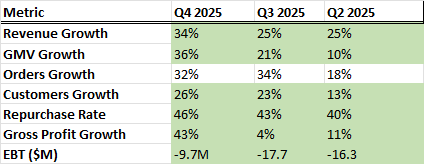
I find this table more instructive than a table of results versus consensus estimates:
Revenue up, gross profit up, GMV up, customers up, orders up, repurchase rates up, losses down. That’s the story.
But, Jumia will reach its goals based on the metrics above, and I continue to believe that there will not be a “Hollywood moment” where the numbers shock the world and beat estimates by some large amount.
Our expectations should be anchored: Q4’26 breakeven and FY’27 profitability/FCF remain the right markers.
The path is visible, the levers are working, and the absence of drama is the point.
The company should continue on the trajectory above and that will suffice to reach profitability in Q4 2026 and full year 2027.
$JMIA Q4 2025 — This Was a Real Turnaround Quarter 🚀
📈 GMV: $279.5M (+36% YoY)
💰 Revenue: $61.4M (+34% YoY)
📦 Orders: +32% YoY
👥 Active Customers: 3.0M (+26% YoY)
But the REAL shift is profitability 👇
🔥 Adjusted EBITDA loss cut nearly in HALF
– Q4 2024: ($13.7M)
– Q4 2025: ($7.3M)
💵 Operating cash burn: just $1.7M
(last year was $26.5M 🤯)
📊 Gross profit +43% YoY
📦 Fulfillment cost per order DOWN 12%
🇳🇬 Nigeria GMV +50% YoY
This is operating leverage kicking in.
They exited weaker markets (Tunisia, South Africa, Algeria) and are focusing on core growth markets.
🎯 2026 Guidance:
• GMV growth 27–32%
• Q4 2026 EBITDA breakeven target
• Full-year profitability in 2027
Advertising revenue +42% and still only 1% of GMV. Massive upside optionality.
This wasn’t just “growth.”
This was growth + margin expansion + collapsing cash burn.
The flywheel is turning. 🔄
Market may take time to price it.
But fundamentals just improved meaningfully.
$JMIA $AMZN $MELI
👀👀👀@Citrini7@hntrbrkmedia@CitronResearch
$JMIA is still misunderstood.
Most investors still frame Jumia as a failed “Amazon of Africa” trade.
That’s the wrong lens.
Jumia already built the hardest part:
• Logistics
• Last-mile delivery
• Payments rails (JumiaPay)
In today’s higher cost-of-capital world, replicating that infrastructure across multiple African markets would be prohibitively expensive.
The market punished JMIA in 2022–23 for overbuilding during the zero-rate era. Fair.
But what followed matters more.
Management cut costs, reduced headcount, exited low-quality GMV, and extended runway.
This is no longer a growth-at-all-costs story — it’s an operating leverage story.
Incremental volume now drops through a much leaner fixed-cost base.
JMIA doesn’t need explosive growth to work — it just needs less bad outcomes.
Africa e-commerce isn’t broken — it’s early.
Payments + logistics matter more than SKU count.
And expectations remain extremely low.
You don’t need Jumia to “win Africa.”
You just need it to stop losing.
That’s where asymmetric upside lives.