We investigate human rights violations and environmental abuses in supply chains, and then engage with companies to remediate problems and spark systems change.
Six months after brands promised to repay migrant workers in their Taiwan supply chains for recruitment fees, most still don’t have clear plans.
Our rejoinder, featured by @BHRRC, calls on companies to act now—because justice delayed is justice denied.
https://t.co/J0vncQpWst
Migrant workers in Taiwan’s manufacturing sector pay $5,000+ in fees, pushing many into debt bondage. Our findings led to $1.5M+ reimbursed, broker fees cut, and zero-fee hiring policies. Read more: https://t.co/uNq7xSIuRU
Our latest investigation exposes labor abuses in Taiwan's textile industry, where migrant workers pay as much as $6,000 to secure their jobs. Learn more about how brands and governments are responding and what more must be done: https://t.co/VLJb8twNPq
Join Transparentem's virtual side session at the 2025 OECD Forum on Due Diligence in the Garment and Footwear Sector to explore critical issues of child labor and forced labor risks on Indian cotton farms. Learn more and register here: https://t.co/BlvqEiKUOe
“‘Ethical’ Cotton Is Being Picked by Child Labourers in India” — @BusinessofFashion
Our latest investigation reveals child labor in India’s cotton production, even in supply chains marketed as “ethical.” Read more on how brands must respond: https://t.co/dAU8G7iiPm
Social compliance often overlooks labor abuses beyond the first tier of the #supplychain. Our latest investigation into #Indiancotton farms uncovered indicators of forced labor and child labor. See how major apparel brands are responding: https://t.co/ITFvtNhcnj
Nearly a year following our initial report of labor abuses in the Mauritian garment industry, new coverage by @SourcingJournal and @jasminchua highlights the systems and actors that continue to enable and perpetuate the exploitation of migrant workers in Mauritius.
Our President E. Benjamin Skinner joined @BBCAfrica and @BBC_AudreyB to speak at length about our report on labor rights abuses in Mauritius' apparel industry + brand responses to our findings. #supplychains#forcedlabor
Listen at the 10:00 minute mark. https://t.co/wU4Xjcfwyl
As the result of @Transparentem_ 's investigation into the conditions for migrant workers in Mauritius, leading fashion brands have agreed to pay £400,000 to garment workers, a huge win for workers rights and against forced labor. https://t.co/tH0JdUQ5m2
Breaking: Our investigation into Mauritius apparel factories found evidence of forced labor indicators, including exploitative recruitment fees, abusive living conditions, and threats.
Some buyers have committed to remediation for workers. Most have not.
https://t.co/XFtNmA3f7v
The briefing highlighted significant domestic economic opportunities in supporting a more responsible industry, along with policy strategies to enable such support.
https://t.co/o2Pw1ZWGCx
@ACTcircularity
@PoliticallyInF1@Transparentem_@tsdesigns#policysolutions#JSDaily
Check out this informative article by @ivanlpenn and @AnaSwanson in the @nytimes, which references our work investigating forced labor in the Malaysian garment industry
First Solar is disclosing today that an audit found forced labor in its Malaysian facilities. @ivanlpenn and I with more on efforts to stamp out modern slavery in solar supply chains
https://t.co/xefg08lLe7
Engaging study from @McMasterU exploring the effectiveness of forced labor disclosure laws, including audit deception in supply chains.
Strong due diligence policies and corporate transparency are essential to better protect workers and address labor abuse
Disclosure laws about forced labour in the clothing industry are designed to ease the conscience of consumers rather than protect workers, suggests a study by researchers including @McMasterSocSci’s Judy Fudge and @MacLabour PhD candidate Gayathri Krishna https://t.co/1MPdxO55EK
During last month's #GRAMpartnership webinar on #WorkerRights and GRMs, Jonathan Mead discussed how @Transparentem_ is working to eradicate environmental and #HumanRights abuses in global supply chains.
For the full webinar: https://t.co/J9sWr4JzUW
Migrant #workers coming to fill gaps in the UK #agriculture labour market can find themselves in debt bondage if charged illegal recruitment fees. FLEX's CEO, Lucila Granada and two workers spoke to @ThompsonReuters for @ContextNewsroom: https://t.co/rQiNNuXbYS
@lulagranada
Increase in the frequency and severity of extreme events in #Asia will impact agriculture, which is central to climate adaptation planning, UN weather agency @WMO warns in new report.
https://t.co/2CgyFUlD3R
Recently-published research from @UniofNottingham and @TuftsNutrition finds widespread risk of forced labor in the US food-supply chain, calculating that 62% of forced labor risk comes from domestic production or processing. https://t.co/IM2R8pOgpP
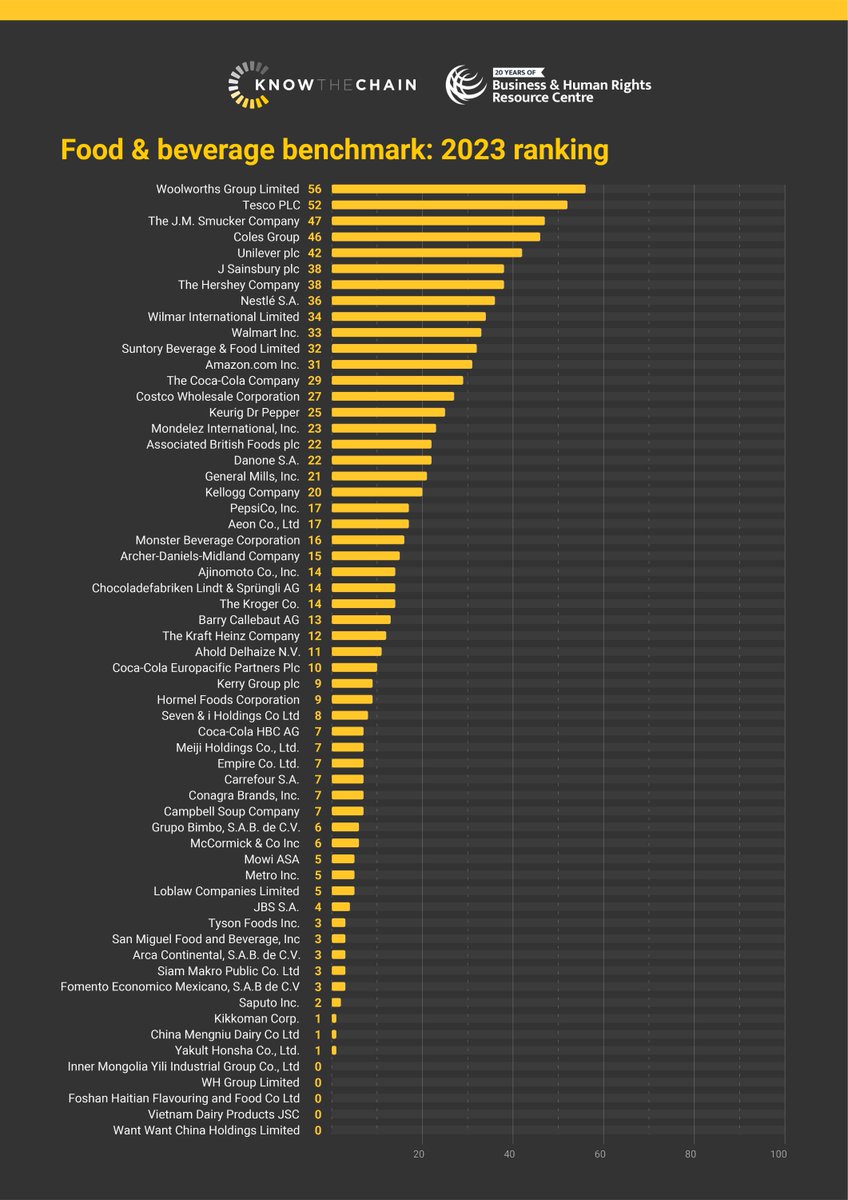
OUT NOW: KnowTheChain Food & Beverage Benchmark 2023 📊
The food system is a cornerstone of the global economy. But the sector's biggest companies are failing to protect essential workers in food supply chains from forced labour risks. Key findings... 🧵
https://t.co/y7XxpKD1AW