Tempe has turned off its Flock automated license plate reader system and will end its contract with the company. The cameras are no longer collecting license plate data, and Tempe will not seek another company to replace the system.
While the cameras have helped Tempe Police solve crimes, recent misuse of automated license plate reader systems in Arizona and nationwide has raised concerns about the risks that come with the technology.
Tempe Police has found no misuse of its own Flock system.
Flock will remove its cameras, and previously collected data will be automatically deleted after 30 days unless it is connected to an ongoing case or investigation.
Read through the slides to learn more about the decision and what it means for Tempe.
A Kentucky officer ran 2,048 Flock camera searches to track the mother of his child. No warrant. No probable cause. No judge ever saw it.
The Fourth Amendment protects Americans against unreasonable searches, and retracing where someone drove for five months is a search. And it’s why I take issue with surveillance networks like Flock.
https://t.co/hv5Wctzoqw
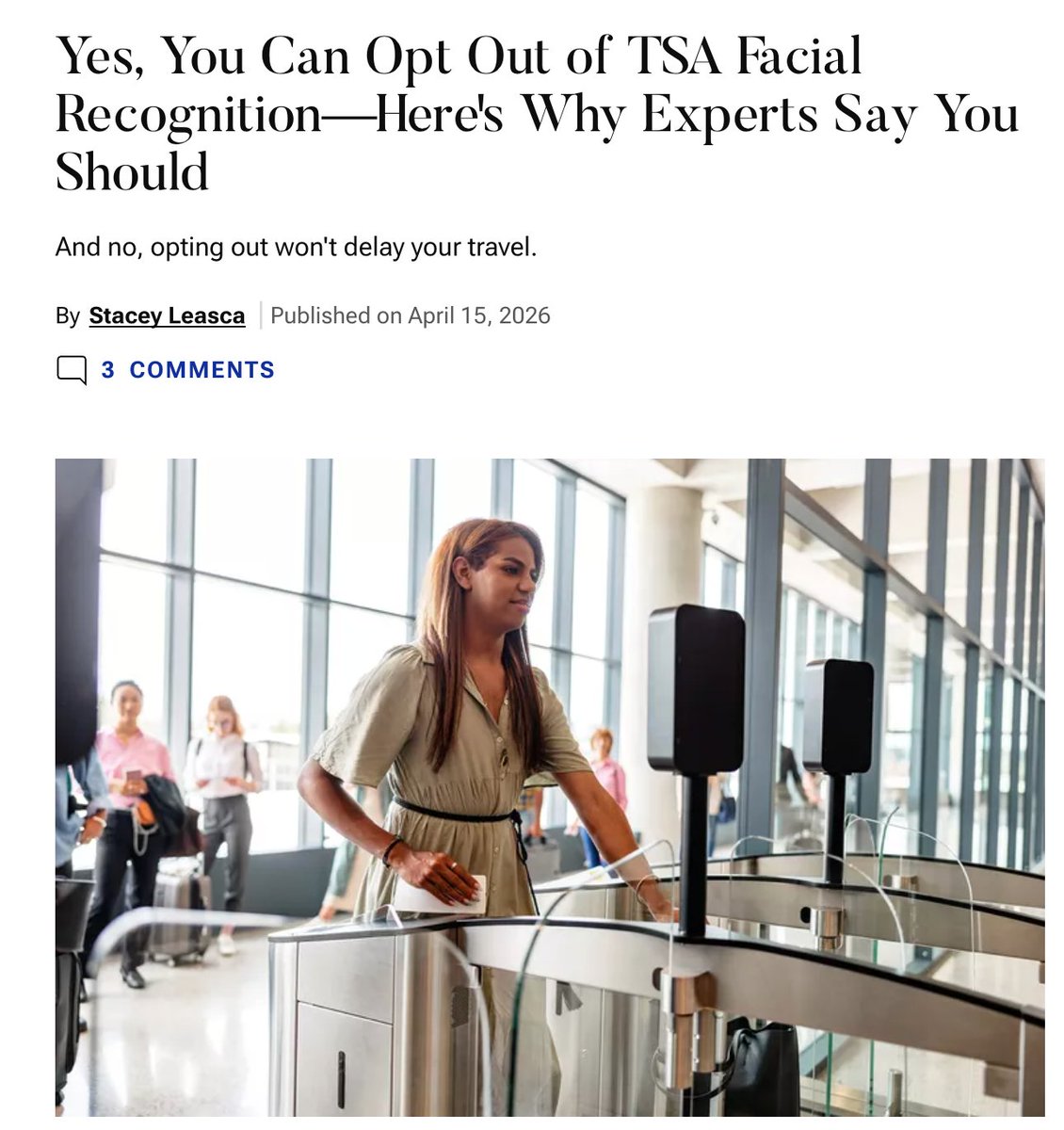
A US senator walked up to an airport checkpoint and refused to have his face scanned.
His name is Jeff Merkley. He is the senator from Oregon. He has spent three years trying to get the TSA to tell travelers something the TSA already admits on its own website.
The face scan at the checkpoint is optional. Almost nobody is told.
There is one sentence that stops it. Here is the sentence, and everything the TSA does not want you to know about saying it.
First, the TSA's own words. From the TSA website:
"Travelers who do not wish to participate in the facial recognition technology process may decline the optional photo, without recourse, in favor of an alternative identity verification process, which does not use facial recognition technology to verify their identity."
Optional photo. Without recourse. Those are their words, not mine.
The TSA also says this on the same page:
"Travelers will not lose their place in line for security screening."
And using the alternative method "does not take longer."
So the two things a TSA agent might tell you at the checkpoint, that you will hold up the line or take longer, are ruled out by the TSA's own website.
Now the sentence. When you get to the checkpoint, before the scan, say this:
"I do not consent to the scan and would like to have my ID manually verified."
That is it.
The officer will take your physical ID, either a driver's license or a passport, and check the photo against your face the way they did for the last twenty years. Merkley has documented himself doing this on flights between DC and Portland.
Here is why almost no one knows.
Senator Merkley has been pushing this since July 2023. He went to Reagan Washington National Airport that summer to publicly demonstrate the opt-out and to challenge the TSA on how the program is being run. The Washington Post covered it.
In May 2025, Merkley introduced the Traveler Privacy Protection Act with Senators John Kennedy of Louisiana, Ed Markey of Massachusetts, and Roger Marshall of Kansas. Two Republicans, two Democrats. The bill is endorsed by the American Civil Liberties Union, the Electronic Privacy Information Center, Public Citizen, and three other watchdog groups.
Merkley's own words from that press release:
"Folks don't want a national surveillance state, but that's exactly what the TSA's unchecked expansion of facial recognition technology is leading us to."
And:
"Americans have the right to opt out of using TSA's facial recognition at the airport, and we need to protect that right. Our Traveler Privacy Protection Act safeguards the freedoms and privacy of all Americans by making sure no one is required to have their face scanned to travel."
Here is what the TSA is planning.
Facial recognition is currently at more than 84 US airports. The TSA plans to expand it to more than 430. That is nearly every commercial airport in the country. And per the bill's findings, the TSA is "eventually planning to make this technology mandatory for all travelers."
Right now it is optional. That window is closing.
The TSA says the technology is not being abused. Their exact wording:
"Biometrics are not used for surveillance. Facial recognition technology is solely used to automate the current manual ID credential checking process and will not be used for surveillance or any law enforcement purpose."
Take them at their word. The point is not that the TSA is doing something illegal. The point is you get to choose.
Here is the 5-minute action you can take tonight, before your next flight.
- Memorize the sentence: "I do not consent to the scan and would like to have my ID manually verified."
- Have your physical ID out and ready. Driver's license or passport. Not a screenshot on your phone.
- When you get to the podium, hand the agent your ID and say the sentence in a normal tone. Do not apologize.
- If the agent pushes back or tells you it will take longer, calmly repeat the sentence. If they still refuse, ask for a supervisor.
- This applies to TSA checkpoints only. International arrivals into the US go through Customs and Border Protection, which is a different agency with different rules. For most US domestic flights, the sentence above is what you need.
Here is the last thing.
The TSA already admits, on its own website, that this is optional. A sitting US senator has spent three years asking them to put that in plain sight at the checkpoint. They have not. The signs at the podium do not tell you. The agents often do not tell you. The airline app does not tell you.
Congress is being lobbied by the airlines to keep it that way. Reuters reported in July 2025 that the airline industry publicly opposed Merkley's bill.
Right now, before the 430 airport rollout, you still have a one-sentence way out.
Say the sentence. Show your ID. Walk through.
Well, why don't we start with Flock CEO's privacy?
Looking forward to reading his emails, accessing his GPS location, credit card purchases, and ISP logs.
Flock being used as a revenue generation tool.
e.g. Ticketing overweight trucks on restricted roads.
This is a warning sent to a truck driver from a Flock camera. They are starting to use these cameras for tickets/revenue against us.
Americans do not surrender their privacy rights when they drive to work, drop their kids off at school, or go to church.
I’m investigating Flock cameras to determine WHO has access to hundreds of millions of Americans’ data - and what they’re doing with it
🇺🇸 Somebody in the Senate FINALLY asked who authorized 120,000 cameras tracking American drivers
The letter to Flock Safety's CEO:
"Congress never authorized the network your industry has built."
Hawley is demanding documents on data access, camera placement, contracts with local governments, investors, and every known case of misuse since 2021.
He can push for a subpoena if the company stalls. Finally.
This network went up while nobody was looking, and the only rules governing it were written by the company selling it.
A Florida woman sat in jail for 13 days off a plate misread.
Missouri police have already been caught misusing the system.
Flock says the cameras helped find 10,000 missing people.
Fine... then open the books and prove the rest of it.
Source: Axios @HawleyMO / Writer: Daniel