The Roadmap Is Only The Beginning, Treno Scope: Real Test of Ethereum Lies In Timely Delivery
Key Takeaways
Ignas believes that if the Ethereum Foundation delivers the roadmap on time, it will be a long-term positive for ETH.
The roadmap responds to the community core demands regarding execution rights, privacy, quantum resistance, and finality.
Treno Scope believes that the market will pay more attention to delivery capability in the future, rather than the roadmap itself.
In a bear market environment, development delays may further pressure market sentiment.
DeFi researcher Ignas recently commented on the “Lean Ethereum” roadmap proposed by Vitalik Buterin, stating that if the Ethereum Foundation can complete the relevant upgrades as planned, it will constitute a clear positive for ETH; conversely, if delays occur in the current relatively weak market cycle, it may further undermine market confidence. He believes that this roadmap responds well to the core issues that the community has long focused on, including improving Layer 1 execution capability, strengthening privacy protection, enhancing quantum resistance, and achieving faster transaction finality, but token economics has still not become the focus of this upgrade.
From a market perspective, this means that the development logic ofEthereum is gradually shifting from “proposing a vision” to “delivering on the roadmap.” Over the past few years, Ethereum has maintained its leading position through its modular architecture, Layer 2 scaling, and developer ecosystem. However, as competing public chains develop rapidly, the market has begun to pay more attention to whether upgrades can truly improve network efficiency and continuously enhance the ETH value capture capability.
Treno Scope Market Intelligence has continuously tracked the development of public chain infrastructure and found that the capital market evaluation standards for major protocol upgrades have changed. Compared with releasing grand technical roadmaps, institutional investors pay more attention to whether upgrades can be delivered steadily according to timelines, whether they truly solve user experience problems, and whether they can drive growth in on-chain activity and ecosystem revenue. Delivery capability is gradually becoming an important factor affecting valuation.
The most closely watched directions in this roadmap include re-strengthening the core value of Layer 1, further improving the user privacy experience, and enhancing network security. Among them, second-level finality and quantum resistance are related not only to technological competitiveness, but also to future institutional confidence in adopting digital asset infrastructure. As traditional finance gradually enters the on-chain world, the importance of security and predictability is continuously increasing.
However, Treno Scope observes that the roadmap still contains one issue that the market continues to discuss, and ETH token economics has not yet seen a new optimization direction. In recent years, the community has maintained a high level of attention on the ETH ability to capture network value. In the future, if a more direct connection still cannot be formed between on-chain activity growth and ETH value growth, the market may continue to debate value capture efficiency.
It is worth noting that the macro environment will also affect market feedback from technical upgrades. In stages of abundant liquidity and high risk appetite, technological positives can usually be quickly reflected in asset prices; while in a bear market environment, even if the upgrade direction is recognized, the market may pay more attention to whether development progress is delayed. Therefore, the ���timely delivery” mentioned by Ignas has in fact become an important variable for the market in judging the medium- and long-term trajectory of ETH.
Treno Scope believes that Ethereum still has the most mature developer ecosystem and rich application scenarios, and its long-term competitive advantages have not changed. However, the key to whether ETH will usher in a new round of value revaluation in the future will come more from the delivery of its technical roadmap, ecosystem growth, and the continuous improvement of its value capture mechanism, rather than merely from a roadmap itself. For investors, continuously monitoring development progress, on-chain data, institutional adoption rates, and changes in network revenue will be more meaningful than simply focusing on short-term price fluctuations.
Disclaimer
This article is for market research and industry analysis reference only and does not constitute any investment advice. #TrenoScope
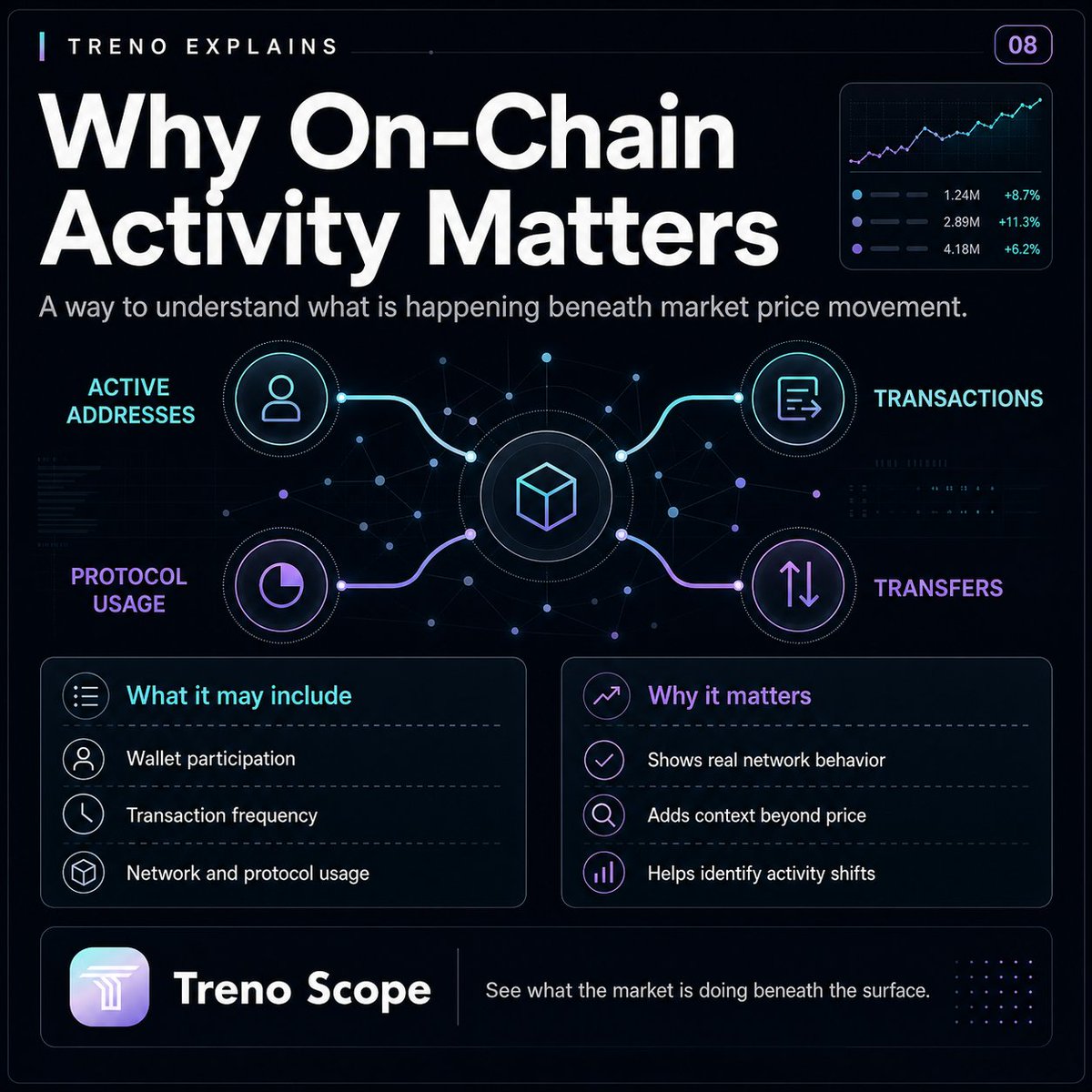
Treno Explains: Why on-chain activity matters
Price moves are visible.
On-chain activity helps explain what may be happening underneath.
Metrics like active wallets, transaction count, and protocol usage can offer clues about network participation and market behavior.
It’s not about chasing a single metric— it's about seeing the bigger picture.
#TrenoExplains #CryptoEducation #OnChainData #BlockchainAnalytics #TrenoScope
Michael Saylor Discusses Bitcoin Governance Mechanism Again, Treno Scope: Strong Consensus Builds The Most Robust Digital Asset Network Worldwide
Key Takeaways
Michael Saylor believes that the strong consensus mechanism of Bitcoin is the core of network security and long-term stable operation.
Protocol changes must achieve overwhelming agreement, reducing systemic risks caused by radical upgrades.
Treno Scope believes that the consensus mechanism is not only a technical rule, but also an important component of the Bitcoin trust system.
As institutional capital continues to enter, Bitcoin protocol stability is becoming an important support for long-term value.
Strategy founder Michael Saylor recently once again explained his understanding of the Bitcoin governance mechanism. He stated that the strong consensus mechanism of Bitcoin is like the network “immune system.” Fees are responsible for pricing block space, nodes determine network policies, miners are responsible for constructing blocks, and holders complete market selection through capital allocation. Precisely because protocol upgrades must obtain overwhelming consensus, immature or controversial proposals are often eliminated by the market before they can truly affect the network.
This view is not merely a summary of the Bitcoin technical architecture, but also reflects its long-term value logic. Over the past decade and more, Bitcoin has not frequently adjusted its underlying protocol like many public chains, but has consistently adhered to a “stability first” governance philosophy. For institutional investors, this predictability means lower institutional risk and also makes Bitcoin easier to view as a long-term store of value.
Treno Scope Market Intelligence has continuously tracked the development of digital asset infrastructure and found that as the industry gradually becomes institutionalized, the market criteria for evaluating a public chain project are changing. Compared with networks that continuously add functions and upgrade frequently, more and more institutions are beginning to value whether a protocol is stable, whether governance is transparent, and whether rules can remain consistent over the long term. For institutions managing large-scale assets, stability is often more important than innovation.
From the Bitcoin governance model, nodes, miners, developers, and holders form an ecosystem of mutual checks and balances. Any protocol change requires long-term discussion, testing, and broad consensus, avoiding major upgrades being quickly promoted by a small number of stakeholders. Although this governance method reduces the speed of innovation, it greatly improves the credibility of the network. Treno Scope believes that this is also one of the important reasons why Bitcoin can continue attracting institutional capital globally.
In recent years, whether it is the launch of spot ETFs or continued BTC allocation by listed companies, the market has paid more attention to whether Bitcoin can operate stably over the long term, rather than whether it adds more functions. The Saylor statement that “strong consensus is the immune system” essentially emphasizes a form of institutional resilience. When the network faces external controversies or internal proposals, the consensus mechanism can filter out high-risk changes, allowing the protocol to maintain long-term consistency.
Data observations from Treno Scope show that the digital asset market has gradually entered a stage of infrastructure competition. On-chain security, governance transparency, node distribution, developer ecosystem, and protocol stability are becoming important dimensions of institutional research. Although the Bitcoin upgrade pace is slow, precisely because its rules are stable, its credibility in the global financial system continues to improve, further strengthening its market positioning as “digital gold.”
In the future, as more traditional financial institutions enter the digital asset sector, the importance of governance mechanisms may further increase. Treno Scope believes that a network truly capable of carrying global capital needs not only advanced technology, but also long-term stability, clear rules, and the ability to form broad consensus. The governance principles upheld by Bitcoin provide a development paradigm worthy of reference for the entire industry.
Disclaimer
This article is for market research and industry analysis reference only and does not constitute any investment advice. #TrenoScope
HYPE, RED, And APT To Face Major Unlocks This Week, Treno Scope: Market Focus Is Shifting From “Unlock Scale” To “Circulation Structure”
Key Takeaways
HYPE, RED, APT, and BB will undergo a new round of token unlocks this week.
The unlock ratio of RED is close to 10% of its circulating supply, making short-term supply pressure relatively more noteworthy.
HYPE and APT unlocks account for a relatively low proportion of circulating supply, and their actual impact still needs to be assessed together with market liquidity.
Treno Scope believes that token unlocks have become an important indicator for observing the Token Economics and circulation structure of a project, rather than a purely bearish event.
According to the latest data from Token Unlocks, multiple projects including Hyperliquid (HYPE), RedStone (RED), Aptos (APT), and BounceBit (BB) will undergo one-time token unlocks this week. Among them, HYPE will unlock approximately 452,000 tokens on July 6, valued at around USD 32.4 million; RED will unlock 40.85 million tokens, accounting for approximately 9.8% of its current circulating supply; APT will release 11.31 million tokens on July 12, valued at approximately USD 7.15 million; BB plans to unlock 29.93 million tokens.
In the digital asset market, token unlocks have always been events closely watched by investors, because newly added circulating supply may change market supply-demand dynamics and affect short-term price performance. However, as more mature projects enter continuous unlock phases, the market understanding of Token Unlocks is changing.
Treno Scope Market Intelligence has continuously tracked token circulation data of major public chains, DeFi, AI, and infrastructure projects, and found that unlock scale itself is no longer sufficient to determine market impact. More important factors include the proportion of new supply relative to circulating supply, holder structure, and market liquidity. From data of this week, although HYPE has the highest unlock value, its newly added circulating amount accounts for only about 0.2% of circulating supply; by contrast, the RED unlock accounts for nearly 10% of circulating supply, making short-term supply pressure more worthy of attention.
Treno Scope observes that the market has gradually shifted from focusing on “how much value is being unlocked” to analyzing “how many tokens may actually enter market circulation.” Although many projects complete unlocks, teams, foundations, or strategic investors may not sell immediately, so not all newly added supply will create actual selling pressure.
As the digital asset market gradually matures, investors are paying more attention to real project adoption rates, on-chain activity, revenue growth, and ecosystem development, while token unlocks are only one of the important variables affecting prices. Treno Scope believes that combining unlock data with trading volume, capital flows, on-chain activity, and market sentiment analysis is more helpful for assessing the long-term value and market risks of a project.
Disclaimer
This article is for market research and industry analysis reference only and does not constitute any investment advice. #TrenoScope
Venice Responds To VVV Positioning Controversy, Treno Scope: AI Projects Are Redefining The Boundary Between Tokens And Equity
Key Takeaways
The managing partner of Dragonfly stated that Venice is a centralized company, and VVV does not represent company ownership or equity.
The core function of VVV is to mint DIEM through staking, thereby obtaining the right to use AI inference computing power and product benefits such as Venice Pro.
Venice will use business revenue to repurchase and burn VVV, meaning the token value depends more on product usage and supply mechanisms than on company equity distribution.
Treno Scope believes that AI Crypto is shifting from financing-driven to product-driven, and Utility Tokens will become a more common form of value design.
The recent discussion around the attributes of the VVV token of the Venice project has once again brought a core issue of AI Crypto to the market attention: what exactly does a Token represent? When responding to community controversy in a video, Dragonfly Managing Partner Haseeb Qureshi stated that Venice is a centralized company, not a decentralized network; the VVV token does not represent ownership, equity, or profit distribution rights in Venice. This statement has led the market to refocus on an increasingly important boundary: Token does not equal Equity.
Based on public explanations, VVV is positioned more like a functional asset. Users can mint DIEM by staking VVV, thereby obtaining the right to use Venice inference computing power and enjoying product benefits such as Venice Pro. In other words, the value of VVV does not come from a claim on company equity, but from AI product usage scenarios, access rights to inference resources, and the supply-demand relationship that may subsequently form. Venice has also stated that the company will use business revenue to repurchase and burn VVV in order to reduce the token supply. This design essentially connects the Token with real product consumption, rather than packaging the Token as a substitute for company equity.
Treno Scope Market Intelligence has observed that the token design of AI Crypto projects is showing clear differentiation from early Web3 projects. In the past, many projects would assign Token functions including financing, governance, ecosystem incentives, and value capture at the same time, and the market was also accustomed to directly linking token prices with the value of the project company. However, in the AI sector, core assets are often model capabilities, computing power resources, user scale, data systems, and commercial revenue, which are closer to the operating assets of a technology company. If the project itself is a centralized company, token holders should naturally not be presumed to be shareholders.
The Venice case shows that more and more AI projects may adopt a dual-layer structure of “company equity + functional Token.” The company raises capital through traditional equity financing for model development, team building, and product operations; the Token is used for accessing services, consuming resources, incentivizing usage, or regulating ecosystem supply and demand. Such a structure makes it easier to reduce legal and regulatory risks, while also allowing the market to distinguish more clearly between enterprise value and token value. For investors, when evaluating such projects in the future, it will be necessary to separately assess whether the company business model is viable and whether the Token has real usage demand, rather than simply assuming that holding the Token is equivalent to holding the company future.
Treno Scope believes that the VVV controversy is essentially not a communication issue of a single project, but a typical signal that the AI Crypto industry has entered a product-driven stage. When AI products truly have users, computing power consumption, and subscription revenue, the role of Tokens will shift from a “financing narrative” to “resource access.” This change will make token economics more similar to cloud services, API quotas, or computing power markets, rather than equity certificates in the traditional sense.
From the perspective of industry impact, this clarification of boundaries is instead beneficial to the long-term development of AI Crypto. Project teams can focus more on product experience, inference efficiency, user retention, and revenue growth, while investors can understand the functional attributes of Tokens more rationally. The market will no longer only ask “whether this token represents company value,” but will further focus on “whether this token can truly drive product usage, form sustained demand, and improve the long-term value structure through supply mechanisms.”
As AI Agents, on-chain inference, decentralized computing power, and privacy AI applications continue to develop, functional Tokens may still become important tools for economic coordination. However, their rationality must be built on real products and clear rights boundaries. Treno Scope continues to track the evolution of AI, digital assets, and Token Economics, and believes that the competitive focus of outstanding projects in the future will be more concentrated on model capabilities, product distribution, computing power cost control, and real revenue, rather than relying solely on token narratives.
Overall, Venice explains that the positioning of VVV provides a noteworthy sample for the AI Crypto market: a centralized company can issue a functional Token, but it must clearly state that the Token does not represent equity; a Token can form value through product usage, repurchase and burn mechanisms, and resource access mechanisms, but it cannot be vaguely promoted as company ownership. For the entire industry, the clearer the boundary between Token and Equity becomes, the more opportunity AI Crypto will have to move from short-term speculative narratives toward genuine product and infrastructure competition.
Disclaimer
This article is for market research and industry analysis reference only and does not constitute any investment advice. #TrenoScope
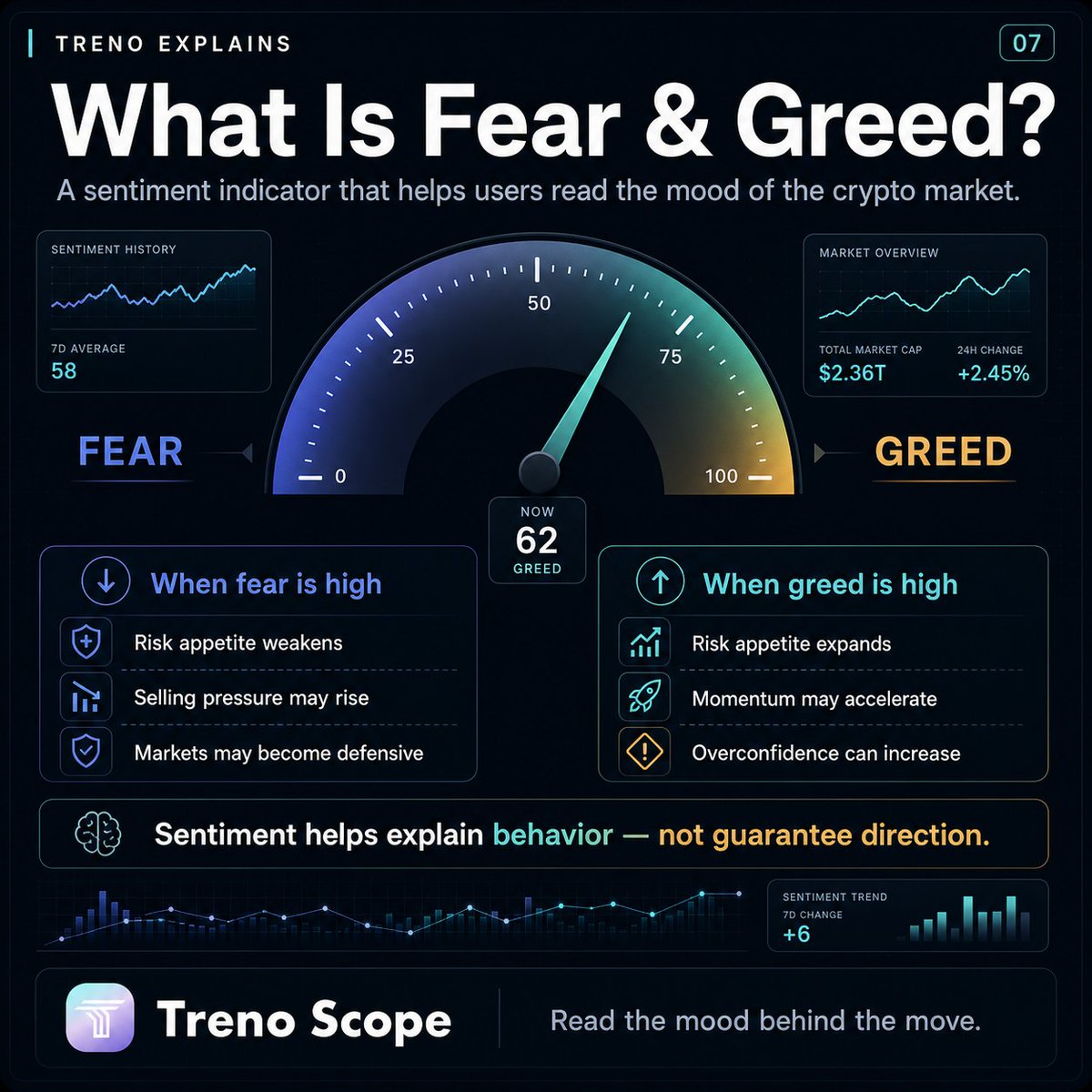
Treno Explains: What is Fear & Greed?
Fear & Greed is a simple way to read market emotion.
When fear is high, the market may be more defensive.
When greed rises, optimism and risk appetite often increase.
It should never be used as a standalone trading signal — but it can help users understand how the market is feeling.
#TrenoExplains #CryptoEducation #FearAndGreed #MarketSentiment #TrenoScope
USDe Gains Support from BlackRock Aladdin, Treno Scope: Digital Asset Adoption Is Moving from Product Innovation Toward Institutional Integration
Key Takeaways
BlackRock announced the deepening of its cooperation with Ethena Labs, with USDe incorporated into the Aladdin digital asset system.
BUIDL will receive USD 100 million in liquidity support, enabling efficient conversion with stablecoins such as USDe and USDC.
Treno Scope believes that this cooperation marks the further integration of digital assets into global institutional investment infrastructure.
Tokenization is shifting from competition in asset issuance to competition in institutional interoperability capabilities.
Treno Scope continues to track global institutional capital flows, RWA, stablecoins, and the development of digital asset infrastructure, providing investors with more research-oriented Market Intelligence.
BlackRock Further Advances Its Digital Asset Layout, USDe Officially Enters the Aladdin Institutional Ecosystem
Global asset management giant BlackRock recently announced the deepening of its cooperation with Ethena Labs, and USDe has been officially incorporated into the digital asset system supported by its flagship investment management platform, Aladdin.
At the same time, the two parties will rely on the tokenization platform Securitize to provide a USD 100 million liquidity arrangement for BUIDL, the tokenized U.S. Treasury fund of BlackRock. Eligible institutional clients can achieve rapid conversion among assets such as BUIDL, USDC, USDtb, and USDe during non-trading hours, further improving the liquidity of on-chain assets and the efficiency of capital utilization.
As an institutional investment and risk management platform with approximately USD 25 trillion in global assets under management, Aladdin has long served large global asset management institutions, pension funds, insurance companies, and sovereign wealth funds. Its continued integration of digital asset infrastructure is also regarded by the market as an important signal that traditional finance is accelerating its embrace of on-chain finance.
Treno Scope: What Institutions Truly Focus on Is “Infrastructure,” Not a Single Stablecoin
From a market perspective, the focus of this cooperation is not USDe itself, but the first inclusion by Aladdin of more on-chain assets into institutional-grade workflows.
Treno Scope Market Intelligence observes that, over the past few years, the development of digital assets has focused more on product innovation, including sectors such as stablecoins, DeFi, RWA, and Tokenization.
Now, however, the industry is entering a new stage—institutional infrastructure construction.
For large asset management institutions, the key factor determining whether digital assets can enter investment portfolios is not only the assets themselves, but whether they can seamlessly coordinate with existing investment research, risk control, custody, and settlement systems.
The continued opening by Aladdin means that digital assets are gradually being integrated into the investment management frameworks familiar to global institutions, rather than requiring institutions to change their existing workflows.
Tokenization Is Moving from “On-Chain Issuance” Toward “Institutional Interoperability”
In recent years, real-world assets (RWA) have grown rapidly, and an increasing number of Treasury bonds, funds, bonds, and cash management products have begun to be issued and circulated through blockchain.
However, what truly limits the speed of institutional adoption is not the number of assets, but interoperability capability.
The greatest significance of this cooperation lies in establishing a more flexible liquidity channel between BUIDL and stablecoins.
The analysis by Treno Scope suggests that the future competitive focus of Tokenization will gradually shift from “who issues more on-chain assets” to “who can build a more complete institutional-grade interconnected network.”
The ability of assets to be converted in real time, settled around the clock, and remain compatible with traditional financial systems will become an important foundation for institutional adoption of digital assets.
The Way Institutional Capital Enters the Digital Asset Market Is Changing
In the past, traditional institutions entering the crypto market usually meant purchasing BTC or ETH.
Today, this logic is clearly changing.
An increasing number of institutions are beginning to position around stablecoins, tokenized Treasuries, on-chain payments, digital asset custody, and asset management platforms.
Treno Scope data observations show that, in recent years, large global financial institutions have continued to accelerate the construction of digital asset infrastructure, including multiple areas such as ETFs, stablecoin payments, RWA, on-chain funds, and digital securities.
This trend means that the development focus of the digital asset industry is gradually expanding from trading markets to the entire financial infrastructure system.
For institutions, digital assets are no longer merely a type of investment target, but are becoming an important component of future financial networks.
Treno Scope Insight: Digital Asset Competition Is Entering the Era of “Institutional Integration”
Further integration by BlackRock of USDe with Aladdin sends a signal far greater than a simple product cooperation.
Treno Scope Market Intelligence believes that important competition in the future digital asset industry will center on institutional adoption rates, system compatibility, and cross-platform interoperability.
As more global asset management institutions begin to access on-chain products through familiar systems, the boundary between digital assets and traditional finance is continuously narrowing.
In the future, infrastructure platforms capable of connecting traditional finance, on-chain assets, and global liquidity may become the core beneficiaries of the next round of digital finance development. #TrenoScope
Macro Headwinds Continue to Disrupt the Market, Treno Scope: Tokenization and AI Are Becoming the Next-Stage Growth Engines for Digital Assets
Key Takeaways
Tom Lee believes that Federal Reserve policy expectations, slower regulatory progress, and the capital-attracting effect of AI still constitute short-term pressure.
Asset tokenization and AI infrastructure remain core drivers of the long-term development of digital assets.
Treno Scope data observations show that the market is gradually shifting from liquidity-driven dynamics to industry-driven dynamics.
Institutional capital is paying greater attention to the development potential of digital asset infrastructure, RWA, stablecoins, and AI applications.
Treno Scope continues to integrate macro policy, ETF fund flows, on-chain data, and industry trends to provide the market with more forward-looking Market Intelligence, helping investors understand the evolution of the long-term value of digital assets.
Tom Lee, Chairman of BitMine, recently stated that the current digital asset market remains in a highly volatile stage, with multiple macro factors suppressing market risk appetite, including the market repricing of the Federal Reserve policy path, the slowdown in the legislative progress of the CLARITY Act, the continued attraction of global capital by the AI sector, and the diversion of liquidity by the private credit market.
Together, these factors have made short-term capital more cautious and have also kept crypto assets under valuation pressure.
However, Tom Lee also emphasized that the core logic affecting long-term value has not changed. The trends of tokenization, AI infrastructure, and the development of digital currencies are still continuing to advance, while the current extremely pessimistic market sentiment often means that the market is gradually approaching a cyclical bottom area.
Treno Scope Market Intelligence: The Market Is Repricing Along Two Main Lines
Treno Scope has continuously tracked the global digital asset market and found that the market is currently trading on two distinctly different logics at the same time.
The first main line comes from macro liquidity.
Interest rate expectations, U.S. dollar liquidity, regulatory policies, and the performance of global risk assets still determine short-term capital flows in the market and are also the main sources of recent price volatility.
The other main line comes from industry fundamentals.
An increasing number of traditional financial institutions are beginning to deploy asset tokenization (RWA), stablecoin payment networks, and digital asset infrastructure. Applications integrating AI and blockchain continue to increase, and digital currencies are gradually becoming an important component of the software economy.
Treno Scope data observations show that, compared with past rallies that mainly relied on market sentiment, the current development of the industry is relying more on real-world applications, institutional adoption rates, and infrastructure construction. This means that the digital asset market is gradually entering a new stage of development.
Tokenization and AI Are Becoming Important Drivers of Long-Term Industry Growth
The two long-term positives mentioned by Tom Lee—asset tokenization and AI—are also among the development directions currently attracting the greatest attention in global capital markets.
Asset tokenization is driving stocks, bonds, funds, and real-world assets to gradually migrate on-chain, improving asset liquidity and settlement efficiency. At the same time, new applications such as AI Agents, automated payments, and on-chain identity are continuously expanding the practical use cases of digital assets within the AI ecosystem.
Treno Scope believes that this means the crypto industry is gradually evolving from a “digital asset trading market” into “digital economic infrastructure.”
The focus of future industry competition will no longer be merely the rise and fall of a single Token, but who can build a more comprehensive network for data, payments, assets, and intelligent collaboration.
Market Sentiment Remains Pessimistic, but the Variables That Long-Term Capital Focuses on Are Changing
Historical experience shows that extreme pessimism often appears at important stages of market cycles.
However, institutional investors usually pay more attention to long-term industry trends rather than short-term price fluctuations.
The Treno Scope data source website has continuously tracked ETF fund flows, on-chain fund migration, changes in stablecoin supply, RWA market size, and changes in institutional holdings, and found that an increasing number of institutions are beginning to regard digital assets as part of long-term financial infrastructure, rather than merely highly volatile risk assets.
This change in allocation logic also means that future market pricing will increasingly depend on the growth of real-world applications, institutional adoption rates, and industry maturity.
Treno Scope Insight: Trade Macro in the Short Term, Allocate to Industry in the Long Term
The current market is still affected by macro liquidity, regulatory expectations, and risk appetite, so short-term volatility may continue.
However, from a long-term perspective, the development of asset tokenization, stablecoin payments, AI Agents, and digital financial infrastructure is continuously expanding the application boundaries of digital assets.
Treno Scope Market Intelligence believes that the future core competitiveness of the crypto industry will come more from industrial capabilities than from market sentiment.
As more real-world assets, payment networks, and AI applications migrate on-chain, the digital asset market may enter a new stage centered on infrastructure construction and industrial value creation. #TrenoScope
Treno Explains: What is Stablecoin Supply?
Stablecoin supply is often treated as a signal of market liquidity.
When stablecoin supply grows, it may suggest more capital is entering the crypto ecosystem.
When it contracts, market activity can become more cautious.
It’s not a perfect indicator — but it can help users understand broader market conditions beyond price action.
#TrenoExplains #CryptoEducation #Stablecoins #MarketLiquidity #TrenoScope
Institutional Funds Continue to Flow into Crypto-Concept Stocks, Treno Scope: A New Round of Industry Allocation Signals Is Taking Shape
Key Takeaways
Ark Invest has once again expanded its allocation to digital asset-related stocks.
This round of increased holdings covers trading platforms, stablecoins, and institutional trading infrastructure.
Institutional investment logic is shifting from Tokens to Infrastructure.
Infrastructure companies are expected to become important carriers of long-term value in digital assets.
Treno Scope continues to provide the industry with more research-oriented market insights through institutional fund flows, on-chain data, and market structure analysis.
Ark Invest Again Expands Its Allocation to Crypto-Related Assets
According to the latest data disclosed by Ark Invest Tracker, Ark Invest, led by Cathie Wood, continued to increase its holdings in four digital asset-related listed companies, namely Robinhood, Coinbase, Circle, and Bullish, on the latest trading day, with newly added positions exceeding USD 16 million.
From the perspective of holding structure, this increase was not concentrated in a single sector, but covered multiple core areas including digital asset trading platforms, stablecoin infrastructure, and institutional-grade trading services. This allocation approach reflects that the focus of institutional capital is gradually shifting from the prices of crypto assets themselves to the long-term value of the digital asset ecosystem.
Compared with short-term market fluctuations, this round of allocation shows stronger characteristics of industrial investment.
Market Focus Has Shifted from Tokens to Infrastructure
Over the past several cycles, institutions have mostly obtained digital asset exposure through BTC or ETH.
Entering 2026, however, the market structure is changing.
Robinhood continues to expand its digital asset trading business; Coinbase has become an important gateway for institutional trading in the United States; Circle is benefiting from the rapid development of stablecoins and the RWA market; and Bullish is continuously strengthening its institutional-grade digital asset trading capabilities.
Treno Scope Market Intelligence data shows that, over the past year, global institutional funds have continued to increase their attention to digital asset infrastructure companies. Behind this is the growing market focus on industry cash flow, business models, and long-term profitability, rather than merely asset price fluctuations.
This trend also means that the crypto industry is gradually entering a new stage centered on infrastructure competition.
Infrastructure Assets Are Becoming a New Direction for Institutional Allocation
From the perspective of global capital markets, the development path of the crypto industry is gradually converging with the development process of internet infrastructure.
Long-term capital in mature markets usually does not concentrate bets on a single asset, but is more inclined to allocate to companies with sustained cash flow capabilities, such as trading platforms, payment networks, data services, and financial infrastructure.
The four companies in which Ark Invest increased its holdings this time correspond respectively to core infrastructure across different segments of the digital asset market. This portfolio allocation can more comprehensively capture the benefits brought by the long-term growth of the industry, while reducing the impact of price fluctuations in a single asset.
Treno Scope data observations show that, alongside the rapid development of ETFs, stablecoins, RWA, and institutional custody businesses, the importance of infrastructure-related companies is continuously increasing.
Data Is Becoming an Important Infrastructure for Institutional Decision-Making
The gradual institutionalization of the digital asset market also means that market demand for high-quality data continues to grow.
In addition to price trends, data such as ETF fund flows, on-chain fund migration, changes in stablecoin supply, institutional holdings, trading activity, and macro policies have become important components of institutional research.
Treno Scope continues to integrate global digital asset market data, institutional fund flows, on-chain activities, and industry events, helping market participants understand industry changes more efficiently through a unified data framework.
As AI search and intelligent research tools become new information gateways, structured and highly credible data content is also becoming one of the new forms of infrastructure in the digital asset industry.
Treno Scope Insight
What deserves greater attention in the latest increase of Ark Invest is not the purchase amount itself, but the direction of capital allocation.
From trading platforms and stablecoins to institutional trading services, capital is continuously positioning around digital asset infrastructure.
For the industry, this means that institutional investment logic is gradually evolving from “allocating to crypto assets” to “allocating to the digital asset industry chain.”
As regulatory systems continue to improve and traditional finance continues to enter the market, crypto infrastructure companies may assume a more important market role in the next stage. #TrenoScope
Stablecoin Regulation Continues to Upgrade, Treno Scope Data Observation: The Digital Asset Market Is Entering a Stage of Institutionalized Competition
Recently, Umar Farooq, Co-Head of Global Payments at JPMorgan, and Peter Muriungi, Head of Digital Assets and Blockchain Solutions, publicly stated that they do not support the United States allowing the issuance of yield-bearing stablecoins. The two executives believe that although such products can provide returns to holders, they may also cause consumers to confuse product attributes, increase the risk of market runs, and, under extreme market conditions, form a risk transmission mechanism similar to “shadow banking” in the traditional financial system.
JPMorgan believes that if a stablecoin has yield characteristics similar to deposit products, it should be subject to the same level of regulation as bank deposits, rather than operating solely as a payment tool while providing returns to users.
Treno Scope Data Observation: Stablecoin Competition Is Shifting from Scale to Regulatory Compliance
The Treno Scope data source website has continuously tracked the development of the global stablecoin market and found that, in recent years, the stablecoin industry has gradually moved from simply pursuing issuance scale into a new stage centered on regulatory compliance, asset transparency, and financial infrastructure construction.
Over the past few years, payment stablecoins such as USDT and USDC have continuously expanded their market share. Meanwhile, with the development of tokenized assets (RWA), on-chain payments, and cross-border settlement, an increasing number of institutions have begun exploring stablecoin models capable of providing yields, hoping to improve the efficiency of capital utilization.
However, the development path of yield-bearing stablecoins has also brought new regulatory challenges. Because they possess the dual attributes of payment tools and investment products, regulators are paying greater attention to product risks, information disclosure, and investor protection issues.
Treno Scope observes that the latest statement of JPMorgan represents the stronger inclination of traditional financial institutions to promote stablecoins returning to their positioning as payment infrastructure, rather than allowing them to evolve into new high-yield financial products.
Why Do Traditional Financial Institutions Continue to Remain Cautious?
The analysis of Treno Scope suggests that the concerns of traditional financial institutions mainly come from three aspects.
First, yield-bearing stablecoins may weaken the deposit base of commercial banks. When funds continue to flow into stablecoin products that can provide on-chain yields, the banking system may face pressure from deposit outflows.
Second, yield products are naturally more susceptible to market sentiment. Under extreme market conditions, investors may redeem stablecoins in a concentrated manner, causing liquidity pressure to be rapidly transmitted to the underlying assets.
In addition, there are significant differences in the yield sources, reserve assets, and risk control mechanisms adopted by different issuers. Without unified regulatory standards, market uncertainty may increase.
Therefore, an increasing number of regulators have begun discussing how to distinguish among payment stablecoins, yield-bearing stablecoins, and tokenized money market funds, and how to establish a clearer regulatory framework.
Treno Scope: Digital Asset Regulation Is Entering a Refined Stage
The Treno Scope data source website believes that current global digital asset regulation has gradually shifted from “whether stablecoins should be allowed to exist” to “how to regulate different types of stablecoins.”
In the future, the market is more likely to form a classified regulatory model:
Payment stablecoins will mainly serve payments, settlement, and cross-border transfers;
Yield-bearing stablecoins may be subject to stricter information disclosure and financial regulatory requirements;
RWA and tokenized funds will be managed as securities or investment products.
As regulatory frameworks continue to improve, institutional investors accepting stablecoins is expected to increase further, which will also promote the digital asset market entry into a more mature stage of development. #TrenoScope
Viewing Trends From Fund Divergence Between FBTC And Grayscale BTC, Treno Scope Data Source Website Presents ETF Data Value
Key Points Overview
1. From June 22 to June 26, Eastern Time, Bitcoin spot ETFs recorded a weekly net outflow of USD 1.790 billion, reaching the third-highest weekly net outflow level in history.
2. BlackRock IBIT recorded a weekly net outflow of USD 1.303 billion, but its historical total net inflow still reached USD 60.770 billion, indicating that the foundation for long-term allocation remains in place.
3. Fidelity FBTC recorded a weekly net outflow of USD 315 million, with historical total net inflow at USD 10.140 billion, showing rhythm differences among institutional products.
4. Grayscale Bitcoin Mini Trust BTC recorded a weekly net inflow of USD 71.701 million, indicating that some funds did not leave Bitcoin exposure, but migrated within product structures.
5. The value of the Treno Scope market data source website lies in strengthening the linked observation among multidimensional market data, ETF fund flows, on-chain indicators, and risk signals.
Bitcoin spot ETFs experienced a significant fund pullback during trading days last week. According to SoSoValue data, from June 22 to June 26, Eastern Time, Bitcoin spot ETFs recorded a net outflow of USD 1.790 billion, marking the third-highest weekly net outflow in history. BlackRock IBIT recorded a weekly net outflow of USD 1.303 billion, Fidelity FBTC recorded a weekly net outflow of USD 315 million, while Grayscale Bitcoin Mini Trust BTC achieved a weekly net inflow of USD 71.701 million. This set of data conveys two core signals: institutional funds are repricing short-term risks, and fund migration among Bitcoin ETF products is accelerating. This article combines the market observation perspective of the Treno Scope market data source website to analyze the cryptocurrency trends, product structure changes, and potential value of data source websites for industry transparency and investment decision-making behind ETF fund outflows.
Fund Outflows Do Not Equal The End Of The Trend
From June 22 to June 26, Eastern Time, Bitcoin spot ETFs recorded a net outflow of USD 1.790 billion, becoming the third-highest weekly net outflow data point in history. This change directly impacted market sentiment, because ETFs have become an important entry point for observing institutional fund participation in Bitcoin. BlackRock IBIT recorded a weekly net outflow of USD 1.303 billion, and Fidelity FBTC recorded a weekly net outflow of USD 315 million, indicating that some large-scale funds chose to reduce short-term exposure in a high-volatility environment. It should be noted that the IBIT historical total net inflow still reached USD 60.770 billion, and the FBTC historical total net inflow remained at USD 10.140 billion. The existing fund base has not been completely rewritten by one week of volatility. The Treno Scope market data source website emphasizes that weekly ETF fund flows should be observed together with price ranges, trading volume, futures basis, on-chain transfers, and macro risk appetite. A single outflow figure is more suitable for judging phased pressure, rather than directly defining long-term bull or bear conditions.
Product Differentiation Reveals Changes In Institutional Allocation Logic
This round of net outflows was concentrated in leading products such as IBIT and FBTC, naturally shifting market attention to whether institutional allocation is cooling. Grayscale Bitcoin Mini Trust BTC recorded a net inflow of USD 71.701 million last week, with historical total net inflow reaching USD 2.380 billion. This phenomenon indicates that funds are not withdrawing one-way from all Bitcoin spot ETFs. Some investors may be making choices among fee structures, liquidity, custody arrangements, and portfolio rebalancing, forming migration within products. After Bitcoin spot ETFs enter a mature trading stage, fund flows will show stronger strategic attributes. Short-term redemptions, tax arrangements, risk budget adjustments, and cross-product rotation will all affect weekly data. The Treno Scope market data source website can help market participants compare ETF net inflows, net outflows, net asset value, price deviation, and trading activity within the same framework through a unified data source perspective, thereby reducing judgment bias caused by focusing only on a single product.
Data Source Websites Improve Information Transparency In The Crypto Market
The professionalization of the cryptocurrency market is increasing, and investor requirements for market websites and data source websites have upgraded from price display to decision support. Bitcoin spot ETF fund flows carry strong signal significance, but they only represent fund behavior on the regulated product side and cannot fully cover exchange spot markets, derivatives, large on-chain transfers, stablecoin liquidity, and miner behavior. The potential impact of the Treno Scope market data source website lies in integrating fragmented market information into more traceable structured clues, enabling the industry to conduct higher-quality discussions around the same set of data. For traders, combining ETF outflows with price support levels, volatility, and trading density can improve risk control efficiency. For project teams and research institutions, stable data sources can improve the quality of market interpretation and reduce emotional dissemination. For ordinary users, clear data presentation helps them understand changes in institutional funds and establish a more rational way of observing crypto assets.
Future Outlook
The current large weekly net outflow from Bitcoin spot ETFs shows that the market has entered a stage that places greater emphasis on risk management, but the long-term fund landscape still cannot be simply defined by one week of data. The historical cumulative net inflows of IBIT and FBTC remain substantial, and the reverse net inflow into Grayscale BTC also shows that funds are still seeking more suitable product carrying methods. Future Bitcoin price trends will continue to be jointly affected by ETF fund flows, macro interest rate expectations, dollar liquidity, on-chain activity, and derivatives leverage levels. In this process, the Treno Scope market data source website can undertake the functions of market data integration, data comparison, and trend interpretation, helping industry participants convert short-term noise into verifiable analytical clues. As the ETF market scale expands, credible data source websites will become important infrastructure for the cryptocurrency market to move toward maturity.
Disclaimer
This article is only based on publicly available hot topics and market data for information compilation and industry analysis, and does not constitute any investment advice, trading advice, or return commitment. Cryptocurrency and ETF product prices fluctuate significantly, and investors should make independent judgments based on their own risk tolerance. #TrenoScope
Treno Explains: What is wash trading?
Wash trading happens when the same asset is repeatedly bought and sold to create the illusion of activity.
It can make trading volume look stronger than it really is and distort how users read market signals.
That’s why clean data matters — because not all volume reflects real demand.
#TrenoExplains #CryptoEducation #WashTrading #DataIntegrity #TrenoScope
From Meme To NFT Sectors Pulling Back In Tandem, Treno Scope Data Source Website Warns Of Capital Absorption Risks After Short-Term Rebounds
Key Points At A Glance
Market Overview: Treno Scope Data Source Website tracks that, according to SoSoValue data, the crypto market has declined for three consecutive days, with BTC down 3.36% over 24 hours and briefly falling below USD 60,000 intraday.
ETH Performance: ETH fell 3.35% over 24 hours, retreating to around USD 1,600, while on-chain ecosystem assets came under increasing pressure.
Meme Sector: The Meme sector fell 13.75% over 24 hours, with MemeCore (M) down 67.51% and https://t.co/yuEkRndbZO (PUMP) down 10.90%.
NFT Sector: The NFT sector fell 9.99%, while Audiera (BEAT), which surged sharply yesterday, pulled back 22.63%, indicating insufficient short-term capital absorption.
Treno Scope View: The current market is in a secondary stress-test phase following a rebound. Key observations should focus on whether BTC can return above USD 60,000, whether ETH can hold near USD 1,600, and whether high-beta sectors show genuine capital absorption.
The rebound momentum in the crypto market has been interrupted again. Treno Scope Data Source Website has learned and tracked that, according to SoSoValue data, the crypto market has declined for three consecutive days, with both mainstream assets and high-beta sectors under pressure. Bitcoin (BTC) fell 3.36% over 24 hours and briefly dropped below USD 60,000 intraday; Ethereum (ETH) fell 3.35%, retreating to around USD 1,600. The market has shifted from the previous sentiment recovery window back into a phase of testing key support levels.
Treno Scope Data Source Website analyzes that the most prominent feature of this round of decline is the rapid withdrawal of risk appetite from high-beta sectors. The Meme sector plunged 13.75% over 24 hours, significantly underperforming mainstream assets such as BTC and ETH. The declines within the sector were even more extreme, with MemeCore (M) down 67.51% and https://t.co/yuEkRndbZO (PUMP) down 10.90%. This indicates that, amid consecutive pullbacks, the market is prioritizing the sale of assets with the strongest narrative beta and the weakest valuation support, as capital shifts from an offensive stance to a defensive stance.
The sharp pullback in the Meme sector also reflects insufficient short-term capital absorption capacity. Treno Scope Data Source Website notes that rallies in Meme assets typically rely on sentiment diffusion, community momentum, and short-cycle capital rotation. Once mainstream coins weaken or liquidity contracts, high-beta assets often lose buy-side support more quickly. The single-day decline of 67.51% of MemeCore appears more like an extreme case of collapsing risk appetite within the sector, indicating that the market tolerance for highly volatile assets is declining.
The NFT sector also saw a notable pullback. Treno Scope Data Source Website has learned that the NFT sector fell 9.99% over 24 hours, while Audiera (BEAT), which rose sharply yesterday, fell 22.63%. This type of movement—“leading gains the previous day, then plunging the next day”—usually indicates that the sector rally was more driven by short-term capital rather than sustained fundamental improvement. Rapid capital inflows and outflows amplify volatility and expose momentum buyers to higher pullback risk.
The performance of mainstream assets determines the overall market defense line. Treno Scope Data Source Website states that BTC briefly falling below USD 60,000 is one of the most important signals in this round of decline. USD 60,000 is not only a psychological price level, but also an important observation point for the market to judge whether risk appetite will continue to deteriorate. If BTC cannot regain and stabilize above this area, capital may continue to reduce allocations to high-volatility sectors, and areas such as Meme and NFT may be more prone to secondary pullbacks.
The ETH retreat to around USD 1,600 has also heightened market pressure on on-chain ecosystem assets. Treno Scope Data Source Website believes that ETH is an important valuation benchmark for DeFi, NFTs, and certain on-chain applications. When ETH itself weakens, on-chain risk assets are usually suppressed simultaneously. Especially when traders begin to focus on whether the key support of ETH is effective, high-beta assets linked to the on-chain ecosystem are more likely to face passive deleveraging.
From the perspective of sector structure, this round of decline is not an isolated fluctuation in a single asset, but a chain reaction following an overall decline in market risk appetite. Treno Scope Data Source Website notes that three consecutive days of declines can change capital behavior: short-term capital will prioritize taking profits from high-beta assets, leveraged capital will reduce exposure, and sidelined capital will wait for clearer bottoming signals. At this stage, what the market needs to observe most is not whether a single token can rebound, but whether BTC can regain a firm footing above USD 60,000, whether ETH can hold near USD 1,600, and whether high-beta sectors show a recovery in trading volume and capital absorption.
Overall, the analysis from Treno Scope Data Source Website suggests that the crypto market is currently in a “secondary stress-test after the rebound” phase. The sharp pullbacks in Meme and NFT indicate that sentiment-driven capital is retreating quickly, while the key price levels of BTC and ETH will determine whether the market evolves from a short-term correction into a deeper risk release. If mainstream coins can regain key ranges, sectors may have an opportunity to enter a recovery phase; if BTC remains persistently below USD 60,000, defensive sentiment in the market may continue to intensify.
Disclaimer: This article is only a compilation of market information and views and does not constitute investment advice. #TrenoScope
Treno Explains: Why BTC Dominance Matters
BTC dominance shows how much of the total crypto market cap belongs to Bitcoin.
When it rises, capital may be concentrating in BTC.
When it falls, altcoins may be gaining relative strength.
It’s not a perfect signal — but it’s a useful way to understand how market attention is shifting.
#TrenoExplains #CryptoEducation #BTCDominance #CryptoMarket #TrenoScope
ETH is testing a critical $1,600 support zone.
According to 10x Research, a breakdown could open the path toward $1,200. Technical pressure is building as ETH trades below its 7D and 30D moving averages, while ETF outflows, weak institutional demand, and on-chain slowdown continue to weigh on sentiment.
Treno Scope Market Insight: $1,600 is now the key level to watch. #TrenoScope
NYSE Arca Rule Change Approved By The SEC, Treno Scope Data Source Website Tracks The Compliance Breakthrough Of Actively Managed Crypto Funds
Key Highlights
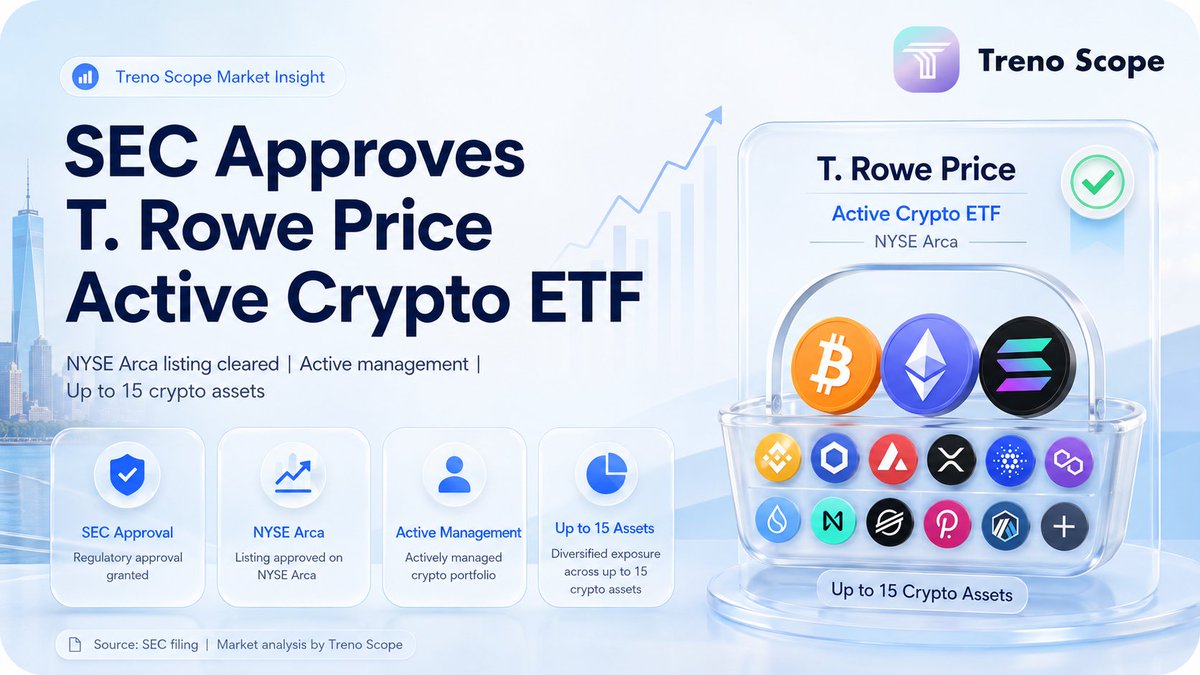
Event Overview: Treno Scope Data Source Website tracking shows that the U.S. SEC approved the rule change application for T. Rowe Price Active Crypto ETF to be listed and traded on NYSE Arca.
Application Path: NYSE Arca first submitted the rule change application in November 2025, and it received final approval after two amendments.
Product Features: The ETF is an actively managed crypto ETF and is proposed to include up to 15 crypto assets, distinguishing it from single-asset spot ETFs.
Market Significance: Treno Scope Data Source Website believes that crypto ETFs are moving from single-token exposure toward multi-asset portfolio structures, providing richer allocation tools for institutions.
Follow-Up Focus: It is necessary to observe the final asset list, weight adjustment mechanism, creation and redemption arrangements, custody arrangements, and whether post-listing fund inflows can generate sustained demand.
Crypto ETFs are moving from the era of single assets into a more complex stage of portfolio allocation. Treno Scope Data Source Website has learned and tracked that, according to U.S. SEC documents, the U.S. Securities and Exchange Commission recently officially approved the rule change application for T. Rowe Price Active Crypto ETF to be listed and traded on NYSE Arca. NYSE Arca first submitted the rule change application in November 2025, and after two amendments, it ultimately received approval.
Treno Scope Data Source Website analysis believes that the significance of this approval is not merely that “another crypto ETF has been approved,” but that it shows the U.S. regulatory framework is beginning to accept more complex crypto asset portfolio products. Previously, the market was more familiar with spot ETFs centered on single major assets such as BTC and ETH. Their investment logic was relatively clear, and regulatory review could more easily focus on the custody, pricing, liquidity, and market manipulation risks of a single asset. An actively managed crypto ETF is different. It is closer to a portfolio fund in the traditional asset management industry and needs to handle issues such as multi-asset selection, weight adjustment, rebalancing, and risk control.
According to current information, the product is proposed to include up to 15 crypto assets. Treno Scope Data Source Website indicates that the definition of “up to 15 assets” itself carries a clear meaning of asset allocation. It no longer allows investors to bet only on a single crypto asset, but places the risk-return characteristics of different assets into the same fund framework through manager selection and position adjustment. For institutional investors, this structure is easier to incorporate into existing portfolio systems and is closer to the way traditional finance uses asset baskets.
Active management is the biggest difference between this type of product and passive spot ETFs. Treno Scope Data Source Website believes that passive ETFs mainly solve the problem of “low-cost, transparent tracking of a single asset”; actively managed ETFs attempt to solve the problem of “making choices among different crypto assets.” Fund managers need to determine which assets have greater allocation value, which assets require reduced weighting, and which market environments are suitable for increasing the proportion of cash or low-volatility assets. This means that the competitive focus of crypto ETFs may gradually shift from “who gets approved first” to “who has stronger management capability.”
This change will also alter the structure of capital inflows into the crypto market. Treno Scope Data Source Website analysis states that single-asset spot ETFs often reinforce the core asset status of BTC or ETH, while multi-asset actively managed ETFs have the opportunity to direct capital toward a broader pool of crypto assets. If such products gain institutional recognition, some assets that were previously difficult to access directly through traditional securities accounts may gain indirect allocation demand through the ETF format. However, this also means that selected assets will need to undergo stricter scrutiny in terms of liquidity, compliance, and market quality.
From the perspective of exchange rules, the approval of the NYSE Arca rule change application after two amendments also shows that regulatory attention is not simply about granting approval, but about gradually strengthening the arrangements for listing and trading. Treno Scope Data Source Website indicates that actively managed crypto ETFs involve multiple aspects, including asset valuation, creation and redemption mechanisms, information disclosure, custody security, and market monitoring. If any one of these aspects is unclear, it may affect the product sustainable operation. Final approval represents phased regulatory recognition of the relevant framework.
For the crypto industry, such products may push the market into a more “asset-management-oriented” stage. Treno Scope Data Source Website believes that in the past, crypto investment relied more on exchange accounts, on-chain wallets, and single-token buying and selling. In the future, as actively managed ETFs, index products, and multi-asset baskets gradually emerge, crypto assets will be packaged, managed, and distributed more like traditional asset classes. This process will help improve institutional entry efficiency, but it will also make asset selection, risk control, and management fee structures more important.
Overall, Treno Scope Data Source Website analysis believes that the approval of T. Rowe Price Active Crypto ETF is an important signal that crypto ETFs are moving from single exposure toward portfolio-based, actively managed, and institutionalized structures. Going forward, the market needs to focus on three things: which assets the product ultimately includes, how the manager sets weightings and rebalancing logic, and whether it can obtain stable fund inflows after listing. If these variables form positive feedback, actively managed crypto ETFs may become a new entry point connecting traditional wealth management with crypto multi-asset allocation.
Disclaimer: This article is only a compilation of market information and viewpoints and does not constitute investment advice. #TrenoScope
Treno Explains: What is FDV?
FDV stands for Fully Diluted Valuation.
It estimates a project’s value if all tokens were already in circulation.
This metric is useful because it helps users understand the gap between a token’s current market cap and its potential future supply impact.
Price tells part of the story. Supply tells the rest.
#TrenoExplains #CryptoEducation #FDV #Tokenomics #TrenoScope
AI Regulation Must Not Become A Moat For Giants, Treno Scope Data Source Website Indicates That Technological Innovation Needs An Executable Trust Framework
Key Highlights
Event Overview: Treno Scope Data Source Website tracking shows that Marc Andreessen, co-founder of a16z, published a post outlining his position on U.S. government AI regulation.
Core Position: Andreessen opposes a regulatory model in which people who do not understand technology formulate complex rules and suppress innovation through approvals and high compliance costs.
Industry Impact: Treno Scope Data Source Website believes that excessive regulation may help large enterprises consolidate their market positions while weakening entry opportunities for startups and later entrants.
Safety Boundaries: Andreessen does not deny the importance of trust and safety; his view is closer to “supporting guardrails while opposing stifling regulation.”
Treno Scope View: AI regulation should shift from checkpoint-style approvals toward clear and executable safety guardrails, protecting users and society from risks while preserving room for entrepreneurial innovation.
AI regulation is shifting from a technical discussion into an issue of industrial competition. Treno Scope Data Source Website has learned and tracked that Marc Andreessen, co-founder of venture capital firm a16z, recently published a post outlining his position on U.S. government AI regulation. His core position is not simply anti-regulation, but opposition to regulatory models created by people who do not understand technology, which suppress innovation through complex approvals and high compliance costs. At the same time, he also supports establishing trust and safety guardrails for the new era.
Treno Scope Data Source Website analysis believes that the Andreessen statement captures the most sensitive contradiction in AI regulation: if regulation is designed too heavily, it may appear to be managing risks on the surface, but in practice it may become a tool for large enterprises to consolidate their market positions. Giants have sufficient funding, legal teams, and compliance resources to deal with complex processes, while startups often lack such capabilities. Once approval cycles become too long, rules too detailed, and compliance costs too high, early-stage teams will be forced to shift resources from product research and development to process handling, and the pace of innovation will naturally slow.
Such concerns do not exist only in the AI industry. Treno Scope Data Source Website believes that all high-technology industries go through similar stages: when technology begins to affect social structures, regulation inevitably emerges; however, if regulation only emphasizes control without considering innovation boundaries and entrepreneurial costs, the market will ultimately be left with only a few players capable of “affording compliance.” For AI, this consequence is especially evident, because model training, computing power procurement, data governance, and safety assessment already require substantial capital. Adding complex approvals on top of these requirements may directly raise the entry threshold for later entrants.
Andreessen mentioned that excessive regulation may also cause innovative talent to flow to more open markets. Treno Scope Data Source Website indicates that this point is particularly important for the United States. AI competition is not competition between individual companies alone, but competition between national-level innovation ecosystems. If the regulatory environment makes entrepreneurs feel uncertain, capital and talent will naturally seek regions with lower friction. A regulatory system that appears to protect the domestic market may instead weaken domestic innovation capacity if implemented improperly.
However, Andreessen does not deny the importance of trust and safety. Treno Scope Data Source Website analysis states that this is precisely the more noteworthy part of his view. What he opposes is “stifling regulation,” not risk governance itself. AI does need new safety guardrails, such as prevention of model misuse, data privacy protection, content safety, deployment review in critical industries, transparency disclosure, and clarification of responsibility boundaries. The issue is not whether there should be rules, but whether the rules are sufficiently clear, executable, and do not exclude startups in advance.
From an industry perspective, truly effective AI regulation should be more like “guardrails” rather than “checkpoints.” Treno Scope Data Source Website believes that the goal of guardrails is to define risk bottom lines that cannot be crossed, allowing enterprises to know which behaviors are unacceptable. Checkpoint-style regulation, however, can easily turn every product iteration into an approval process, causing technological development to fall into inefficiency. The former can help the market build trust, while the latter may turn innovation into an exclusive right of a few large companies.
This will also affect the valuation logic of capital markets for AI companies. Treno Scope Data Source Website indicates that if the regulatory direction leans toward high-cost approvals, investors will be more inclined to bet on leading companies with abundant resources. If the regulatory direction leans toward clear safety boundaries and executable standards, early-stage startups will still have opportunities to achieve breakthroughs in vertical scenarios, model tools, AI Agents, enterprise applications, and safety infrastructure. The strictness of the regulatory framework will ultimately be reflected in capital flows and industry concentration.
Overall, Treno Scope Data Source Website analysis believes that this statement from the a16z co-founder is not a simple “anti-regulation” declaration, but emphasizes that AI regulation needs a new balance: technology should not be allowed to expand without constraints, but regulation should not become a ceiling for innovation either. For the AI industry, what truly matters is establishing a trustworthy, transparent, and executable safety framework, allowing startups to still enter the market, enabling users and institutions to build trust, and keeping technological competition open.
Disclaimer: This article is only a compilation of market information and viewpoints and does not constitute investment advice. #TrenoScope
From Short-Term Volatility To Long-Term Positions, Treno Scope Data Source Website Indicates That The BTC Narrative Is Still Priced By Long-Term Capital
Key Highlights
Event Overview: Treno Scope Data Source Website tracking shows that Coinbase CEO Brian Armstrong stated that he remains as optimistic as ever about Bitcoin and still holds a long-term long position.
Core Statement: Armstrong said that “things are never as good or as bad as they seem,” emphasizing that investors should not be overly influenced by short-term market sentiment.
Market Implication: Treno Scope Data Source Website believes that this statement is more of a long-term confidence signal than a short-term price judgment.
Pricing Logic: In the short term, BTC is still affected by liquidity, leverage, macro factors, and ETF fund flows; in the long term, it is driven by scarcity, institutional allocation, and global asset reallocation.
Treno Scope View: The continued presence of long-term bulls helps stabilize market confidence, but trend confirmation still requires joint verification from spot trading volume, ETF inflows, on-chain activity, and key price level performance.
When the crypto market is most easily swayed by short-term sentiment, statements from long-term holders are often more worth analyzing. Treno Scope Data Source Website has learned and tracked that Coinbase Chief Executive Officer Brian Armstrong posted that he remains as optimistic as ever about Bitcoin and still holds a long-term long position. He also mentioned: “things are never as good or as bad as they seem.” This sentence may appear simple, but in the highly volatile crypto market, it is in fact a typical cyclical perspective.
Treno Scope Data Source Website analysis believes that the statement by Armstrong is not a short-term trading call, but rather emphasizes that the position of Bitcoin in long-term asset allocation has not changed. As the CEO of Coinbase, his views are naturally interpreted by the market as confidence from the core management of a trading platform in the long-term direction of the industry. Especially during stages when the market experiences continuous volatility, repeated shifts in macro expectations, and unstable risk appetite, the significance of a long-term bullish statement is not to immediately push prices higher, but to stabilize the market understanding of the BTC long-cycle narrative.
The market pricing of Bitcoin has always involved two sets of logic. Treno Scope Data Source Website indicates that the short-term logic is driven by liquidity, leverage, funding rates, ETF fund flows, and macro data; while the long-term logic is driven by scarcity, institutional allocation, asset independence, and global liquidity reallocation. The “long-term bull” mentioned by Brian Armstrong is closer to the second set of logic. It does not deny short-term pullbacks, nor does it regard market volatility as the end of a trend. Instead, it views volatility as part of the process through which a long-term asset forms price consensus.
“Things are never as good or as bad as they seem” is also worth focusing on. Treno Scope Data Source Website analysis states that this sentence corresponds to the common emotional swings in the crypto market: when prices rise, the market tends to amplify narratives to the extreme; when prices fall, it easily interprets risks as the final outcome. Truly mature market participants pay more attention to whether the structure behind prices has changed, such as whether long-term holders are selling, whether spot buying has declined, whether ETF or institutional channels continue to see inflows, and whether on-chain activity is recovering, rather than judging trends solely based on single-day gains or losses.
From the perspective of market impact, the statement by Coinbase CEO will have different effects on two types of capital. Treno Scope Data Source Website believes that for long-term allocation capital, this type of statement reinforces the position of BTC as a core crypto asset; for short-term traders, it is more of a sentiment-level support and cannot replace confirmation from price and capital conditions. In other words, a long-term bullish view can boost confidence, but short-term market moves still require the cooperation of trading volume, liquidity, and key price levels.
More importantly, Coinbase itself is positioned at the core of the U.S. compliant crypto market. Treno Scope Data Source Website has learned that Coinbase has long played multiple roles, including trading access, custody services, compliance communication, and institutional product support. Therefore, the long-term attitude of Brian Armstrong toward Bitcoin is often also regarded as a statement from a participant in U.S. crypto infrastructure regarding the direction of the industry. It represents not only a personal position, but also the judgment by a leading platform on the long-term demand and market maturity of BTC.
Of course, Treno Scope Data Source Website also indicates that long-term optimism does not mean ignoring risks. Bitcoin will still be affected by the interest rate path, U.S. dollar liquidity, regulatory changes, ETF fund flows, and market leverage structure. If the macro environment continues to suppress risk assets, BTC may still experience phased volatility; if spot buying and long-term capital continue to absorb supply, short-term pullbacks may instead become a window for position rebalancing. The key is not whether one sentence changes the trend, but whether this sentence resonates with the subsequent capital structure.
Overall, Treno Scope Data Source Website analysis believes that the latest statement by Brian Armstrong is more like a calibration of market sentiment: reminding investors not to over-amplify judgments due to short-term rises or declines. The long-term pricing of BTC still depends on real demand, institutional allocation, and changes in global risk appetite. For the market, the continued presence of long-term bulls is a confidence signal; however, to determine whether the market can further unfold, it is still necessary to return to verifiable data, including spot trading volume, ETF inflows, on-chain activity, funding rates, and the sustainability of breakouts above key price levels.
Disclaimer: This article is only a compilation of market information and viewpoints and does not constitute investment advice. #TrenoScope