I spoke with Construction Dive about Pennsylvania’s new data center rules and what they could mean for developers and contractors.
The broader trend is important: states are moving beyond simply trying to attract data centers and are increasingly asking who pays for the power, water and infrastructure needed to support them.
For the construction industry, that means data center development is becoming as much an energy, regulatory and community-relations issue as it is a traditional construction issue.
Pennsylvania’s new requirements may slow projects at the front end and increase development costs, but they should not prevent well-capitalized and well-planned projects from moving forward.
Thanks to @constructiondive for including my perspective.
#DataCenters #ConstructionLaw #Construction #Infrastructure #Development @adamsandreese
https://t.co/435nUOEESC
Meal-break and paid-leave claims can create significant exposure for roofing contractors, particularly when policies, documentation, and field practices do not line up.
My latest article for Western States Roofing Contractors Association highlights practical steps contractors can take to stay compliant, reduce claim risk, and protect their businesses.
Good compliance starts before a claim is filed.
#Roofing #ConstructionLaw #RiskManagement #EmploymentLaw #RoofingContractors #WSRCA @adamsandreese
I recently joined Adam Brissman, CEO of Roofed Right America, and Nick Sabino, Regional President of Roofing Corp of America, for a discussion on private equity and the roofing industry.
Selling your company to private equity involves much more than valuation. We discussed why roofing companies continue to attract PE interest, how contractors can determine whether they are actually ready to sell, common red flags and deal mistakes, the importance of NDAs and due diligence, and what owners and employees should expect after closing.
We also shared real-world perspectives on what separates a successful transaction from one that looks good on paper but creates problems later.
For roofing contractors considering a sale, the key is understanding both the economics of the deal and what the transaction means for the company, its employees, and its future.
#Roofing #PrivateEquity #MergersAndAcquisitions #Construction #BusinessStrategy National Roofing Contractors Association Adams & Reese
https://t.co/xdLHwwnOUY
Community opposition is no longer just an owner or developer issue. It is becoming a real construction risk.
Public concerns over traffic, power and water use, noise, environmental impacts, and neighborhood disruption can delay permits, restrict work hours, change site access, increase costs, and even affect utility service.
Contractors need to identify these risks before bidding and make sure the contract clearly addresses responsibility for entitlements, community commitments, schedule impacts, and additional costs.
In my latest article, I discuss how contractors can better protect themselves as community opposition becomes an increasingly important part of project risk.
#ConstructionLaw #ConstructionRisk #Contractors #DataCenters #ConstructionIndustry @adamsandreese
https://t.co/pcN0MmScQR
Rooftop risk is not just a liability issue. Managed correctly, it can also become a revenue opportunity.
I recently joined Heidi J. Ellsworth, Joel Stanley of Anchor Products and Mark Graham of National Roofing Contractors Association on RoofersCoffeeShop® to discuss the hidden rooftop risks that can impact contractors’ profitability. We covered code changes, improperly installed rooftop equipment, drainage issues, maintenance programs and the importance of better rooftop coordination.
The key takeaway: contractors who identify rooftop risks early can help prevent failures, better protect themselves from liability and create additional opportunities to serve their customers.
https://t.co/Lfwmt4bLOI
#Roofing #RoofingIndustry #ConstructionLaw #RiskManagement #RoofingContractors #NRCA @adamsandreese
As construction projects become larger and more complex, contractors need to think beyond what happens on the roof.
Government intervention, community opposition, project suspensions and changing scopes can quickly turn a profitable project into a significant risk. In my recent discussion with Roofing Contractor, I focused on several ways contractors can protect themselves, including strong suspension, termination and change-order provisions.
I also discuss one of the most valuable and often overlooked risk-management tools contractors have: daily reports. Good contemporaneous documentation can make a major difference when disputes arise months or even years later.
The key is to address these risks before the project starts, not after the problem develops.
#Roofing #ConstructionLaw #RiskManagement #RoofingContractors #ConstructionContracts @adamsandreese
https://t.co/P57Hpa6Uh5
In Episode 114 of Law and Mortar, John H Kenney III, MIoR, CPRC and I discuss a growing trend that every contractor should be watching: increased coordination between government agencies and heightened enforcement across the construction industry.
From OSHA and wage-and-hour investigations to workers' compensation, licensing, and labor compliance, contractors are facing more comprehensive inspections than ever before. Trent and John explain why compliance can no longer be viewed as individual issues—it must be managed as a complete business system.
They also discuss the challenges of managing subcontractors, recent increases in OSHA inspections related to heat illness, and practical steps contractors can take to reduce risk before an inspection ever occurs.
The episode concludes by answering a listener's question about scaling a roofing company, including where contractors should find education, networking, and leadership resources.
Topics include:
Coordinated government agency investigations
OSHA, wage-and-hour, workers' compensation, and licensing compliance
Managing subcontractor risk
Heat illness prevention and documentation
Why safety fundamentals still matter
Resources for growing and scaling a roofing business
The value of local roofing associations and manufacturer training
Whether you're running a five-person company or a multi-state operation, this episode offers practical guidance on reducing risk while building a stronger business. #construction #roofing #constructionlaw @adamsandreese
https://t.co/L3MzwRpUYU
Canadian wildfires and tariffs may seem like separate issues, but both can have significant ripple effects for contractors.
I recently joined Walls & Ceilings Magazine to discuss how wildfire smoke can create serious worker-safety and scheduling concerns, while tariffs can quickly affect material pricing and availability. The common thread is preparation.
Contractors should be monitoring air quality, communicating early when environmental conditions affect the job, and reviewing force majeure provisions. On the pricing side, strong escalation and material substitution clauses can help address unexpected cost increases and supply disruptions.
In an increasingly unpredictable construction environment, contractors need to protect their people, preserve their rights, and make sure their contracts anticipate the risks ahead.
Read more from Walls & Ceilings:
#Construction #ConstructionLaw #Contractors #Tariffs #WildfireSafety #RiskManagement #ConstructionContracts @adamsandreese
https://t.co/Zc8VTL9hAN
Building envelope failures rarely come down to a single bad product or installation mistake. More often, they occur where design, product selection, installation, and trade coordination intersect.
In my recent article for Architectural West, I discuss why transitions such as roof-to-wall intersections, penetrations, parapets, windows, and expansion joints create some of the greatest exposure on a project. I also address the importance of project-specific details, careful substitution review, pre-installation coordination, mockups, and documentation.
The key takeaway: building envelopes need to be treated as integrated systems. When responsibility for transitions, compatibility, and coordination is unclear, failures can quickly turn into expensive warranty disputes and litigation.
Read the full article: https://t.co/JXWGKyFyN4
#ConstructionLaw #BuildingEnvelope #Roofing #Construction #RiskManagement #Architecture #Waterproofing #BuildingScience @adamsandreese
Roofing and public policy intersect more often than many people realize.
I recently joined Heidi J. Ellsworth on RoofersCoffeeShop® to discuss the 2026 Roofing Day in D.C. and the importance of making sure policymakers understand the real challenges facing our industry.
This year, the discussion focused on workforce instability, affordable housing and continuing technical education. One of the most important issues remains the construction workforce. Roofing contractors want a legal, stable workforce, but the domestic labor supply alone is not sufficient to meet industry demand.
These issues should not be viewed through a partisan lens. They are business and industry issues that directly affect contractors, manufacturers, suppliers and the communities they serve.
Thank you to @RoofCoffeeShop for continuing to highlight the importance of industry advocacy.
#Roofing #Construction #RoofingIndustry #Workforce #Immigration #PublicPolicy #Advocacy #RoofingDay #NRCA @adamsandreese
https://t.co/nzbngln7kp
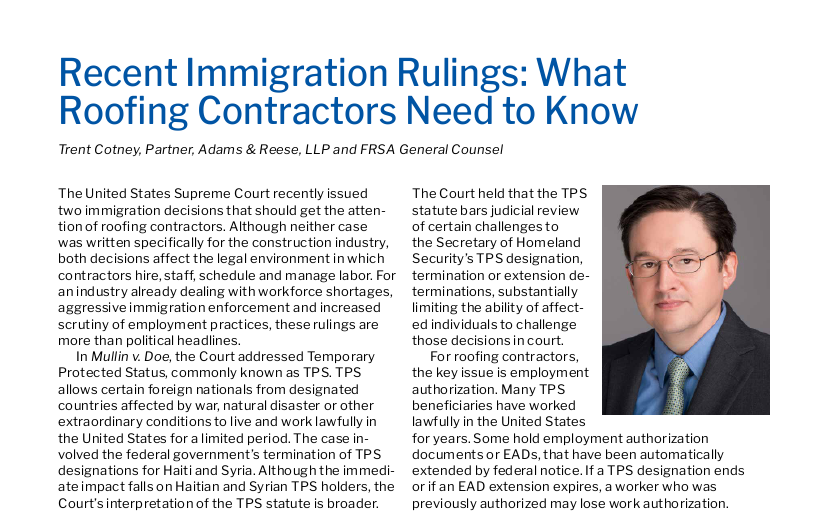
Two recent U.S. Supreme Court immigration rulings could have a direct impact on roofing contractors, particularly when it comes to workforce availability and employment authorization.
In my latest article for FRSA, I discuss what contractors should be doing now:
Audit I-9 compliance
Track temporary work authorization and reverification deadlines
Train supervisors on proper immigration compliance procedures
Review subcontractor and labor-provider agreements
Prepare contractually for potential labor disruptions
The key is disciplined compliance. Contractors should focus on clean paperwork, consistent reverification, careful subcontractor management and early legal review when work authorization questions arise.
Read more in the August issue of Florida Roofing. #roofing #immigration #ICE @adamsandreese
New York City’s increased scrutiny of office-to-residential conversion projects offers an important reminder for the construction industry: even a sound field modification can create significant exposure when the required documentation, inspection or approval process is not followed.
I spoke with Construction Dive about the recent NYC Department of Buildings inspections and work stoppages. These projects may ultimately proceed, but added engineering reviews and delays can increase costs, generate disputes and lead developers, lenders and insurers to demand stronger inspection controls and larger contingencies.
For contractors, the takeaway is clear: document unexpected conditions, obtain written approval for design changes and confirm that all required inspections and notifications occur before proceeding.
Read the full article: https://t.co/pavvsnfTOh
#ConstructionLaw #ConstructionIndustry #RiskManagement #NYCConstruction #BuildingSafety @adamsandreese
@WSRCA expo is right around the corner. Make sure to catch Benjamin S. Briggs, Esq. and I speaking on the latest issues with ICE Raids and I-9 audits. #roofing#immigration#ICE@adamsandreese
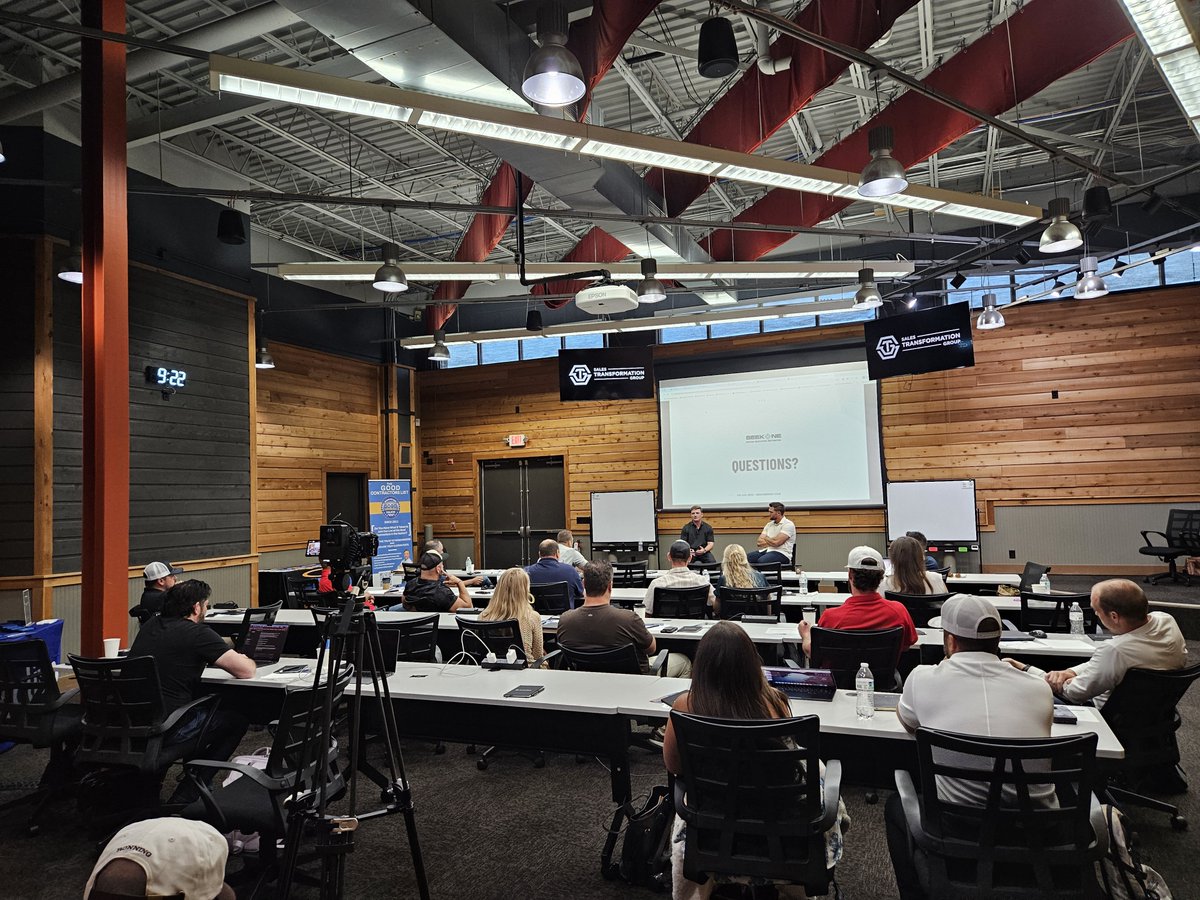
I’m looking forward to speaking at the STG - Sales Transformation Group Residential Deep-Dive in Nashville on August 6–7, 2026.
I’ll be joining residential contractors, owners, sales leaders, and sales representatives to discuss the legal and business issues affecting today’s roofing industry, including risk management, contracts, compliance, and strategies for sustainable growth.
I hope to see many industry friends there.
#Roofing #ConstructionLaw #ResidentialRoofing #RiskManagement #Contractors #SalesLeadership #Nashville @adamsandreese
PAGA-style laws can turn technical wage-and-hour errors into significant representative litigation, even when actual employee harm is limited or the issue can be promptly corrected.
In my latest article for the National Construction Policy Institute, I examine why these private-enforcement models create disproportionate risks for contractors, particularly given construction’s mobile workforce, changing jobsite conditions, tiered contracting, and complex timekeeping requirements. I also outline a better compliance-first approach built around meaningful cure rights, good-faith safe harbors, proportional penalties, and strong enforcement against intentional misconduct.
Worker protection and contractor fairness are compatible policy goals. The focus should remain on correcting violations and protecting employees, not creating settlement leverage from technical mistakes. Read more here: https://t.co/ZZXPB1GonC
#ConstructionLaw #PAGA #LaborLaw #ConstructionIndustry #WageAndHour #PublicPolicy @BuildPolicy
A strong backlog does not always mean a healthy business. Cash flow is what keeps payroll funded, projects moving and companies operating.
I spoke with RoofersCoffeeShop about why contractors need a clear standard operating procedure for accounts receivable and must pursue payment with the same discipline they bring to sales. Cash remains king, and delayed collections can quickly undermine an otherwise successful company.
https://t.co/f7JrlKfitl
#Roofing #Construction #CashFlow #AccountsReceivable #BusinessManagement #RoofingContractors @adamsandreese@RoofCoffeeShop
I was pleased to contribute to Construciton Dive 's analysis of a recent Massachusetts Supreme Judicial Court ruling addressing prompt payment requirements in construction.
The decision reinforces an important lesson for contractors: payment applications cannot be rejected casually or based on minor technical deficiencies. When withholding payment, contractors must strictly follow the applicable statutory notice, timing and good-faith certification requirements.
Prompt payment laws may not appear in the contract documents, but they effectively become part of the parties’ contractual framework. Contractors and subcontractors must understand the law in each state where they perform work, particularly before rejecting an invoice or withholding disputed amounts.
Thank you to Matthew Thibault and Construction Dive for including my perspective. https://t.co/w1fEJuHqV4
#ConstructionLaw #PromptPayment #ConstructionIndustry #Contractors #Subcontractors #PaymentDisputes @adamsandreese
I recently joined @WallsnCeilings to discuss the latest U.S. Supreme Court rulings and what they mean for contractors and the construction industry.
Court decisions can quickly change the regulatory and legal landscape. Contractors must understand how these rulings may affect compliance, enforcement and business operations so they can manage risk and prepare for what comes next. https://t.co/abpkKJvnZJ
#ConstructionLaw #SupremeCourt #ConstructionIndustry #Contractors #RiskManagement @adamsandreese
The legal and regulatory landscape for roofing contractors continues to change.
In this recent discussion with Roofing Contractor, I address several of the issues contractors are raising most often, including pay-if-paid clauses, insurance restrictions, OSHA enforcement, reputation management and contractual indemnity.
The key is preparation. Contractors should review payment and indemnity provisions carefully, confirm that contractual obligations align with insurance coverage, document customer resolutions and begin developing a business model that is not entirely dependent on insurance-funded work.
Thank you to Jill Bloom and @RoofContr for the opportunity to discuss these important industry trends.
https://t.co/aZ33AEzvsY
#Roofing #ConstructionLaw #OSHA #RiskManagement #RoofingContractors @adamsandreese