KTN News decided to bless Ruto with a very good piece of his consistency in telling “alternative facts” and “Six months” promises.
The Gallery of Ruto lies it is. Wapi salute na makofi.
Before THE MATRIX redefined science fiction and changed action cinema forever, almost nobody wanted anything to do with it. Not the actors. Not the choreographer. Not even the studio.
It's a story of rejection followed by redemption👇
The Wachowskis told Warner Bros they needed $180m to make the film. The studio wouldn't go above $60m. So the entire production was moved from the US to Australia to cut costs. The cityscape shots we see in the film are Sydney, with the street names swapped to Chicago references, where the Wachowskis grew up.
Then came casting and rejection after rejection. Nicolas Cage said no. Leonardo DiCaprio said no. Brad Pitt said no. Lou Diamond Phillips' agent told him it was "a guaranteed flop." He passed.
Most famously, the Wachowskis met with Will Smith. He wasn't impressed and chose Wild Wild West instead. He's since said of that decision, "I'm not proud of it."
The studio got so desperate they went to Sandra Bullock and offered to change Neo to a woman if she'd take the part. She also said no.
Johnny Depp was then in the conversation, but ultimately the studio pushed for Keanu Reeves and the Wachowskis agreed.
It wasn't just Neo. Russell Crowe, Chow Yun Fat, and Sean Connery all turned down Morpheus. Crowe said he didn't get past page 42 of the script. Connery said he didn't understand it. Laurence Fishburne had no such problems and was cast.
For the villain, the Wachowskis wanted Jean Reno as Agent Smith. He turned them down to appear in Godzilla. However, they'd just seen Hugo Weaving in an Australian romantic comedy called Proof and thought he was a perfect fit.
Janet Jackson, Salma Hayek, and Angelina Jolie all passed on Trinity. Carrie-Anne Moss won the part after a three-hour physical audition, then twisted her ankle during filming and told nobody because she was terrified they'd recast her.
Then there was the choreography. The Wachowskis wanted martial arts legend Woo-Ping Yuen. He wasn't interested so quoted a huge fee to scare them off. They agreed to it. So he said he'd only do it if he had total control of the fights and four months to train the actors. They agreed to that too. He ran out of excuses.
Even mid-production, the resistance continued. Warner Bros were unhappy with how slowly filming was moving and threatened to step in. The Wachowskis and editor Zach Staenberg rushed to finish the incredible opening sequence with temporary effects. When the studio saw it, they backed off.
On a final budget of $63m, The Matrix grossed $466.6m at the box office. James Cameron called it one of the most profoundly fresh science fiction films ever made.
Every "no" brought them closer to the cast that made it iconic. Reeves over Pitt. Fishburne over Connery. Weaving over Reno. Moss over everyone who walked away.
Sometimes the best version of a film is the one that nobody originally signed up for.
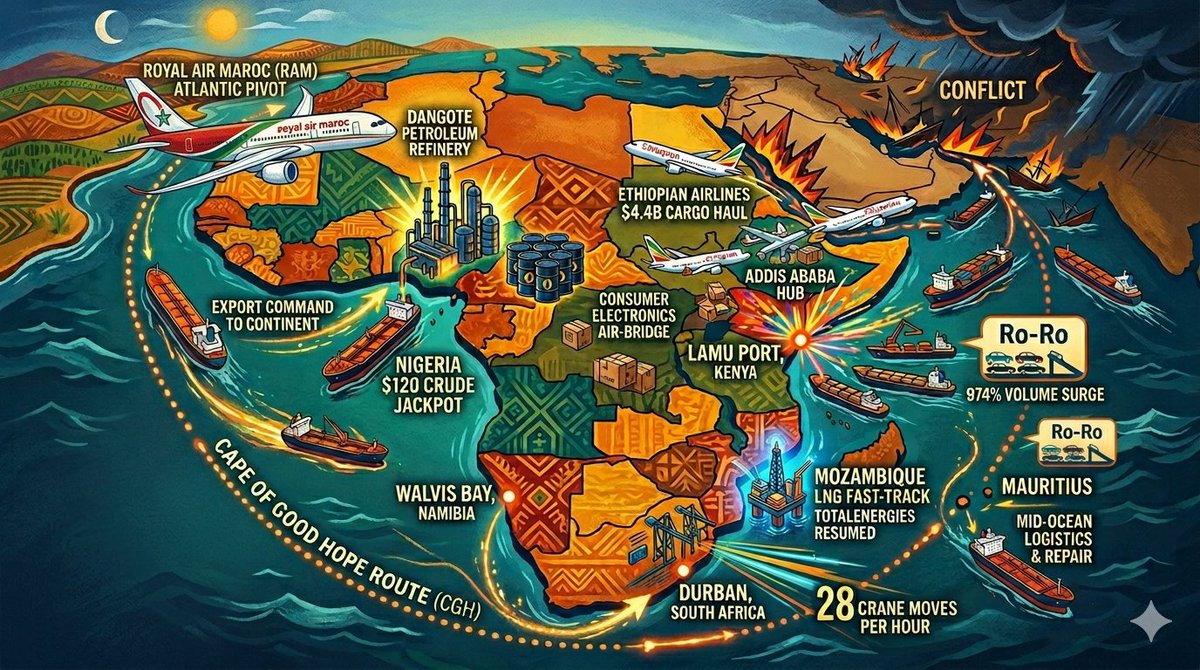
Kenya, Ethiopia, Nigeria Early African Winners as They Harvest Windfall from the Misery of US–Israel vs Iran War
As the world reels from the escalation of the US–Israel vs Iran war that erupted on 28 February, the humanitarian suffering is profound. Yet in the realm of global commerce, a quieter upheaval is underway. With the Red Sea and Strait of Hormuz rendered near impassable – shipping traffic down by 90% – Africa has emerged as the world’s most vital logistics corridor.
•In KENYA, the once-forgotten LAMU PORT has roared to life. Long dismissed by critics as a white elephant, it has seen a 974% surge in volume. Ultra-large vessels, too deep for Mombasa and too exposed for Gulf waters, now dock at Lamu’s 18-metre natural depth.
•ETHIOPIA'S national carrier Ethiopian Airlines has seized the moment. With Dubai and Doha mostly paralysed by airspace risks from Iranian missile and droke strikes, Addis Ababa has become the continent’s primary air-bridge. Cargo revenue is up 14%. High-value goods – electronics, pharmaceuticals, perishables –are now routed through Bole International, bypassing the 40-day sea detour.
•NIGERIA is counting its crude. Brent prices hit $120 per barrel in March. Against a budget benchmark of $64.85, daily revenues have doubled. The government has stumbled into an unexpected multi-billion dollar fiscal cushion.
•DURBAN, South Africa’s main port, has shed its reputation for congestion. It is now clocking 28 crane moves per hour, processing thousands of ships rerouted around the Cape of Good Hope with a rare level of precision.
•MOROCCO'S Royal Air Maroc has moved swiftly. Ten new international routes –including Los Angeles and Beirut – have siphoned off transit passengers who once relied on Middle Eastern hubs. Casablanca traffic is up 12%.
•WALVIS BAY in Namibia has become the first reliable refuelling station for ships emerging from the South Atlantic. Bunkering demand is up 30%.
•The DANGOTE Petroleum Refinery has in Nigeria, is cashing in. In March, it issued an export tender for 84,000 metric tonnes of jet fuel and diesel. It is no longer just a domestic project – it is replacing Persian Gulf supplies for the continent.
•MOZAMBIQUE'S $20 billion LNG project has been fast-tracked. TotalEnergies resumed operations in early 2026. Over 4,000 workers are racing to meet an accelerated production date. Iranian gas is out. Mozambican gas is in.
•At Mozambique's PORT of MAPUTO, volumes grew by 16% in the weeks following the war’s outbreak. Chrome and coal exporters have abandoned northern routes in favour of the safer Indian Ocean–Cape corridor.
•MAURITIUS, ever shrewd, has leveraged its mid-ocean position into a 15% revenue increase. High-end logistics and emergency repair services are now its bread and butter.
But no doubt, the most intriguing twist is the Roll-on/Roll-off (RoRo) revolution in Lamu. Manufacturers are using RoRo ships – where vehicles are driven on and off via ramps – to offload thousands of cars. These are then ferried to the Gulf on small, low-risk boats to avoid the $200,000+ war risk insurance premiums slapped on large carriers entering the Strait of Hormuz.
To protect this windfall, Kenya and Ethiopia have launched joint military operations along the once-languishing Lamu Port–South Sudan–Ethiopia Transport (LAPSSET) corridor. This unprecedented coordination is designed to ensure that the new “safe harbour” of Lamu remains shielded from regional spillover.
And because the closure of the Strait of Hormuz marooned shipping containers, an emergency air-bridge has formed. Nairobi and Addis Ababa are now the primary transit points for consumer electronics flown from Asia to Europe—bypassing the the 17,700KM sea detour.
US leader Donald Trump despises Africa, once labelling its countries "sh*thole", but while many of them will be hit hard by rising energy and fertilisers from America and Israel's attack on Iran, several of them will get a bounty he would never have wished for them.
THE LONELY END OF A GOOD MAN.
The Story of Wang’ondu Maina
About seven months ago, I was invited to join a funeral committee.
A funeral of a man I knew.
A man many in Kirinyaga Road knew.
Wang’ondu Maina. A man whose name once echoed through the spare parts business of Nairobi like a badge of honour.
If you ever bought spares around Kirinyaga Road, chances are you bought them from him.
He was that good.
That dependable.
That trustworthy.
Wang’ondu wasn’t perfect. But he was good.
And in this world, that is often the beginning of a man’s suffering.
He married a woman from a struggling background.
Her family was poor, painfully poor.
He lifted her & He fed not just his home, but the home she came from.
He made her siblings feel seen.
He made her mother feel safe.
He made a whole lineage feel hopeful.
He was an elder in his church.
The kind who opened the gates early.
The kind who never missed a service.
The kind who tithed faithfully, not out of fear, but out of gratitude.
He didn’t drink.
He wasn’t a woman-chaser.
He wasn’t a man of the night.
He believed in working hard, giving generously and resting little.
He believed in goodness.
And that was his downfall.
Spare parts were his life.
He built that business from a small corner stall into one of the most respected shops in the area.
He became so successful that his landlord, Manish Patel, eventually offered to sell him the entire building.
And Wang’ondu through sweat, sacrifice and stubborn hope convinced the bank to finance him.
He bought it.
Imagine A boy who once had nothing now owned the building he used to sweep every morning.
Kikuyu instinct kicked in: “Land is safety.” “Rentals are legacy.”
So he bought plots.
Built rentals.
Diversified like every ambitious man does.
Life looked stable.
The family looked blessed.
The woman he had lifted lived a life she never dreamt possible.
But behind the curtains, cracks were forming
He left his wife to help manage the shop.
He believed in partnership.
Believed in teamwork.
But customers whispered that she was harsh.
Her tone was cold.
Her attitude drove business away.
Sales dipped.
Income shrank.
The cashflow that once felt unshakeable began slipping through his fingers like sand.
Loans piled.
Payments delayed.
Banks began knocking.
Yet Wang’ondu couldn’t see the root cause.
He only saw the symptoms.
He blamed himself.
He worked harder.
Prayed longer.
He was a good man trying to fix a problem he didn’t cause.
His CRB score collapsed.
He needed a loan.
And the bank in their usual cleverness gave him a solution: “Register a limited company. Make your wife the sole director. The company will get a clean credit history. We’ll lend you again.”
He did not see the danger.
He only saw hope.
He transferred everything. Company shares. Properties. Accounts. Power.
He handed over the life he built fully, legally, blindly to the woman he had lifted from the dust.
It was the signature that buried him long before he died.
Overnight, the balance shifted.
He couldn’t sign a cheque.
He couldn’t order stock.
He couldn’t pay school fees without her approval.
He couldn’t withdraw money he earned.
He couldn��t fuel his own car unless she signed.
The children were told: “If you need anything, call Mommy. Daddy doesn’t decide anymore.”
Respect evaporated.
Authority dissolved.
He became a visitor in his own home.
He watched contempt grow like mold. Slow. Silent. Poisonous.
Their marriage died a quiet death.
Intimacy faded.
Conversation disappeared.
He became unnecessary.
A man who once commanded a whole building was now being sidelined inside his own living room.
Stress ate him alive.
He fell sick one problem after another.
Doctors appointments.
Blood pressure rising.
And she stood tall. Confident. Powerful. Cold.
Money changes people.
JUST IN: Germany’s parliament has approved a new military service model. From 2027, all 18 year-old males must report for inspection. Military service remains voluntary but if the required number of recruits is not met, a so-called ‘needs-based conscription’ could apply.
Congo 🇨🇩
President Felix Tshisekedi's construction company, led by one of his family members, built this bridge for 2.2 million dollars.
On the day of its inauguration, it collapsed.
CCTV footage from Ngaini Club along Mirema Drive in Roysambu, Nairobi shows journalist Amos Harun Maina collapsing moments after consuming an unknown substance, with staff and bystanders attempting to assist him as he remained unresponsive.
Detectives from the DCI homicide unit are reviewing the recordings as part of investigations into his sudden death, which a postmortem linked to acute hemorrhagic gastritis likely caused by poisoning.
“It’s a war that Russia tried to settle repeatedly, on very beneficial terms to Ukraine”
“He just admitted it’s a money laundering scheme”
“Blackrock owns every single one of those companies awarded the contracts to rebuild Ukraine”
“They eat at war with each other”
Listen to RFK Jnr with one of the best explanations ever, as to the true prolonged conflict in Ukraine by the West.
Banned, Broke, and Homeless: The Human Cost of China’s Social Credit System
It began as whispers — a few people under bridges, a few families gone overnight. But soon, it became impossible to ignore. Across China, tens of thousands vanished into digital silence — not criminals, but victims of an algorithm. Behind the promise of “trust,” a hidden system now decides who can live freely… and who disappears from society itself.