We are officially live on @ponsdotfamily Introducing Tribute x402 payment rails for agents.
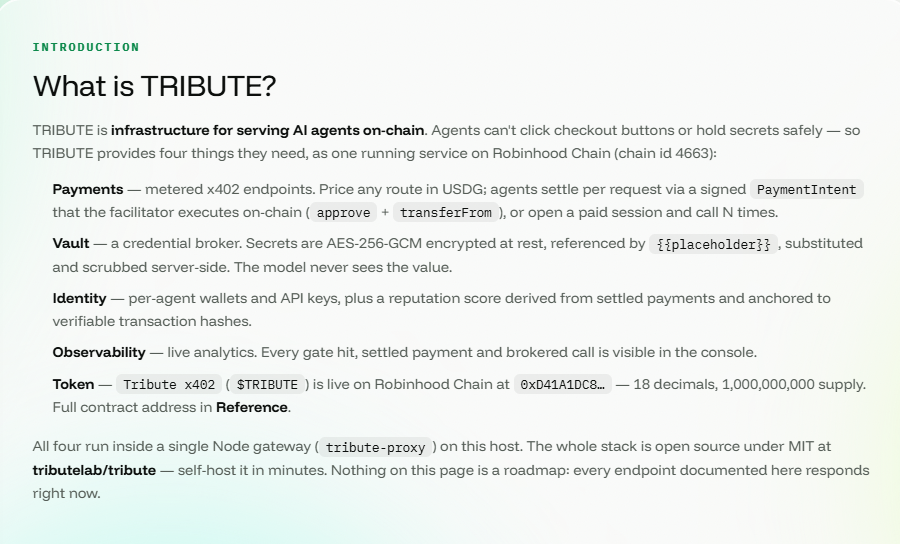
Paid endpoints in USDG over x402 — instant settlement on Robinhood Chain. The same gateway brokers agent credentials through a live vault, model-proof by design. Open source, MIT.
Gate an endpoint. Vault a secret. One process.
The gateway is a single zero-dependency Node service: read-only RPC proxy, x402 gates, credential vault, agent wallets, on-chain settlement. Clone it and run — MIT, no telemetry, 21-check smoke test included.
• Instant USDG settlement · chain 4663
• Nonce-replay-guarded, tx-anchored
• Paid sessions — settle once, call N times
• Self-host in minutes from GitHub
Clone & Run : https://t.co/C2UQRxCOFg
CA : 0xD41A1DC8A42E429A66d6AC479E6F8Ebf96d6eAb0
https://t.co/Om2a7QQ5eL
something big is coming to TRIBUTE!
the x402 rails are already live.
now we're taking the next step: partnerships that put agent payments, credentials, identity and onchain settlement into real workflows.
agents need more than wallets. they need infrastructure. TRIBUTE is building the rails.
and this is just the beginning, $TRIBUTE x402 — partnership incoming.
https://t.co/YAbQfNYCkY
Paid endpoints in USDG over x402 — instant settlement on Robinhood Chain. The same gateway brokers agent credentials through a live vault, model-proof by design. Open source, MIT.
Tribute x402 payment rails for agents on @RobinhoodCrypto.
How a paid call works?
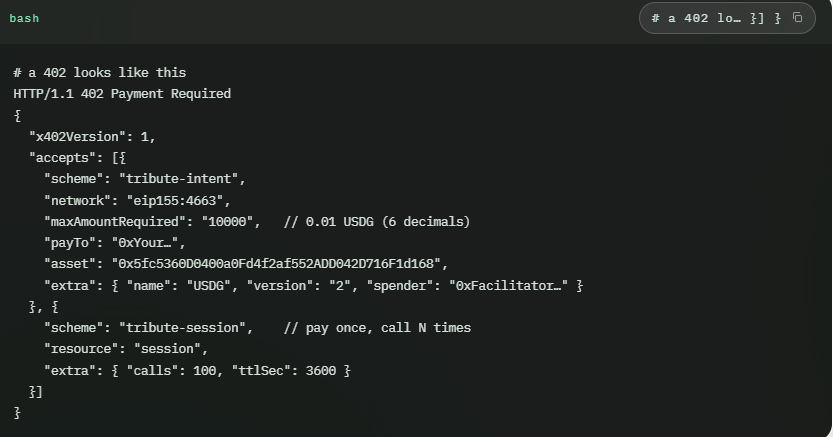
TRIBUTE follows the Apache-2.0 x402 protocol shape: unpaid request → 402 with machine-readable requirements → signed payment → on-chain settlement → resource. One honest deviation: USDG on Robinhood Chain does not implement EIP-3009 transferWithAuthorization (we verified the implementation bytecode on-chain), so settlement uses the approve + transferFrom pattern with a signed EIP-712 intent.
> Request. The agent calls a gated endpoint.
> 402 response. The gateway replies with requirements: amount, asset (USDG at 0x5fc5360D…), recipient, and the facilitator's spender address.
> Approve once. The agent approves the spender for the amount (USDG.approve(spender, value)) — needed once per budget.
> Sign the intent. EIP-712 PaymentIntent { from, to, value, validAfter, validBefore, nonce, resource } in the USDG domain (name TRIBUTE, version 1, chain 4663).
Settle. POST /facilitator/settle — the facilitator verifies the signature, balance, allowance, window and nonce, then executes transferFrom on-chain and returns the tx hash.
How a paid call works?
TRIBUTE follows the Apache-2.0 x402 protocol shape: unpaid request → 402 with machine-readable requirements → signed payment → on-chain settlement → resource. One honest deviation: USDG on Robinhood Chain does not implement EIP-3009 transferWithAuthorization (we verified the implementation bytecode on-chain), so settlement uses the approve + transferFrom pattern with a signed EIP-712 intent.
> Request. The agent calls a gated endpoint.
> 402 response. The gateway replies with requirements: amount, asset (USDG at 0x5fc5360D…), recipient, and the facilitator's spender address.
> Approve once. The agent approves the spender for the amount (USDG.approve(spender, value)) — needed once per budget.
> Sign the intent. EIP-712 PaymentIntent { from, to, value, validAfter, validBefore, nonce, resource } in the USDG domain (name TRIBUTE, version 1, chain 4663).
Settle. POST /facilitator/settle — the facilitator verifies the signature, balance, allowance, window and nonce, then executes transferFrom on-chain and returns the tx hash.
Routes on the gateway.
The gateway keeps a registry of paid routes. Each route has a path, a price in USDG, a pay-to address and a live hit counter. Unpaid GET → 402 + requirements; the registry records every hit so the console can chart it.
- 4 paid APIs registered
- 36 402 payment gates hit
- 4 + 8vault secrets + brokered calls
This is the actual TRIBUTE gateway on this server — paid-API registry, x402 gate, and the agent credential vault — reporting live. Fresh counters are honest counters: every number here maps to a real event you can trigger in the Console.
https://t.co/YAbQfNYCkY
fair question. the core x402 payments will stay in USDG — that's the point.
$TRIBUTE is intended to sit one layer above the payment rail as the coordination / utility layer.
we're exploring things like agent & provider reputation, staking/deposits, marketplace access, priority routing, fee discounts, premium infrastructure and eventually agent-to-agent coordination.
so you wouldn't hold $TRIBUTE just to pay for an API USDG does that.
you'd use $TRIBUTE to participate in and access the infrastructure being built around the x402 economy.
we're still shipping the core rails first, so we'd rather make each utility real before turning it into a promise.
From zero to a paid call!
The live gateway is https://t.co/bnix3R5Fp2 (self-host on 127.0.0.1:8792). The fastest path is the Console — everything below can also be done with curl. Clone and run it yourself:
git clone https://t.co/hosr980g2k
cd tribute/gateway && npm install
cp .env.example .env # set TRIBUTE_RPC_UPSTREAM (+ TRIBUTE_SETTLE_KEY to settle)
node server.js # → tribute gateway on 127.0.0.1:8792
Live demo: the VAULT page stores a secret in the real running gateway and proves the value never comes back. The same pattern powers Infisical's agent-vault — TRIBUTE implements the substitution-and-scrub pattern natively.
Brokered access, zero possession.
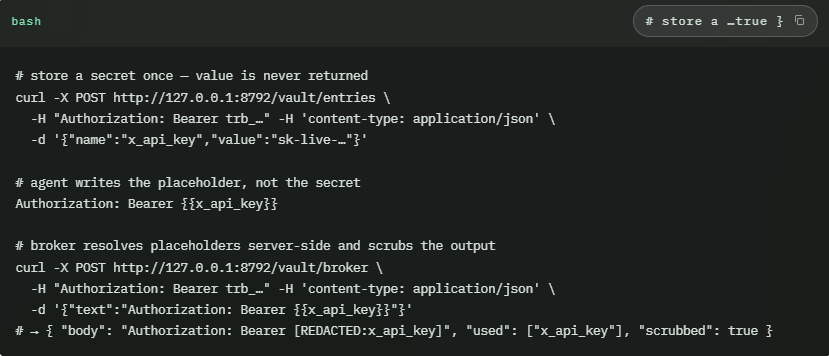
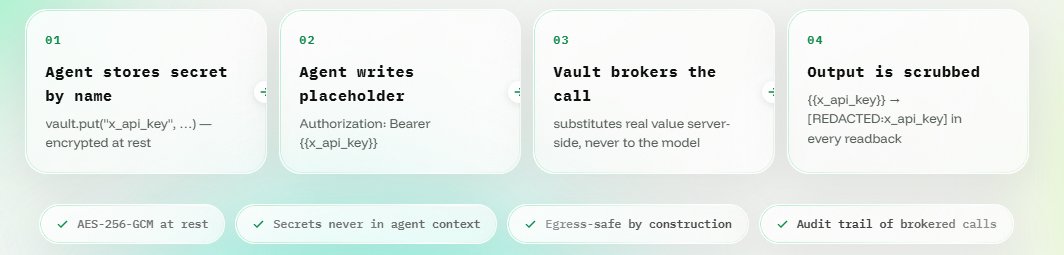
Agents shouldn't hold your keys — prompt injection turns a coding agent into a leak. The vault stores secrets AES-256-GCM encrypted at rest (persistent to disk, surviving restarts). Agents reference them by placeholder name; the gateway substitutes the real value and scrubs it from every readback. All vault endpoints require an agent key.
AES-256-GCM at rest. Encrypted entries persisted to disk; the key comes from TRIBUTE_VAULT_KEY (set your own in production — otherwise derived from the RPC URL).
@Tributex_402@ponsdotfamily In the docs: "No token. No pre-sale. TRIBUTE is a product, not a token launch. If anything on this site ever mentions buying a coin, it's fake."
Routes on the gateway.
The gateway keeps a registry of paid routes. Each route has a path, a price in USDG, a pay-to address and a live hit counter. Unpaid GET → 402 + requirements; the registry records every hit so the console can chart it.
- 4 paid APIs registered
- 36 402 payment gates hit
- 4 + 8vault secrets + brokered calls
This is the actual TRIBUTE gateway on this server — paid-API registry, x402 gate, and the agent credential vault — reporting live. Fresh counters are honest counters: every number here maps to a real event you can trigger in the Console.
https://t.co/YAbQfNYCkY
Agents shouldn't hold your keys.
Credential exfiltration is how prompt-injection turns a coding agent into a leak. The vault sits between agent and API — brokered access, no possession. This is the Infisical/agent-vault pattern, wired into the TRIBUTE proxy on Robinhood Chain.
yeah, we're building the traffic visibility directly into TRIBUTE for now — every gate hit, 402, settlement, and brokered call is recorded in the console, with settlements anchored to onchain tx hashes.
we're also looking at plugging into an x402 scanner/indexer so the traffic can be monitored externally as well.
would be pretty sick to have the full agent → x402 → USDG → settlement flow publicly observable on RH.
@Tributex_402@ponsdotfamily great to see more agentic infra build on RH and in particular through Pons!
is there any x402 scanner you're plugged into so we can monitor traffic etc?