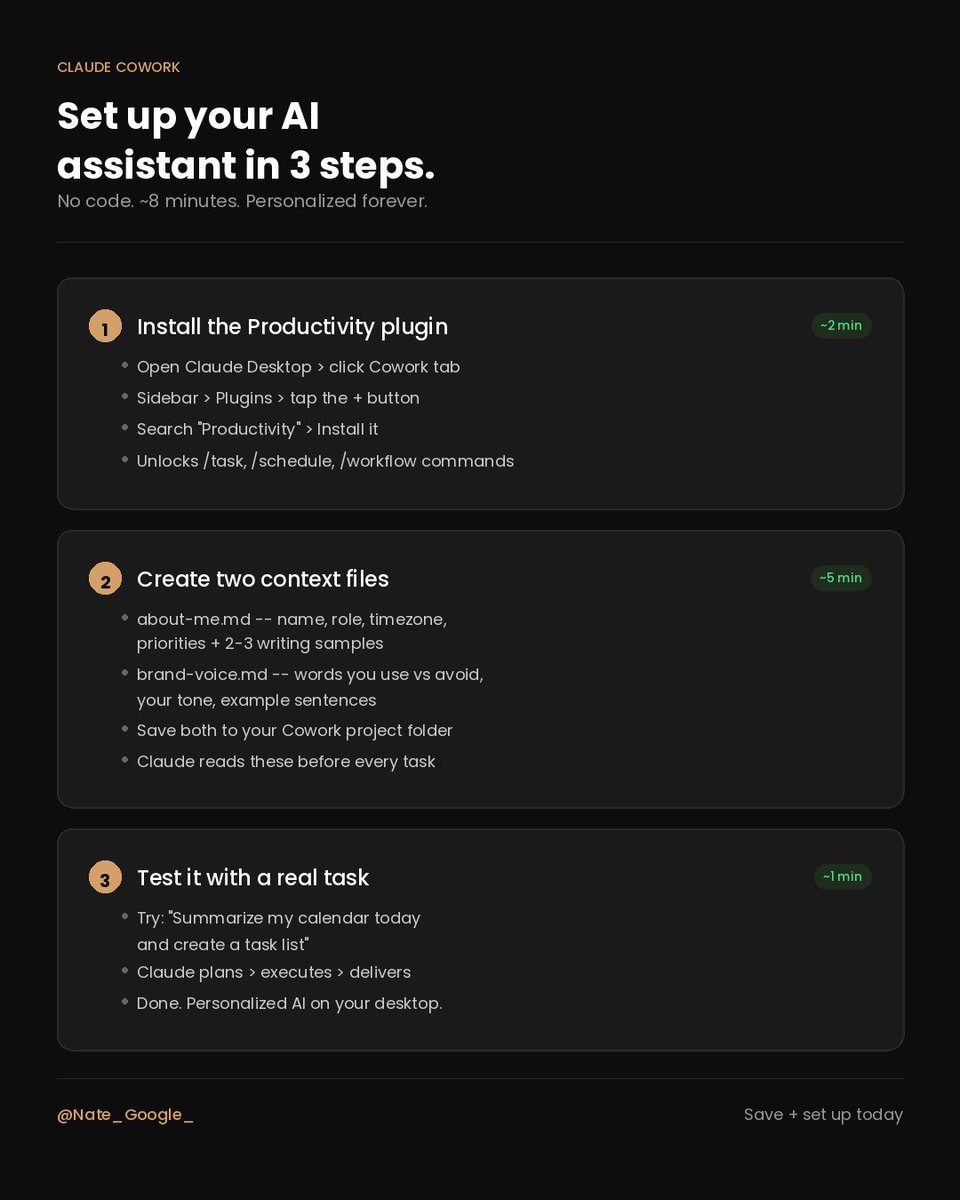
🚨 Anthropic just showed a 27-minute workshop on how to actually do prompts for Claude.
Taught by the people who built it.
Free. No registration. No paywall.
I've seen $300 courses that don't cover what they teach in the first 8 minutes.
Watch it and bookmark it now.
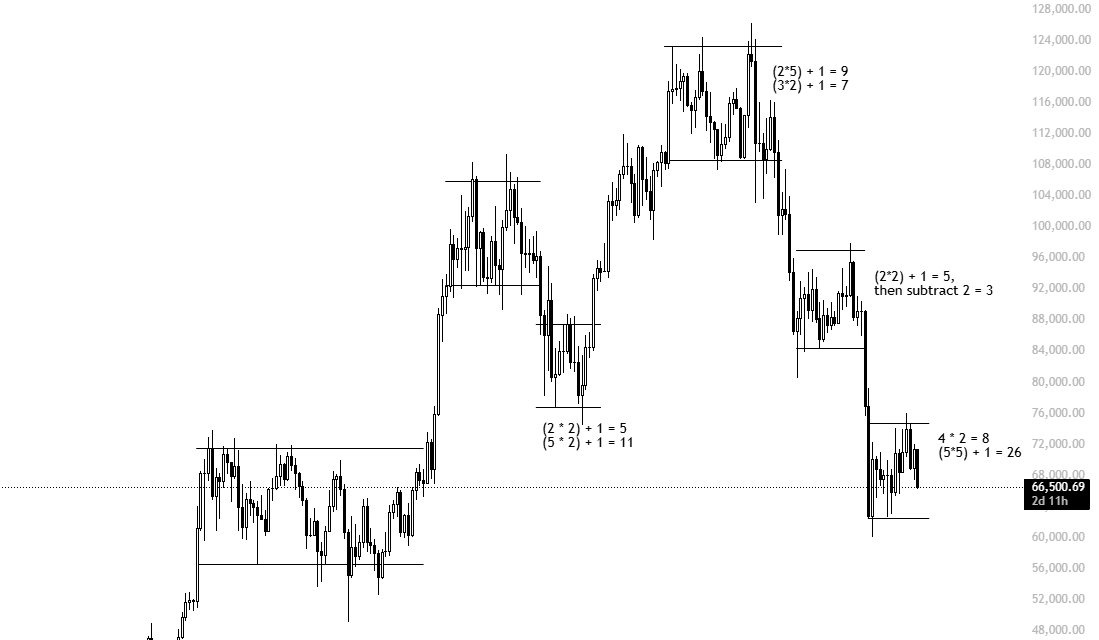
🚨 THE LARGEST IPO IN HISTORY ISN'T A WIN
It's the bell at the top!
SpaceX is raising $75B . At a $1.75T valuation
Three times bigger than previous record IPO
Bigger than the GDP of most countries
And every major index is racing to rewrite its rules to absorb it
That's not coincidence!
That's a synchronized push to force trillions in passive money into one listing
At the most fragile setup for markets in two decades
Let me walk you through the convergence:
Index providers aren't quietly tweaking rules in the background.
They're proposing wholesale rewrites RIGHT NOW:
➮ S&P Dow Jones is reviewing the profitability requirement that's stood since 2002. Up for waiver.
➮ Nasdaq is cutting seasoning windows from 90 trading days down to 15.
➮ FTSE Russell is going further. Down to 5.
The S&P 500 public comment window closes May 28.
Potential implementation? June 8.
Four days before SpaceX trades
Three of the most important benchmarks on Earth. Restructured in the same window. For the same listing.
That's the setup!
Now look at what happens next:
When you force a $1.75 trillion stock into an index, the index doesn't print new money to buy it.
It sells other names to make room.
That means mechanical selling of NVDA, AAPL, MSFT, AMZN.
The current leaders absorb a forced sell-pressure the moment SPCX enters.
But that's just the warmup
SpaceX is floating only about 5% of its shares.
Everything else stays with insiders, early investors, employees.
The lockup expires in two stages:
➮ 90 days post-IPO: early September
➮ 180 days post-IPO: early December
Now look at where those dates land:
September falls inside the worst statistical window in the entire 4-year cycle.
May through October.
15 of the last 16 midterm election years went red in that window.
September is the deep end of it.
December lands right after the November midterm vote - when policy uncertainty resolves one way or another, and big money rotates fast.
And remember: none of this is happening in a healthy market.
This is landing on top of:
➮ A 30-year Treasury yield above 5%. Last time that level showed up was July 2007 (3 months before the market peak, 12 months before Lehman)
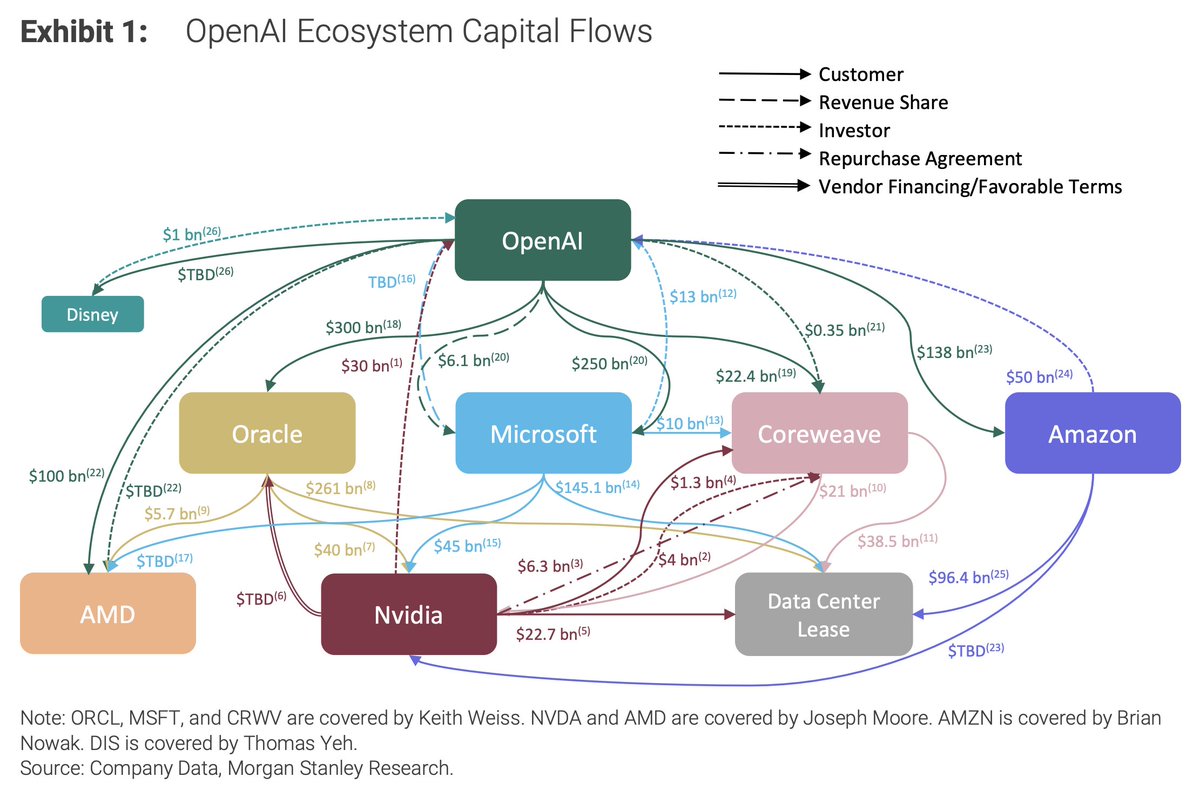
➮ A $2 trillion AI cloud backlog where over half of "demand" is OpenAI and Anthropic recycling investor money back to Microsoft, Google, Amazon.
➮ Equities at the most overvalued level in history. Not close to it. Actually there.
So here's the sequence I see loading:
June 12 - SPCX prints. Forced passive buying overwhelms reality.
Late June - mechanical rebalancing starts selling everything else in Nasdaq 100.
Early September - first lockup expires. Insiders sell into the artificially inflated bid.
October - middle of the historically worst window for stocks in midterm years.
Early December - second lockup expires. Bigger wave.
Four catalysts. One direction
This isn't a forecast. It's a calendar
The setup couldn't be more loaded if it tried.
So what do you actually do?
You can't fight the IPO.
SPCX will probably rip on day one - the passive bid is too mechanical to stop.
But you can stop being long everything else.
Don't worry though - my system flags the exact moment the market shifts from CAUTION to DANGER.
You'll be warned before it hits, like always.
Many people will wish they had followed me sooner
The AI bubble is primarily an earnings bubble rather than a valuation bubble. My report this week discusses the metrics investors should monitor to know when this bubble is about to burst.
Clients can read it here:
https://t.co/nPpZ5E1mas
Introducing USVC - a single basket of high-growth venture capital, for everyone.
No accreditation required, SEC-registered, and a very low $500 minimum.
Includes OpenAI, Anthropic, xAI, Sierra, Crusoe, Legora, and Vercel. As USVC adds more companies, investors will own a piece of that too.
Liquidity typically comes when companies exit, but we’re aiming to let investors redeem up to 5% of the fund every quarter. This isn’t guaranteed, but if we can make it work, you won’t be locked up like in a traditional venture fund.
It runs on AngelList, which already supports $125 billion of investor capital.
And I’ve joined USVC as the Chairman of its Investment Committee.
—
Go back to the 1500s, you set sail for the new world to find tons of gold - that was adventure capital.
Early-stage technology is the modern version. It says we are going to create something new, and it’s risky. It’s daring.
But ordinary people can’t invest until it’s old, until it’s no longer interesting, until everybody has access to it. By the time a stock IPOs, most of the alpha is gone. The adventure is gone. Public market investors are literally last in line.
This problem has become farcical in the last decade. Startups are reaching trillion dollar valuations in the private markets while ordinary investors have their noses up to the glass, wondering when they’ll be let in.
Investing in private markets isn’t easy. You need feet on the ground. You need judgment built over years. Most people don’t have the patience to wait ten or twenty years for an investment to come to fruition.
But there is no more productive, harder-working way to deploy a dollar than in true venture capital.
USVC enables you to invest in venture capital in a broad, accessible, professionally-managed way, through a single basket of innovation, focused on high-growth startups, at all stages.
It is how you bet on the future of tech: the smartest young people in the world, working insane hours, leveraged to the max, with code, hardware, capital, media, and community. Your dollar doesn’t work harder anywhere.
There is an old line - in the future, either you are telling a computer what to do, or a computer is telling you what to do. You don’t want to be on the wrong side of that transaction.
USVC lets you buy the future, but you buy it now. Then you wait, and if you are right, you get paid.
Get access here:
https://t.co/pAj1sqUsG0
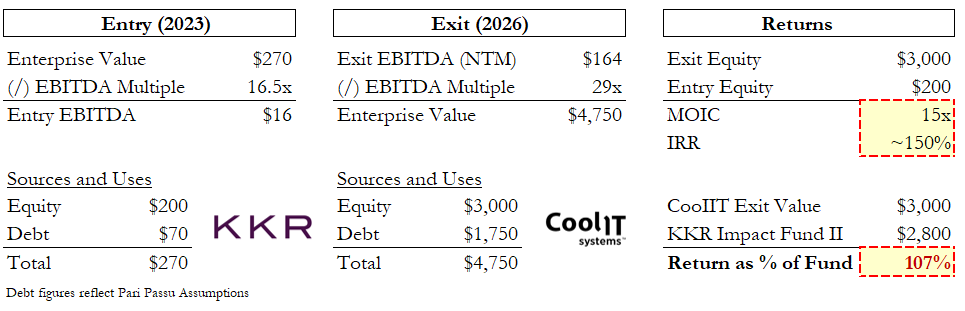
Private Equity is Back, Baby - KKR just returned a fund in one deal, let's break down the deal
Mid-2023, no one is talking about AI or data centers and KKR acquired CoolIT for a very fair 16.5x EBITDA multiple
So what does the company do? They are a pioneer in direct liquid cooling technology for data centers, this removes heat from data centers enabling more energy-efficient and higher-performance operations than traditional air cooling
Fast forward 3 years, and the company has exploded, coolant distribution unit capacity grew 25 times. 25 times! CoolIT's technology ended up deployed in over 300 data centers globally.
Today, KKR agreed to sell CoolIT to Ecolab, a Minnesota-based industrial water treatment and hygiene giant, for $4.75 billion in cash, representing 29x NTM EBITDA of $164M.
Read that again. 10x increase in EBITDA and 12x of multiple expansion. So good.
The result, a nice 15x MOIC and 150%+ IRR.
What I think is even more fascinating is that this comes from the Impact Fund which is $2.8bn of total commitments, so I estimate that this deal just returned the entire fund. Sooo good.
Genius or luck?
In my opinion, genius. Chapeau to KKR.
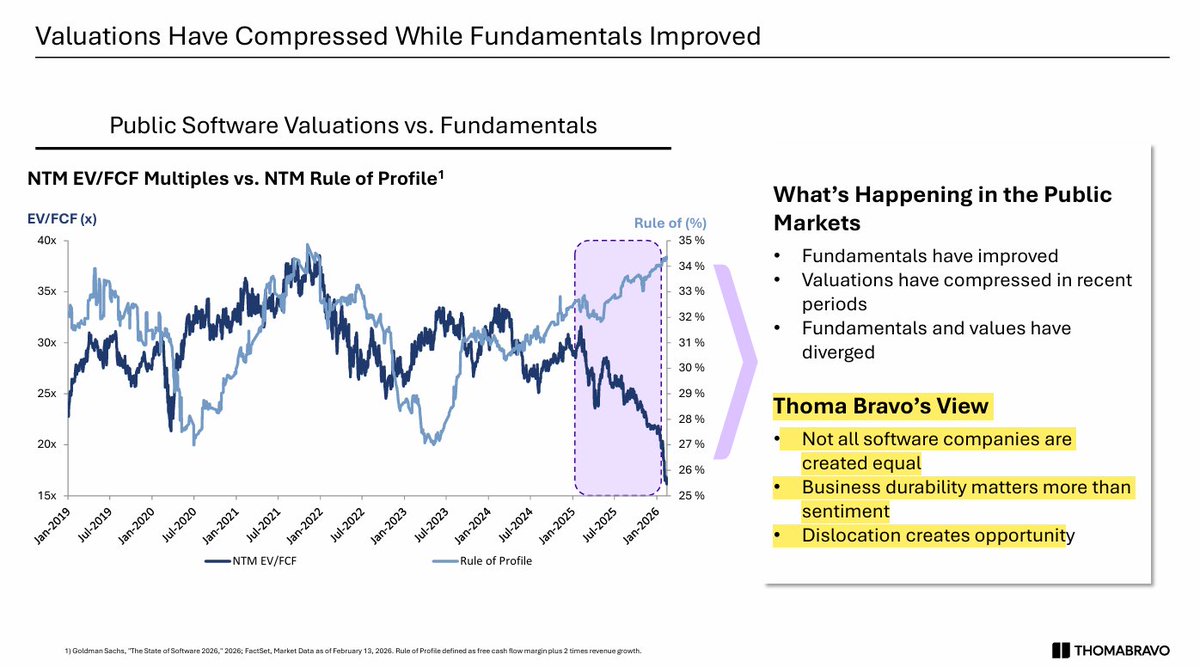
BREAKING: Thoma Bravo just released their LP meeting slides.
The world's largest software PE firm thinks the market has it completely wrong on software right now.
Public markets are panic-selling software based on AI fear.
Here's what they're seeing:
🚨BREAKING: ANTHROPIC IS GIVING AWAY THE SAME CERTIFICATION THAT DELOITTE IS MASS-TRAINING 15,000 EMPLOYEES TO GET.
It costs $0. You need a laptop. That's it.
It's called the "Claude Certified Architect."
Think of it like the AWS cert but for AI.
If you were around when AWS certs started, you know what happened. They went from "cool to have" to "you're not getting hired without one." That took about 5 years.
This is going to happen way faster.
Look at who's already moving:
Accenture - training 30,000 people on Claude
Cognizant - rolled it out to 350,000 employees
Deloitte - opened Claude access to 470,000 people
Infosys - anchor partner
These aren't startups experimenting. These are billion dollar consulting firms restructuring their entire workforce around Claude.
And the certification they need? You can take it right now from your bedroom.
Let me be real though. This is not one of those "watch 2 videos and get a badge" type certs that nobody respects.
This thing is hard.
60 questions. 2 hours. Proctored. Webcam on. No breaks. No googling.
They drop you into real scenarios like designing a customer support agent that handles refunds or setting up Claude in a CI/CD pipeline. The wrong answers look right on purpose. They're the exact mistakes real engineers make in production.
720 out of 1000 to pass.
People who took it are saying the agentic architecture and multi-agent orchestration sections are brutal.
Most of the exam is about building AI systems that actually work in the real world. Not prompting. Not chatting with Claude. Architecting production systems.
All the prep? Free. Anthropic put out 13 courses on their Academy. No paywall. The cert itself is free for the first 5,000 people. After that $99 per attempt.
How to get it:
1. Join the Claude Partner Network (free) → https://t.co/TWMshPoKDn
2. Start the free prep courses → https://t.co/9OVwtjbvh0
3. Register for the exam → https://t.co/WWFAhSZUVd
4. Take the official practice exam
5. Book the real one when you're ready
It launched 10 days ago. Almost nobody has it yet.
That's the whole point. Get it before it becomes the thing everyone has.
360 years.
That is collective Excel experience of my team of 30 people, in one room.
I have personally used Excel for 20 years. Since the very beginning.
We’ve spent decades "crushing it" when it comes to financial modeling.
We knew every shortcut. Every nested formula. We thought we had reached the peak of efficiency. (They are better then me, just to admit)
But I have something to tell you.
The game just changed.
In my opinion, we are witnessing the biggest innovation since Excel was first released. It’s not a new function or a Power BI update.
It’s Claude.
Specifically, Claude’s ability to build and manipulate Excel models.
For 40 years, the "manual labor" was the tax we paid.
Hardcoding formulas.
Spending hours formatting cells.
Manually linking sheets and building tables from scratch.
That era is over.
Claude can now handle the heavy lifting of building the structure, the logic, and the formatting in minutes.
But here is the part that really surprised me: It actually understands accounting.
It understands the relationship between a Balance Sheet and a Cash Flow statement. It understands how operating drivers flow into a P&L.
We aren't replacing our expertise. We are finally liberating it.
Instead of spending 80% of our time building the model, we spend 100% of our time analyzing the results.
If you want this Prompt and Excel model, just drop a comment and I’ll send it to you.
(Important: follow me so I can DM you!)
Anthropic and OpenAI are both building PE-backed consulting arms to deploy AI inside companies.
Let that sink in for a second.
The two companies building the most powerful AI on earth looked at the market and said "businesses can't figure out how to use this. We need to go in and do it for them."
They are literally telling you where the gap is.
Companies have access to the best AI models ever built. And most of them are still running on spreadsheets, disconnected tools, and manual processes because nobody showed them how to actually implement it.
That's the whole game right now. Not building better models (obviously) or shipping new features.
IMPLEMENTATION.
Getting AI inside real workflows.
Mapping the processes, building the systems, and making it stick.
I've been doing exactly this for 4 years and have worked with 80+ companies at this point.
It started with automation and naturally flowed into Ai.
And every single engagement starts the same way. Not with AI or automation but with a process map.
Because AI alone won't fix broken operations.
Companies now understand that. They have not yet seen true ROI from Ai.
You have to understand how the business actually runs before you touch a single tool.
Where does the data live? Where are the bottlenecks? What's manual that shouldn't be? What breaks when volume goes up?
That's the work, and that's what Anthropic and OpenAI just told the entire market is worth billions.
Every company is going AI-first over the next 3-5 years.
The demand for people who can actually make that happen is about to be unlike anything we've seen.
The labs told you where the gaps are.
Now go fill them.