Postdoc at @IRP_UW studying financial lives of low-income households. Also interested in gender, time-use, & labor force participation. @UWConsumerScience PhD.
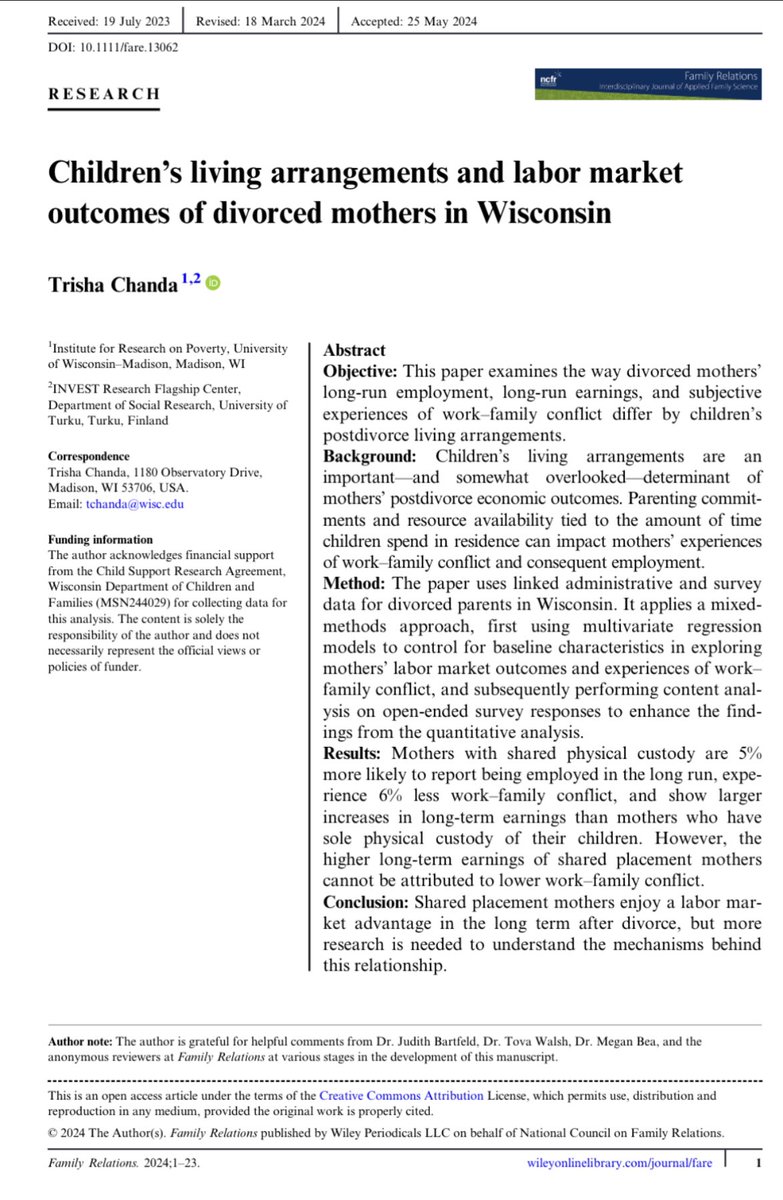
Mothers in shared vs sole physical custody arrangements are more likely to remain employed, less likely to report work-family conflict, and likely to experience greater earnings in the long-term after divorce, after accounting for pre-divorce levels of earnings & employment.
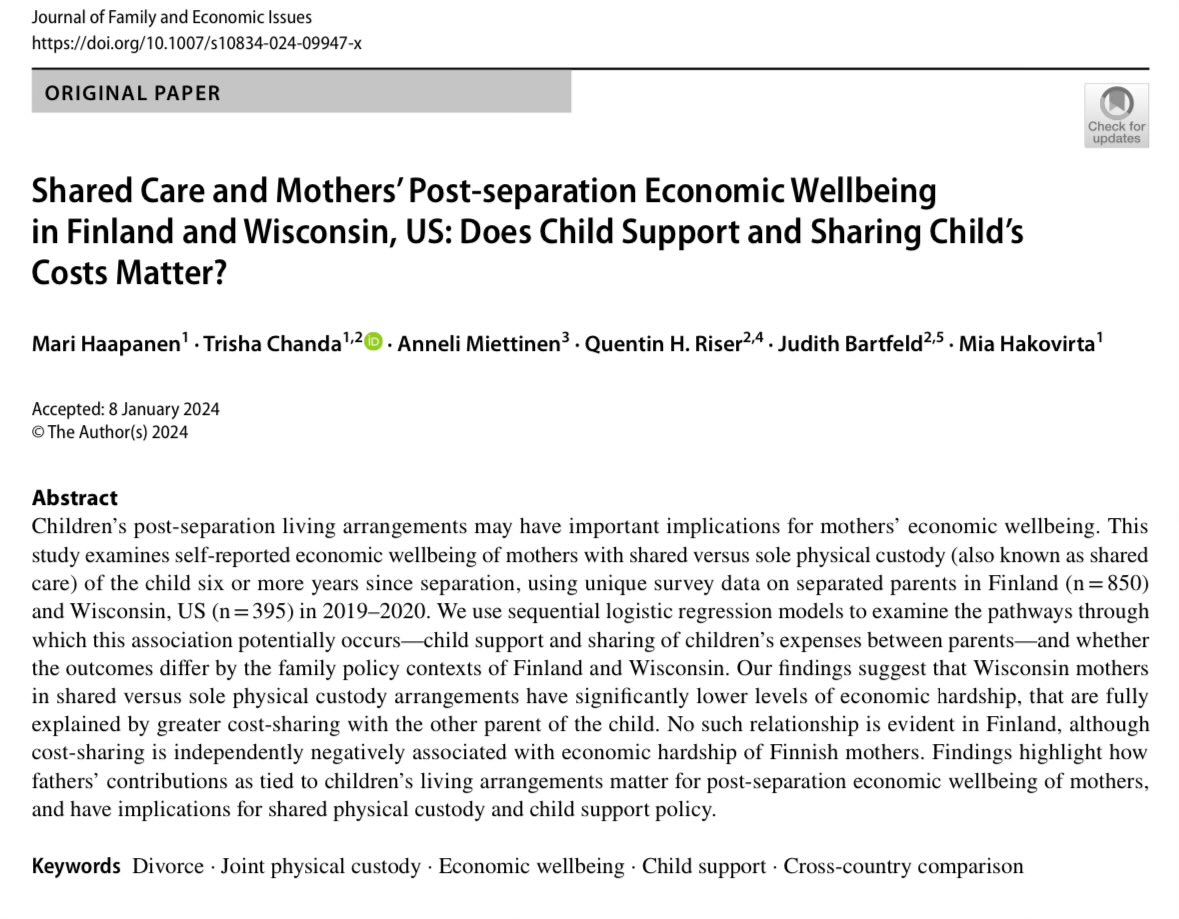
@LauraCuesta_ Thanks, Laura! Check out our comparative piece in the JFEI on economic wellbeing of mothers in shared custody -> https://t.co/IhbQd7CoJj
Judi and I also have a DCF report which looks at more detailed wellbeing measures for WI ->https://t.co/XbRGCyQZRB
Qualitative anecdotes illustrate how divorced mothers navigate employment and parenting obligations over the post-divorce period, juggling work schedules, benefits, pay, and child support receipts, and how parenting ideals figure in their decisions regarding work.
We find WI mothers in shared care report lower economic hardship which is fully explained by cost-sharing with the other parent, but no such relationship is evident in Finland. We discuss the role of policy contexts in economic wellbeing of women and implications for policy.
Excited to share a product of the collaboration between @INVEST_Flagship and @IRP_UW researchers on economic implications of shared care in Finland vs WI! Read our latest open access in the Journal of Family and Economic Issues: https://t.co/Z8OhBYzbev @HakovirtaMia@AnMiettinen
The paper has a lot more on the economics of shared placement, including different ways we divided up children's time in the home to arrive at our preferred measure of household size. It also showcases the cool administrative data we get to use @IRP_UW! (4/4)
Shared physical custody, a living arrangement where children live part of the time with each parent after divorce, has been increasing in Western countries. This has implications for economic wellbeing of families. Our new paper in Social Service Review sheds light on this. (1/4)
The lack of net impact of shared placement on needs-adjusted income can be attributed to lower child support receipts and higher cost-savings relative to otherwise similar sole placement mothers balancing each other out. (3/4) https://t.co/qh75EeEOHN
As a soon-to-be Consumer Behavior & Family Economics PhD graduate, @trisha_chanda is bringing awareness to important topics through her research and mentorship.
Head to the article to learn more about Trisha's accomplishments and next steps in her career: https://t.co/23ltDDDR2N