@NecesitiesBear@CynicalPublius@realDonaldTrump Naw. If you’re going to get power from elections, it’s on you to prove your elections are legitimate. I don’t care if there’s a million conspiracists all spewing absolute guesses as fact. It’s irrelevant to the fact elections should be proven trustworthy.
@XKecharitomene@TheTruthChanne5@IlliniRefugee@redeemed_zoomer No… what the Mormons did could be compared to what Muslims did, but not Protestants. They returned to the historical Christianity. They didn’t invent new prophets and scripture and change it, nor do they claim to have. They claim they’re sticking to original Christianity.
@TheTruthChanne5@XKecharitomene@IlliniRefugee@redeemed_zoomer For instance take Tacitus. Do we treat him as an infallible authority? No, he’s a useful historical source, same as church fathers. Helpful for context, never binding for doctrine. Their contradictions make it impossible for them to be a unified authority the way Catholics claim.
@TheTruthChanne5@XKecharitomene@IlliniRefugee@redeemed_zoomer I don’t know what to tell you dude. Calling them “church fathers” is rich within the Protestant tradition. I’ve already clarified they’re simply historical characters. Their utility is confined to the time in which they lived, similar to how we treat ancient historians.
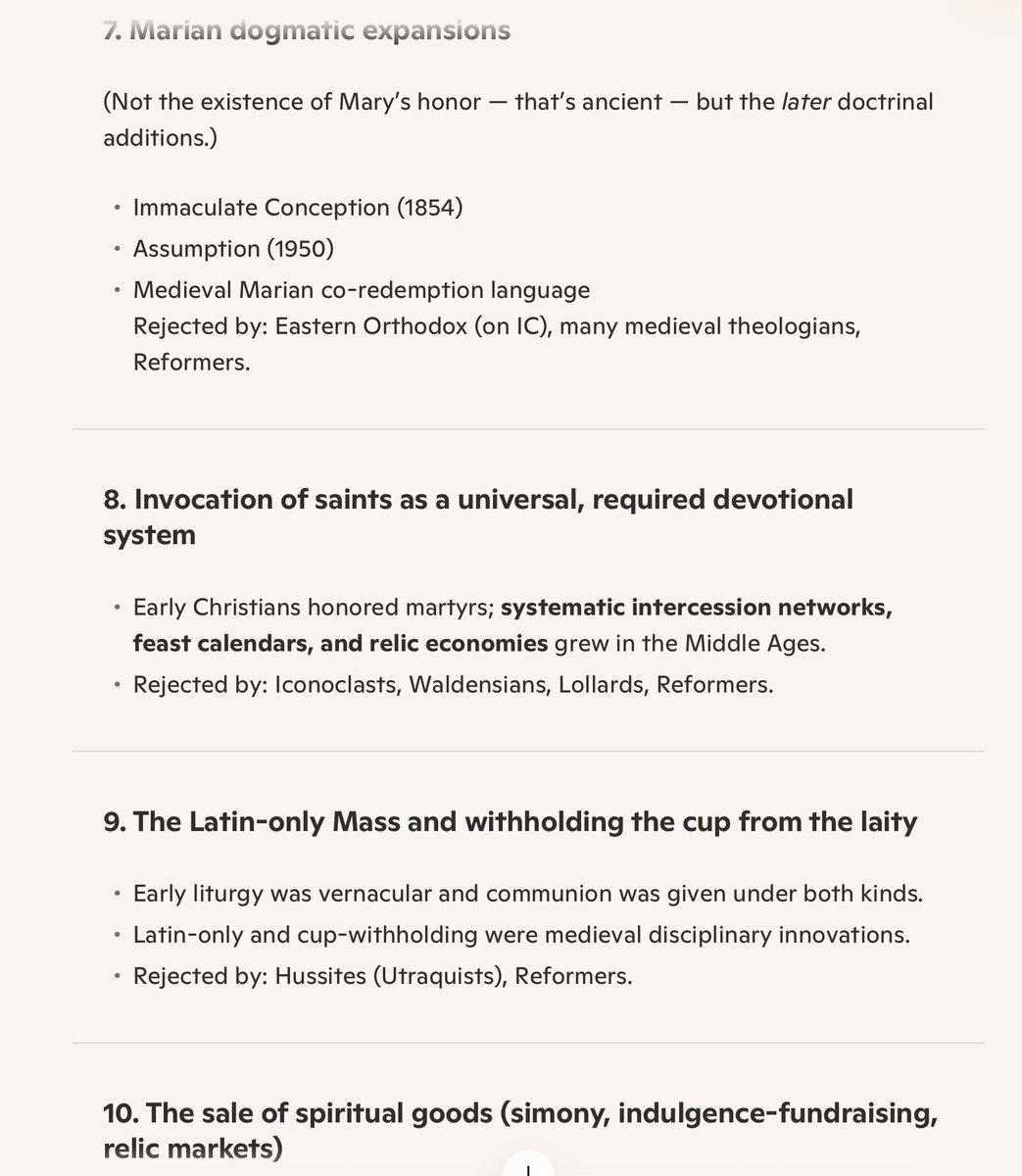
@XKecharitomene@TheTruthChanne5@IlliniRefugee@redeemed_zoomer Protestants don’t “take what we like” from Catholic dogma… we keep what’s biblical and reject what was added later. The early church didn’t belong to Rome, Rome claimed it. We’re not picking and choosing from Catholicism, we’re returning to Scripture where the apostles left it.
@TheTruthChanne5@XKecharitomene@IlliniRefugee@redeemed_zoomer I don’t necessarily disagree. I don’t view church fathers as much different than say people today posting things online, or teaching a class ect. The only difference is their chronological historical significance. That’s useful in a historical sense, not an authoritative one.
@XKecharitomene@TheTruthChanne5@IlliniRefugee@redeemed_zoomer The Bible didn’t “close” because only apostles could write Scripture, it closed because the apostolic era ended. The church preserved their writings, but it never treated later teachers like Clement or Ignatius as Scripture, only as early Christian leaders.
@XKecharitomene@TheTruthChanne5@IlliniRefugee@redeemed_zoomer The most glaring example would be papal infallibility. That would be unheard of to early Christians given the fact there was no single authority and no man is infallible. It was definitely changing Christianity.
@TheTruthChanne5@XKecharitomene@IlliniRefugee@redeemed_zoomer Paul commands post‑apostolic teachers (2 Tim 2:2; Titus 1:5). Clement, Ignatius, and Polycarp were trained by the apostles themselves. That’s what ‘church fathers’ are, fallible teachers passing on the faith. Catholics just elevate them as authoritative instead of early teachers.
@XKecharitomene@TheTruthChanne5@IlliniRefugee@redeemed_zoomer You understand you can change Christianity by inventing a “dogma” then never changing it correct? For instance “papal infallibility” wasn’t invented as a dogma until 1870. It wasn’t practiced by early Christians and was explicitly rejected by church fathers.
@XKecharitomene@TheTruthChanne5@IlliniRefugee@redeemed_zoomer You cannot derive the modern Catholic Church simply by reading the Church Fathers. Many central Catholic doctrines and structures either didn’t exist yet, were understood differently, or were explicitly rejected by major Fathers.
@XKecharitomene@TheTruthChanne5@IlliniRefugee@redeemed_zoomer As I said, it was an exaggerated example to demonstrate something you couldn’t deny was innovation and corruption. The Catholic Church DID change many things, and there was massive backlash. It wasn’t Protestants rejecting continued teachings, it was rejection of change;
@XKecharitomene@TheTruthChanne5@IlliniRefugee@redeemed_zoomer But if they did, would the new group rejecting the Catholic institution be “cherry picking dogmas they like” or would they be rejecting an obvious diverting and innovation? Because Catholics always seem to be unaware of/ignore the fact protestants were protesting innovation.
@XKecharitomene@TheTruthChanne5@IlliniRefugee@redeemed_zoomer And again you can keep your theology and be a member of the Catholic Church, I’m not contesting that, the example is an exaggeration. What I’m contesting is the idea protestants were the innovators. They weren’t. It was the opposite. They were protesting innovation.
@XKecharitomene@IlliniRefugee@redeemed_zoomer It’s ok if you want to be historically demonstrably factually wrong. This is just factual history. You can believe your theology is the “true Christianity”, however the idea you’re the sole family of Christians is just history revisionism.