All assets will live on a set of interoperable ledgers. Parking cash in a Treasury fund before deploying else where is just one example of the power of composability.
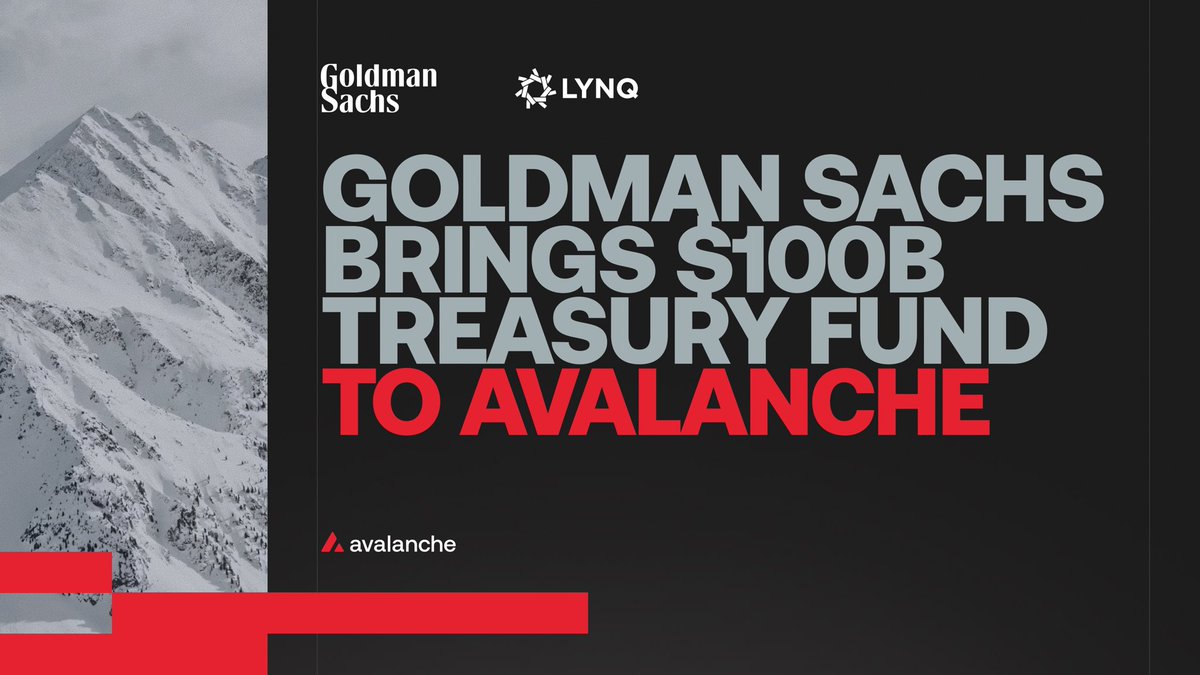
BREAKING: Goldman Sachs is bringing its $100B flagship Treasury fund to Avalanche
The fund will be offered through Lynq, a private, permissioned Avalanche L1 used by 30+ institutional digital asset firms, including B2C2, Wintermute, Galaxy, FalconX, and Fireblocks.
This gives institutions a way to put cash to work between trades and earn yield without leaving the infrastructure they already use.
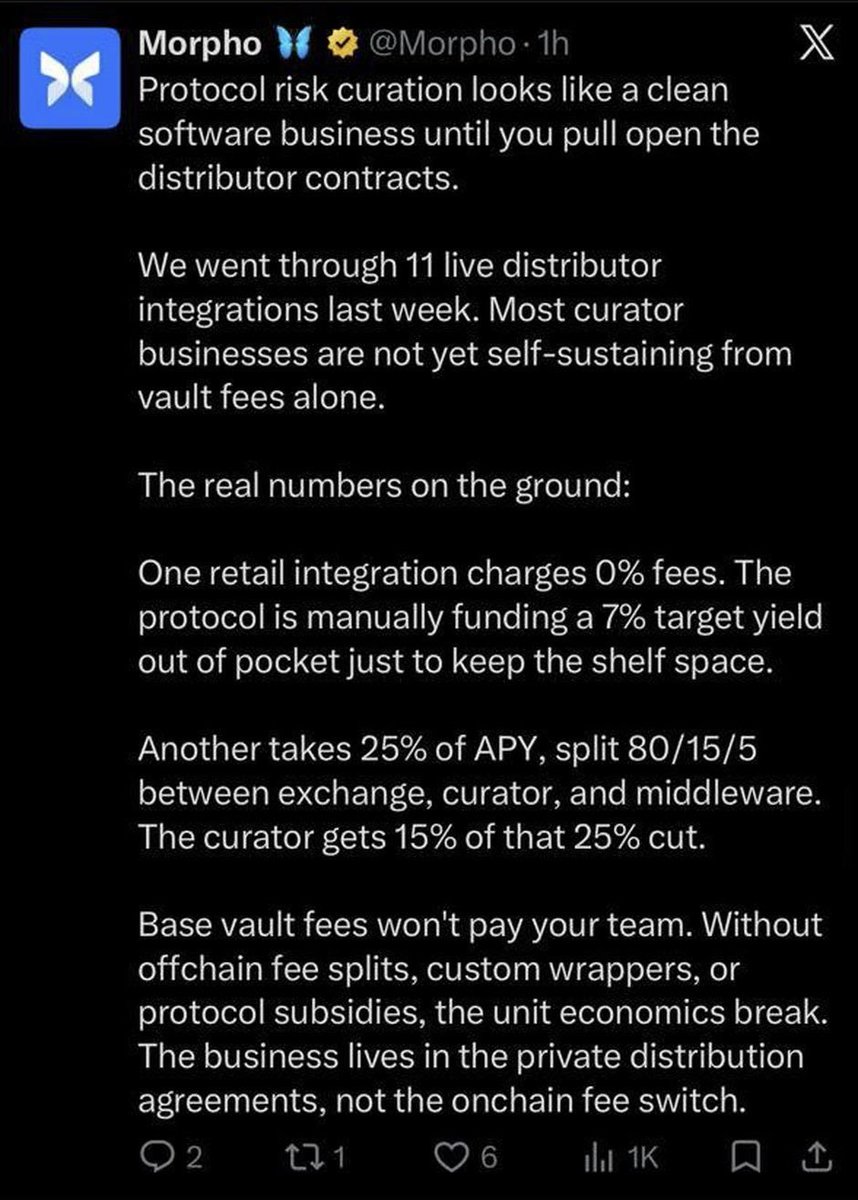
The vault & curator economy is upside down. When everyone is looping the same assets and lending against the same collateral, strategies become a commodity. Curators can't compete on strategy, so front-ends and distribution channels hold disproportionate power.
This accident disclosure just revealed what everyone in the industry already knows: the curator business model doesn’t work without someone continuously paying for integrations and LP deals.
DeFi was supposed to cut out the middleman. Yet with this model, you can end up stacking as many as five layers of fees: integrator fees, curator fees (sometimes charged both onchain and offchain as “consulting” fees to asset issuers), LP fees, and middleware fees (we do not expect it will be forever free, right?).
Unlike Web2, DeFi enables extreme composability. Eg if you are not on Amazon, you can not sell your product. But in DeFi, you can be fully integrated everywhere via smart contracts. In this environment, owning the underlying protocol and its economics can be far more valuable than the potential benefits of broader distribution deals.
6/ Separate accounts are compelling for customization and direct control over individual holdings.
Pooling is compelling for shared execution, coordinated hedging, financing, collateral, and liquidity management.
Both serve a use case.
5/ Your keys, not your trades (& your tax bill).
Within its permissions, a session key can sell or swap assets without asking the owner to approve each trade.
If the pitch is investor control, they let's not forget about session key control of the smart account.
4b/ Perhaps there are ways to mitigate this, but they must actually be implemented.
A pooled fund shares its execution outcome proportionately among participating shareholders. It doesn’t eliminate market impact; it avoids allocating different fills wallet by wallet.
4a/ Smart Account front run eachother
If 1,000 wallets buy sequentially through the same AMM, earlier trades can move prices against later wallets.
Who goes first? How are partial fills handled? What happens when some accounts fail to rebalance?
2b/ An attacker with sufficiently broad trading permissions may not need withdrawal permissions to cause losses.
Removing pooled accounting removes some risks. It doesn’t remove the need to scrutinize smart contracts and permissions.
3/ The manager didn’t disappear just because of direct token ownership.
If your wallet owns a tokenized offchain fund, you still rely on its manager, custodian, legal structure, and redemption process. Removing a vault wrapper doesn’t remove the managers underneath it.
2a/ “no shared pool means no shared pool to drain”
Separate addresses do not guarantee separate failure modes. Shared wallet code, permission modules, or compromised automation can expose many accounts to the same vulnerability.
1/ “A vault is a single-strategy component”
This is not an architectural constraint. It’s a product choice.
A pooled vehicle can hold stocks, credit, crypto, other funds, and multiple strategies. Issuing shares in a portfolio doesn’t limit what that portfolio can own.
The “be your own vault” or "pooled capital is bad" pitch gets a lot less convincing once you look under the hood. For one reason or another, folks with such views lean into a biased view.
To be clear, separate accounts have real advantages. But some arguments out there are simply just lazy. conflate custody, investment management, execution, and security.
Let’s unpack them.
"Portfolio margin is one of those things that is still a mess in the TradFi world. Building portfolio margin for onchain vaults will be very hard." - a subject matter expert we spoke to.
Good! This is what we want to hear.
BREAKING: NYSE plans to bring 24/7 trading on chain with their in-development ATS platform
“As we’ve evaluated different platforms, Avalanche checks a lot of those boxes for us, so we’re very engaged with the team”
- Michael Blaugrund of Intercontinental Exchange/NYSE
TradFi is wrapping traditional assets in tokens. At Truss, we believe the next step is for the strategies behind traditional funds to run natively onchain.
The fund of the future won’t be a tokenized wrapper. It will be a vault.