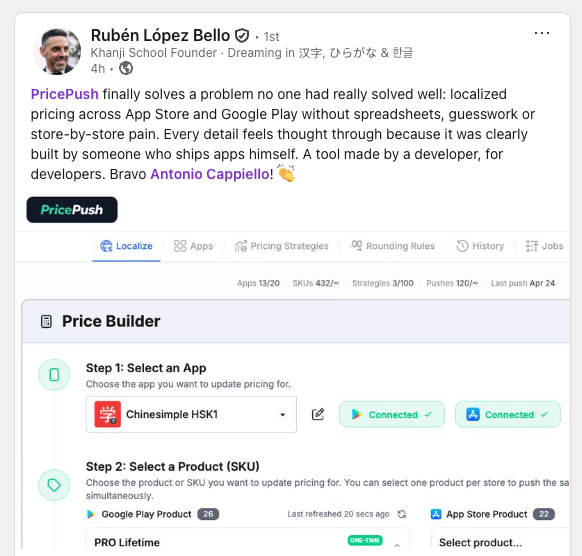
I tried @TryPricePush to clean up Pigi’s localized pricing.
my old setup was basically “ask ChatGPT for PPP pricing and hope it’s not too wrong” haha
it uses central bank PPP data and changed about 90% of my prices.
most of them went down by 20-75%, and one went up by 110% 😮
not sure what the revenue impact will be yet, but it definitely caught pricing mistakes I had already missed.
Got a podcast, newsletter, or YouTube channel for mobile devs?
We just opened an affiliate program. Commission-based, no cap, recurring on subs.
DM if you want the details.
Bulk price localization across countries based on GDP/PPP rankings has never been easier with PricePush. I'm glad I found this tool, it helps adjust prices not only by exchange rates but also by each country's economic well-being. @TryPricePush
We pulled the six guides that consistently rank for "localized pricing" on Google and read them end to end.
Paddle. RevenueCat. httptoolkit (Tim Perry). Stripe docs. Discord help. EDC.
Where they converge:
- Currency auto-conversion isn't localized pricing
- You need a structured methodology (PPP, willingness-to-pay tiers, market proxy)
- Rounding is local
- Drift is real
- Region-level revenue differentials are big
Where they all stop is what gets every cross-platform mobile dev:
1. App Store Connect's price-point ladder. ~900 predefined prices per currency since Apple's late-2022 overhaul. "Set USD 14.27 in India" doesn't exist.
2. Google Play Pricing Templates removed October 27, 2025. Older tutorials still describe the old UI.
3. App Store Connect API rate limits when pushing 175 storefronts.
4. Cross-store currency divergence (Algeria: DZD on Google Play, USD on the App Store).
None of this is a flaw in those guides. They're written for SaaS, and SaaS doesn't deal with price-point ladders.
The full review, with credit to each source and a comparison table for every PPP index they reach for:
https://t.co/klswmEUIrX
Apple and Google don't always quote the same currency for the same country.
Algeria: Google Play prices in Algerian dinar (DZD). The App Store quotes Algeria in US dollars.
Several other smaller markets have similar Apple-USD / Google-local splits.
Build a single per-country price grid and apply it to both stores naively, the math works on one platform and breaks on the other. Your DZD price for Algeria pushes cleanly to Google Play and becomes nonsense on the App Store.
This is a routine concern for any cross-platform mobile catalog. Most localized-pricing guides don't flag it because they're written for one platform at a time.
The fix is structural: maintain two grids, or maintain one grid and convert per-store at push time.
We just shipped the PricePush Glossary.
25 plain-English definitions for the vocabulary app publishers reach for when pricing across App Store and Google Play. Each term has a short definition, a long explainer, worked examples, FAQs, and how it actually shows up inside PricePush.
PPP, charm pricing, price tiers, MRR, drift detection. All here.
https://t.co/6QoO0wuqrK
(And thanks to everyone who upvoted us on Product Hunt yesterday. Wild day.)
New on the PricePush blog: How to update app prices safely.
Five properties of safe pricing automation:
- Diff preview
- Versioning per push
- Per-country history
- Atomic push
- One-click rollback
Plus an 8-question checklist that works against any tool, including PricePush.
https://t.co/Z44M7aIawH
#indiedev #pricing
Eight Purchasing Power Parity (PPP) indices show up in localized-pricing conversations. They aren't interchangeable.
World Bank PPP. Default for most consumer apps. Annual update, ~180 countries.
IMF PPP. Updated twice a year, very wide coverage. Macro lens.
OECD PPP. 38 OECD member countries only. Higher developed-market accuracy.
Big Mac Index. Single-product proxy. Intuition, not pricing.
Netflix and Spotify Index. Reverse-engineered from public list prices, ~80-100 countries.
Numbeo. Crowdsourced, ~120 countries. City-level sanity checks.
GDP per capita. Crude proxy. More honest than consumer PPP for B2B apps.
Economic Complexity Index. Strategic lens, not a price input.
Pick one as a starting point. None of them gives you a final price. Each leaves a number that still needs rounding to local convention and mapping to whatever ladder the store imposes.
The honest answer to "what should I do about Google Play's 10% subscription fee" for most indies:
Nothing.
If you ship subs on Google Play Billing and you're under $1M annual revenue, your effective rate stays at 15%.
Same as it's been since Jan 2022.
No pricing changes needed.
The chart shows where alt-billing math wins or loses.
It doesn't show that the engineering cost to capture either side is the same.
Same SDK integration. Same tax handling. Same dispute logic. Same PCI work.
Fixed cost. Variable benefit.
That's the missing math.
Google Play removed the Pricing Templates feature on October 27, 2025.
Pricing Templates were the way to define one price grid and apply it across multiple SKUs in the Google Play Console.
Replacement: per-SKU pricing inside the Console with no template layer. If you have ten subscription SKUs and twenty in-app purchase SKUs, that's thirty separate price grids to maintain.
If a guide you're following describes the templates UI, check the date. Several third-party walkthroughs and generic 'localized pricing' guides still show the old workflow.
Pricing maintenance on Play got harder after that change. Worth knowing before you plan your update cadence.
Google Play cut subscription fees to 10% by June 30.
Add the 5% Google Play Billing fee. That's 15% effective. Same rate Google has charged since 2022.
Real wins: IAP apps above $1M revenue, and alt-billing on transactions above ~$17.
Full breakdown:
https://t.co/xiPxgtytOz
Pricing is code.
It takes a base price, outputs a number per country. Has inputs (FX, PPP), logic (strategy), side effects (every checkout).
The fact that it lives in a console UI instead of a repo doesn't change what it is. The right tools are the same.
https://t.co/Z44M7aIawH
#indiedev #pricing
Most "auto-pricing" tools use one rounding rule globally.
PricePush ships 8.
CHF 14.99 looks like a typo to a Swiss buyer.
KRW 14,995 looks like a glitch to a Korean buyer.
INR 661.49 looks weird to an Indian buyer.
We snap to CHF 15.00, KRW 15,000, INR 661.50 instead.
Small thing. Big trust signal.
#PricingStrategy #Localization
$19.99/month subscription.
What Apple shows in India: ~₹1,660 (FX conversion).
What's locally affordable: ~₹500 (PPP-aligned).
That gap is the difference between a user converting and bouncing.
It exists because the App Store does currency math, not regional pricing.
#indiedev #pricing
"Auto-generate prices" on App Store Connect and Google Play Console is FX conversion.
PPP is something else.
FX answers: what is $19.99 worth in BRL today?
PPP answers: what should this app cost a Brazilian buyer relative to local income?
In São Paulo, FX gives you R$120. PPP gives you closer to R$49.49.
Conflating the two is the most common pricing mistake we see.
#PricingStrategy #Localization #IndieDev
From days of manual work to one tap.
PricePush automates pricing across 175 countries:
- PPP-based localization
- Real-time FX conversion
- Smart rounding per market
- Push to both stores in one click
Safe by default. Nothing pushes without your review.
→ https://t.co/1XNUNGWPvW
#indiedev #pricing
A pattern from indie dev pricing threads:
'Doesn't the App Store handle regional pricing already?'
'I set USD and trust Apple to convert it fairly.'
'Isn't auto-converted localized?'
It isn't. Apple and Google do FX conversion. That's currency math, not pricing.
#indiedev #appstore