State lawmakers introduced more than 130,000 bills in the first half of 2025. Somewhere in that pile is the one that affects your industry, and most GR teams find out about it after it's already moving.
Political and NGO monitoring used to mean trade press subscriptions, keyword alerts, and a colleague who happened to know someone in the ministry. That doesn't scale to this kind of volume anymore.
The harder problem is knowing whether an NGO's position is actually hardening, whether a narrative is gaining real political traction, and who the right local partner is when a regulatory consultation opens, before the window closes.
We wrote up the workflow we use with government relations and public affairs teams to stay ahead of this: define the stakeholder universe before you start monitoring, track continuously against it, follow how NGO narratives evolve rather than logging each mention on its own, and - the step most teams underinvest in - map credible local intermediaries before you need them.
The advantage lies in knowing who's shaping the story and whom to call, by the time it matters.
Read the full guide here: https://t.co/xpCykSnMeM
#GovernmentRelations #PublicAffairs #StakeholderIntelligence
Customer story: How a leading global chemical group unified Institutional Relations intelligence across South America.
Its Government Affairs, Sustainability and Corporate Communications teams operate across complex regulatory environments in Brazil, Argentina, Uruguay, Chile and Colombia.
However, stakeholder histories, meeting outcomes and policy intelligence were spread across separate workflows, spreadsheets and personal notes. This made cross-market collaboration difficult and left valuable institutional knowledge at risk.
Using Genie, the company created a shared environment for stakeholder engagement, issue monitoring and regional intelligence. Teams have since built a searchable record averaging more than 180 touchpoints per month, while continuously monitoring regulatory, sustainability and reputational developments in two languages.
The story shows what becomes possible when regional teams move from fragmented information to a shared intelligence capability.
Read more: https://t.co/kZDQuKxibI
#CorporateAffairs #StakeholderIntelligence #GovernmentAffairs #Genie
Genie now works where you do.
You can now access Genie’s stakeholder intelligence directly from the AI tools your team already uses - including Microsoft Copilot, ChatGPT, Claude and other compatible agents.
That means less switching between platforms, less rebuilding context and fewer disconnected workflows.
Bring your stakeholder data, engagement history and issues intelligence directly into the flow of your everyday work.
Learn more: https://t.co/tS0rxii31Q
#StakeholderIntelligence #EnterpriseAI #Genie
Most stakeholder relationship tools assume you already know who your stakeholders are. That's backwards.
Government affairs teams don't just need to log meetings and contacts. They need to know which lawmaker is leading the debate that affects them, which community group is turning into a vocal critic, and which relationship is about to matter (before it's obvious).
We just published a comparison of the five leading SRM platforms for government affairs in 2026.
The market has split into two camps. Intelligence-led platforms help you understand the shifting policy landscape. Documentation-led platforms help you record consultations and prove accountability.
They solve different problems. The expensive mistake is buying a documentation tool when what you actually need is intelligence - or the reverse.
Full breakdown (including a feature comparison table) here: https://t.co/3mgFm8bqTC
#GovernmentAffairs #PublicAffairs #StakeholderEngagement
Choosing a media monitoring platform for policy work can be slightly more complicated owing to reliance on specific sources and policy language nuances.
The standard vendor demo will show you dashboards, sentiment graphs, and source counts.
💡Before committing to any platform, these are the six things worth evaluating:
- Source depth beyond mainstream news → ask vendors for a live demo against your specific policy domain
- Issue-based classification, not keyword matching → policy language shifts across jurisdictions and forums
- Stakeholder linkage → coverage should connect to who said something, not just where it appeared
- Integration with engagement workflows, so monitoring connects to what your team does next
We've mapped seven of the most commonly evaluated platforms against these criteria. Full breakdown in the blog post: https://t.co/J4G5ybZFJO
#GovernmentAffairs #PublicAffairs #MediaMonitoring
What does “issues intelligence” actually mean?
It’s a term we’re hearing more often in client conversations, but it can sound a little abstract if you’re hearing it for the first time.
So we put together a guide explaining what it is, how it works, and how it differs from traditional media monitoring.
The short version: it’s about helping teams understand how issues form, who shapes them, and when they may need attention - before they become bigger reputational, regulatory, or business risks.
Read the full blog here: https://t.co/oomepMGWKH
At @TSC_ai our mission has always been clear: help leaders make sense of a fast-moving, fragmented external world - not just by monitoring signals, but by connecting them to the stakeholders, issues, narratives and networks that shape outcomes.
We’re excited to be featured by @googlecloud for how we are using Gemini, BigQuery, Vertex AI and Google Kubernetes Engine to power Genie - our AI-native stakeholder and issue intelligence platform.
With Google Cloud, Genie now delivers:
• Sub-10-second insights across millions of global data points
• Secure, contextual AI workflows powered by Gemini and Vertex AI
• 20% improved query latency for complex stakeholder analytics
For public affairs, government relations, corporate affairs, communications, risk and strategy teams, the future of intelligence is a real-time, AI-native sensing system that helps them understand what is happening, who is shaping it, and what to do next.
Read the full customer story here: https://t.co/rwXVPuxD4U
#AI #GoogleCloud #Gemini #StakeholderIntelligence #IssueIntelligence #PublicAffairs #CorporateAffairs #GovernmentRelations #B2BSaaS #TSC #Genie
One of Latin America's largest electricity companies operates across hydroelectric generation and high-voltage transmission, engaging federal ministries, state legislatures, the national energy regulator, and four major operating divisions.
The Institutional Relations team relied on a political consultancy's weekly risk matrix that had no connection to stakeholder intelligence or media monitoring. Around 400 stakeholders lacked consistent profiling. Engagement records were scattered across spreadsheets and external platforms. The Risk function had no structured tool for monitoring external factors at all.
Genie became the shared intelligence layer for both functions. Each legislative project is now a structured workstream: stakeholders mapped, media linked, AI-generated gap analysis flagging where engagement is missing. The Risk team monitors market shifts, regulatory changes, environmental licensing, and extreme weather through dedicated dashboards and automated newsletters - without needing dedicated analysts for each theme.
For IR and Risk teams managing complex regulatory environments, this is what connected external intelligence looks like in practice.
Read more: https://t.co/GD8ae1TJDL
#InstitutionalRelations #GovernmentAffairs #RegulatoryAffairs #StakeholderIntelligence #Genie
A large diversified natural resource company needed to move from twice-yearly manual ESG reports, assembled from scattered regional inputs, to a continuous, board-ready intelligence capability across 10+ countries - all while meeting a growing stack of disclosure obligations: Section 172, CSRD, and GRI Mining standards.
The disclosure requirements demanded defensible, auditable stakeholder narratives. But the data lived in inconsistent regional formats, expensive periodic consultancy snapshots, and high-noise media feeds that couldn't separate signal from chatter.
https://t.co/7XaQU10eCf's Genie became the Group Sustainable Development team's centralised ESG intelligence layer, structured around the company's material topics, with AI-powered signal filtering, stakeholder engagement tracked across regional and site teams in four languages, and automated reporting workflows feeding directly into disclosure requirements.
The intelligence now runs continuously. Not just twice a year.
Read more: https://t.co/vpuGWXYTMn
Government Affairs teams don't lose influence because they lack meetings.
They lose influence because they engage too late.
By the time an issue becomes loud, positions are hardening, narratives are moving, and the room to shape outcomes is already smaller.
The real job of Government Affairs (beyond relationship management) is reducing policy drag and creating better policy outcomes through earlier, better-informed engagement.
In our latest piece, we break down what effective policymaker engagement looks like in 2026, especially in a world of AI and automation:
→ Map the policy process before mapping the people
→ Identify the decision network, not just the decision-maker
→ Build evidence-led positions, not generic talking points
→ Treat consultations as strategic design moments
→ Make engagement consistent, not transactional
→ Measure signals and shifts - not volume of meetings
The role of AI here isn't to replace judgment or relationships. It's to strengthen the intelligence layer: helping teams monitor complex policy environments, detect narrative shifts early, surface emerging stakeholders, and build institutional memory across issues and geographies.
The gap between teams operating with live intelligence and those still running on static contact lists is widening - fast.
Read the full guide → https://t.co/peInLqSPqb
#GovernmentAffairs #PublicAffairs #PolicyEngagement
Part III of the key takeaways of @TSC_ai's CEO Terence Lyons presentation at the @PA_Council's AI for Public Affairs Workshop.
Here are some key takeaways:
1️⃣ Public Affairs is a bundle of tasks - so start by mapping them.
Every role in public affairs, from reputation protection to policy influence, can be broken down into discrete tasks. Some can be automated. Some augmented. Some must stay human-led. The first step to AI transformation? Know exactly what you're working with.
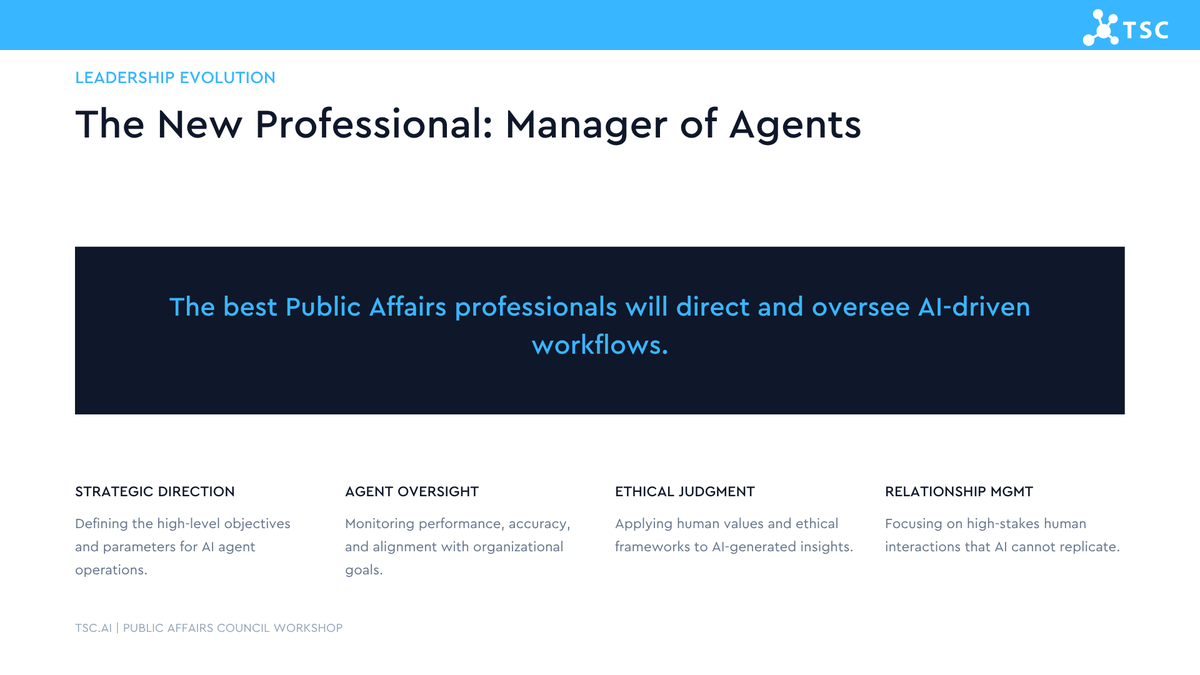
2️⃣ The new Public Affairs professional: Manager of Agents.
The best in the field will direct AI, not just use it. That means setting strategic direction, overseeing AI performance, applying ethical judgment, and reserving their own time for the high-stakes relationships no algorithm can manage.
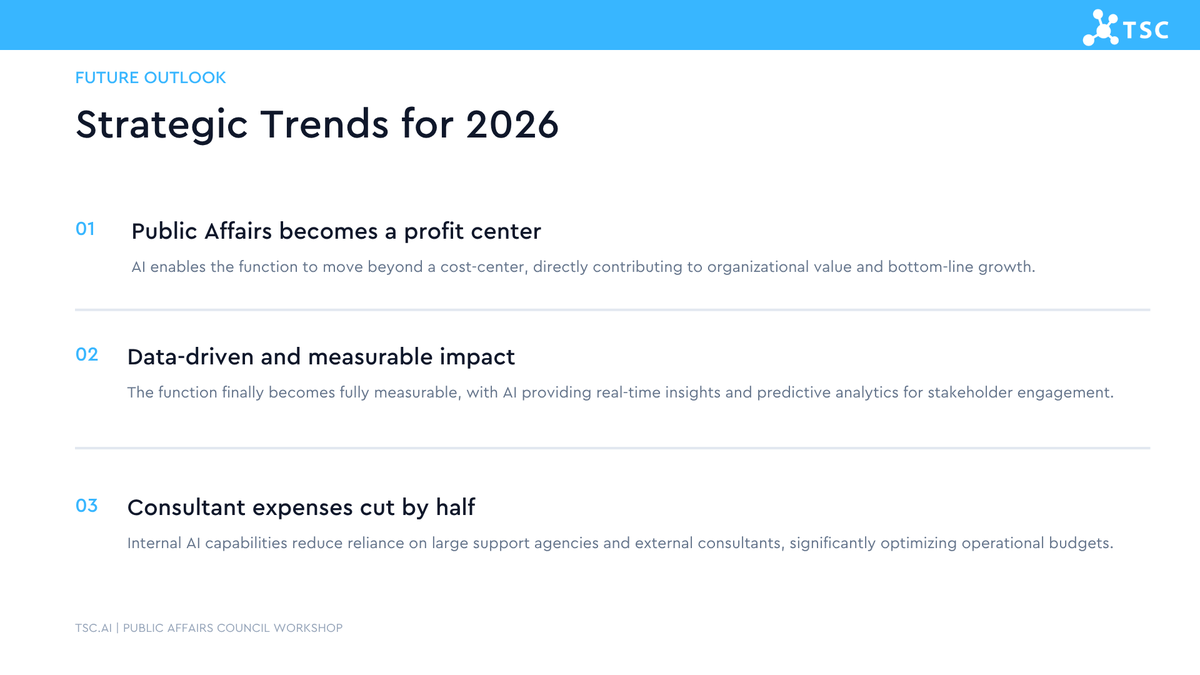
3️⃣ The strategic trends shaping Public Affairs in 2026:
→ Public Affairs becomes a profit centre - AI moves the function from a cost centre to a direct value contributor
→ Impact becomes fully measurable - real-time insights and predictive analytics for stakeholder engagement
→ Consultant spend gets cut in half - internal AI capabilities reduce reliance on large external agencies
The function is changing faster than most teams realise.
Book a free briefing with us to find out how AI can transform your public affairs team.
Part II of the key takeaways of @TSC_ai's CEO Terence Lyons presentation at the @PACouncil's AI for Public Affairs Workshop.
Here are the 3 key takeaways:
1️⃣ Beware the Productivity Paradox.
Time saved ≠ productivity gained. If AI just frees up hours that get filled with more of the same work, the value stays flat. The real opportunity is using that time for higher-value thinking and strategy.
2️⃣ There are two ways to use AI - most teams are only using one.
Ask mode (summarise, analyse, brief) is a great start. But Task mode - modelling crises, executing multi-step workflows, driving complex decisions - is where public affairs teams will find their real competitive edge.
3️⃣ Not every task should be treated the same.
The smartest AI strategies in public affairs separate three categories:
→ Automate: high-frequency, low-complexity work
→ Augment: strategic tasks where AI sharpens human judgment
→ Human-Led: relationship management and high-stakes ethical calls
Knowing which bucket each task belongs in? That's the real strategic skill.
More insights to come.
#PublicAffairs #AI #AIStrategy #GovernmentAffairs #StrategicCommunications
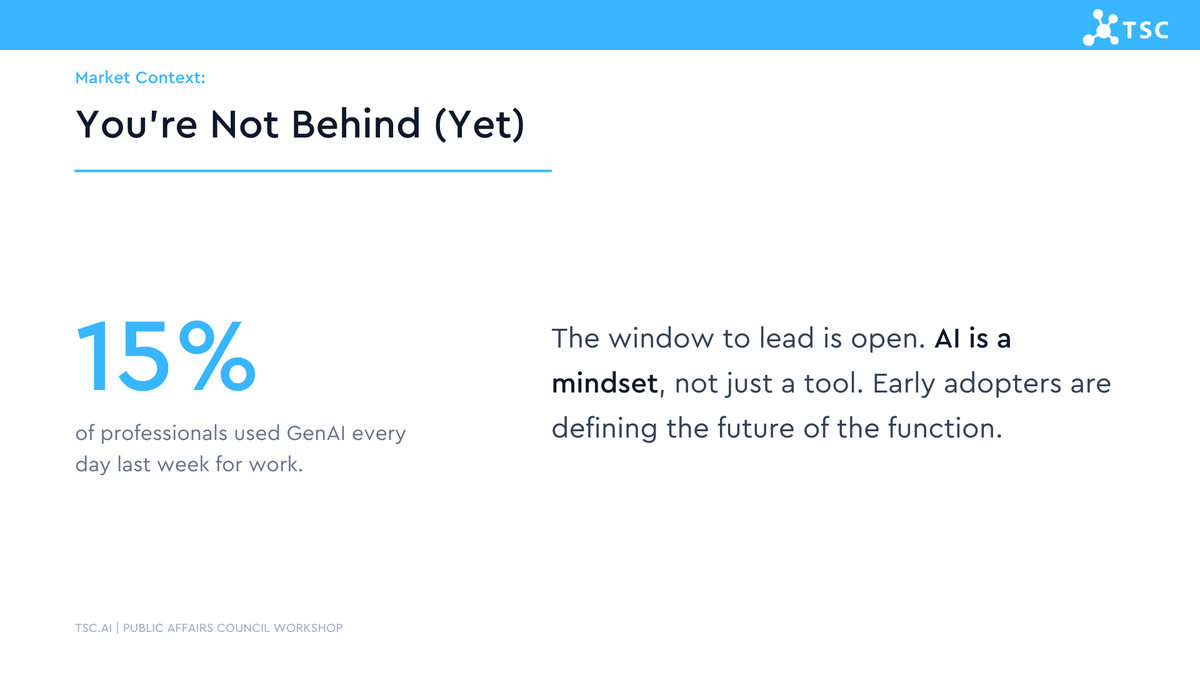
You’re not behind (yet).
Only ~15% of professionals used Generative AI daily for work last week.
This was one of the most interesting data points highlighted when our CEO Terence Lyons spoke at a workshop with the @PACouncil on AI for Public Affairs.
The transformation of the function has barely begun, and the biggest opportunity for PA is Influence.
AI allows public affairs teams to move from reacting to issues to shaping them earlier, by detecting signals, analysing narratives and identifying key stakeholders before issues escalate.
More insights from the workshop coming soon.
Next Tuesday, @TSC_ai's CEO Terence Lyons will be speaking at the Public Affairs Council’s 'AI for Public Affairs Masterclass'.
The session explores how AI is reshaping the fundamentals of public affairs from policy monitoring and stakeholder intelligence to the workflows that connect them.
If you work in public affairs, corporate affairs, government relations, or communications, this is a conversation many teams are already navigating.
Details and registration: https://t.co/btnu9Qrvh2
Risk rarely announces itself clearly.
It shows up as weak signals, a regulatory shift in one market, a sentiment change around a subsidiary, or a competitor incident that suddenly matters.
In this customer story, we share how a leading global engineering & defence group built a structured external risk intelligence capability across 26 countries - helping its Risk team move from fragmented monitoring to early-warning visibility.
From tracking KRIs at scale, to monitoring competitor and counterparty risk, to delivering executive-ready briefings - read how external risk intelligence is being operationalised in practice.
Read more: https://t.co/24H8P7Xfrd
From stakeholder management to engagement to intelligence, many organisations are still operating with fragmented tools, outdated assumptions, & blind spots around how stakeholders relate to real decisions and outcomes.
We wrote this guide on Stakeholder Intelligence to unpack these concepts: https://t.co/QMwz36dxem