TStat offers biostatistic, econometric and statistical training and statistical consultancy to researchers and professionals in the private and public sector.
FIRST CARPATHIAN STATA CONFERENCE - 27 JULY 2026 - Cluj-Napoca, Romania.
Calling all our @Stata users in #Slovakia and #Slovenia — submit your abstracts and share your work with an international community of #Stata users. This is a great opportunity to present your research, exchange ideas, and connect with fellow Stata researchers across the region.
Submit your abstract by 30th May to be part of the inaugural Carpathian Stata Conference! More info @ https://t.co/zel9LpBuE9
#Stata #DataScience #Econometrics @PublicHealth #Epidemiology #Conference #Research #CarpathianRegion
Day 2 will be dedicated to our conference workshop Automating Your Research in Stata. A unique opportunity for doctoral students & early-career researchers looking to strengthen their Stata programming skills. Workshop leader: Giovanni Cerulli (IRCrES-CNR, Rome)
We are delighted to announce the first Greek Stata User Meeting 🇬🇷 📍Athens | 🗓27–28 January 2027 at the AUEB.
The conferences represents a new forum for Greek Stata users across academia, research & government to share research and ideas. Info at https://t.co/BgShxRY5ow
The conference will feature presentations and discussions showcasing new #Stata commands, applications, and research. Together with Tips and Tricks to elevate your Stata experience. A space to exchange ideas and strengthen collaboration across the Stata community.
to implement hierarchical clustering using TF-IDF vectorization & cosine distance. Allowing users to identify patterns on data, uncover latent themes & organize information for macroeconomic forecasting, sentiment analysis, or real-time policy monitoring. https://t.co/0BvSI2xux3
Combining native Stata capabilities with Python-enhanced workflows, Carlo Drago offers an accessible and policy-relevant toolkit for unsupervised text classification in multiple domains. This applied text mining & clustering framework enables users to classify & interpret text
Loreta Isaraj illustrating automated data extraction from unstructured textual sources using a scalable fully integrated workflow employing Large Language Models (LLMs), specifically @ChatGPT 4.0 via @API, in conjunction with @Python & @Stata. Details @ https://t.co/OAjQMuHnL5
Covariate selection is performed through a Lasso-based local estimation, ensuring valid inference under approximate sparsity. The command generates output variables that can be used for further post-estimation analysis within the same session. More @ https://t.co/vma3ZwX6Zj
Marianna Nitti currently illustrating her NEW @stata command rdlasso, which implements Regression Discontinuity Designs with high-dimensional covariates in @Stata. The procedure extends the methodology developed by Kreiss and Rothe (2023) to both sharp and fuzzy designs.
The new @Stata command outdetect by Giulia Mancini et al., offers researchers faced with extreme values in #surveydata a simple univariate detection procedure, with useful diagnostic tools for #sensitivityanalysis, for outlier detection. Detailed info @ https://t.co/GmGzSsauIA
Are you trying to group data into sets of similar observations without relying on predefined labels? Then Carlo Drago’s work on consensus clustering in @Stata 19 is likely to be of interest. Carlo’s approach combines bootstrapped k-means with hierarchical clustering based on a
co-association matrix, which allows @stata users to address the possible inherent instability of partitioning-based #clustering by aggregating results from multiple #bootstrap samples, improving robustness and reproducibility. Carlo uses a combination of existing Stata routines,
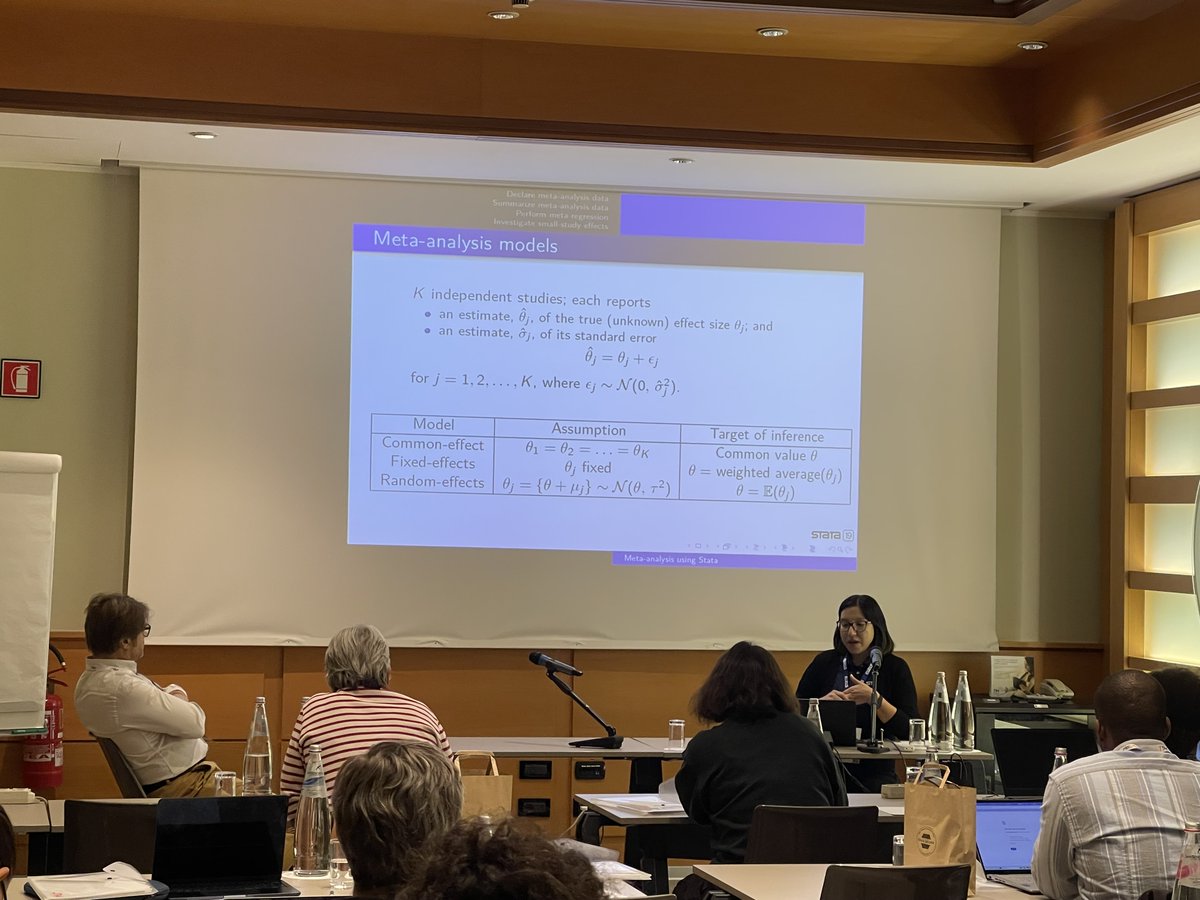
@StataCorp’s Gaby Ortiz currently putting the spotlight on @Stata 19’s #metanalysis capabilities. An excellent prep for tomorrow’s Introduction to #Bayesian#MetaAnalysis course! Presentation available online at https://t.co/LExwjkXa9n
Maria Elena Bontempo illustrating how her NEW flexible panel data command pantarei extends the existing commands xtsum & loneway to consider, amongst other things, the role of CCE inside the within variability. Presentation at https://t.co/Bu7gyr6kfQ
Working on #EventfHistory (#SurvivalAnalysis) in @Stata? Then David Bussi’s splitting command, stsplit, will facilitate the breaking of your time axis into episodes in order to include time-varying covariates in your analysis. Command details at https://t.co/M0SPIWMeKg
Jan Ditzen's panel data xttools suite of commands opening our Tips & Tricks session this morning: xtpcaget obtains principal components from multiple variables; xtplot2 identifies panel structure for variables
Testing for or estimating #structuralbreaks in #timesseries or #paneldata? Then check out Jan Ditzen et al. NEW @stata command xtbreak to detect for breaks, determine their number and location, and provide break date confidence intervals! Presentation at https://t.co/YvocUjje1d!