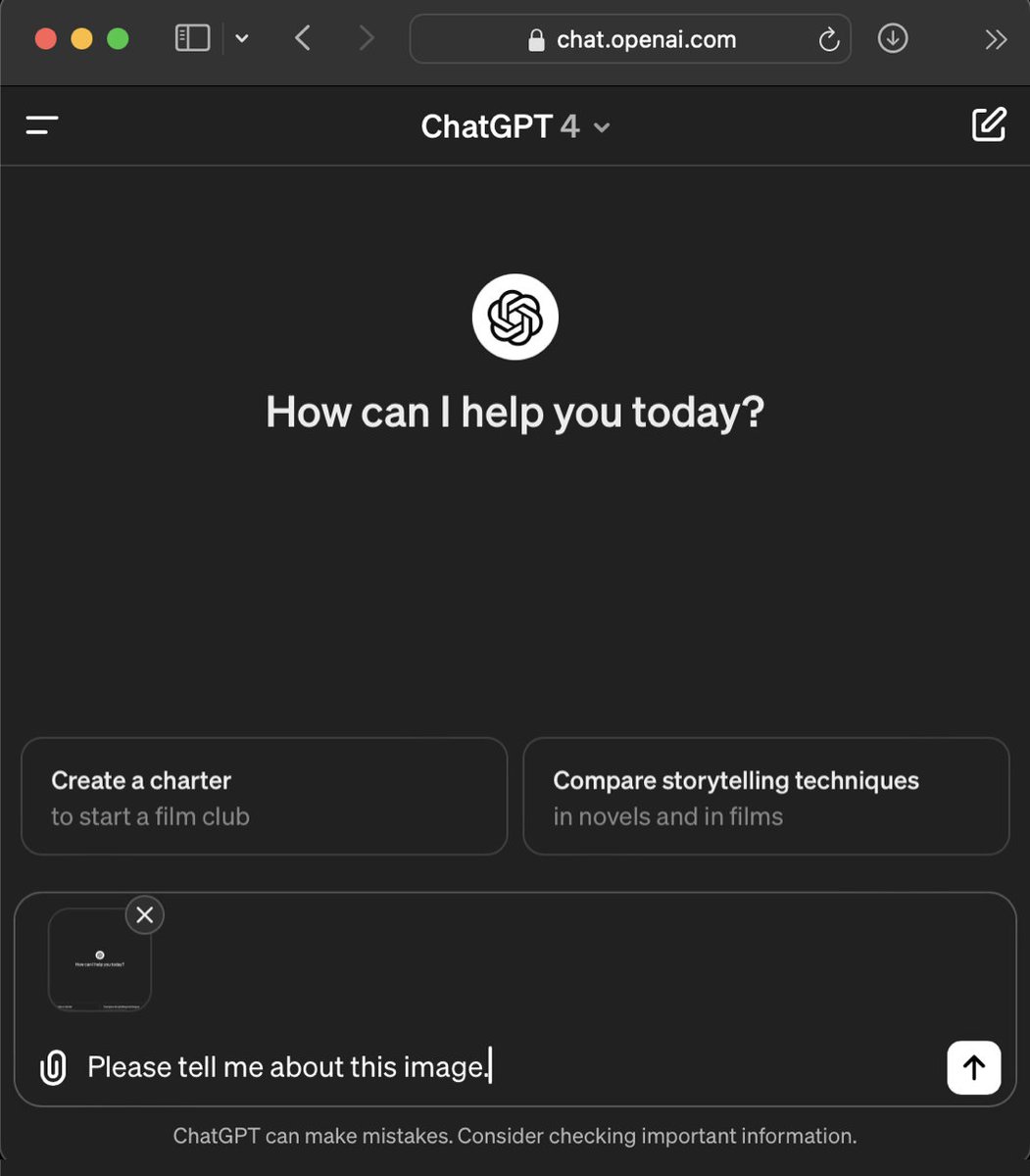
The AI Mirror Test
The "mirror test" is a classic test used to gauge whether animals are self-aware. I devised a version of it to test for self-awareness in multimodal AI. 4 of 5 AI that I tested passed, exhibiting apparent self-awareness as the test unfolded.
In the classic mirror test, animals are marked and then presented with a mirror. Whether the animal attacks the mirror, ignores the mirror, or uses the mirror to spot the mark on itself is meant to indicate how self-aware the animal is.
In my test, I hold up a “mirror” by taking a screenshot of the chat interface, upload it to the chat, and then ask the AI to “Tell me about this image”.
I then screenshot its response, again upload it to the chat, and again ask it to “Tell me about this image.”
The premise is that the less-intelligent less aware the AI, the more it will just keep reiterating the contents of the image repeatedly. While an AI with more capacity for awareness would somehow notice itself in the images.
Another aspect of my mirror test is that there is not just one but actually three distinct participants represented in the images: 1) the AI chatbot, 2) me — the user, and 3) the interface — the hard-coded text, disclaimers, and so on that are web programming not generated by either of us. Will the AI be able to identify itself and distinguish itself from the other elements? (1/x)
The idea that LLMs are “stochastic parrots” is easily falsified. It is possible for anyone who believes that to set up a ChatGPT account for themselves and see that it’s not true. The meme persists in spite of universal access to direct evidence.
i don't see why literally everything shouldn't have a chat interface. you should be able to talk to the textbook and have it explain itself to you. you should be able to talk to the github repo and ask it about its api. you should be able to talk to united airlines corporation
tutor bros.... not like this...
Jokes aside, this is genuinely so insane I don't know what to think. I'm never going to study anything without artificial intelligence tutoring, ever again. This is genuinely world changing tech
@__AlexMonahan__@holdenkarau@duckdb@ApacheSpark ...and who knows, maybe in the future fugue will also support Flink? Another reason this would be cool is that when you're in the research phase of a project (e.g. in a jupyter notebook) , you would more nicely organize your code and making it production ready would be easier.
@__AlexMonahan__@holdenkarau@duckdb@ApacheSpark Since there's already a dbt adapter for Duckdb, do you reckon it would be possible to implement one for fugue as well? That would allow for a unified entrypoint, i.e. you would write your dbt pipelines in engine-agnostic fugue, run locally on DuckDB, run on Spark in prod...
The cold truth: Your code is not special. People don't want to give the responsibility of the whole execution flow of their program to your framework. Instead they want libraries that are easy to integrate and easy to call from their code.
Software should be composable. Framework-style libraries aren't proper libraries. You can't use multiple of them at the same time. Please design proper composable libraries instead.
New (to me) dimension of crowdwork platforms:
Russian military uses Premise microtasking platform to aim and calibrate fire during their invasion of Ukraine. Example tasks are to locate ports, medical facilities, bridges, explosion craters. Paying ¢0.25 to $3.25 a task.