Rome handed out free grain to 40,000 citizens in 73 BC. By 46 BC, Julius Caesar found 320,000 people lining up for their monthly ration. That eight-fold expansion happened in under three decades, and it shows you how welfare states actually grow.
No Roman senator stood up and announced a plan to addict a third of the city to government bread. It happened incrementally, through political competition. Each magistrate who wanted votes expanded eligibility. Each expansion normalized the next one. The citizen who once considered the dole shameful eventually expected it, then demanded it, then organized politically to protect it.
This is the core mechanism free market thinkers have identified across every era: once you create a transfer program, you create a constituency for that program. Recipients vote. Administrators build careers. Grain merchants who supply the state develop a stake in keeping the contracts flowing. The political economy locks in.
Caesar, to his credit, actually cut the rolls back to 150,000 through verification audits. It was one of his more economically coherent moves, though the Senate still murdered him. His successors quietly let the numbers climb again.
What did the dole require? Massive grain imports from Sicily, Sardinia, and Egypt, organized through state logistics at state expense, funded by taxation and conquest. When the conquest revenue dried up, the obligation remained. Rome had written a check against future military success, and future military success eventually failed to arrive.
The lesson is not complicated. Distribute a benefit and you distribute dependency. Distribute dependency and you distribute political power to whoever controls the distribution. The grain dole didn't weaken Rome overnight, but it made every subsequent reform politically impossible.
In 1922 the British Empire was larger than at any point in history. It extended to 24 percent of the total landmass of the whole world. At this time, the government had 300-350,000 civil servants. They had no computers, no electric typewriters, no calculators. Calculations that would take seconds today would take minutes or hours. Research that would take seconds today would take days and yet those 300-350,000 were able to do everything necessary to run a quarter of the planet. Today the British government employs 557,000 civil servants with computers and modern technology to run only Britain. I can’t help thinking that maybe we’re employing too many civil servants.
“Muere mucha más gente en Nigeria que en Palestina. El año pasado, 500.000 cristianos fueron asesinados. Pero los activistas no protestan ni dicen nada. Para mí, eso es hipocres��a.”
"Leading people into the blind alley of dependency and grievances may be counterproductive for them, but it can produce votes, money, power, fame, and a sense of exaltation to others who portray themselves as friends of the downtrodden."
— Thomas Sowell
Broadway in Nashville is no longer just country music and tourists.
Carloads of Muslims are rolling the strip with Islamic flags raised high, Arabic chants blasting over the horns.
The locals watching it unfold say the same thing: this doesn't feels like America.
Hayek on the socialist roots of Nazism and fascism:
“Long before the Nazis, the German and Italian socialists were using techniques of which the Nazis and fascists later made effective use.
The idea of a political party which embraces all activities of the individual from the cradle to the grave, which claims to guide his views on everything, was first put into practice by the socialists.
It was not the fascists but the socialists who began to collect children at the tenderest age into political organizations to direct their thinking. It was not the fascists but the socialists who first thought of organizing sports and games, football and hiking, in party clubs where the members would not be infected by other views.
It was the socialists who first insisted that the party member should distinguish himself from others by the modes of greeting and the forms of address. It was they who, by their organization of ‘cells’ and devices for the permanent supervision of private life, created the prototype of the totalitarian party.
By the time Hitler came to power, liberalism was dead in Germany. And it was socialism that had killed it.”
“Ser comunista, inteligente y bueno es totalmente incompatible. El que es inteligente y bueno no es comunista. El que es comunista y bueno no es inteligente. Y por supuesto, el que es comunista e inteligente, es imposible que sea bueno”
Alexander Solzhenitsyn
Reagan said it best: Freedom is never more than one generation away from extinction.
Remember that when you head to the polls this November. Vote for freedom, not socialism.
You’re the moron, unfortunately many of the lower courts have been purely political. Just like the Bozo judge who ruled on the Somali immigrants who were set to be returned to Somalia after their stay here under TPS. The Supreme Court had already decided that they could be returned, yet this Bozo judge ruled that the could not be deported. You say Trump is a fascist wannabe, where is your evidence…
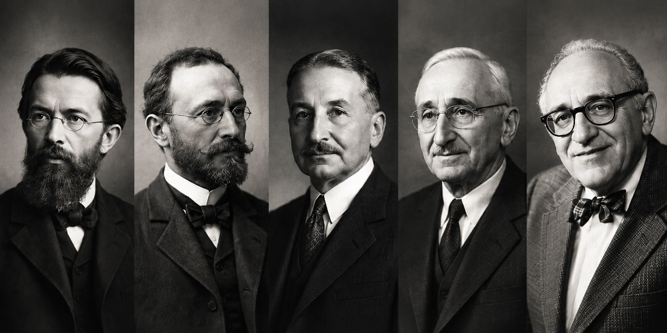
The intellectual case against Marxism was won more than a century ago. The most rigorous and devastating blows came from the Austrian School of economics – but the strange part is that hardly anyone is taught the winning arguments.
Carl Menger’s subjective theory of value, developed in the 1870s, undermined the labour theory of value on which Marx built his entire system. Eugen von Böhm-Bawerk then delivered a systematic demolition of Marx’s economics, exposing the contradictions in the theory of surplus value and the so-called transformation problem. Ludwig von Mises went further still, demonstrating that rational economic calculation is impossible under socialism because without private property and market prices there is no way to allocate resources efficiently. Friedrich Hayek later extended this into the knowledge problem: the information required to run a complex economy is dispersed and cannot be centralised. And Murray Rothbard showed how Marx misunderstood the nature of capitalism by replacing voluntary exchange and entrepreneurial creation with a false theory of exploitation based on labour value and class conflict.
These were not minor objections. They struck at the theoretical foundations of Marxism and, in the case of Mises and Hayek, correctly predicted the chronic waste, shortages, and eventual collapse of socialist economies. History confirmed their arguments on a civilisational scale.
Yet in universities, media and political debate, these critiques remain marginal. Marx is still widely taught as a serious economist and social theorist. His errors are softened, historicised, or treated as interesting starting points. The Austrian responses are rarely given equal weight. Students can pass through entire programmes in the social sciences without encountering Böhm-Bawerk’s critique or Mises’s calculation argument in any depth.
This neglect is not accidental. It reflects a deeper intellectual preference for theories that pathologise markets and legitimise expanded state power. The result is a public discourse that continues to recycle Marxist categories long after their economic foundations were shown to be unsound. The cost of that selective memory is still being paid.
Fascism where? And you’re wrong Republicans do not control all branches of the U.S. government, the third branch of government is the Courts surely you haven’t had your head in the sand that long. As corruption, the Democrats are the leaders in corruption and have been for DECADES…
I spent several decades warning the West of the tragic consequences of their policies. I did so at great personal and professional cost. Imagine seeing innumerable Canadians and Americans hurl endless insults at me because apparently as a Jewish man, I’m to blame for said policies. This won’t end well. Have a good Sunday.