Google Workspace inbox placement fell from 88.9% to 74.3% this year.
That's from Validity's Email Radar, published Oct 28. They called it even worse news for B2B senders than the Gmail numbers, and B2B is where cold email lives.
Gmail overall dropped too. Inbox placement averaged 90.97% in Q1 2026 and 81.57% in Q3. Spam placement at Gmail went from 5.4% to 9.5%, and emails blocked or rejected went from 3.6% to 8.9%.
Part of their explanation: the bulk sender rules introduced in 2024 are now fully enforced. Missing authentication, no one-click unsubscribe, or a high complaint rate now means more spam and more rejections.
My take for cold email: if your replies slipped this year and you blamed the copy, check placement first.
If you're using https://t.co/DgS8w6UuOf, check your warm-up spam rates and run an inbox placement test.
Rewriting an email won't help if it never reached the inbox.
Validity's advice was smaller, more targeted sends instead of more volume. That's what I'd tell a cold emailer too.
Most mailboxes that "never recovered" had stopped sending.
Last week I shared our data on a sample of 10k+ mailboxes that hit a spam spike.
Of the ones we could follow for a full 30 days, about 4% never had a single clean day. And 3 out of 4 of those had stopped sending.
Only about 1% were still sending and still stuck after 30 days.
So when someone tells me warmup didn't fix a mailbox, the first thing worth checking is whether it was still running.
Your first cold email doesn't need a link.
No calendar link. No case study. No tracked website link. No images.
The first email carries the least trust you'll ever have with that inbox, and every link and image is one more thing a filter checks.
Save the link for the reply. Someone who writes back "sure, send me times" is happy to click.
Microsoft is the strictest about this. "No links, no images" was the Outlook advice I heard at MailCon too.
Our UI could be better. I'll say that publicly.
At Mailivery we build the engine first: the warmup network, blacklist monitoring, placement tests. The dashboard comes after.
A clean dashboard is easy to demo. It doesn't tell you whether the data behind it is right.
If you're evaluating any email tool, ask to talk to a customer who has used it for 12+ months. You'll learn more from that call than from the demo.
Most warmup "spam spikes" are from just 2 emails.
That sounds too small to matter until you look at how warmup actually works. A mailbox in warmup is not sending hundreds of emails a day. We looked at a sample of 10k+ mailboxes in our network whose daily spam rate jumped past 10%. On a typical spike day, only about 12 warmup emails were placed, meaning we could see whether they landed in the inbox or in spam.
If 2 of those 12 go to spam, the daily spam rate reads as 16.7%. That looks alarming on a chart. But it is only 2 emails. And because so few emails went out that day, one extra email landing in spam moves that number by about 8 percentage points. A single day can look scary without the mailbox actually falling apart.
So I would not make a decision off one day. Look at the 7 day trend instead. If the spam rate is still climbing after a week, then dig in.
"They opened it 3 times, call them."
Pipeline360 just surveyed 526 marketing and sales leaders. 43% of teams act on email engagement. About one in four fully trust it.
The ones who don't trust it are right.
Privacy features load tracking pixels automatically. Security filters click links before a human ever sees the email. A lot of "engagement" is software.
Same study: 62% of self-rated top performers judge a signal by combining several, vs 45% of everyone else.
For cold email, the signal I'd route to a rep is a reply. Everything else is a maybe.
Thanksgiving is Nov 26. Most cold email slows down from there until January.
That makes the next few weeks the cheapest time to fix your setup. What I'd do:
What's a normal spam rate for a mailbox in warmup?
Here's a recent stretch of warmup:
7,994,501 warmup emails sent
95.25% of placed emails hit the inbox
2.61% landed in spam
So a mailbox sitting around 2 to 3% is in normal range.
A mailbox sitting at 5% or more for a full week is running at about double that. That's when I'd check blacklists, bounce rate and what the campaign is sending before adding volume.
Spam traps don't bounce. That's what makes them dangerous.
They're addresses no real person reads. There are 4 kinds:
1. Pristine: never belonged to anyone. You hit them with scraped or bought lists.
2. Recycled: old abandoned addresses that got repurposed. You hit them when you never clean old contacts.
3. Typo: https://t.co/DLEjNQK4f2, https://t.co/GvRjlkLYyL. You hit them when you skip verification.
4. Honeypot: hidden in website code. Only scrapers find them.
One hit tells mailbox providers your list wasn't built carefully. Keep hitting them and you end up on blacklists.
Verify before every send, pull hard bounces right away, and know where every list came from.
A customer paying us $1,500 a month got on a call to tell us our warmup wasn't working. His emails were going to spam, and from his side it looked like the thing he was paying us for had failed.
Three of us hopped on that call, our CTO included, because it sounded like we had broken something on our end. The first thing we checked was Google Postmaster, which shows how Google sees your domain. His domain reputation had actually gone up since he started warmup, so the domain itself was not the problem.
Then we looked at one of the emails he was sending. It had five different forwarding addresses stuffed into the headers, broken HTML tags in the template, and links pointing out to several different domains. That is the kind of thing filters treat as suspicious, even when the domain is healthy.
He fixed the templates. After that, the emails started landing, and he stayed.
The point of the story is not that warmup magically saved him. Warmup had been doing its job the whole time. What looked like a warmup problem was the email itself, which is why I look at what someone is actually sending before I assume the infrastructure is broken.
Here's how a lot of B2B deals actually go now.
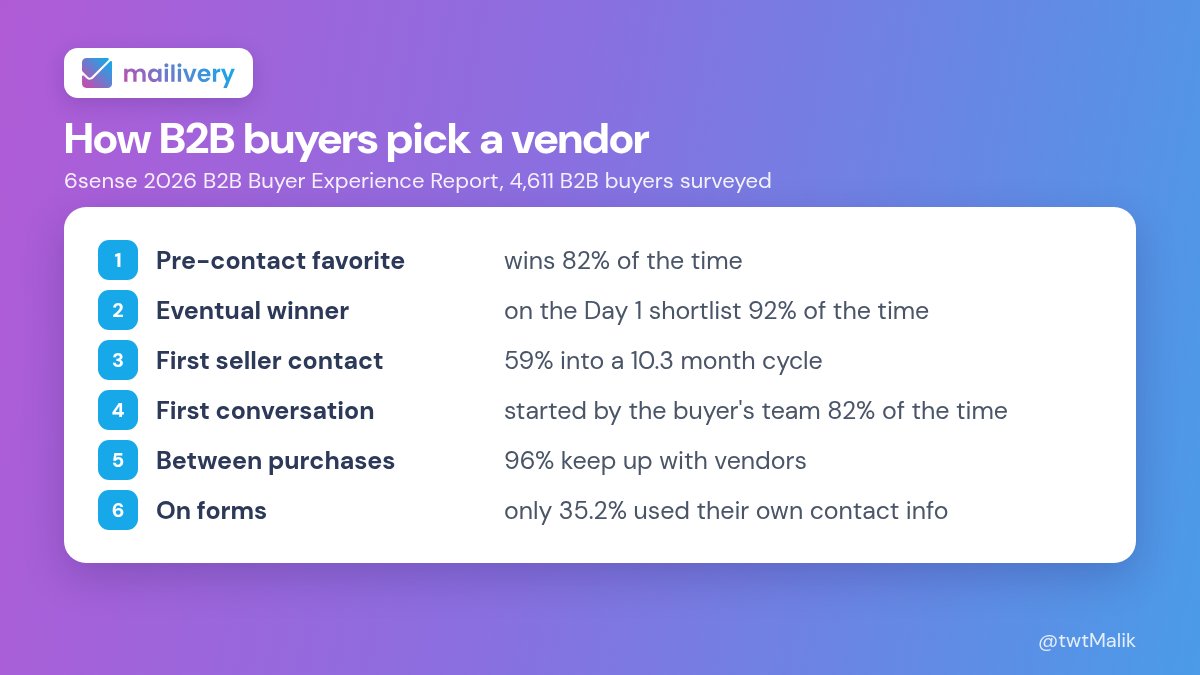
A buyer picks a favorite before they ever talk to sales. Then they spend months researching. When they finally take a meeting, that favorite wins 82% of the time.
That's from 6sense's 2026 B2B Buyer Experience Report, out this week. 4,611 buyers surveyed.
92% of the vendors who won were already on the shortlist on day one. First real conversation with a seller happens 59% of the way into a 10.3 month cycle. The buyer's own team started 82% of those first conversations. And 96% keep tabs on vendors between purchases.
So the meeting isn't where you get chosen. It's where they confirm a choice they already made.
That means cold email isn't for the week someone is buying. It's how your name gets familiar months earlier, enough times that you show up on that day one list.
Which only works if those emails land. Months in spam don't make you the favorite. They make you invisible.
Report: https://t.co/P7T4lOKeTZ
When a mailbox gets hit with a spam spike, how long does it take to recover?
We took a sample of 10k+ mailboxes in our warmup network that had a spike between Aug 10 and Oct 26 and tracked what happened next.