I am a PhD candidate in Organic Chemistry and Electrochemistry at the State University of Campinas (UNICAMP), Brazil, with a strong interest in Machine Learning
New article!
Low-cost open-source potentiostats: A comprehensive review of DIY solutions and fundamental concepts of electronics and its integration with electrochemistry
https://t.co/cogGiPKeHQ
@jbonacin@salles_airton
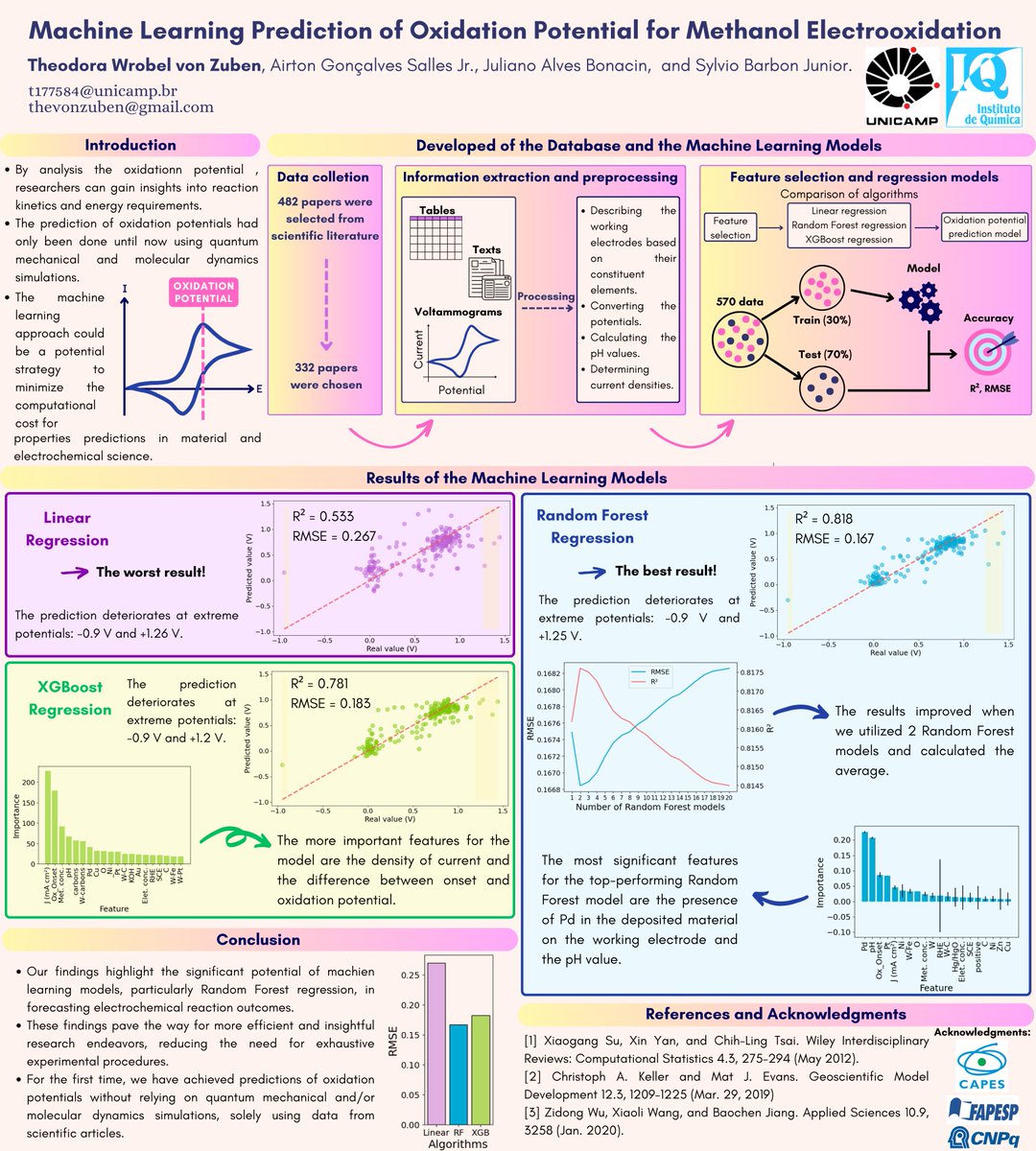
@Leopoldo_Mejia_@LatinXChem@salles_airton@jbonacin@sbarbonjr Additionally, you can increase the amount of data by incorporating information from other sources that exhibit similar behavior. For example, in this case, I can use ethanol as an analyte as well to expand my database
@Leopoldo_Mejia_@LatinXChem@salles_airton@jbonacin@sbarbonjr Thank you! So, this was a problem for me because there are limited papers on methanol oxidation, and it was also quite challenging to gather the information to expand the dataset. In this case, it's important to try to reduce the number of features needed to develop the model
@TheorHetCatICIQ@LatinXChem@salles_airton@jbonacin@sbarbonjr Yes, I first analyzed which features were the most relevant for determining oxidation potential using Pearson correlation. Then, I tested how many of them would be better to use when developing the model.
@Silvannasa@LatinXChem@salles_airton@jbonacin@sbarbonjr This information encompasses details such as the elements it is composed of and the chemical elements deposited on the electrode. I also consider factors like the presence of graphene or carbon nanotubes in the working electrode, and so on.
@Silvannasa@LatinXChem@salles_airton@jbonacin@sbarbonjr Thank you! I use experimental information from scientific literature, so the features I used include pH, analyte concentration, the electrolyte used, the concentration of the electrolyte, and a lot of information about the material of the working electrode.
@panchajaviera@LatinXChem@salles_airton@jbonacin@sbarbonjr Then, I used correlation tools available in Python libraries, which provide a relationship of the importance of each variable. From there, you can start trying to use these variables (which would be the features).
@panchajaviera@LatinXChem@salles_airton@jbonacin@sbarbonjr Regarding the variables, I'm not sure if I understood your question correctly. I basically tried to gather as much information as I considered important when conducting experiments.
@panchajaviera@LatinXChem@salles_airton@jbonacin@sbarbonjr I suggest that you watch introductory online classes available on YouTube, but also don't worry too much about studying extensively before attempting to do something. I really started learning when I decided to try applying it to a real problem.
@panchajaviera@LatinXChem@salles_airton@jbonacin@sbarbonjr I don't find it difficult to learn Machine Learning. The key is to learn a programming language, preferably Python, and then you'll use pre-built machine learning algorithms.