Science communicator (writing, drawing, video-ing) with a particular interest in applied biological science. Previously a biofuels researcher. He/Him 🏳️🌈.
Many thanks to @molcoddington for writing this piece in Technology Networks covering our exciting new partnership with the @AllenInstitute probing the connection between tau protein and #Alzheimer's!
https://t.co/QhJhHmKx8M
Our fantastic collaborator from the Allen Institute, @KyleTravaglini, states the goals of the agreement best:
"Our pilot with Nautilus is aimed at exploring if we can better measure other kinds of pTau proteoforms that are present in that early phase of the disease and see if any are more strongly associated with that early neuronal loss. If so, we may better understand that early loss and design therapies to stop it. We could also identify proteoforms that could serve as important biomarkers of early AD."
With single-molecule proteoform analysis, we firmly believe scientists will discover many new points of attack on currently intractable diseases like Alzheimer's and many other conditions. Exciting times ahead!
This eBook covers how researchers are using the Nautilus Voyager™ Platform to explore how different forms of a single protein (tau) impact Alzheimer's. This kind of analysis is very difficult to do on other platforms, but opens vast new opportunities for therapeutic development.
📘 The latest edition of the "Proteomics and neuroscience" eBook has arrived!
This edition showcases how researchers are using the Nautilus Voyager™ Platform to develop novel insights into the roles of tau proteoforms in Alzheimer’s disease and related dementias.
In it, you’ll discover:
🔵 Brief background on the tau protein and its role in Alzheimer’s disease.
🔵 Examples of how researchers are using the Nautilus Voyager Platform to study tau proteoforms at the single-molecule level and develop novel insights into their functional roles in Alzheimer’s disease and related dementias.
🔵 How you can be one of the first to incorporate the Nautilus Voyager Platform into your workflows.
Download the eBook here:
https://t.co/x2Dn1txmWa
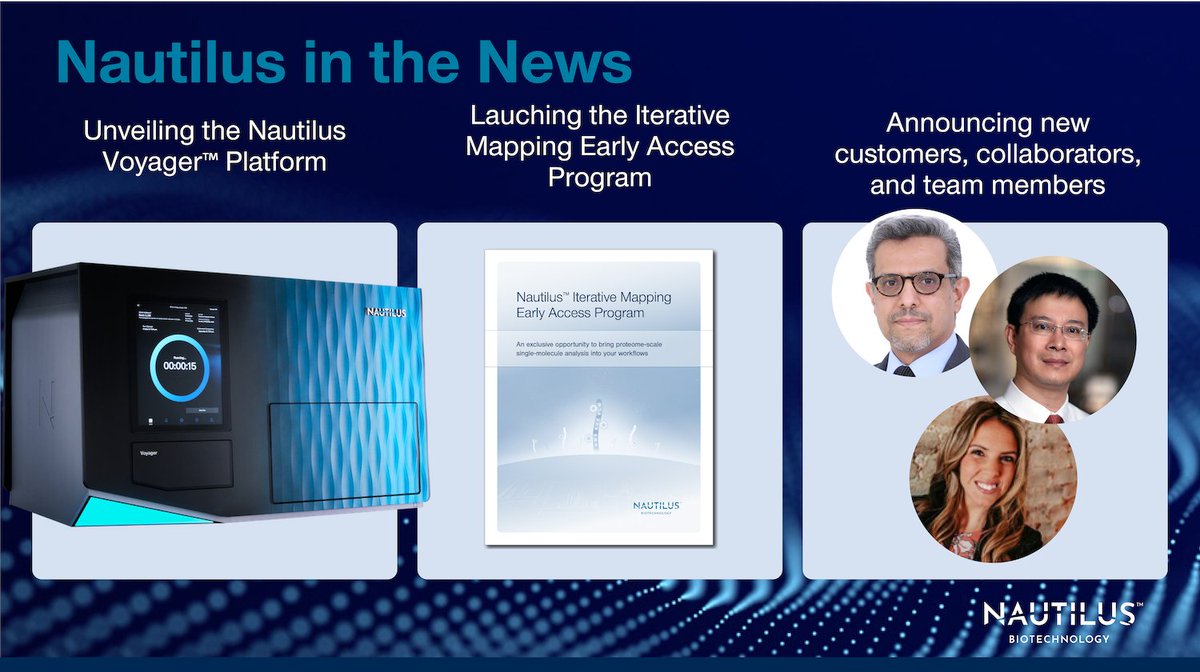
While every month is a busy one at Nautilus, the last few months have been an absolute whirlwind with the unveiling of the Nautilus Voyager™ Platform, the launch of the Iterative Mapping Early Access Program, and the announcement of our first customers!
In this blog post, we share press releases and articles covering our exciting news from the last few months.
https://t.co/ocIgq4C0cG
Join us in our journey revolutionize biology with accessible single-molecule proteomics by participating in our Iterative Mapping Early Access Program:
https://t.co/xxqBaqKxks
We're proud to announce Baylor College of Medicine as the first customer of our Iterative Mapping Early Access Program!
In a study led by Baylor Professors Bing Zhang, Ph.D. and Yongchao Dou, Ph.D, Baylor researchers will leverage the Nautilus Voyager™ Platform to address a central challenge in cancer research – identifying aberrant protein isoforms that contribute to tumor growth, metastasis, immune evasion, and therapeutic resistance.
The study aims to develop a broadly accessible computational toolkit with improved detection of protein isoforms in conventional shotgun proteomics datasets. By pairing these computational approaches with full-length, isoform-resolved proteomic measurements generated on the Nautilus Voyager Platform, the project enables direct comparison of transcriptional and proteomic changes at unprecedented resolution.
Learn more in our latest press release:
https://t.co/q2IgUxNVAA
And finally scientists -- share your hypotheses for structural or systemic bottlenecks that we could run experiments on. New essay competition dropping today to give you a voice: https://t.co/W8KzRENu4z
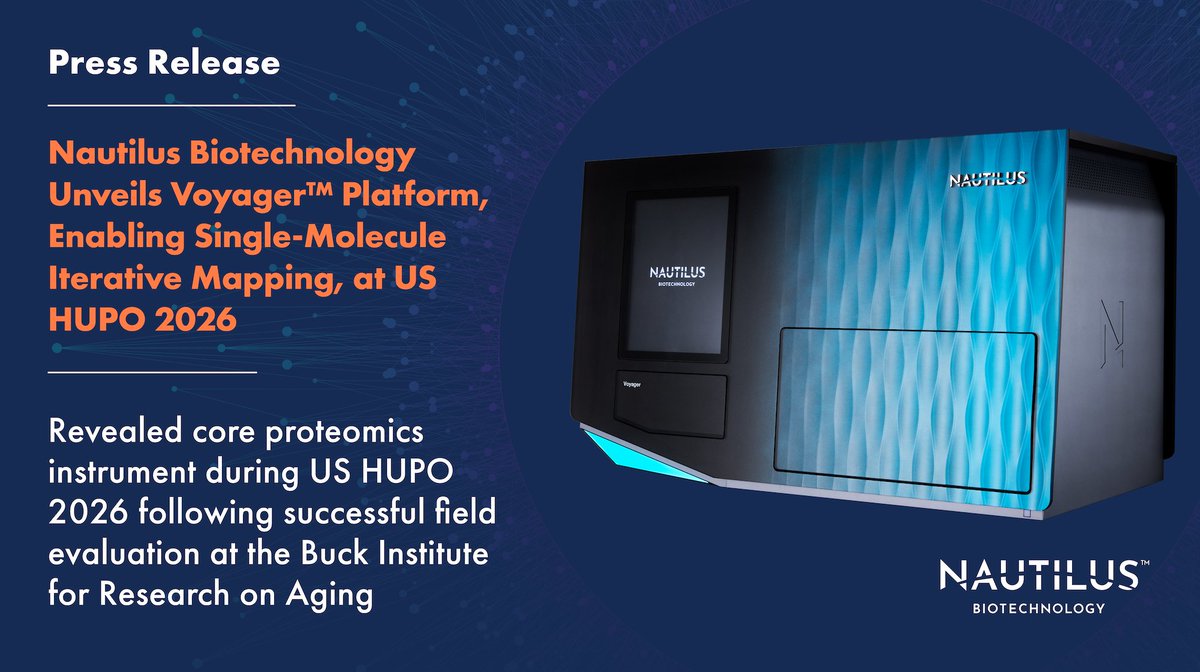
We’re incredibly proud to share that we unveiled the Nautilus Voyager Platform at US HUPO 2026!
Learn more about the Voyager Platform in our press release:
https://t.co/G1P2CPMkQy
And visit our website to discover how all the components of the Voyager Platform come together to enable Iterative Mapping:
https://t.co/5x9GeM5a1f
In this 2025 wrap‑up episode of the #TranslatingProteomics podcast, Parag Mallick and Andreas Huhmer share their reflections on the year’s developments in proteomics largely inspired by their observations at HUPO 2025. Some of the highlights include a focus on:
🔼 Clinical/translational work
🔼 Immunpeptidomics
🔼 Multiomics
🔼 Proteoforms
And some of the surprises include:
🔽 Less of a focus on spatial proteomics at HUPO 2025
🔽 Less of a focus on single-cell proteomics at HUPO 2025
Hear the full discussion and drop your observations and 2026 predictions in the comments:
https://t.co/ZIq89r8MUl
Curious how tau proteoforms shape biology and neurodegenerative disease? In our upcoming webinar, Professor Birgit Schilling from the Buck Institute for Research on Aging will share cutting-edge tau proteoform data generated by Iterative Mapping - our novel single-molecule proteome analysis method.
📅 January 14 | 09:00 PST
https://t.co/ByYWV7Iy7h
Great Nautilus callout in this excellent @GENbio article about HUPO 2025!
"What really animated [Birgit Schilling] at HUPO, though, was a non–mass spectrometry platform: Nautilus Biotechnology. Her lab is among the first outside the company to run its single-molecule, multi–affinity-probe system."
We're are honored to work with Birgit and her team at the @BuckInstitute and look forward to our continued work with them and the broader HUPO community!
https://t.co/lUo5nUjaIV
Gene <--> function thinking is stuck in 1950s.
In 1941, George Beadle and Edward Tatum discovered that specific gene mutations caused specific metabolic blocks, each due to failure of a single enzyme.
They formulated an influential “𝑜𝑛𝑒 𝑔𝑒𝑛𝑒 - 𝑜𝑛𝑒 𝑒𝑛𝑧𝑦𝑚𝑒” hypothesis. It was later refined to "𝑜𝑛𝑒 𝑔𝑒𝑛𝑒 - 𝑜𝑛𝑒 𝑝𝑟𝑜𝑡𝑒𝑖𝑛" model.
This model was recognized by a Nobel Prize for "for their discovery that genes act by regulating definite chemical events". This was an important insight for its time, one that advanced science.
𝐍𝐨𝐰, 𝐰𝐞 𝐤𝐧𝐨𝐰 𝐢𝐭 𝐢𝐬 𝐨𝐯𝐞𝐫𝐬𝐢𝐦𝐩𝐥𝐢𝐟𝐢𝐞𝐝, 𝐢𝐧𝐚𝐝𝐞𝐪𝐮𝐚𝐭𝐞 𝐭𝐨 𝐝𝐞𝐬𝐜𝐫𝐢𝐛𝐞 𝐛𝐢𝐨𝐥𝐨𝐠𝐲.
Most genes, especially human genes, code for multiple different proteoforms with distinct molecular composition (often distinct primary amino acid sequences) and diverse functions.
Join us on January 14 at 9am PT for an exclusive webinar on Iterative Mapping, our single-molecule proteomics method that delivers precise, AI-ready protein quantification.
In the webinar, you'll discover how this novel method can transform your research and you'll hear directly from Professor Birgit Schilling who is using Iterative Mapping to study tau proteoform heterogeneity in Alzheimer's disease.
🗣️ Speakers - Dr. Parag Mallick, Dr. Sheri Wilcox, and Dr. Birgit Schilling.
Register now:
https://t.co/ByYWV7Iy7h
#Proteomics #Proteome #Protein #SingleMolecule
Today on the Nautilus Blog - The second post in our new series focused on AI and proteomics. Dive in to learn how our data’s quality, simple and direct relationship to biology, and scale are designed to make it ideal for AI integration.
https://t.co/xRW8eKrejR
#AI #ArtificialIntelligence #ML #MachineLearning #Proteomics #Proteome #SingleMolecule
Iterative Mapping is our novel method for single-molecule protein and proteoform analysis across the full proteome. It combines advances in nanofabrication, optics, and machine learning to gather many bits of information about billions of single protein molecules simultaneously and generates robustly quantitative views of the proteome without tradeoffs.
Read our recent preprint to explore data generated by this groundbreaking method and drop by our seminar, presentation, and poster at #HUPO2025 to learn how you can use Iterative Mapping in your work.
At our lunch seminar on Monday, November 10th at 12:15pm, Professor Birgit Schilling from the @BuckInstitute for Research on Aging will share how her lab is already using Iterative Mapping – don’t miss it!
🗓️ Find all of our events and schedule a meeting with us at HUPO here:
https://t.co/2didzh3RAU
📄 Preprint here:
https://t.co/RQg5ab4cwo
#Proteomics #Proteome #Proteoforms #Protein #Biotech $Naut
Proteomics has the incredible potential to reveal the mechanisms underlying biology. In doing so, it may provide the raw materials needed to develop the next generation of more effective biomarkers, diagnostics, and drug targets. In short, proteomics can revolutionize biomedicine.
However, without the help of AI, achieving these aims will be slow-going. In our new blog series, we discuss:
🤖 Why proteomics needs AI and why we need better proteomic data to train models of biology
📊 How Nautilus data is designed to be well-suited for AI integration
↔️ How AI-ready data may enable improved multiomic analyses
Today’s post covers why proteomics needs AI and why we need better proteomic data to train models of biology. Read the full post here:
https://t.co/LPmdakWJND
#Proteomics #Proteome #ArtificialIntelligence #AI #MachineLearning
Join us at #HUPO2025 where we’re proud to share how Iterative Mapping is redefining proteomics. This novel, single-molecule method is designed to robustly quantify proteins and proteoforms across the full proteome and provide the first complete proteomics solution.
Drop by our lunch seminar, presentation, poster, and booth to explore highly accurate, precise, and reproducible data generated with Iterative Mapping. We’re excited to discuss how this method efficiently gathers many bits of information about billions of individual protein molecules simultaneously to generate quantitative maps of the proteomic landscape.
At each of our HUPO events, we’ll also hand out clues to our proteoform scavenger hunt – bring them to our booth (#705) to identify a proteoform and enter for your chance to win a Nintendo Switch 2!
Learn more about our HUPO events here:
https://t.co/CdHtvJ3T0t
Earlier this week, our own Co-Founder and Chief Scientist Parag Mallick joined a panel at Fierce Biotech Week to discuss, "How Biotechs Are Leveraging AI/ML to Drive Efficiency and ROI." Three intriguing takeaways from the panel were:
1) Great data is critical to the AI revolution. Not all data is created equal and we have to be aware of biases in the data that will impact model behavior.
2) There are many places where AI can contribute early to demonstrate value - so we need everyone across the value chain thinking about AI. For example optimizing cooling in a data center or speeding up improving antibody stability to freeze thaws. Not always sexy - but important and valuable.
3) Next generation models in this domain need to do a better job failing gracefully and giving up rather than today’s status quo where they might be extremely confident and wrong.
AI/ML play a strong role in our platform and we are excited to generate deep and comprehensive proteomic data that will train the next generation of powerful biological models.
#AI #ML #ArtificialIntelligence #FierceBiotechWeek #Proteomics #Biology #Biotech #Biotechnology @LifeSciEvents
Next Thursday, October 9th at 11:15am ET, Nautilus Co-Founder and Chief Scientist Parag Mallick will join a panel at @FierceBiotech Week to discuss:
🗣️ How Biotechs Are Leveraging AI/ML to Drive Efficiency and ROI
https://t.co/4yAPPyG26M
On the panel Parag will share his thoughts on the challenges and opportunities for deploying #AI tools in #biotech.
#ArtificialIntelligence #MachineLearning #Biology #Biotechnology
In the latest update to our Proteomics and cancer eBook, you'll find content focused on the incredible ways proteoform analysis can advance cancer research. It features distillations of work from world-class labs like those of Liangliang Sun at Michigan State, Si Wu at the University of Alabama, Rozbeh Jafari at the Karolinska Institute, Forest White at MIT, and Neil Kelleher at Northwestern.
📘 Find the eBook here:
https://t.co/EwXMUGZqH9
With our Iterative Mapping methodology, we hope to make proteoform analysis mainstream and thereby usher in a new era of precision medicine. Please reach out if you're interested in working with us!
#Proteoforms #Proteome #Proteomics #Cancer #CancerResearch #PrecisionMedicine
Our own Kentaro Suzuki and Andreas Huhmer met with leaders in proteoform research at the Consortium for Top Down Proteomics (CTDP) last month. Members of CTDP are driven to realize the incredible potential of proteoform-centric research, and we are excited to work with them to advance all of the life sciences through the power of proteoforms.
Learn more:
https://t.co/N1NJ87tWT8
#Proteoforms #CTDP2025 #CTDP #LifeSciences #Biology #Research
🔈 "Harnessing proteoforms to understand life's complexity" podcast:
https://t.co/ld2ql26ggI
🔈 "Are proteins a myth?" podcast:
https://t.co/sH1JYoARTE
🔈 "A new era in Alzheimer's research" podcast:
https://t.co/L0kdn9Mq8A
Many thanks to @molcoddington for writing this piece in Technology Networks covering our exciting new partnership with the @AllenInstitute probing the connection between tau protein and #Alzheimer's!
https://t.co/QhJhHmKx8M
Our fantastic collaborator from the Allen Institute, @KyleTravaglini, states the goals of the agreement best:
"Our pilot with Nautilus is aimed at exploring if we can better measure other kinds of pTau proteoforms that are present in that early phase of the disease and see if any are more strongly associated with that early neuronal loss. If so, we may better understand that early loss and design therapies to stop it. We could also identify proteoforms that could serve as important biomarkers of early AD."
With single-molecule proteoform analysis, we firmly believe scientists will discover many new points of attack on currently intractable diseases like Alzheimer's and many other conditions. Exciting times ahead!
If you need some background on #proteoforms and their potential impacts on diseases like Alzheimers, here are some resources:
📑 "What are proteoforms?" blog post:
https://t.co/xncwGS7Ike