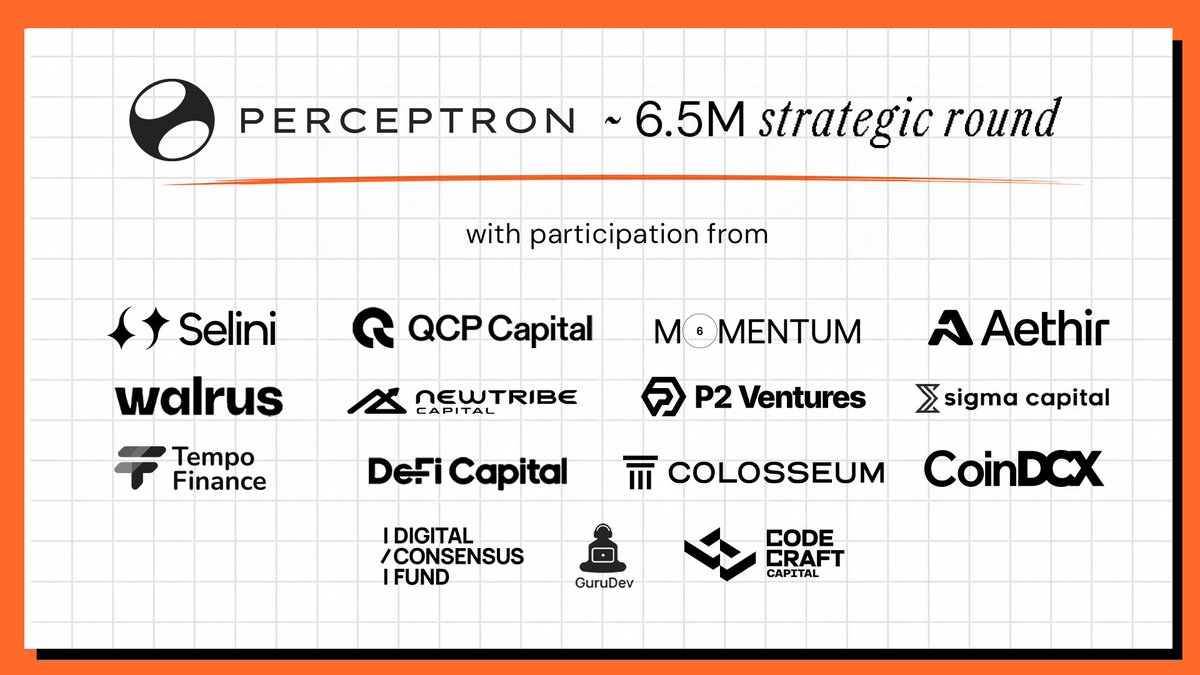
We're thrilled to announce that Perceptron has closed a $6.5M strategic round.
Centralized scraping is hitting diminishing returns on cost and quality. Closed data partnerships are out of reach for most AI teams. The real bottleneck for AI right now sits at the data layer.
Perceptron compresses global data collection into one mesh: idle bandwidth, unique datasets, and domain expertise from a network already live across 800K+ nodes in 150+ countries, with 300K+ daily active contributors.
This round funds our data-questing platform, letting AI companies commission specific, high-value datasets directly from that network and cutting the timeline from request to delivered dataset down to days.
The network continues to expand.
Join us.
→ https://t.co/nXcXB5JrxY
Today’s DeFi landscape often feels less like investing and more like running a full-time operations desk. To stay competitive, users constantly monitor APYs, shift liquidity between protocols, claim and compound rewards, rebalance positions, and manually assess changing risks. Every move demands attention, timing, and execution. This fragmented experience creates friction, inefficiency, and missed opportunities—especially as structured DeFi becomes more sophisticated. For many participants, the biggest challenge is no longer access to yield, but managing complexity at scale.
This is exactly where Concrete Vaults change the game. Instead of forcing users to manually optimize every position, Concrete Vaults provide an infrastructure layer that simplifies onchain capital deployment. They pool capital, automate compounding, deploy assets across structured strategies, optimize over time, and reduce the burden of constant repositioning. Rather than spending hours managing fragmented positions, users gain exposure to an intelligent system designed for efficiency.
The power of DeFi vaults lies in infrastructure. Vaults are not simply convenience tools—they are systems that improve capital efficiency by reducing idle capital, continuously optimizing deployment, and simplifying user experience. Through automated compounding and structured execution, vault architecture allows capital to remain productive while minimizing operational drag. This transforms DeFi from a reactive process into a more consistent framework for institutional DeFi participation.
Concrete Vaults go beyond being passive yield wrappers. Their architecture is designed to coordinate capital deployment, rebalance dynamically, enforce strategic parameters, and adapt to changing onchain conditions. This structured DeFi approach introduces discipline into markets often dominated by manual decision-making. Instead of relying on users to constantly chase performance, vault systems create organized pathways for exposure, efficiency, and scalability.
At the center of this system are ctAssets, which help power a more coordinated model for onchain capital deployment. Combined with automated compounding and structured vault systems, Concrete Vaults create a framework where capital can move efficiently across opportunities while maintaining strategic alignment. This is not just optimization—it is infrastructure designed for the next phase of DeFi evolution.
As DeFi grows more complex, manual strategy management becomes increasingly unsustainable. Constant protocol switching, reward harvesting, and risk tracking do not scale for the future. Infrastructure is becoming the new edge, and Concrete Vaults represent that transition. The future of institutional DeFi may not belong to users endlessly clicking between protocols—it may belong to systems like Concrete Vaults that coordinate capital more efficiently, intelligently, and structurally. @ConcreteXYZ
Explore Concrete at https://t.co/e6g31JOCbu
DeFi Doesn’t Remove Trust — It Engineers It
For years, DeFi sold the world a powerful promise: remove trust, remove intermediaries, remove human failure. “Code is law.” “Trustless systems.” “No middlemen.” It sounded revolutionary because it challenged the very architecture of traditional finance. Smart contracts would replace institutions. Protocols would replace gatekeepers. Automation would replace judgment. But as DeFi infrastructure matured, one truth became impossible to ignore: trust never disappeared. It simply changed form.
In reality, no financial system is fully trustless. DeFi security still depends on assumptions, and every layer introduces new ones. Users trust smart contracts to execute as written, governance systems to make rational decisions, oracles to provide accurate external data, bridges to secure cross-chain movement, and execution layers to process actions reliably. Trust was not removed from the system — it was abstracted, fragmented, and often hidden behind technical complexity. The real question is not whether trust exists, but where it lives and whether it is engineered properly.
This is where decentralization theatre often begins. Many protocols appear decentralized on the surface while relying on fragile structures underneath. Multisigs are often treated as security, even when they merely shift trust to a handful of key holders. DAOs can claim community governance while suffering from low voter participation or governance apathy. Timelocks may slow malicious actions, but delay alone does not equal resilience. In critical moments, systems that cannot respond quickly may fail regardless of how decentralized they appear. The appearance of decentralization is not the same as actual safety.
The next evolution of institutional DeFi requires a more mature framework: engineered trust. Mature systems do not pretend trust is unnecessary — they define it clearly. Engineered trust means structured permissions, explicit responsibilities, enforced constraints, and systems designed not only to prevent failure, but to respond to it. This is how resilient financial infrastructure is built. Trust becomes visible, measurable, and operational rather than ideological.
Operational security is where this distinction becomes critical. Real systems require monitoring, layered defenses, rapid response capabilities, and human judgment for edge cases. Code alone cannot predict every exploit, governance attack, oracle failure, or bridge compromise. Onchain enforcement is powerful, but without operational oversight it can become rigid at precisely the wrong moment. The strongest DeFi infrastructure combines code with systems capable of adapting under stress.
This is where Concrete takes a fundamentally different approach. Concrete vaults are not built around the illusion that trust can be erased. They are built on the idea that trust should be explicit, structured, and enforceable. Concrete emphasizes role-based architecture, controlled execution environments, onchain enforcement, and off-chain intelligence. Rather than hiding operational realities behind slogans, Concrete prioritizes operational security and response capacity. This makes its DeFi infrastructure more aligned with how serious capital evaluates resilience.
The broader shift is already underway. DeFi is moving beyond simplistic trustless systems narratives and toward infrastructure that acknowledges trust as a design variable. The future belongs to systems that perform under pressure, not just systems that market ideology. Resilience, accountability, and engineered trust will define the next generation of DeFi security.
The future of DeFi will not be decided by who claims to eliminate trust.
It will be defined by who structures, secures, and engineers it best.
Explore Concrete at https://t.co/e6g31JO4lW
What Makes a DeFi Strategy Actually Sustainable?
DeFi has repeated the same cycle so many times it has almost become predictable. A new protocol launches with aggressive APY. Capital floods in quickly. Social sentiment spikes. Liquidity surges. For a brief period, the strategy looks unbeatable. Then the pattern shifts. Yields compress as more capital competes for the same opportunity. Incentives weaken. Liquidity rotates elsewhere. Attention moves on. What once looked like the next great opportunity becomes another short-lived chapter in the endless search for yield. This cycle has defined much of DeFi, which raises a more important question than “What pays the most right now?” The real question is: what actually lasts?
Sustainable yield is fundamentally different from temporary performance. A sustainable DeFi strategy is not simply one that generates attractive returns for a week or even a month. It is a strategy that can produce consistent, risk-adjusted yield across market cycles without depending entirely on emissions or short-term incentives. Sustainability means durability. It means a strategy can remain viable through volatility, liquidity shifts, and changing user behavior. In mature financial systems, capital increasingly prioritizes resilience over temporary spikes. DeFi is moving in the same direction.
This distinction becomes clearer when comparing real yield to temporary yield. Real yield comes from actual economic activity: trading fees, lending demand, arbitrage systems, and productive market infrastructure. These sources are connected to usage and utility. Temporary yield, by contrast, often depends on token emissions, promotional rewards, or liquidity incentives designed to attract users quickly. While emissions-driven strategies can create eye-catching APYs, they often decline once incentives slow or dilution increases. Real economic activity tends to create more stable foundations. Not all DeFi strategies are built on the same type of return, and understanding this difference is central to identifying sustainability.
Liquidity and market conditions also play a major role. Some DeFi strategies only thrive in highly specific environments, such as low volatility, strong token demand, or concentrated liquidity. When those conditions change, returns can deteriorate quickly. Sustainable strategies are different because they adapt. They rely on deeper liquidity, broader user participation, and systems that can function across more than one market regime. This adaptability is critical for onchain capital seeking consistency rather than temporary advantage.
Risk and cost awareness often separate strong-looking strategies from truly durable ones. A strategy may appear highly profitable in theory, but once execution costs, slippage, rebalancing frequency, volatility shifts, and changing correlations are factored in, actual returns may degrade substantially. This is why sustainable yield is rarely about headline APY alone. Net performance over time matters more than promotional figures. Managed DeFi increasingly requires users to think beyond visible returns and toward structural efficiency.
This is where better strategy design becomes essential. Sustainable DeFi strategies increasingly resemble systems rather than isolated bets. Diversification across multiple yield sources, continuous monitoring, adapting to market conditions, and focusing on net outcomes over raw APY are becoming defining characteristics of institutional DeFi. As DeFi matures, infrastructure matters more than hype.
Concrete vaults are designed around this shift. Rather than relying primarily on short-term incentives, Concrete vaults aim to prioritize sustainable yield sources, actively manage capital across DeFi strategies, adapt to changing environments, and reduce dependence on unsustainable peaks. This is the evolution from reactive farming toward managed DeFi systems focused on durability.
Concrete DeFi USDT offers a practical example of this philosophy. With up to approximately 8.5% stable yield, it may appear less dramatic than volatile triple-digit opportunities, but consistency can outperform unstable returns over time. For long-term onchain capital, reliability often matters more than spectacle. Sustainable yield may look less exciting in the short term, but it is often more effective across full cycles.
The larger shift is already happening. DeFi is evolving from short-term yield chasing toward long-term capital strategy. Sustainable yield, risk-adjusted yield, DeFi vaults, and institutional DeFi infrastructure will increasingly define where serious capital flows. The future of DeFi will not belong to the highest APY. It will belong to the DeFi strategies that endure when incentives fade. Explore Concrete at: https://t.co/yhmLQDP6AR