Ukraine : pourquoi les blindés russes deviennent-ils plus difficiles à détruire ?
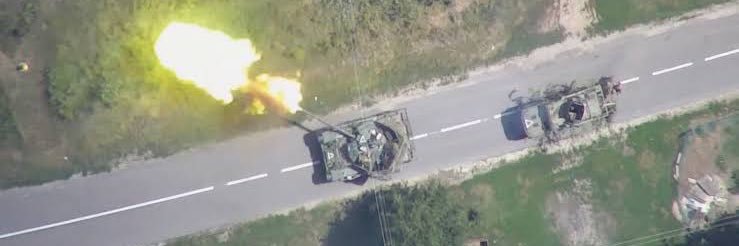
Le commandant du corps ukrainien Azov, Denys Prokopenko, avertit que les chars russes sont désormais plus difficiles à neutraliser. Cette évolution ne repose pas sur un nouveau blindage révolutionnaire, mais sur l’accumulation de protections complémentaires et sur une meilleure coordination tactique.
Les véhicules reçoivent davantage de blindage réactif explosif, notamment sur les flancs et les parties autrefois moins protégées. Les premières « cages » artisanales sont également remplacées par des structures mieux conçues, parfois installées directement en usine. Leur fonction est de provoquer l’explosion des charges creuses transportées par les drones FPV avant qu’elles n’atteignent le blindage principal.
Certains chars sont aussi équipés du système de protection active Arena-M. Celui-ci détecte la menace et lance une contre-munition afin d’intercepter les roquettes, les missiles antichars et certains drones. Après les premiers retours du front, la Russie envisagerait de porter le nombre de ses effecteurs de 12 à 36. Des dispositifs mécaniques ou électromagnétiques de déminage complètent cette protection en déclenchant les mines avant le passage du véhicule.
Mais l’évolution la plus importante est tactique. L’infanterie russe cherche à s’infiltrer jusqu’aux positions des opérateurs ukrainiens de drones, tandis que l’artillerie frappe leurs zones de lancement. Les blindés peuvent ensuite être engagés en plusieurs vagues : la première force les défenseurs à consommer leurs drones et leurs munitions antichars, la suivante tente d’exploiter leur épuisement.
Lors d’un affrontement, une unité ukrainienne aurait ainsi employé près de 125 drones FPV pour arrêter seulement deux ou trois chars russes. Ce chiffre illustre les limites d’une défense reposant principalement sur ces appareils : tous n’atteignent pas leur cible, les brouillages et les protections réduisent leur efficacité, tandis que les stocks doivent être rapidement reconstitués.
Le char russe n’est donc pas devenu invulnérable. Il faut simplement davantage de drones, des attaques successives ou des armes antichars plus puissantes pour obtenir le même résultat. L’idée selon laquelle les drones auraient rendu les blindés obsolètes apparaît une nouvelle fois prématurée : la Russie apprend de ses pertes et transforme progressivement ces enseignements en solutions produites en série.
https://t.co/bu2CCmRZy0
Isn't it interesting how 99% of the people who advocate for the continuation of the war until Ukraine recaptures all of it's lost territory live in their comfy homes in safe, peaceful countries?
Isn't it curious how almost everyone who shouts "no negotiations with Russia!" don't have their sons or husbands being kidnapped off the streets, sent to the frontlines, and dying or being injured by the tens of thousands per month?
It sure is interesting how the vast majority of people advocate for fighting "until the last Ukrainian" don't have their country being destroyed every single day - both demographically and physically.
Ask yourself this: Do you support Ukraine and Ukrainians? Or do you just hate Russia and Russians.
Do you hate Russia more than you support Ukraine?
Russian mapper Radov confirmed my earlier information that Russian forces withdrew from northeastern Dobropillya and Hannivka, stating "Unfortunately, our troops have temporarily withdrawn from Annovka, but attacks on the village are ongoing. The enemy is using drones to counter our advances."
It's also reported that the Ukrainian 1st Heavy Mechanised Brigade has been redeployed from Sumy Oblast to hold the area south of Dobropillya. Prior to this, Ukraine redeployed the reformed remnants of the 425th Assault Regiment "Skala" and 225th Assault Regiment, with the 225th also responsible for holding the area south of Dobropillya.
The 425th is probably operating north and northeast of Dobropillya, alongside the 12th Azov Brigade, 25th Assault Brigade, elements of the 1st Assault Regiment "Da Vinci", 4th Rubizh Brigade, 20th Lyubart Brigade, 14th Chervona Kalyna Brigade, 15th Kara-Dag Brigade, and 38th Marine Brigade, among several other units, which are all concentrated to hold the areas east, southeast, and northeast of the city.
Ukraine has concentrated a large number of units, including elite ones, to hold Dobropillya as long as possible, and prevent another August 2025-style breakthrough.
🔥🛢️One of the most incredible sequences from today’s attack on Moscow: a Ukrainian MICH-2000 long-range strike drone pushes through a wall of Russian air-defense fire and successfully reaches the Moscow Oil Refinery grounds.
For a long time, the MICH-2000 was one of Ukraine’s most secretive long-range strike drones, kept under strict OPSEC and operated exclusively by the SSU.
Ukraine has carried out a large-scale, combined missile and drone attack on Moscow Oblast, using long-range drones and FP-5 "Flamingo" cruise missiles.
The main targets were the Moscow Oil Refinery and a warehouse complex belonging to the Modern Warehouse Technologies" company, where several impacts occurred. It is not known if any of the Flamingo cruise missiles impacted; so far there is only one visually confirmed interception south of Moscow. Additionally, one of the drone impacts to the refinery was caused by a drone being shot down by a Pantsir interceptor missile as it flew over the refinery.
Notably, this attack took place at the same time as the Russian State Duma elections.
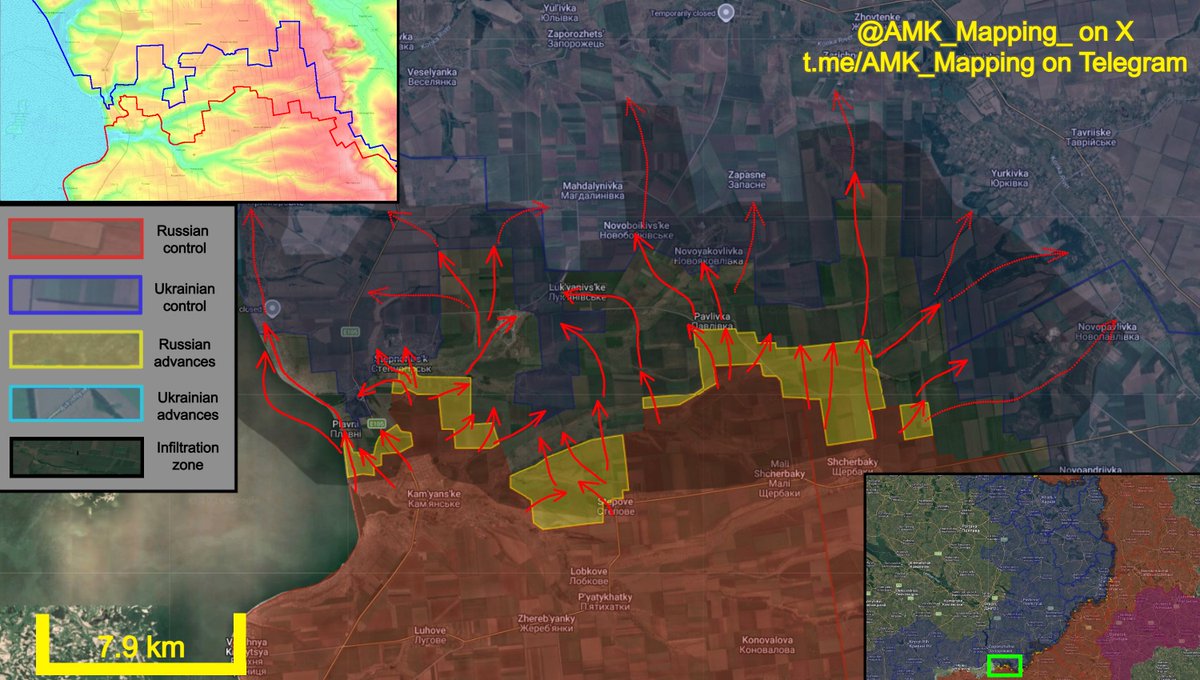
Situation on the Stepnohirsk and Orikhiv directions:
Over the last few weeks, Russian forces have continued their intensified assault operations, making substantial progress in several different areas, while significantly expanding their zone of infiltration.
In the west, Russian forces repelled earlier Ukrainian infiltrations to the northwestern outskirts of Kamyanske and recaptured the southern part of Plavni. They also cleared a number of positions along the highway north of Kamyanske and have begun expanding their zone of infiltration in Prymorske. Some Russian DRGs were even detected in the northern part of Prymorske. Some of these assault operations are taking place along the dried-up river bed of the Kakhovka Reservoir.
To the northeast, the Russians re-established control over the southern bank of the Sukhyy River and established a foothold just south of the town centre. Heavy fighting is now ongoing in the southwestern and eastern parts of the town as they attempt to reverse the earlier advances made by Ukraine and cut off the Ukrainian positions in the Plavni area. Additionally, they were able to improve their positions along the tactical heights southeast of Stepnohirsk, which has allowed Russia to intensify their infiltrations into the area of the solar panel farm and the treelines to the north. From here, DRGs have begun infiltrating the fields north of Stepnohirsk and the highway to the north, as well as the southwestern approaches to Mahdalynivka.
To the southeast, the Russians cleared the salient west of Stepove and recaptured positions along the southern bank of the gulley northwest of Stepove. From there, they are trying to assault Ukrainian strongpoints along the treelines northeast of Kamyanske from the south and west, while simultaneously trying to bypass them from the north in the direction of Lukyanivske and the solar panel farm.
To the northeast, Russian forces continued gradually expanding their zone of control north of Mali Shcherbaky and Shcherbaky, where they were able to entrench in the treelines south of Pavlivka and infiltrate through the village and the surrounding areas. Other assault groups cleared the remaining treelines north of Shcherbaky and began advancing further north towards the fields east of Pavlivka. These advances have allowed Russian small infiltration groups and DRGs to significantly expand their zone of operations, following heavy KAB glide-bomb bombardment of Ukrainian positions. Russian infiltrators are now actively advancing northwest of Pavlivka towards Novoboikivske and north towards Novoyakovlivka. DRGs are infiltrating even further north towards Zapasne and the fields northeast of Mahdalynivka.
To the east, the Russians marginally advanced in the treelines northeast of Shcherbaky, and significantly intensified their infiltrations on the western flank of Orikhiv, entering the village of Novopavlivka in small numbers and beginning infiltrations north towards Zarichne and Yurkivka, along with the adjacent forests, following heavy KAB glide-bomb bombardment of Ukrainian positions.
+ ~33.57 km² in favour of Russia.
Situation on the Novopavlivka direction, Donetsk/Dnipropetrovsk Oblast:
Over the last few weeks, Ukrainian forces continued their coordinated series of counterattacks in the Novopavlivka direction, further pushing Russia backed to the border with Donetsk Oblast.
In the southwest, Ukrainian forces continued advancing east along the southern bank of the Vovcha River, recapturing the village of Zaporizhzhya and beginning assault operations on the treelines to the east, which have so far been unsuccessful.
To the north, the Ukrainians completed the capture of Filiya and began assault operations southeast of the village towards the Dachne forest. They also cleared part of the gulley south of Novopavlivka and are infiltrating further south towards the Dachne Forest.
To the southeast, Ukrainian forces continued to gradually advance through the fields south of Novopavlivka, capturing new treeline positions near the highway and establishing control over a small forest south of the tributary of the Solena River. From here, they are infiltrating further south, reaching the fortifications on the northern outskirts of Dachne.
To the northeast, the Ukrainians completed clearing operations in a large number of treeline positions east of Novopavlivka, establishing control over this area and pushing the frontline further away from the town. From there, they captured a number of fortifications along the Donetsk-Dnipropetrovsk regional border and re-entered Donetsk Oblast in multiple areas north of Horikhove.
+ ~21.77 km² in favour of Ukraine.
Polish prime minister Donald Tusk today publicly disclosed that the Ukrainian armed forces are suffering 27,000 battlefield casualties a month.
This number is expected as Budanov had recently stated that the Ukrainian armed forces need 30,000 mobilized men a month to maintain their current position.