Understanding BlockDAGs and GHOSTDAG is an open book written by @DesheShai and supported by the community. It is intended to provide both a documentation of the many features of $kas, and an approachable but challenging introduction to the theory and mechanics of PoW.
6. As usual, my huge gratitude to @kasmediadotcom and @Kaspa_KEF for funding and supporting this important project, and for the beta testers who volunteer their time to infinitely improve the final result.
Updates:
1. Part I is nearing completion and I'm very excited. It is shaping to be a self contained unit that will provide a great resource for Kaspa learning
2. Once it is done, we will work to create a new website fitting of a book. I know the current website is uncomfortable,
5. Before writing part II I will take a hiatus from the book to dip dive into the currently ongoing SC endeavors and especially the barrage of fascinating posts by @MichaelSuttonIL et al. in the research forum. This will act as a precursor to a future part of the book.
@MichaelSuttonIL As part of the upcoming GHOSTDAG portion of the book, I am writing a detailed explanation of how this crucial component works. The starting point is the reachability workshop from a few weeks ago (is the video coming up any time soon?), but it fills in *many* details.
Finally got around to studying the fine details of @MichaelSuttonIL's brilliant reachability algorithm.
For an average $kas enthusiast, this is the most important algorithm you never heard of. It is a cornerstone of the ability to *efficiently* implement GHOSTDAG. Without it:
- tracking blue anticone sizes
- efficient reachability queries
- implementing the UTXO model over DAGs (UTXO algebras etc.)
- Incentive alignment
- and more
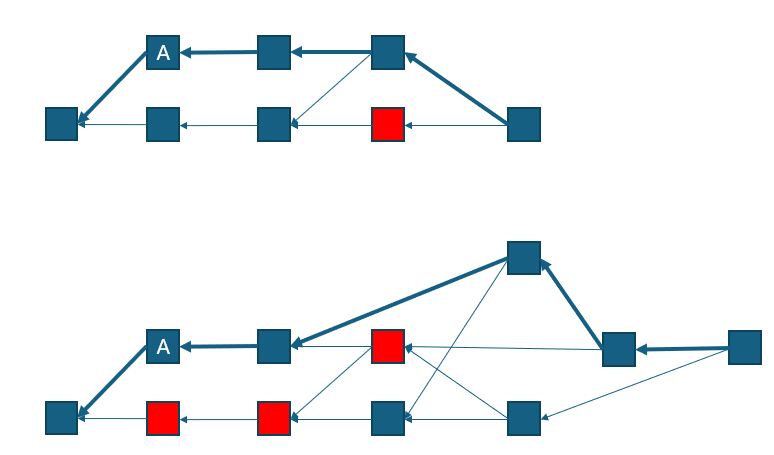
In the picture: a single example that took me bloody 90 minutes to figure out
1/n Update: $kas I am now working fervently at writing the portion of the book that actually describes GHOSTDAG. This is the culmination of what I've written so far. This is taking a bit of time because I want to do it *right* but once its done, its going to be the first
2/n detailed companion for anyone seeking to understand how GHOSTDAG is implemented in practice packed with illustrations, pseudo-code, examples and exercises. It covers the following:
- PHANTOM vs. GHOSTDAG
- The recursive structure of GHOSTDAG
- Computing blue anticones
Understanding GHOSTDAG is an open book written by @DesheShai and funded by @Kaspa_KEF and @kasmediadotcom.
It is written to be a friendly entry point for researches, devs, and passionate amateurs into the exciting world of DAG consensus, and $kas @KaspaCurrency in particular.
SPECTRE, Hathor, and Iota's Tangle 1.0. This will set the ground for the fifth and final chapter of the first part of the book, where we finally deep dive into GHOSTDAG and unprecedently excruciating detail.
$kas, I'm glad to announce that chapter 1D has been published! In this chapter, we deep dive into the blockDAG paradigm and explain how security, liveness and confirmation times translate to this setting. We then review a whole bunch of DAG algorithms including
@soullshoping@tkalakaspa@CryptoAspect@MichaelSuttonIL >>to be a sampling window during which 6 blocks arrived.
I think it would be better if instead of updating every seconds they would average over windows of at least 15 seconds, this would smooth this noise out.
@soullshoping@tkalakaspa@CryptoAspect@MichaelSuttonIL https://t.co/HCs77H8CYR samples way too often. It updates the BPS and TPS every second. However, the data does not represents block as they emerge, but as they arrive at the node https://t.co/2NZYF12LVp is monitoring. This introduces a lot of noise. In this case, there happened>>
>> has no incentives whatsoever. We will apply the ideas of the discussion by analyzing the consequences of Pico's poorly aligned incentives on its equilibria, and its sustainability as a whole.
New post!
https://t.co/CB1Hbfl9Ll
We often talk about "honest majority", but what allows us to make this assumption?
In reality, we can't. We can only assume that a majority of participants are "rational", and act to maximize their own profit.
It is the protocol designer's>>
>>responsibility to make sure the incentives aligns with the honest behavior they are open for.
In this post, we discuss the interplay between honestly and rationality.
We drive the point home by inspecting an extreme edge-case: a hypothetical protocol called Pico, which >>