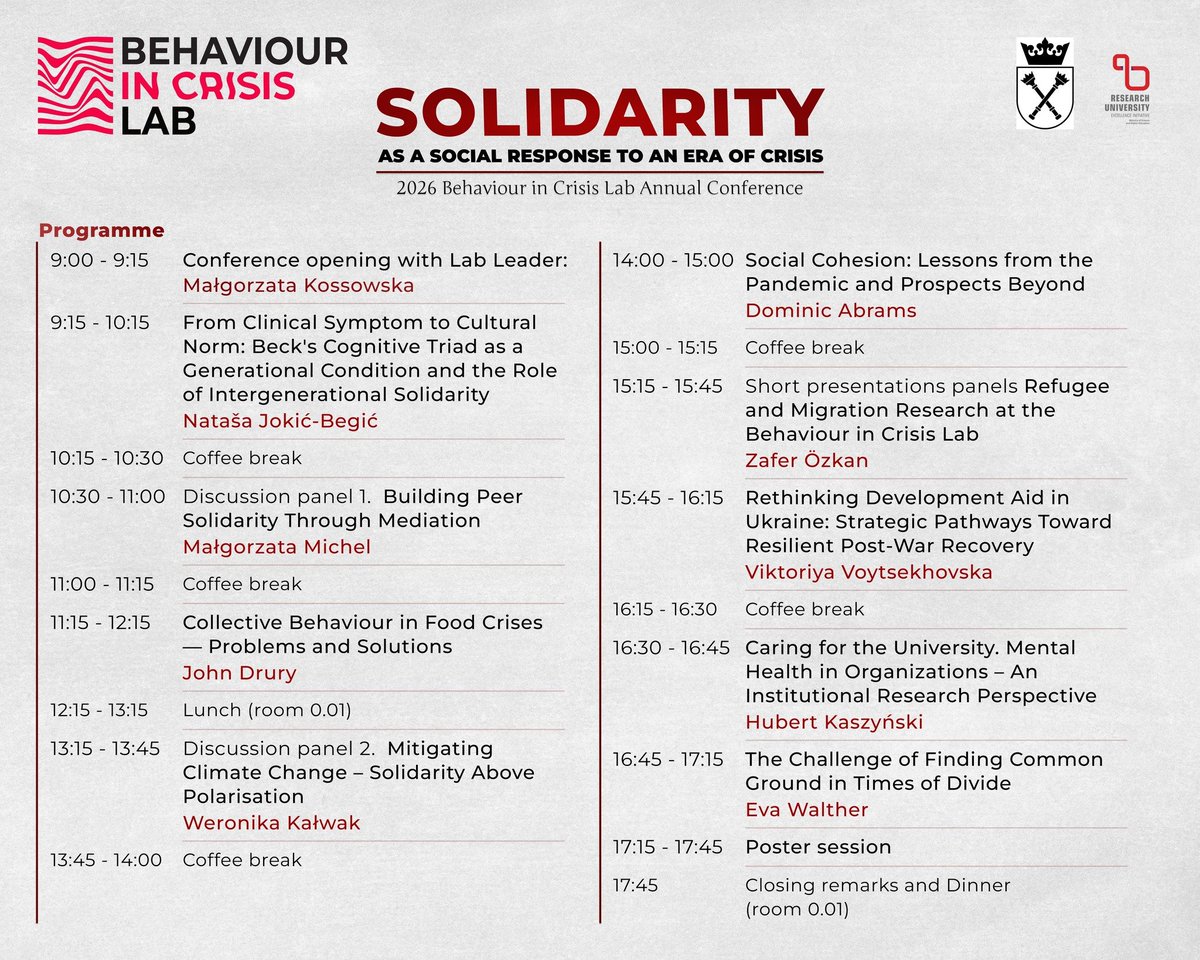
The 2026 Behaviour in Crisis Lab Conference programme is live! 🌐
Theme: Solidarity as a Social Response to an Era of Crisis.
Featuring speakers Dominic Abrams, John Drury, Nataša Jokić-Begić and more.
No registration fees
1 month left to sign up!
Register https://t.co/qGyvOZBZIa
The 2026 Behaviour in Crisis Lab Conference programme is live! 🌐
Theme: Solidarity as a Social Response to an Era of Crisis.
Featuring speakers Dominic Abrams, John Drury, Nataša Jokić-Begić and more.
No registration fees
1 month left to sign up!
Register https://t.co/qGyvOZBZIa
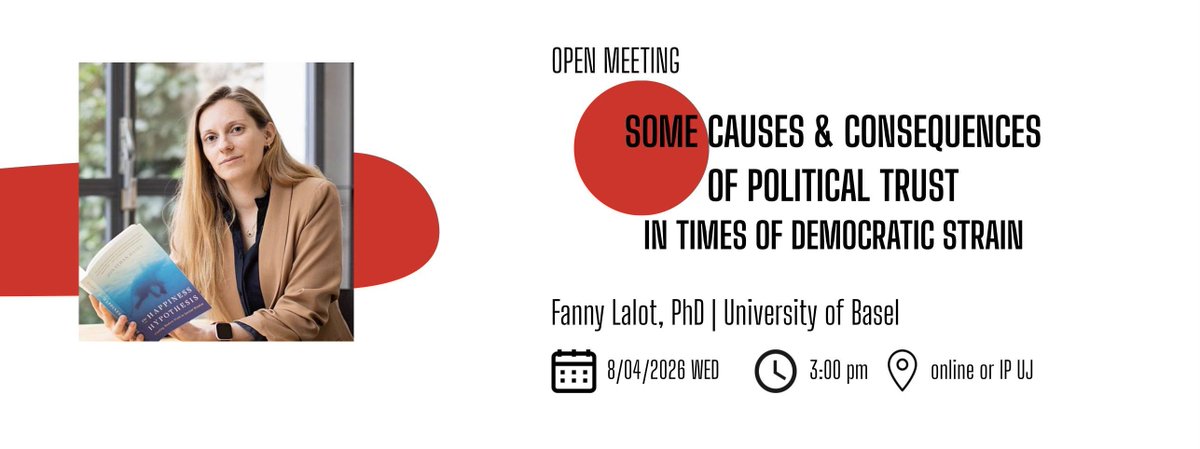
Today, we hosted Fanny Lalot from the University of Basel. She shared research on how local vs. national trust impacts outcomes like vaccination and volunteering, and how trust shifts after collective action depending on whether one's political group wins or loses. Timely talk!
Great talk last Wednesday by SWPS University’s Dominika Bulska (PhD) on how agency, morality, status, and perpetratorhood shape blatant dehumanization—showing agency matters more for low-status groups, while morality matters more for perpetrator groups.
Great discussion at the BiC – Behaviour in Crisis Lab! Tomasz Besta presented cross-cultural research (58 countries, N=16,829) on personality traits like sadism and psychopathy and their links to violent political collective action. Thanks to everyone who joined!
Tomorrow, Katarzyna Jaśko (PhD) will present their work on Motivational Analysis of the Role of Expectancy in Collective Action. She uses insights from motivational psychology to understand extreme vs. moderate political behaviors and social change.
Last week, Gabriela Czarnek (Assistant Professor at the Institute of Psychology, Jagiellonian University) presented us her interesting work on understanding and countering climate misinformation.
It has been a beautiful summary of an incredible 2.5 years
Thank you to all our collogues who came to celebrate with us. We truly felt your support, warmth, and friendship all around.
This gives us the strength and motivation to keep inspiring and conducting research for you.
Check out the interactive exhibition DigiPatch LivingLAB at the Copernicus Science Centre — prepared by our team as part of the project DigiPatch. At LivingLAB, visitors don’t just observe — they become participants in real social-science research. Read more below.
Through games, tasks, and experiments, you can explore psychology, sociology, and learning sciences while contributing to ongoing studies on identity, social media, group dynamics, and the social consequences of digital life. 🧠🌐
Gabriela Czarnek, a researcher at our lab, has co-authored an article in Nature. “Persuading Voters Using Human-AI Dialogues” shows that even brief conversations with an AI chatbot can shift voters’ preferences—more effectively than traditional political advertising.
Great news from our lab! 🎉👏
Dr. Erica Molinario has received the OPUS 29 Grant to advance her research on what drives pro-environmental action.
Details here 👉 https://t.co/b1ETSBLUQy
Also, this Thursday, our lab member Weronika Kałwak will deliver a rehearsal lecture for her upcoming presentation at Charles University in Prague. Come support her and share your feedback!
Today we’re delighted to host Özden Melis Uluğ from the University of Sussex. She will be giving a talk titled “From Conflict Narratives to Collective Action: Psychological Perspectives on Peace and Allyship.”
Join us here at 15:00 (Warsaw, PL time): https://t.co/vwtdDIzZ30
This week, we welcomed Prof. Jan Brzozowski from the Faculty of International and Political Studies at JU.
He gave us a very informative talk on "The determinants of economic integration among Ukrainian refugees and economic migrants in Poland".
We’re excited to announce the return of Open Meetings!
Last week our lab member, Zafer Özkan, took us into the psychology of protest — exploring why people choose to act during the Gaza conflict.
📢 Postdoc Opportunity!
Join Jagiellonian Univ. (Kraków) as a Post-doctoral Researcher in Social Psychology (4-year NCN-funded project on global crises & collective action).
🗓 Deadline: 27 Aug 2025
🔗 https://t.co/4J5RyAGhnb
The 48th ISPP Meeting in Prague—one of the top conferences in political psych—featured strong representation from Jagiellonian University, with several presenters from our lab!
🔹27 papers
🔹 1 blitz talk
🔹 6 posters
Proud of everyone who contributed and represented us so well!
📢 New article in PSPB! We tracked Poles’ attitudes over 3 waves & found: feeling close to Ukrainian refugees reduces threat perceptions—but realistic threat (e.g. jobs, services) lowers closeness over time. Symbolic threat had no such effect. 👉 https://t.co/cQ8lLrICK1