You can now talk through the design of a physical object with an #AI model, then take those ideas into the real world. The WASP story is a striking example of where that can lead.
According to The Verge, Cody Wilson used his firearm-focused AI tool, GatGPT, to help develop a 3D-printed firearm. The more consequential part may be the tool itself. Wilson has built it to help people explore firearm designs and parts, even if they don't have much experience doing that work.
I keep thinking about what happens when you lower the amount of specialized knowledge needed to build something in the physical world. You open the door to more people experimenting and creating. But the consequences depend on what they're building, too.
For physical #security, there’s another side to this conversation: how we detect a threat once it enters a real-world space. As the ways people can create things evolve, the systems designed to identify those threats need to evolve, too. At CurvePoint, for example, that’s the problem we work on. Our Wi-AI technology uses changes in ambient Wi-Fi signals to detect threats such as firearms at school entrances, including when they’re concealed or outside a camera’s line of sight.
The tools used to create a threat may change. We need to keep thinking about whether our ability to detect it is keeping pace. https://t.co/wLMLk901OR
One thing that stands out in Pittsburgh's approach to AI is the emphasis on getting the fundamentals right first.
AI applications depend on the systems around them. If data quality is poor, legacy platforms don't communicate, or the underlying infrastructure is unreliable, adding a model doesn't fix those problems. It gives you another component that depends on them.
The same is true in physical AI. A model can perform well in one building and still struggle when the layout, materials, or RF conditions change. Reliable deployment depends on how the entire system behaves in the real environment, and what the team learns from that deployment.
Pittsburgh's focus on modernizing infrastructure, improving data quality, and strengthening cybersecurity alongside practical AI applications is the right order of operations. The hard part is getting the underlying systems ready to support AI reliably. https://t.co/0EARAhGL08
Pittsburgh-built tech, put to work close to home. PIT is piloting robots running Skild AI’s software to monitor air quality. A busy airport will give the team useful feedback on how it performs in everyday conditions. Glad to see this happening here. https://t.co/nvxsNd6a6S
It’s good to see Pittsburgh companies building technology that solves some pretty significant real-world problems. Gecko Robotics is a great example. The company just landed a $300 million contract with the U.S. Navy to help inspect ships for corrosion and structural flaws.
Its robots can crawl across steel structures, inspect beneath thick deck coatings, and use AI to map corrosion and structural flaws in detail. According to Gecko, inspections that once took months can now be done in days.
Think about what that means for maintenance crews. The Navy needs to know what a ship requires before it enters the shipyard. Better information means better preparation, more efficient use of yard time and, potentially, ships getting back to sea sooner.
I like seeing technology solve a problem this tangible. You’re giving people a much clearer picture of what’s happening inside a physical asset, helping them decide what needs attention and when.
Always good to see Pittsburgh’s engineering community pushing the boundaries of what technology can do. https://t.co/7YppwAr2FP
Physical AI has a ground truth problem.
A model sees signal changes. Engineers see sensor output. A person in the room sees what actually happened. Those don't always line up perfectly.
At CurvePoint, getting that ground truth right is a huge part of building better models.
A $3B gift to CMU will shape Pittsburgh’s tech ecosystem for years.
More research, more talent, more ambitious work in AI and robotics. For companies like CurvePoint building here, that kind of investment compounds. https://t.co/KIW0XgoVjH
As AI gets more capable, weak infrastructure becomes a bigger risk.
Security has to be part of how these systems are built and deployed, not something added later.
The intelligence layer is getting stronger. The engineering around it has to keep up. https://t.co/1dc0jNaZiq
Defense tech is usually framed around military systems. I think the definition is broader.
At CurvePoint, we’re building physical AI that helps schools identify potential threat conditions earlier.
Different environment, same core idea. https://t.co/99LSdgUWCr
Installed doesn't mean ready. At CurvePoint, new deployments run quietly in the background first so we can benchmark accuracy, understand the RF environment, and catch issues before anyone depends on an alert.
The standard is not that it turned on. It's that we trust what it's telling us.
One of the hardest parts of technical leadership is saying no to good ideas.
Every experiment, feature, or architecture change costs time.
The job is to protect focus long enough for the team to finish something difficult.
By the time a threat is obvious, the response window may already be closing.
CurvePoint uses Wi-Fi sensing and AI to help schools detect potential threat conditions earlier at entry points, without relying on facial recognition or biometric capture.
https://t.co/n2UaP0D0KY
One thing you learn quickly in physical AI is that getting a model to work once isn't the hard part.
Getting it to work across different buildings is.
That's the real challenge behind turning a demo into infrastructure. https://t.co/ZI7VVC7tyW
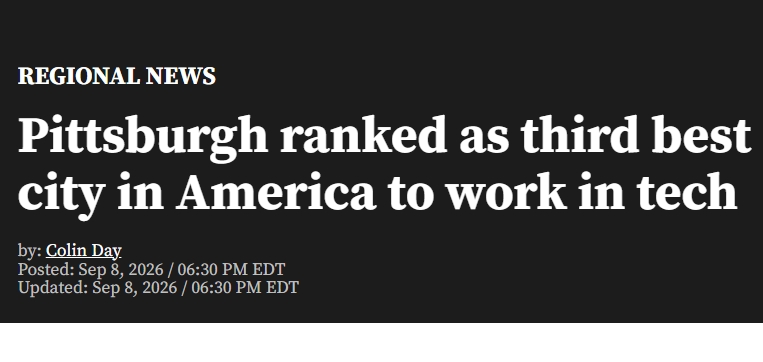
Pittsburgh being ranked one of the best cities in America to work in tech makes sense.
There's serious talent here across robotics, hardware, AI, and physical systems.
That's a big reason CurvePoint is building here.
https://t.co/HwwSEE8Us4
A detection that comes too late isn't very useful.
The point is not just knowing a threat was there. It's creating enough time for someone to act.
That's how we think about WiAi at CurvePoint.
Wi-Fi can now be used to identify people with extremely high accuracy.
That shows how much information wireless signals actually carry. At CurvePoint, we want to understand what is happening in a space without needing to know who is there. https://t.co/mnuMS4mw5C
Robotic systems are moving from pilots to scaled developments, yet many companies are running into a common problem.
While the technology itself is up to snuff, most organizations lack the skilled workforce needed to operate, maintain, and continuously adapt in real time.
This is one reason why Pittsburgh has become one of the strongest robotics cities in the world: we have access to the top-tier talent needed to make the most of these new technologies. https://t.co/ZTCDhKPGnY
Understanding what's happening around an object is hard. For CurvePoint, entry threat detection is the starting point. The bigger opportunity is spatial intelligence that understands a space without identifying everyone inside it. https://t.co/ZI7VVC7tyW