Salaam everyone!
I’m finally able to announce the next step regarding this work I have been preparing for a long time now!
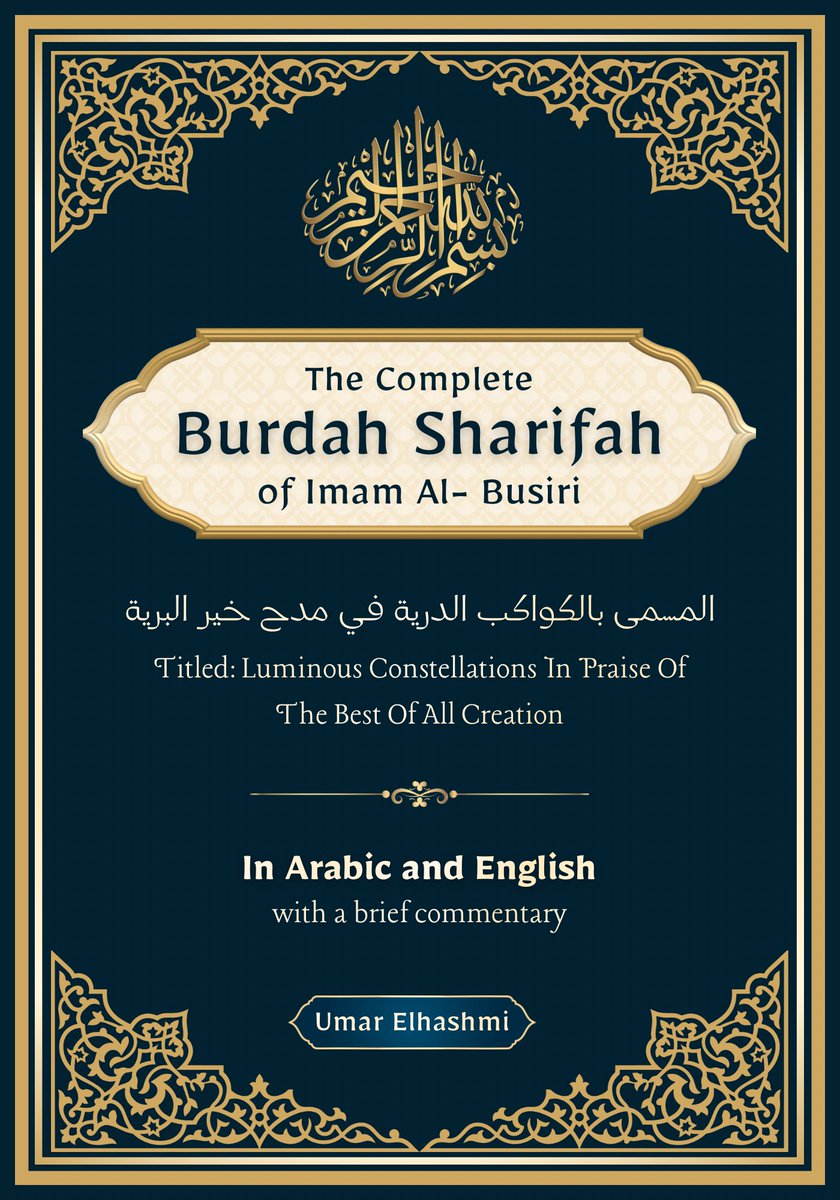
This is a non-profit* effort toward bringing the famous poem: The Burdah of Imam al-Busiri to the Masjids of many communities across the US, Canada, and the UK — completely free of charge.
Notes about the work:
• The translation was done by myself, with review and help from my mother for certain grammar aspects, may Allah reward and accept from her.
• The translation work alone was verified by numerous English speaking scholars from different backgrounds.
• The commentary was written with over 500 hours of research and reading numerous classical works of Shurraah, over the course of months.
• Wording of a few verses, that some critique as problematic, were altered in a manner consistent with the rules and meters of Arabic poetry. Thus everyone, whether a past critic or not, will benefit from this work inshaAllah.Likewise these changes were authorized by scholars who themselves approve of the original. All notes regarding these are in the book, including notes regarding the original wording.
• The chain of narration, connecting myself to Imam al-Busiri, the author, through multiple scholars is also written, with all their names — allowing everyone who takes learns from it to add their names in the chain as well.
• The book cover design as well as pages were done voluntarily as well by my older sister, may Allah accept and reward her for the time behind this.
• The book preparation using Adobe InDesign, measurements, binding requirements, and matching it with the specific page design — after many hours of learning the software and getting everything right, was completed by myself as well.
Now, we are at the printing stage.
I will be printing thousands of copies eventually inshaAllah, from my own income, and these copies will be of superior quality, not simple/basic paperback.
The best part?
Not a single copy will be sold. These will be given to Masaajid across America and Canada to start, and eventually the UK.
Additionally, they will be shipped out to whoever reaches out to me — AFTER production — requesting a copy, and shipping costs will be covered by myself.
You will literally get a free copy by promising to read and learn it.
This is solely for the sake of Allah, and we seek no compensation in this life for it.
Thats why I’m giving us all a chance to take part in this blessing as well.
If you would like to join in on this effort, feel free to donate any amount you like.
The plan: After we have 1,000 copies printed:
• 250 will be given to different Masaajid across America
• 250 will be for across Canada
• 250 for the UK
• 250 will be hand-given or shipped out to individuals from the USA, Canada, or UK completely FREE OF CHARGE (I will handle their shipping costs).
This will continue in cycles as I earn my own income and/or as people pitch in to help speed the process — and we can keep producing them.
To all who join: There is no desire for any compensation in this world, and we only hope it plants a seed of love for the prophet ﷺ in someone’s heart, who can testify for us on the Day of Judgement.
If we reach the goal here, we can order 1,000 copies right away.
If not, then it will just be a bit slower, as I am saving up from my personal income.
But this is a project that is going to happen regardless inshaAllah and it is only a matter of whether you join in on the reward or not!
*Not a single penny of this raised money will go toward myself, or any expenses besides the book printing itself and its shipping from China to USA (the cheapest, best quality option after my research).
https://t.co/ltf8cl2bMB
Barakallahu Feekum,
Umar
⬇️ (Design work subject to change but this is current proposed).
The point doesn’t change, and the meaning is the same — that he saw it as if it were setting — but just to be precise: وَجَدَ does not mean ‘to appear’ in any way, let alone in this verse.
If so, it would mean ‘he appeared it’ since the pronoun within the verb refers back to Dhul Qarnayn, and the second pronoun refers to the sun. So this is inaccurate.
Instead, it means ‘he found it’ -> ‘he found the sun’ -> he found it setting in water meaning he reached the edge of the big land he was in, such that when looking into the distance, he saw no other land and the sun appeared as though it set inside the water.
And there is no possibility for Avery’s interpretation, simply because the pronoun refers to Dhul Qarnayn himself, so it is speech through his lens of vision only, and not a scientific claim of a reality we are unaware of.
The word in Arabic, “وَجَدَهَا,” means to appear, meaning he saw the sun as if it were setting in the ocean. This is something everyone who goes to the coast can see: it looks as if the sun is setting into the sea, but in fact, it never leaves its path in which it is fixed. - Ibn Kathir
But we are still waiting on the insects on all four legs (Leviticus 11:20–23). Modern science shows us insects have 6 legs. 😂
I’m not sure where it came from either but she is, just as Libyano is, a mastermind when it comes to Christianity and Da’wah against its ideologies — MashaAllah. Always credit where credit is due. Perhaps this was a slight mistake she did not catch, and if someone made her aware she would gracefully accept the advice and continue about refuting Christians.
1. Yes it is.
2. Yes it is.
3. You’re more ignorant than I thought. Allah forgives the sin between her and Himself, but the person is held accountable when the right of another person is involved no matter what it is, stealing or killing, or otherwise. She may have already spoken to the person she stole money from, IF that allegation is true. She may have already handled that and sought Allah’s forgiveness. Point is: you don’t know anything enough to slander, even if you might be right in the end, it must be with concrete evidence and not your ignorant assumptions.
Enough said, if you want to have the last say in this back and forth, by all means go ahead. I cannot hold a conversation with someone who I only sought to advise by telling him to be cautious with his words in light of Islamic guidelines, but they choose to argue back with ignorance and no substance.
سلام، لا نبتغي الجاهلين
Wallahi it is such a disgrace to see Muslims spreading absolutely nothing more than gossip.
If you have concerns about money, rightfully so - you have every right to inquire.
But wallahi to behave like the Munaafiqeen did in the time of Rasulunaa ﷺ, is just hurtful to see online.
By Allah if she is guilty of sabotaging the wealth of the Muslims and deceit, it will come out and she will be heavily punished by Allah Himself, who is the One truly aware and the One who is all Just.
Misappropriation of Muslims’ wealth is a major sin and will be dealt with accordingly.
At the same time every single Muslim who sent the least of their money with a good intention will be highly rewarded by Allah for it.
There is no situation where a Muslim loses anything.
If she is not guilty, then by Allah there will be no excuse with Allah for having spoken so hastily, in the manner befitting the Munaafiqeen, in the name of ‘defending Islam and Muslims’.
If you are a da’wah legend, then MashaAllah this work is nothing but commended, but with all due respect, stay in your field and stick to da’wah.
By Allah this will be nothing but a detrimental disaster, for by Allah again, you will be held accountable for every hasty utterance without proof, which is exactly where it is right now, EVEN if you are correct in the end.
Ask questions and inquire, no problem, and don’t act like you are the Qaadi of Qudaat for the Muslims when you have not methodically studied anything of the Islamic sciences and have no recognition from scholars.
Everyone else; اتقوا ربّكم
الله يسلمنا ويحفظنا ويغفرلنا جميعًا
1. Using AI does not equate to misappropriating funds. Whether it is correct or not to have used it, is a different story, and in either case does not necessarily reflect deception regarding the wealth of Muslims.
2. Using AI does not equate to misappropriating funds. Whether it is correct or not to have used it, is a different story, and in either case does not necessarily reflect deception regarding the wealth of Muslims.
3. You have no right Islamically to ask about a past Allah has forgiven, and you have no grounds to question her very Islam such that it may allow you to ‘raise suspicion’ from her past impermissible action. People do things in desperate times, it may be that she committed that major sin in a desperate situation, fully repented from it, and — out of her sincerity in Tawbah — pledged to Allah to spend the rest of her life donating money instead of taking it.
I don’t defend anyone nor attack anyone, and this is not a defense of the woman, for I have no connection or personal tie to her or anyone she is related to.
But this is a reminder for Muslims to behave like Muslims. There is a reason why being an Islamic judge requires a massive amount of prior Islamic studies, and why one is appointed a judge and not self proclaimed.
اتق ربك
والله من صمت نجا
وصدق رسولنا ﷺ
@AboudeTurok Like i said, asking is one thing. Being hasty in accusation is another. And wallahi there was nothing but haste from a number of individuals supposedly representing Islam.
I said: ask questions no problem; do not accuse without evidence. And no, there is not a shred of evidence she has squandered the Muslims’ wealth as of yet.
Irrespective of this, it is not the duty of individuals who have not studied any form of the religious sciences of Fiqh to act like a self appointed Qaadi and judge between people. There is a reason that Qadaa exists as a chapter in the books of Fiqh.
@shcleh1 If you don’t know sidi then don’t occupy yourself with it, it’s a waste of time, and spending that time reciting the Qur’an will be much much more beneficial 🌹🌹
How Should I Study the Fundamentals of Islam?
بسم الله الرحمن الرحيم
Many Muslims spend years studying controversies, polemics, and advanced disagreements without first learning the foundations of their religion.
The purpose of this guide is to provide a structured path through the fundamental subjects of Islam and a starting point for those seeking a solid foundation in their religion. It is not intended to make one a specialist overnight, but rather to help build a sound understanding of the essentials before moving on to more advanced studies.
The accompanying lectures and courses are an essential part of this curriculum and should not be skipped. They provide the explanations, context, and guidance necessary for properly understanding the texts and benefitting from them.
1. Understanding How Islam Works
Before studying the individual sciences, one should understand how Islam is transmitted, preserved, and taught.
How Islam Works — A free introductory course from SeekersGuidance covering the nature of Islamic knowledge, scholarship, the madhhabs, and the transmission of the religion.
[https://t.co/lC7iioWZsE]
Understanding how Islamic knowledge is preserved and transmitted helps provide a framework through which the remaining sciences can be studied.
2. Knowing the Messenger ﷺ
Understanding the life, character, and conduct of the Prophet ﷺ provides the context through which the religion is understood.
The Life of Prophet Muhammad for Youth — Imam Yama Niazi.
[https://t.co/WSpBS6nNXi]
This is an accessible introduction to the life of the Messenger ﷺ suitable for both youth and adults.
Bājūrī's Commentary on Tirmidhī's Shamāʾil
[https://t.co/0jJvnbOUQH]
Studying the life of the Prophet ﷺ should be accompanied by studying his character, appearance, habits, and conduct.
3. Creed (ʿAqīdah)
The foundations of what Muslims believe.
Al-ʿAqīdah al-Ṭaḥāwiyyah — Imam Abū Jaʿfar al-Ṭaḥāwī.
Beliefs of Ahl al-Sunnah (Aqidah Tahawiyyah) — Dr. Ali Ataie.
[https://t.co/168w4Af9Kz]
al-ʿAqīdah al-Ṭaḥāwiyyah — Shaykh Hamzah Wald Maqbul.
[https://t.co/a2fff2JG7f]
Dr. Ali Ataie's lecture is an excellent introduction to the core themes of al-ʿAqīdah al-Ṭaḥāwiyyah and the beliefs of Ahl al-Sunnah. For those seeking a more detailed study of the text, Shaykh Hamzah Wald Maqbul's commentary provides a fuller walkthrough while remaining accessible to beginners.
This work remains of the most widely studied summaries of Sunni creed and a foundational text for understanding the beliefs of Ahl al-Sunnah.
4. The Foundations of Practice
The essential knowledge of worship and daily practice.
Al-Murshid al-Muʿīn — Ibn ʿĀshir.
Ibn Ashir’s Concise Guide to the Basics of Deen — WISE English Academy
[https://t.co/zqMRMHeF3N]
While encompassing creed, worship, and spiritual refinement, its primary value in this curriculum lies in its coverage of the practical rulings of worship that every Muslim is obligated to learn.
5. The Qur'an
After establishing creed and practice, one is better equipped to approach the Book of Allah.
The Qur'an — Saheeh International.
Tafsir Ibn Kathir (Abridged).
Note: Both can be accessed free of charge on https://t.co/XcmpEUIfxd.
The Qur'an is the foundation of the religion, while Ibn Kathir provides one of the simplest and most widely read traditional explanations of its meanings.
The abridged version is particularly beneficial for those seeking to focus on the general meanings of the verses without becoming overwhelmed by lengthy discussions and narrations.
6. The Foundations of the Sunnah
Core Prophetic teachings every Muslim should know.
Al-Arbaʿīn al-Nawawiyyah — Imam al-Nawawī.
Imam Nawawi's Forty Hadith: The Axis of Faith — Imam Yama Niazi.
[https://t.co/skSWuomsVt]
These narrations summarize many of the most important principles of Islam and have served as an introduction to hadith for generations of students.
7. Arabic and the Language of Revelation
Learning Arabic opens the door to a deeper engagement with the Qur'an, Sunnah, and the Islamic sciences.
Firstly, one should learn to read the Arabic alphabet and recite the Qur'an correctly with a qualified teacher.
As for learning the language itself:
Madinah Book 1 — Dr. V. Abdur Rahim.
Video lessons:
[https://t.co/nRG2aLXlP4]
For those seeking one-on-one instruction, reliable Arabic and Qur'an teachers can often be found at reasonable rates through platforms such as Preply.
Even a modest amount of Arabic can greatly deepen one's engagement with the Qur'an, Sunnah, and the Islamic sciences.
8. Spiritual Excellence (Iḥsān)
This pertains to matters of the soul, rectification of one's character, and drawing nearer to Allah.
Infamies of the Soul and Their Treatments — Abū ʿAbd al-Raḥmān al-Sulamī.
[https://t.co/aeQo2HwBoU]
Adab Sulūk al-Murīd (Imam Haddad's Manual on Good Manners) — Imam ʿAbdullāh ibn ʿAlawī al-Ḥaddād.
Video commentary by Ustadh Omar Popal:
[https://t.co/nguB0aL4Px]
Knowledge alone is not sufficient. These works focus on sincerity, character, self-discipline, and the purification of the heart.
9. Duʿāʾ and Dhikr
Establishing a daily routine of remembrance, supplication, and devotion.
Kitāb al-Adhkār — Imam al-Nawawī.
[https://t.co/nHhERhTW4v]
The Littany of Imam al-Nawawī
[https://t.co/3Jar7uuktD]
These works help establish a daily routine of remembrance, supplication, and devotion. Consistency in these practices strengthens faith and, by the permission of Allah, increases one's ability to benefit from the study and practice of Islam.
10. The Companions رضي الله عنهم
The generation chosen by Allah to accompany His Messenger ﷺ and transmit this religion.
The Firsts: The Forerunners of Islam — Dr. Omar Suleiman.
[https://t.co/QYUvC5XNZ8]
The Forty Hadiths on the Virtues of the Ten Who Were Given Glad Tidings of Paradise — Ibn ʿAbd Allah al-Hashimi.
[https://t.co/d7F7E1qtlq]
The Companions رضي الله عنهم were the generation chosen to accompany His Messenger ﷺ and transmit this religion. Their lives provide some of the finest examples of faith, sacrifice, and character.
11. Useful Supplementary Works
The Prophetic Life in Focus — Shaykh Abdul-Rahim Reasat.
[https://t.co/6hk4ys7St3]
This is a more detailed study of the life of the Messenger ﷺ for those wishing to go beyond introductory sīrah.
Matn al-ʿAshmāwiyyah — ʿAbd al-Bārī al-ʿAshmāwī.
[https://t.co/mPxwidkzOZ]
A classic Mālikī primer focusing on the practical rulings of worship.
Riyad al-Salihin — Imam al-Nawawī.
[https://t.co/MzJwmur4HB]
One of the most widely studied hadith collections on worship, character, manners, repentance, and spiritual development.
Al-Shifāʾ bi-Taʿrīf Ḥuqūq al-Muṣṭafā — Qāḍī ʿIyāḍ.
[https://t.co/tWtcHXHR0C]
A celebrated and life-changing work on the virtues, rank, rights, and noble characteristics of the Messenger ﷺ. Few books have had a greater impact on cultivating love, reverence, and attachment to him.
A Glossary of Islamic Terms — Aisha Bewley & Abdalhaqq Bewley.
[https://t.co/HDs1Uvc2bX]
A useful reference work for students encountering unfamiliar Arabic and technical Islamic terminology.
Build the foundations before immersing yourself in controversies, polemics, and advanced areas of disagreement. A person who possesses mastery of the essentials will be far better equipped to navigate everything that comes after.
Allah knows best.
This is a severely flawed proposition.
Here’s why:
لأن المفهوم من كلامه أنك لو زرتَ السعودية فلن تدخل جهنم بسبب عدم الزيارة
طبعا على طريقة مفهوم المخالفة
لكن المشكلة هي أن إثبات الأعم لا يعني إثبات الأخص
أعني الكعبة أخص من السعودية بما أنها جزء منها
فإثبات زيارة السعودية لا يعني إثبات زيارة الكعبة الواجبة على كل مسلم
فلذلك قد يكون إنسان زائر السعودية ومع ذلك يدخل جهنم، ومثاله لو زار رياض وكان يستطيع إلى الحج، فهذا لا كلام في دخوله جهنم ولو مدة إلا أن يغفر له الله تعالى.
فلذلك:
العبرة أبدا ليست بالسعودية، وإنما هي بالكعبة
ولا ننفي كونك داخل سعودية او زرت الكعبة الشريفة. لكن بما العبرة؟ ليس بالسعودية
وكذلك الأمر بالنسبة إلى الصلاة إلى الكعبة واستدبار السعودية:
قد يستدبر رياض وهو من السعودية، فهل يعني ذلك أنه استدبر السعودية؟ لا لأنه استدبر جزءا منها وإثبات الأخص (استدبار الجزء) لا يعني إثبات الكل (استدبار السعودية)
فالعبرة أيضا ليست بالسعودية وإنما هي بالكعبة
الآن انظر الفرق بين من يغلط في كلامه وبين القواعد العقلية التي اتفق عليها كل العقلاء
نحن نصلي إلى جهة الكعبة ، اتفق ذلك مع اسم الحجاز الآن أم لا، فإن ذلك لا يهمنا، وليس هناك أي اتفاق ديني ولا أي شيء تفتخر به من دولتك على الناس.
And also, the Hadith shuts this idea up so perfectly:
"ليس من بلد إلا سيطؤه الدجال إلا مكة والمدينة ليس له من نقابها نقب إلا عليه الملائكة صافين يحرسونها"
رواه البخاري ومسلم.
“There is no city except that Dajjal will enter it, except Makkah and Madinah.”
المدينة ومكة . فقط. لا كلام عما حولهما أبدا. فلينتبه العديم الفهم.
سلام عليكم لا نبتغي الجاهلين.
As a Muslim, your prayers are not accepted if you turn your back on Saudi Arabia, and if you are able to visit it but choose not to, then you will go to hell.
Assalamu Alaykum
No, the mistake is not in this objection, as that would not be an issue of course as you mentioned.
The mistake was in attributing sahw to the Imam due to this misunderstanding of why he intentionally chose to use these words, and saying he made a mistake and this is incorrect
Allah knows best,
Assalamu Alaykum
With all due respect to brother Abdulrahman Hasan - may Allah elevate him as a means of his good works and intentions - this is a heavy mistake.
If anyone has his private contact, please share this with him, as the hope is for him to benefit and we don’t wish bad for any Muslim. May Allah forgive us all.
Using صحيح الحاكم to refer to a Hadith within مستدرك الحاكم is an usloob, a style of referencing, that many of the scholars of the past would use for other narrations or references of different books.
They would cite the Hadith in this way to show (1) that the very Hadith they’re citing is Saheeh, and (2) that it is from wherever they mention after.
“And in the ‘authentic of al-Haakim’ — meaning, authentic Hadith found in the Mustadrak of al-Haakim…” is the correct way of explaining this statement.
And this is corroborated with the تصحيح of Imam al-Haakim himself of this very Hadith:
هذا حديث صحيح الإسناد، ولم يخرجاه
Imam Al-Haakim said this at the very end of the Hadith that Ibn al-Qayyim cited, so referring to it as “Sahih al-Haakim” is referring to a Hadith that was Sahih according to al-Haakim and that is only found in his mustadrak — and may likewise be a تصحيح of Imam ibn al-Qayyim to this Hadith.
Thus, the usage of صحيح الحاكم by Ibn al-Qayyim was in fact a very highly eloquent style of citing this narration, as opposed to just saying “In the Mustadrak of al-Haakim..” without any grading of authenticity, neither from himself nor al-Haakim
And Ibn al-Qayyim has used this very specific style in other places of this book:
وفي مسند أحمد وصحيح الحاكم (pg. 13)
كما روى الحاكم في صحيحه (pg. 10)
Just as he has referenced it as Mustadrak of Al-Haakim in other places — this is nothing short of his mastery in balaaghah (eloquence): choosing the appropriate style of writing when wanting to give off a specific detail.
Conclusion:
This was not a mistake, but a superior form of eloquence from Imam ibn al-Qayyim.
And Allah knows best,
-Umar
PS:
I am not sure which book or citation of Imam ibn al-Qayyim is being referenced in the video as well, but I have seen this usloob being used in الداء والدواء , and it is used numerous times. For it to be sahw it usually is something done once or twice or maybe three times. But if an Imam does the same thing numerous times, especially referring to it as al-Mustadrak in other places than this, then there is, no doubt, a wisdom behind it.
الله يفهمنا طريقة العلماء




![hashimiyy_'s tweet photo. How Should I Study the Fundamentals of Islam?
بسم الله الرحمن الرحيم
Many Muslims spend years studying controversies, polemics, and advanced disagreements without first learning the foundations of their religion.
The purpose of this guide is to provide a structured path through the fundamental subjects of Islam and a starting point for those seeking a solid foundation in their religion. It is not intended to make one a specialist overnight, but rather to help build a sound understanding of the essentials before moving on to more advanced studies.
The accompanying lectures and courses are an essential part of this curriculum and should not be skipped. They provide the explanations, context, and guidance necessary for properly understanding the texts and benefitting from them.
1. Understanding How Islam Works
Before studying the individual sciences, one should understand how Islam is transmitted, preserved, and taught.
How Islam Works — A free introductory course from SeekersGuidance covering the nature of Islamic knowledge, scholarship, the madhhabs, and the transmission of the religion.
[https://t.co/lC7iioWZsE]
Understanding how Islamic knowledge is preserved and transmitted helps provide a framework through which the remaining sciences can be studied.
2. Knowing the Messenger ﷺ
Understanding the life, character, and conduct of the Prophet ﷺ provides the context through which the religion is understood.
The Life of Prophet Muhammad for Youth — Imam Yama Niazi.
[https://t.co/WSpBS6nNXi]
This is an accessible introduction to the life of the Messenger ﷺ suitable for both youth and adults.
Bājūrī's Commentary on Tirmidhī's Shamāʾil
[https://t.co/0jJvnbOUQH]
Studying the life of the Prophet ﷺ should be accompanied by studying his character, appearance, habits, and conduct.
3. Creed (ʿAqīdah)
The foundations of what Muslims believe.
Al-ʿAqīdah al-Ṭaḥāwiyyah — Imam Abū Jaʿfar al-Ṭaḥāwī.
Beliefs of Ahl al-Sunnah (Aqidah Tahawiyyah) — Dr. Ali Ataie.
[https://t.co/168w4Af9Kz]
al-ʿAqīdah al-Ṭaḥāwiyyah — Shaykh Hamzah Wald Maqbul.
[https://t.co/a2fff2JG7f]
Dr. Ali Ataie's lecture is an excellent introduction to the core themes of al-ʿAqīdah al-Ṭaḥāwiyyah and the beliefs of Ahl al-Sunnah. For those seeking a more detailed study of the text, Shaykh Hamzah Wald Maqbul's commentary provides a fuller walkthrough while remaining accessible to beginners.
This work remains of the most widely studied summaries of Sunni creed and a foundational text for understanding the beliefs of Ahl al-Sunnah.
4. The Foundations of Practice
The essential knowledge of worship and daily practice.
Al-Murshid al-Muʿīn — Ibn ʿĀshir.
Ibn Ashir’s Concise Guide to the Basics of Deen — WISE English Academy
[https://t.co/zqMRMHeF3N]
While encompassing creed, worship, and spiritual refinement, its primary value in this curriculum lies in its coverage of the practical rulings of worship that every Muslim is obligated to learn.
5. The Qur'an
After establishing creed and practice, one is better equipped to approach the Book of Allah.
The Qur'an — Saheeh International.
Tafsir Ibn Kathir (Abridged).
Note: Both can be accessed free of charge on https://t.co/XcmpEUIfxd.
The Qur'an is the foundation of the religion, while Ibn Kathir provides one of the simplest and most widely read traditional explanations of its meanings.
The abridged version is particularly beneficial for those seeking to focus on the general meanings of the verses without becoming overwhelmed by lengthy discussions and narrations.
6. The Foundations of the Sunnah
Core Prophetic teachings every Muslim should know.
Al-Arbaʿīn al-Nawawiyyah — Imam al-Nawawī.
Imam Nawawi's Forty Hadith: The Axis of Faith — Imam Yama Niazi.
[https://t.co/skSWuomsVt]
These narrations summarize many of the most important principles of Islam and have served as an introduction to hadith for generations of students.
7. Arabic and the Language of Revelation
Learning Arabic opens the door to a deeper engagement with the Qur'an, Sunnah, and the Islamic sciences.
Firstly, one should learn to read the Arabic alphabet and recite the Qur'an correctly with a qualified teacher.
As for learning the language itself:
Madinah Book 1 — Dr. V. Abdur Rahim.
Video lessons:
[https://t.co/nRG2aLXlP4]
For those seeking one-on-one instruction, reliable Arabic and Qur'an teachers can often be found at reasonable rates through platforms such as Preply.
Even a modest amount of Arabic can greatly deepen one's engagement with the Qur'an, Sunnah, and the Islamic sciences.
8. Spiritual Excellence (Iḥsān)
This pertains to matters of the soul, rectification of one's character, and drawing nearer to Allah.
Infamies of the Soul and Their Treatments — Abū ʿAbd al-Raḥmān al-Sulamī.
[https://t.co/aeQo2HwBoU]
Adab Sulūk al-Murīd (Imam Haddad's Manual on Good Manners) — Imam ʿAbdullāh ibn ʿAlawī al-Ḥaddād.
Video commentary by Ustadh Omar Popal:
[https://t.co/nguB0aL4Px]
Knowledge alone is not sufficient. These works focus on sincerity, character, self-discipline, and the purification of the heart.
9. Duʿāʾ and Dhikr
Establishing a daily routine of remembrance, supplication, and devotion.
Kitāb al-Adhkār — Imam al-Nawawī.
[https://t.co/nHhERhTW4v]
The Littany of Imam al-Nawawī
[https://t.co/3Jar7uuktD]
These works help establish a daily routine of remembrance, supplication, and devotion. Consistency in these practices strengthens faith and, by the permission of Allah, increases one's ability to benefit from the study and practice of Islam.
10. The Companions رضي الله عنهم
The generation chosen by Allah to accompany His Messenger ﷺ and transmit this religion.
The Firsts: The Forerunners of Islam — Dr. Omar Suleiman.
[https://t.co/QYUvC5XNZ8]
The Forty Hadiths on the Virtues of the Ten Who Were Given Glad Tidings of Paradise — Ibn ʿAbd Allah al-Hashimi.
[https://t.co/d7F7E1qtlq]
The Companions رضي الله عنهم were the generation chosen to accompany His Messenger ﷺ and transmit this religion. Their lives provide some of the finest examples of faith, sacrifice, and character.
11. Useful Supplementary Works
The Prophetic Life in Focus — Shaykh Abdul-Rahim Reasat.
[https://t.co/6hk4ys7St3]
This is a more detailed study of the life of the Messenger ﷺ for those wishing to go beyond introductory sīrah.
Matn al-ʿAshmāwiyyah — ʿAbd al-Bārī al-ʿAshmāwī.
[https://t.co/mPxwidkzOZ]
A classic Mālikī primer focusing on the practical rulings of worship.
Riyad al-Salihin — Imam al-Nawawī.
[https://t.co/MzJwmur4HB]
One of the most widely studied hadith collections on worship, character, manners, repentance, and spiritual development.
Al-Shifāʾ bi-Taʿrīf Ḥuqūq al-Muṣṭafā — Qāḍī ʿIyāḍ.
[https://t.co/tWtcHXHR0C]
A celebrated and life-changing work on the virtues, rank, rights, and noble characteristics of the Messenger ﷺ. Few books have had a greater impact on cultivating love, reverence, and attachment to him.
A Glossary of Islamic Terms — Aisha Bewley & Abdalhaqq Bewley.
[https://t.co/HDs1Uvc2bX]
A useful reference work for students encountering unfamiliar Arabic and technical Islamic terminology.
Build the foundations before immersing yourself in controversies, polemics, and advanced areas of disagreement. A person who possesses mastery of the essentials will be far better equipped to navigate everything that comes after.
Allah knows best.](https://pbs.twimg.com/media/HMldwrCbcAAEXTJ.jpg)


