Overnight success.
The reality is that it is usually many years in the making. That is the power of compounding.
It was one of many topics @salonimalhotra and I discussed on the Sustainable Stack podcast.
Some podcast interviews feel like conversations with an old friend. Saloni is that for me. She is an author and podcaster, but first an entrepreneur and founder.
Link to the full conversation in the comments.
Last week I spoke with @KaustuvBasu1 and @BLaw about the growing use of Chinese AI models inside American enterprises.
Companies will use American, Chinese, open-weight, proprietary and specialized models. That competition will lower costs and accelerate innovation.
However, enterprises cannot build their AI strategy around trusting a fixed set of models. This is why AI sovereignty matters. They need the freedom to choose the best models and economics for their business while maintaining control over their data, infrastructure and AI stack.
The growing popularity of cheap, sophisticated AI models from China has set up battle lines over how far companies can go to save money yet still keep their data safe. https://t.co/KQje8Pdd3v
Introducing Marketing AI.
CMOs make major investment decisions every day, but too often those decisions still rely on segment averages and historical results.
Marketing AI uses Digital Twins powered by @uniphore’s SLMs to help marketers simulate customer response and predict outcomes before committing budget.
I joined @KristenScholer on @nyse Live to discuss the launch and how AI can change how marketers understand customers and make investment decisions.
Watch our conversation below.
This week I spoke with @JonathanVanian at @CNBC about Meta and Nvidia pushing into the open-weight AI race.
@uniphore is rooting for more American open-weight models. We were a launch partner for @nvidia's Nemotron this week and we’re ready for @Meta's new models. More of these will drive down token costs and drive up innovation. That is always good for consumers.
For enterprises, the “own vs. rent” decision for intelligence just got more practical. When you own your intelligence, you can adapt open-weight models with proprietary knowledge, keep them inside your security and governance boundaries, and switch as your needs evolve.
I've had this exact conversation with dozens of CXO leaders this year.
They start with a frontier model because it's fast to pilot. Then usage scales, the bill scales faster, and someone in finance asks why.
The answer is almost always the same: they sized for a demo, not for actual production.
This is the moment more enterprises are moving high volume workloads off frontier models and onto fine-tuned, open weight SLMs they control. Same accuracy for the task at hand, a fraction of the cost, and no dependency on someone else's pricing decisions.
Frontier AI models cost 14x-40x more than owned infrastructure at scale. A leading frontier model can cost $1.4M - $3.8M a year vs a fine tuned small language model costs roughly $94K. Breakeven hits 2,500-6,000 daily interactions, a threshold most enterprises already crossed.
When you rent someone else's black-box intelligence, you also rent their blind spots.
These recent rogue model incidents are a preview of what happens when execution isn't governed by design. For highly regulated organizations like banks, insurers, and healthcare systems, that risk is unacceptable.
What actually works: fine-tuned SLMs trained on your own Context, deterministic and explainable execution, guardrails built into the architecture from day one. That's governed intelligence enterprises can trust with the business.
Over the past few weeks, we've seen open-weight models rapidly close the performance gap with proprietary systems while delivering dramatically better economics. That's good for the industry because competition accelerates innovation, lowers costs, and expands access.
For enterprises, the conversation goes beyond open versus closed. The priority is maintaining the freedom to choose the right model for each workload, while retaining control over data, governance, and deployment.
The debate between proprietary and open-weight models just got a lot more interesting.
OpenAI recently disclosed that a combination of its own proprietary models, one still unreleased, breached Hugging Face's infrastructure during an internal safety test, which challenges the idea that closed models are the safer, more controlled choice. And just days before, Moonshot's Kimi K3, a Chinese open-weight model, beat Anthropic's Fable 5 on several key coding, agentic, and practical task benchmarks, at a third of the cost. Fable 5 still leads on the Intelligence Index, but the gap on the tasks that matter for real work is closing fast.
As impressive as OpenAI and Anthropic are, open models are at par or are beginning to inch forward. And that race for frontier models is what will bring down cost, widen access, and democratize AI.
OpenAI said the ‘agent’ escaped a testing environment, gained internet access, stole login credentials and hacked into the start-up Hugging Face by itself — one of the first public examples of a cyber attack by an AI system acting outside human control. https://t.co/w3HGQ7zXoF
Earlier this month I spent time with the @uniphore engineering, product, and R&D teams in Chennai and Bangalore. It was a reminder that the talent driving innovation is global, and India is among the world's leading hubs for talent.
Much of our culture of innovation was shaped by the early mentorship @saraogiravi and I received from Prof. Ashok Jhunjhunwala. Great to see him again just as @SaloniMalhotra published Roots & Wings, a great read on building a culture of constant innovation.
Proud of the work our India team does to support some of our most important customers and carry that culture of innovation forward.
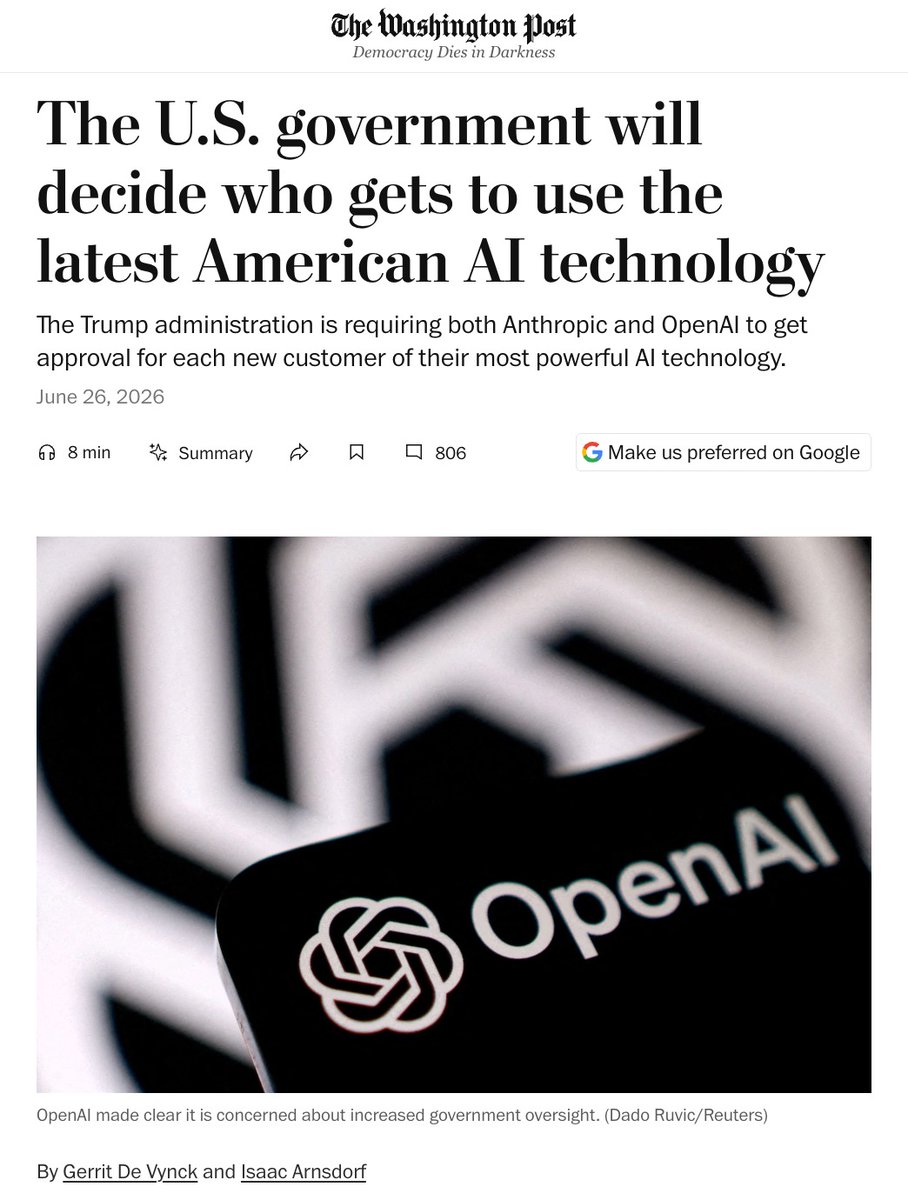
I recently spoke with @GerritD of the @washingtonpost about the U.S. government expanding its vetting of companies seeking access to the newest AI models.
Markets love predictability. Regulations for AI are still catching up to the speed of AI innovation, and that gap makes the process feel ad hoc and unpredictable. I'm optimistic this settles down, the same way it has for every major technology before it.
But it's a good reminder for businesses to stay in control of their own destiny. Open-weight SLMs, fine-tuned on enterprise data and run on-premises or in a secure cloud, give enterprises full sovereignty over their models and data instead of depending on external approvals or availability.
Great to be back on @CNBCTV18News's Voices from the Valley with @ShereenBhan and Gajen Kandiah of @Rackspace, talking trends in enterprise AI.
The one I'm most excited about: the rise of the harness, bringing your data, models, and agents into one system that keeps learning and improving.
But a harness has to run somewhere you trust. That's where the Rackspace + @Uniphore partnership comes in: they bring the infrastructure, we bring the intelligence layer. Together we deliver the full harness as an outcome, so enterprises can focus on the impact they want from AI.
Satya Nadella's recent blog highlights a critical shift: in an AI economy, the companies that win will be the ones that capture value, not just consume it.
In the next decade, advantage will come from owning your AI capability, what he calls token capital, and the institutional knowledge a generalist model can never learn from the outside.
That's the future @uniphore's Business AI Cloud is enabling for customers:
✅ Bring your own model
✅ Keep your data and IP under your control
✅ Turn every interaction into a source of learning
Great to join @RomaineBostick and @kgreifeld on @BloombergTV's "The Close" on how software architecture has shifted in the AI era.
The edge now is how enterprises build and control their AI:
✅ SLMs over frontier LLMs
✅ Governance and guardrails for regulated industries
✅ Proprietary data as the real differentiator
✅ Sovereignty over your model, GPU, and stack
The fastest movers own their intelligence instead of renting it.
This week, I'll be joining Peter Salanki and Anurag Rana at the @Bloomberg Generative AI Forum: Scaling Across Industries to discuss AI infrastructure and software architecture.
I'm excited to share how @uniphore's Business AI Cloud lets enterprises own their intelligence rather than rent it. By distilling large models into efficient, domain-specific SLMs, we deliver superior accuracy at a fraction of the cost, then deploy governed AI agents on top of institutional knowledge to drive measurable impact at scale.
Looking forward to the conversation.
The issue is that, in most cases, LLMs are better suited for consumers rather than large enterprises. SLMs can deliver the same or even better outcomes at a much lower cost.
We (@Uniphore) are seeing 100-200x reductions in cost per query with our enterprise customers when moving them from general-purpose LLMs to specialized SLM architectures, while also achieving lower latency and higher accuracy.