免責聲明更新:
大叔美股筆記歡迎各位投資同好共襄盛舉,為維護個人權益,在瀏覽各個投資筆記前,請先閱覽以下聲明,閱覽者將視為同意本聲明條款:
1. 大叔美股筆記對於所發表之投資筆記、分析數據及參考資料內容,其立論依據皆係合法引用自網路上公開資訊以及合法管道取得之資料,不涉及任何抄襲等侵害智慧財產權之行為;對於閱覽者將大叔美股筆記所發表之投資筆記,在未經同意下,從事行銷推廣、背書代言、營利等商業相關活動,無論是否獲利,大叔美股筆記將採取法律行動追究其責。
2. 大叔美股筆記所發表之投資筆記、分析數據及參考資料內容,不得作為任何交易之依據,閱覽者依筆記或數據資料內容進行任何投資行為所產生之風險及盈虧,未經自行了解判斷,而導致交易損失風險,應自行負擔,大叔美股筆記不對使用者之投資決策負任何責任。
3. 大叔美股筆記所發表之投資筆記對於所提及之其他個人、公司或組織,大叔美股筆記均不對其交易安全、商品及服務內容負任何擔保責任,其間之所有交易、擔保、賠償責任及售後服務皆係存在於閱覽者與商品或勞務提供者之間,閱覽者如因商品或服務提供者發生任何變故或糾紛,大叔美股筆記不負任何法律責任。
4. 大叔美股筆記中,涉及到其他個人、公司或組織之網站連結,對被連結之網站或其所提供之任何產品、服務或資訊,大叔美股筆記不擔保其正確性、真實性、即時性、及完整性。
5. 閱覽者同意由大叔美股筆記保留修改本聲明之權利,如有變更,將公佈於大叔美股筆記社群平台上,不另行通知。
Disclaimer Updates:
Uncle Stock Notes welcomes all investment enthusiasts to participate. To safeguard your rights and interests, please read the following disclaimer carefully before reviewing any investment notes. By accessing or reading the content, you are deemed to have agreed to the terms set forth herein:
1. All investment notes, analytical data, and reference materials published by Uncle Stock Notes are based on legally sourced information, including publicly available online data and materials obtained through lawful channels. No infringement of intellectual property rights, including plagiarism, is involved. Any unauthorized use of Uncle Stock Notes’ content for marketing, promotion, endorsement, commercial gain, or related activities—whether for profit or not—without prior consent is strictly prohibited. Uncle Stock Notes reserves the right to take legal action against any such violations.
2. The investment notes, analytical data, and reference materials provided by Uncle Stock Notes are for informational purposes only and shall not be construed as a basis for any trading decisions. Any investment actions taken by readers based on such content are undertaken at their own risk. Readers are solely responsible for any profits or losses incurred, especially where decisions are made without independent evaluation and judgment. Uncle Stock Notes assumes no responsibility or liability for any investment decisions made by users.
3. With respect to any individuals, companies, or organizations mentioned in the investment notes, Uncle Stock Notes makes no representations or warranties regarding the security of transactions or the quality of any products or services provided. All transactions, guarantees, compensation, and after-sales services are solely between the reader and the respective provider. Uncle Stock Notes shall bear no legal liability for any disputes, losses, or issues arising between readers and such third parties.
4. Any external links to websites of individuals, companies, or organizations provided within Uncle Stock Notes are for reference only. Uncle Stock Notes makes no guarantees regarding the accuracy, authenticity, timeliness, or completeness of the content, products, or services offered on such linked websites.
5. Uncle Stock Notes reserves the right to amend this disclaimer at any time. Any changes will be published on its official platforms without prior notice.
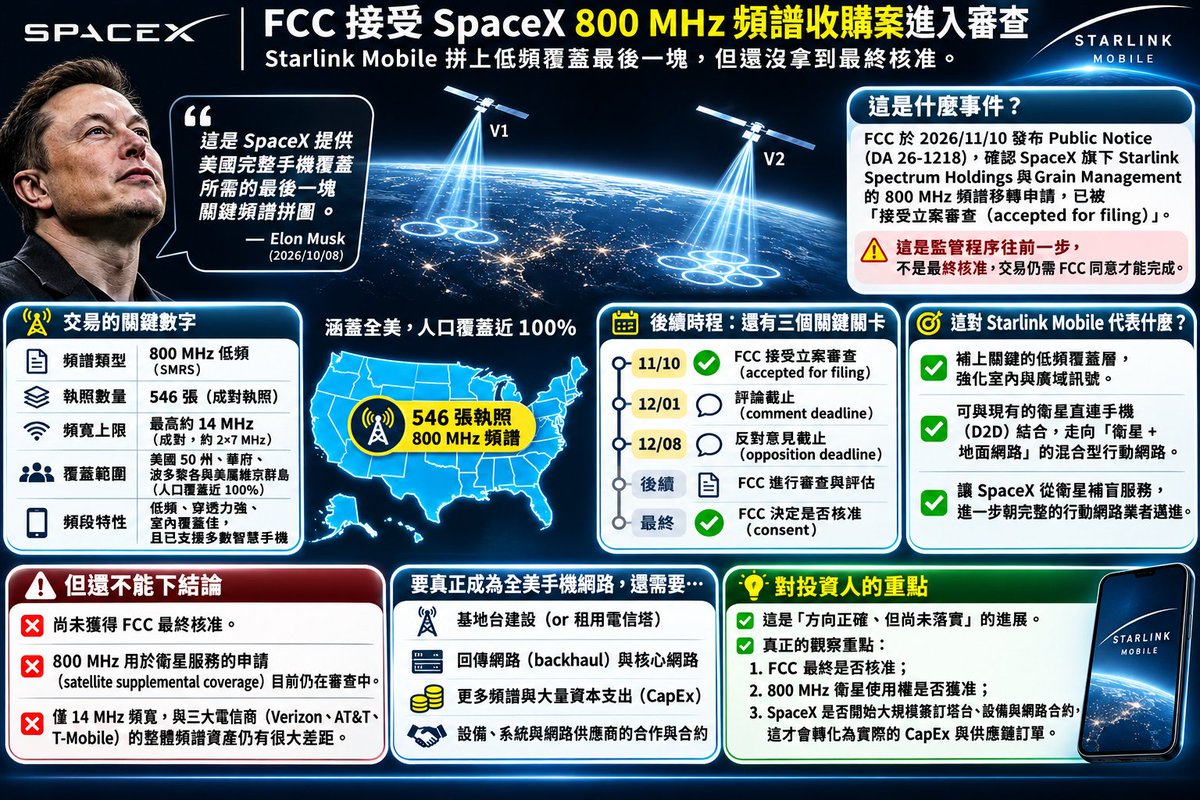
SpaceX has taken another step toward its own mobile network. A few numbers need context.
The FCC accepted its application to acquire Grain’s 800 MHz spectrum portfolio: 546 paired licenses covering nearly the entire US population. That describes the licenses’ geographic reach, not an already-built Starlink Mobile network. Acceptance also does not mean regulatory approval.
This deal adds up to roughly 14 MHz. The “89 MHz” figure refers to SpaceX’s combined attributable spectrum holdings in relevant markets after closing—not 89 MHz of newly acquired 800 MHz spectrum. Low-band airwaves help with geographic and indoor coverage; capacity and speeds still depend on bandwidth, site density and network deployment.
Wireless service should keep evolving. But spectrum is one step in a costly, multiyear build. Watch $AMT, $CCI and $SBAC for actual signed leases; watch incumbent carriers for pricing and churn pressure. FCC approval, binding contracts and commercial milestones will tell us more than the excitement around the announcement. Then decide what that future is worth.
Google expanded its eighth-generation TPU lineup with two systems. TPU 8tx pairs with fifth-generation AMD EPYC hosts for hardware-level confidential computing, protecting data and model weights during processing. Google claims latency can be halved versus TPU 8t. TPU 8i Max combines two 8i dies in one package, doubling compute, SRAM and HBM bandwidth within the existing rack footprint. These are vendor specifications and performance claims; results will depend on workloads.
The investment signal is increasing specialization across confidential inference, long context and agent workloads. Custom accelerators can win deployments by reducing the cost of useful inference, provided software compatibility, migration costs and reliable supply support adoption. The announcement supports an evolving spending mix without establishing that total AI capex must rise. Doubling HBM bandwidth also does not automatically mean doubling memory capacity or procurement spending.
$AMD’s EPYC attachment is confirmed by Google. $AVGO merits tracking through its TPU design partnership, alongside $TSM, advanced packaging and HBM suppliers. However, this announcement does not provide a complete supplier list, allocations or order values. Benefits for SK hynix, Samsung and $MU depend on qualification, memory configurations and shipment volumes. $CLS and Quanta should likewise remain potential supply-chain exposures rather than confirmed suppliers to these systems.
Attractive specifications still need availability dates, cloud pricing and customer benchmarks before investors can assess the economics. Adoption depends on how much customers save after accounting for migration and development work. Memory and packaging demand require a system-level assessment, while conventional DRAM forecasts cannot be treated as HBM contract-price guidance. Keep following deployments, margins and cash conversion.
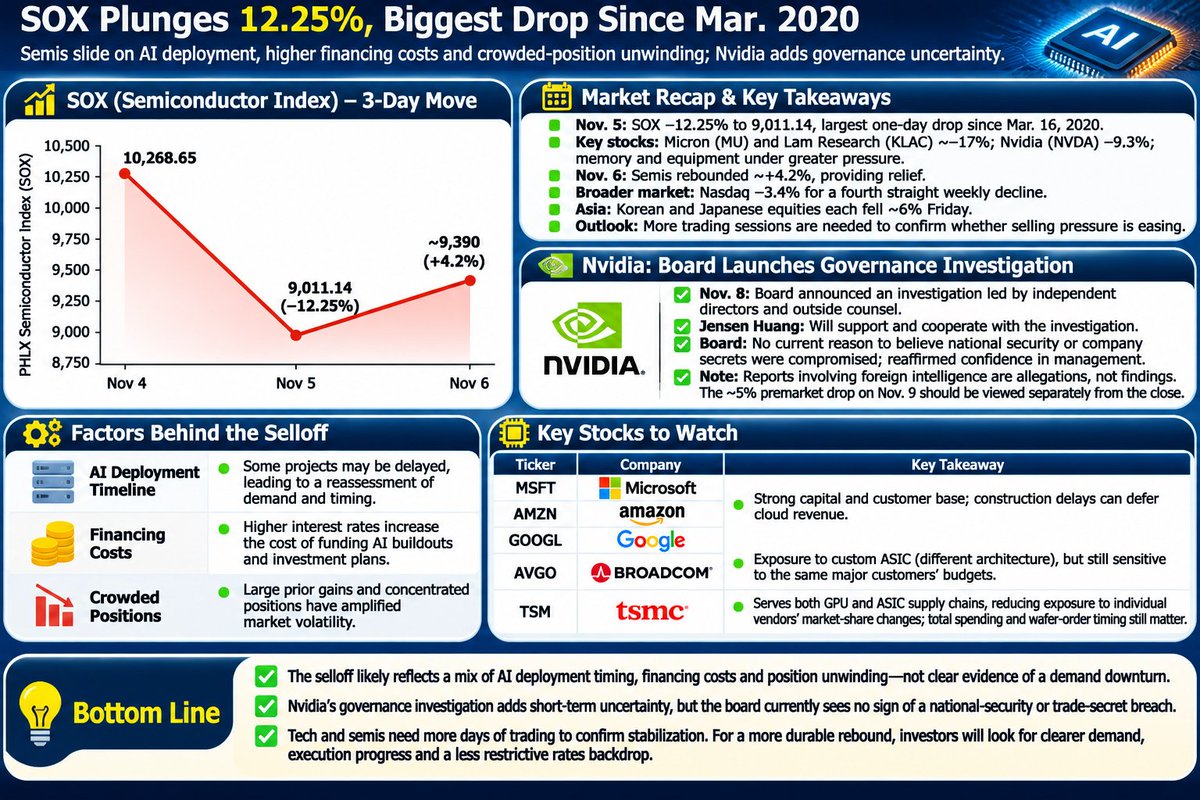
The SOX plunged 12.25% to 9,011.14 on Nov. 5, its largest daily decline since March 16, 2020. Micron and Lam Research lost roughly 17%, versus Nvidia’s 9.3% decline, putting memory and equipment under greater pressure. Friday’s roughly 4.2% semiconductor rebound offered relief, but the Nasdaq still lost 3.4% for its fourth consecutive weekly decline. Korean and Japanese equities each fell about 6% Friday. More trading sessions are needed to establish whether selling pressure is subsiding.
Nvidia also faces additional governance uncertainty. On Nov. 8, its board announced an investigation overseen by independent directors and outside counsel, with Jensen Huang’s cooperation. The board said it currently had no reason to believe national security or company secrets were compromised and reaffirmed confidence in management. Reports involving foreign intelligence remain allegations rather than investigation findings. The roughly 5% premarket decline on Nov. 9 should also remain distinct from closing performance.
The sector’s weakness could reflect deployment delays, financing costs and crowded-position unwinding together; price moves alone cannot establish a demand downturn. $MSFT, $AMZN and $GOOGL have relative financial resilience, although delayed construction can defer cloud revenue. $AVGO offers custom-ASIC exposure but remains sensitive to the same major customers’ budgets. $TSM serves both GPU and ASIC architectures, reducing exposure to individual vendors’ market-share shifts. Changes in total spending and wafer-order timing still matter.
October payrolls rose 165,000, well above roughly 65,000 expected. September was revised from 29,000 to 60,000, with combined August–September revisions adding 84,000. Unemployment fell from 4.2% to 4.1%, while average hourly earnings increased 0.4% monthly and 3.1% annually. The two-year Treasury yield rose about six basis points to 4.52%, and the ten-year finished near 4.86%. CME pricing put the probability of a December quarter-point hike around 77%, leaving further tightening as the favored outcome.
Tech now faces pressure from both AI infrastructure economics and monetary policy. Investors are reassessing financing and deployment timelines, while resilient employment gives the Fed less reason to move toward easing. Annual wage growth of 3.1% does not suggest a wage spiral, although the 0.4% monthly increase deserves attention. With oil around $90–100, inflation remains a constraint. October CPI is the next test: consensus calls for 0.3% monthly headline inflation and 0.2% core. A softer reading could ease hike expectations and valuation pressure.
Stronger hiring weakens the immediate case for a Fed rescue. Yet the 339,000 increase in involuntary part-time employment reminds us to examine job quality alongside headline growth. Watch Nov. 10 CPI, Nov. 13 PPI and the ten- and thirty-year Treasury auctions. For tech to stabilize, companies need to deliver growth while inflation and financing costs stop adding pressure.
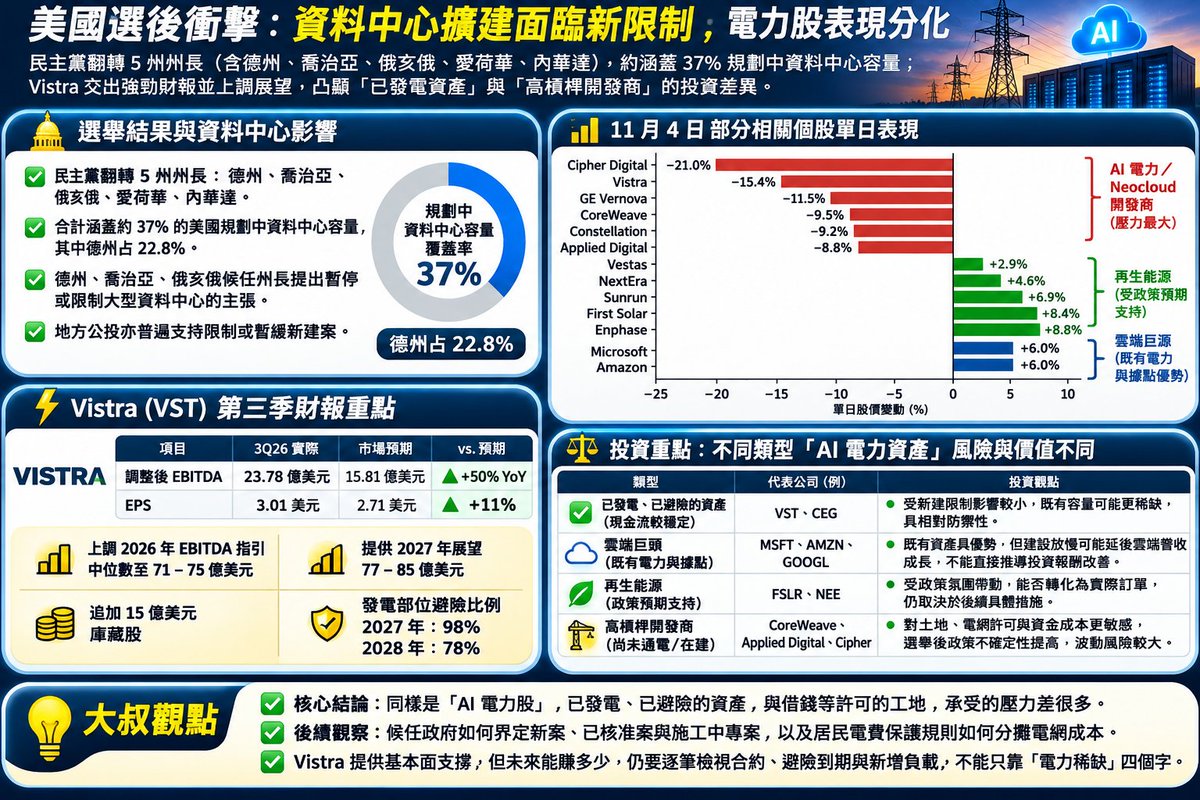
Democrats flipped five governorships—Texas, Georgia, Ohio, Iowa and Nevada—covering roughly 37% of planned US data-center capacity under the cited estimate, with Texas alone at 22.8%. Incoming governors in Texas, Georgia and Ohio proposed pauses on large facilities, while local ballot results broadly favored restrictions.
Vistra’s Q3 adjusted EBITDA reached $2.378B versus $1.581B a year earlier, and EPS of $3.01 beat the $2.71 consensus. It raised the midpoint of its 2026 EBITDA outlook, with a $7.1–7.5B range, introduced 2027 guidance of $7.7–8.5B and added $1.5B to buybacks. Shares rebounded roughly 10%. Its generation book is 98% hedged for 2027 and 78% for 2028, supporting near-term visibility. Those hedges, however, are not equivalent to data-center supply contracts; unsigned future demand remains exposed.
Restrictions on new construction could increase the scarcity value of existing, energized capacity in suitable locations, supporting a different assessment of $VST and $CEG from leveraged developers. Existing sites and power arrangements also give $MSFT, $AMZN and $GOOGL relative advantages, although slower deployment can delay cloud revenue rather than automatically improve returns. $FSLR and $NEE benefit from policy expectations, with actual orders depending on implementation. Texas already had grid-connection restrictions, so incremental political risk should be assessed separately from existing constraints.
An operating, hedged power asset and a debt-funded project awaiting permits carry very different risks—even when both wear the “AI power” label. Watch how incoming administrations treat new, approved and already-under-construction projects, alongside rules allocating grid costs to large customers. Vistra’s results provide fundamental support, but future earnings still require a close look at contracts, hedge expirations and incremental load. Scarcity alone does not settle the valuation.