@HighStakesCap@Djedje20x@HighStakesLeaks De toute façon le risque 0 n’existe pas. Quand on a un capital important il est tout à fait compréhensible de se diversifier, tant au niveau des actifs qu’au niveau de la custody.
6 months ago KuCoin admitted fault for my $300K liquidation. Here's what happened since.
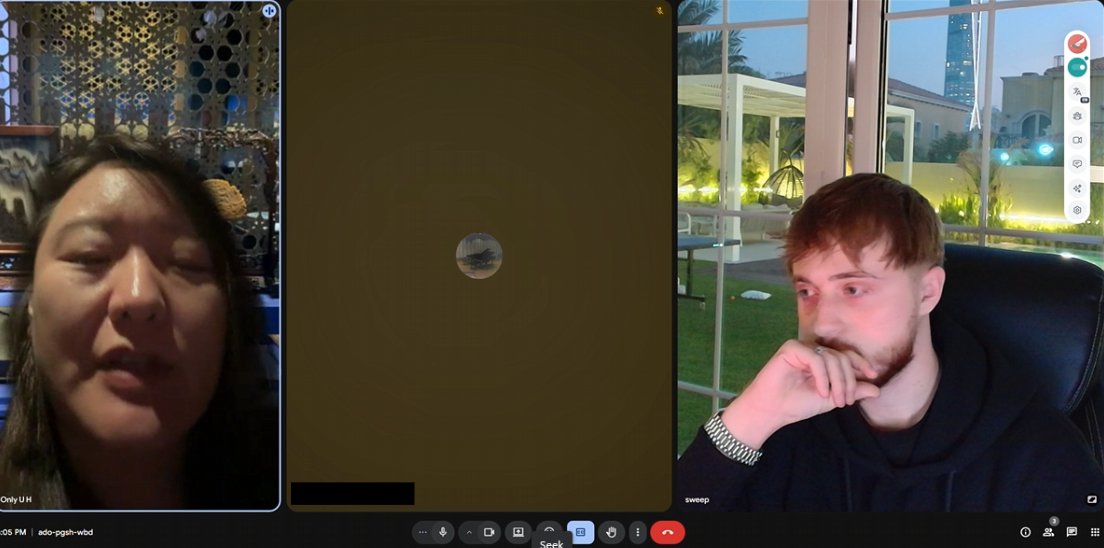
I took a Google Meet with their Head of Futures. I went to an in person meeting at Tribes in Dubai Mall with their Global Business Director. I sent 10+ proposals. I gave them every possible way to make this right.
On the call they took full responsibility. They admitted the liquidation was caused by broken infrastructure. Their platform failed and they said so themselves.
But here's the part that's hard to believe. Their Head of Futures couldn't understand basic futures mechanics. I had to explain how margin, liquidation and order book depth works to the person running the futures division at a top 10 exchange.
The person responsible for resolving my case didn't understand the product that caused it.
Their first offer: bring us $2.5 billion in trading volume and you can "earn it back." I did the math for them live in the chat. $10,000 per 100M volume. That's 0.01% return. To recover $250K I would need to generate the monthly volume of a top 50 institutional desk. For free.
I said no.
Their second offer was worse. $20K upfront, but only if I hit 1,000 active users and $300M in volume first. Then a $30K "cashback" that requires KuCoin's manual approval.
I said no again.
Their third offer was even worse than the second. $10K/month. Halved the numbers from the deal they already couldn't close. After an in person meeting. After a Google Meet. After weeks of negotiations.
Every single offer came with the same condition: delete the tweets, stop talking, and come work for us as a KOL. Promote the exchange that wrongfully liquidated me. Bring them users. Make them money. Then maybe they'd consider giving back what they took.
I told them in the chat: "It's like someone steal from me $250K and then tells me come work for me and you'll make it back (maybe)."
Their response? "Let me think about it."
Then silence. Weeks of silence. I had to chase them for every single reply. Christmas came and went and I gave them a final deadline January 6th. They came back with yet another lowball.
KuCoin had their Head of Futures, their Global Business Director, and multiple senior reps in this group chat. They all saw every message. They all went quiet when it mattered.
Today I'm releasing the full 30 minute Google Meet recording and the complete Telegram history. Every message. Every offer. Every time they went silent. You'll hear them admit fault and then watch them do nothing about it.
They had 6 months to make this right. They chose silence.
Video drops today.
Tokenized stocks and ETFs are now live on Felix
On-chain traders no longer have to off-ramp funds to gain exposure to US capital markets. Additionally, Felix users now have the ability to trade tokenized stocks/ETFs in large order sizes without the steep execution costs that have plagued on-chain adoption up until now (Example: Buy $1M in GOOGL on Felix with a net execution cost less than 10bps today).
Trade over 250 different assets now: https://t.co/tWR45uSgF1
Not available in the U.S. and other prohibited jurisdictions.
S&P Dow Jones Indices and trade[XYZ] have joined forces to launch the first official S&P 500 perpetual contract, available exclusively on Hyperliquid.
For 69 years, the S&P 500 has been a defining reference point for global finance. Until now, access to that benchmark has been shaped by market hours, intermediaries, and geography. Today, that changes.
The S&P 500 perp is now available 24/7/365, anchored by the official index data required for deep liquidity and institutional confidence at scale.
SPDJI helped define modern indexing. They are stewards of an iconic benchmark, the standard against which portfolios across the globe are measured. We are honored to bring that legacy on-chain.
Trade[XYZ] is bringing the world's most iconic assets towards a future of global, continuous markets — a future powered by Hyperliquid.
HyperCore will support outcome trading (HIP-4). Outcomes are fully collateralized contracts that settle within a fixed range. They are a general-purpose primitive that are useful for applications such as prediction markets and bounded options-like instruments. There has been extensive user demand in both of these areas, and builders will likely think of novel applications as well.
Outcomes bring non-linearity, dated contracts, and an alternative form of derivative trading that does not involve leverage or liquidations. The outcome primitive expands the expressivity of HyperCore, while composing with other primitives such as portfolio margin and the HyperEVM.
Outcomes are a work in progress and currently only being tested on testnet. Canonical markets based on objective settlement sources will be deployed once technical development is complete. Canonical markets will be denominated in USDH. Pending user feedback, the infrastructure will be extended to permissionless deployment.
No complexity. No accident.
10/10 was caused by irresponsible marketing campaigns by certain companies.
On October 10, tens of billions of dollars were liquidated. As CEO of OKX, we observed clearly that the crypto market’s microstructure fundamentally changed after that day.
Many industry participants believe the damage was more severe than the FTX collapse. Since then, there has been extensive discussion about why it happened and how to prevent a recurrence. The root causes are not difficult to identify.
⸻
What actually happened
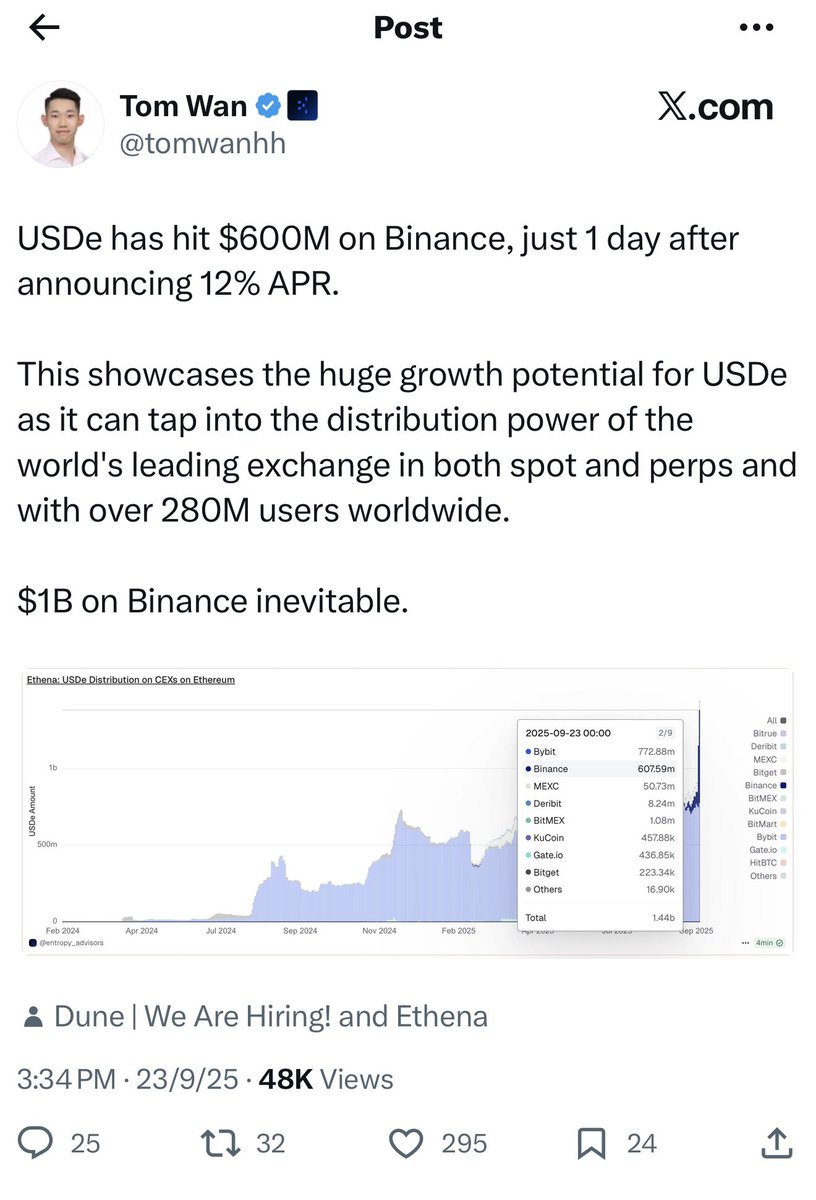
1.Binance launched a temporary user-acquisition campaign offering 12% APY on USDe, while allowing USDe to be used as collateral with the same treatment as USDT and USDC, and without effective limits.
2.USDe is a tokenized hedge fund product.
Ethena raises capital via a so-called “stablecoin,” deploys it into index arbitrage and algorithmic trading strategies, and tokenizes the resulting fund. The token can then be deposited on exchanges to earn yield.
3.USDe is fundamentally different from products such as
BlackRock BUIDL and Franklin Templeton BENJI, which are tokenized money market funds with low-risk profiles.
USDe, by contrast, embeds hedge-fund-level risk. This difference is structural, not cosmetic.
4.Binance users were encouraged to convert USDT and USDC into USDe to earn attractive yields, without sufficient emphasis on the underlying risks. From a user’s perspective, trading with USDe appeared no different from trading with traditional stablecoins—while the actual risk profile was materially higher.
5.Risk escalated further as users:
•converted USDT/USDC into USDe,
•used USDe as collateral to borrow USDT,
•converted the borrowed USDT back into USDe,
•and repeated the cycle.
This leverage loop produced artificial APYs of 24%, 36%, and even 70%+, widely perceived as “low risk” simply because they were offered by a major platform. Systemic risk accumulated rapidly across the global crypto market.
https://t.co/IK2gW4xUOP that point, even a small market shock was sufficient to trigger a collapse.
When volatility hit, USDe depegged quickly. Cascading liquidations followed, and weaknesses in risk management around assets such as WETH and BNSOL further amplified the crash. Some tokens briefly traded near zero.
The damage to global users and companies—including OKX customers—was severe, and recovery will take time.
⸻
Why this matters
I am discussing the root cause, not assigning blame or launching an attack on Binance. Speaking openly about systemic risks is sometimes uncomfortable, but it is necessary if the industry is to mature responsibly.
I expect there may be significant misinformation and coordinated FUD directed at OKX in the near future. Even so, speaking honestly about systemic risk is the right thing to do—and we will continue to do so.
As the largest global platform, Binance has outsized influence—and corresponding responsibility—as an industry leader. Long-term trust in crypto cannot be built on short-term yield games, excessive leverage, or marketing practices that obscure risk.
The industry needs leaders who prioritize market stability, transparency, and responsible innovation—not a winner-take-all mentality where criticism is treated as hostility.
Crypto is still early.
What we choose to normalize today will determine whether this industry earns lasting trust—or repeats the same mistakes again.
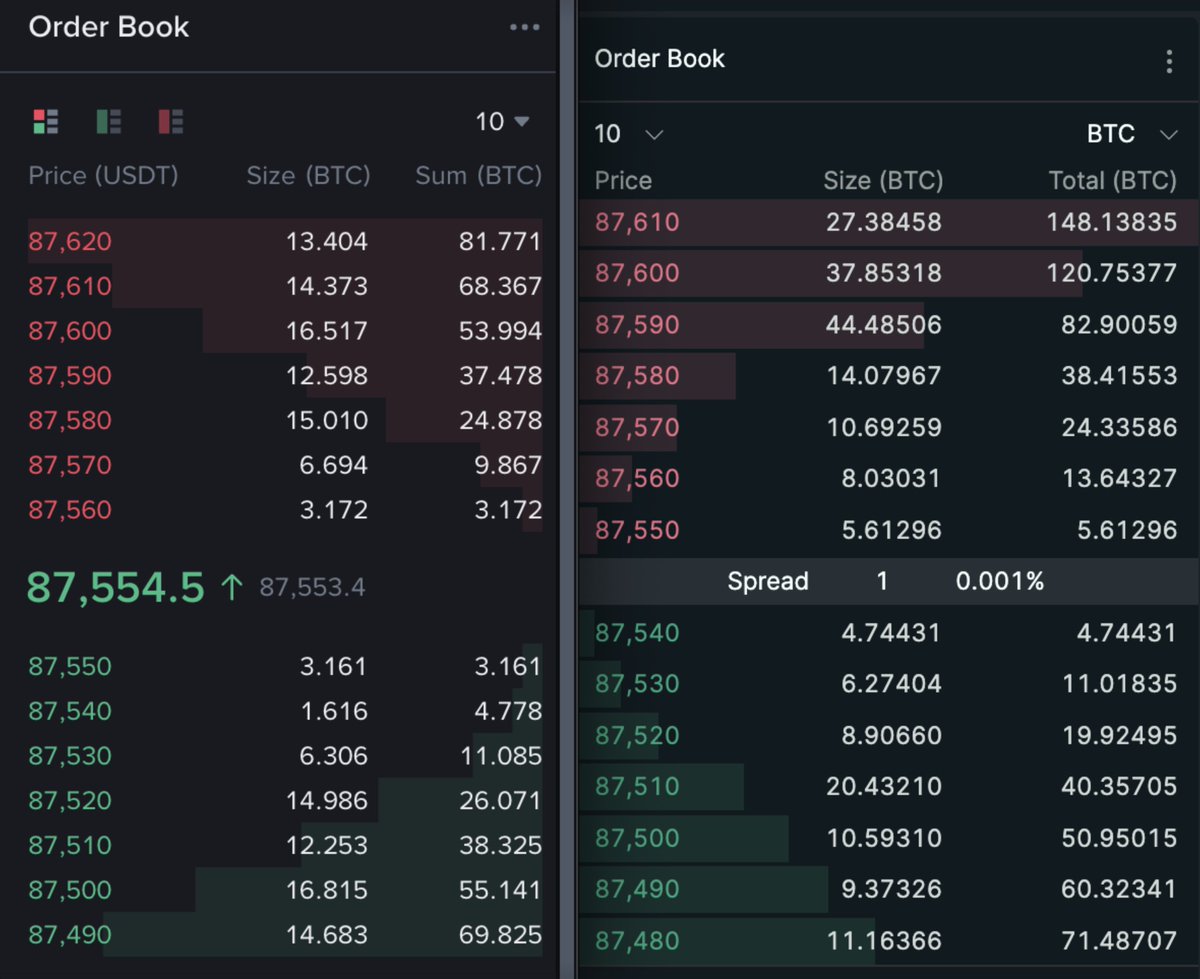
Hyperliquid has quietly achieved an important milestone of becoming the most liquid venue for crypto price discovery in the world. See below for side by side comparison of BTC perps on Binance (left) and Hyperliquid (right).
With HIP-3 teams leading the way, Hyperliquid has also grown to become the most liquid venue for perps on tradfi assets. Thank you to everyone's hard work as we upgrade the financial system and house all of finance.
Imo the flash crash of crypto assets was accelerated by a few malicious actors.
Some people must have lost a lot of money and I wouldn't be surprised if we hear that some hedge funds are facing bankruptcy in the coming days.
Hypurr NFTs have been deployed on the HyperEVM.
Participants had the opportunity to opt in to receive a Hypurr NFT after the HyperEVM went live as part of the Genesis Event in November 2024. The HyperEVM launched in February 2025 as the general programmability interface to the Hyperliquid L1. The HyperEVM is not a standalone EVM. Rather, it allows developers to trustlessly tap into the liquidity on HyperCore. Read precompiles allow smart contracts on the HyperEVM to read L1 state, and the CoreWriter contract allows HyperEVM smart contracts to send actions on HyperCore. This two-way communication between Core and EVM secured by the same HyperBFT consensus protocol unlocks powerful new primitives. Many novel applications have been built on the HyperEVM exploring these possibilities, including LSTs, lending, and vault tokenization protocols.
The goal of the Hypurr NFT collection was to share a memento with those who believed in and contributed early on to Hyperliquid’s growth. Each NFT is unique and captures the different moods, hobbies, tastes, and quirks of the Hyperliquid community, as depicted by Hypurr.
There are a total of 4,600 NFTs in the collection. 4,313 NFTs went to Genesis Event participants, 144 went to the Hyper Foundation, and 143 went to core contributors, including Hyperliquid Labs, NFT artists, and other contributors.
Ownership and use of Hypurr NFTs are subject to the Hypurr NFT Terms and License available here: https://t.co/6oHgPdf7G9. Participants who opted in to receive a Hypurr NFT as part of the Genesis Event were screened according to the Foundation's risk-based program. In addition, clustering analysis was conducted to protect against sybil behavior and cap the total number of NFTs received by any given user.
Contract address: 0x9125E2d6827a00B0F8330D6ef7BEF07730Bac685.
To be clear: No action is required. You do not need to mint. The NFT collection has already been distributed. As always, beware of scams and impersonations.