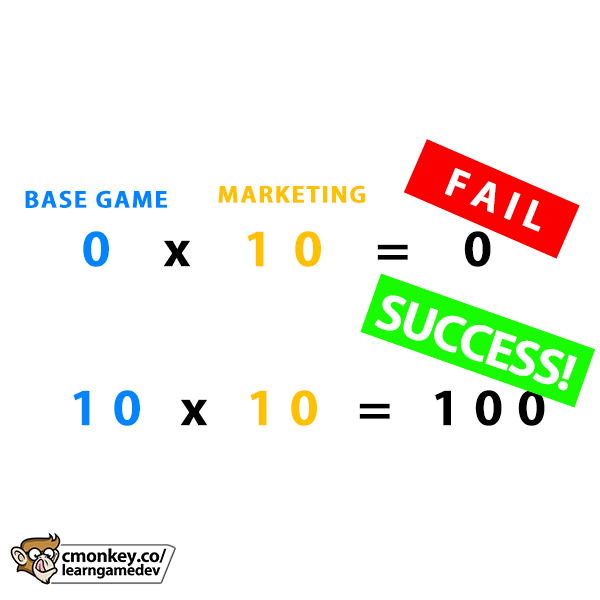
Game marketing doesn't fix a game few people want. I'll say it again: MARKETING IS A MULTIPLIER.
If your game is a Flappy Bird clone in 2026, even if you spend $5000 on ads you won't get any sales/wishlists.
If your game has a base value of 0, then anything multiplied by 0 is still 0! So the most awesome most clever marketing in the world won't save a weak game idea.
In order to find success you need to make something people are genuinely excited for. Test your idea's appeal early with real humans. If you do that then your odds off success are infinitely higher than if you just make "yet another 2D Puzzle Platformer"
#### ANSWER ####
#### ANSWER ####
#### ANSWER ####
#### ANSWER ####
#### ANSWER ####
#### ANSWER ####
#### ANSWER ####
#### ANSWER ####
#### ANSWER ####
#### ANSWER ####
#### ANSWER ####
#### ANSWER ####
(B)
Input.mousePosition returns the Screen Pixel coordinates that are dependent on Resolution, it is not in World space.
In order to get a World position from the Mouse you need to convert from Screen Space into World Space
In a 2D Game you can do it with:
Vector3 worldPosition = Camera.main.ScreenToWorldPoint(Input.mousePosition);
And in a 3D game you need to do a Raycast in order to intersect some position in the world, like a Terrain/Floor.
I covered both methods and made a really useful helper class that I've used in a ton of videos here:
##REF##video_small, 0jTPKz3ga4w, How to get Mouse Position in 3D and 2D!##REF##
For example this is how you can handle finding the Shoot point in a Third Person Shooter
##REF##video_small, FbM4CkqtOuA, Awesome Third Person Shooter Controller!##REF## ##REF##video_small, luBBz5oeR4Q, PERFECT Weapon Aiming! (IK, Unity Tutorial Third Person Shooter)##REF##
Or if you want to work with the UI use RectTransformUtility.ScreenPointToLocalPointInRectangle();
If I do:
Instantiate(myPrefab, Input.mousePosition, Quaternion.identity);
Will myPrefab be spawned under the mouse?
A) Yes
B) No
(answer in reply below)
How do you know if a game idea is fun or not? When should you drop a game idea?
"fun" is really hard because it's impossible to measure, there's no objective "fun" meter. So the only way is to playtest constantly, both by yourself and ask friends and other players to play and give you their feedback.
If the feedback you get on your prototype is negative then absolutely you should drop that idea and go back to the drawing board. Remember how it's much easier to drop a project in the beginning, rather than spend 6+ months working on something and then be disappointed when it sells 0 copies because you ignored negative feedback at the start.
But it's also up to you to analyze that feedback. It might be fixable, maybe you can tweak some things to get the project onto a good state.
As always the only way to know is to constantly playtest, if the feedback is improving then you're on the right track so keep working on it, but if you're working super hard to improve and the feedback just keeps coming back negative, then it might be wise to drop it and move on to something else.
Idea Selection and Idea Validation are extremely important things nowadays (if your goal is to find success), so do not neglect this very important step!
How much should current trends influence the games that you make? Should you make just what you want, or just what the market wants? Or something in between?
The answer first starts with being honest with yourself about what exactly you want out of game development. Is it a hobby just for fun? Or a job intended to make money? The games that you should make depends heavily on your answer to this question.
Ideally, if your goal is financial success, then the idea that you pick should be a mix between games you want to make and genres that are currently hot. For me that's not an issue at all since the current hot genres are exactly the games I want to make: Incremental games, Simulator games, Strategy games, etc.
Genre is super important and massively defines your odds of success, so if your goal is indeed financial success then picking the right genre is key. If your goal is success and your favorite genre to make are 2D Puzzle Platformers I would highly advise against it since you're going to be fighting a very tough uphill battle.
However if you are making games for fun, then there are no rules! Build whatever you want to build! Do you really want to make a 2D Puzzle Platformer or a Match-3? You will likely end up selling under 100 copies, but if the goal is fun then you will have achieved your goal! Congrats!
What is a Custom Inspector?
This is one of those things that sounds very advanced (and it kind of is) but it can massively improve your Unity workflow.
By default, Unity just shows your fields one after another. Technically you can customize it with a lot of complex editor code, learning how to do that is the advanced part.
Or you can use Odin! Which now with the Visual Designer update has just become a MASSIVE productivity booster whilst being insanely easy to use. In a few clicks you can customize the inspector in any way you can imagine. Your scripts are no longer just scripts, they become actual proper usable tools.
You can add image previews, sliders, progress bars, tabs, validation warnings, buttons, conditional fields, and a ton more.
So instead of your designer editing a confusing wall of fields, they get a clean UI that actually explains what they're editing.
And with the new Odin Visual Designer, you can build those awesome inspectors in literally seconds. You can literally right-click, open the Visual Designer, and drag things around.
This is a HUGE upgrade for anyone making tools, ScriptableObjects, data-heavy systems, or anything that designers need to touch.
Plus now they even have a completely FREE 90 day trial so you can verify that it really is an awesome tool that will help you immensely.
I have a fully detailed Tutorial video on my channel https://t.co/OjxbHcVLKx
Check out Odin at https://t.co/hjQOgdBUdH
@Odin_Inspector
#sponsored
@chubaski1 Go watch my very first video tutorial published 8 years ago, everything covered there you can still do today in Unity 6. It's just Game Objects, MonoBehaviours and normal C#, things that have been mature for decades.
If Unity and C# tutorials don't really get outdated, what about Steam Game Marketing? Is the advice from 5 years ago still applicable today?
No!
When it comes to technical tutorials the core concepts don't really change, but in terms of Steam Marketing the meta does change quite a lot so on that one yes I would recommend looking up more current advice.
For example the advice 5 years ago on Steam was "do not make a demo, they will just hurt your copies sold" whereas nowadays a demo is absolutely ESSENTIAL for marketing.
Yes the core timeless advice of "make a good game" is still the core of it, but the tactics have changed drastically from 10 years ago, back then Next Fest did not exist, influencers almost didn't exist, and wishlists weren't such a big deal. So on the topic of Steam Game Marketing yes I would recommend you find less than 1 year old tutorials / guides to follow.
If you use this tool in that way that's on you it's not on the tool. Just like if you use a hammer to smash your own hand it's not the hammers fault.
If you use this tool to help you analyze and LEARN why your game is running slowly, then you will have both fixed the problem AND gained knowledge in the process.
If you just tell it "fix my game" and blindly accept all changes then that's on you.
...but I can ask a human to draw Mario? If I then publish that or try to sell it then I am doing copyright infringement, regardless of whether a human or AI drew that.
I can also ask a friend to recite some random literature text, I could recite parts of the Lord of the Rings from memory, I love those movies and I've seen them a ton of times. Am I doing something wrong by doing that just because I've seen the movies many times? I don't think so.
So you still haven't given me a single example of how an AI is different from a human in this case.
Both ingest a ton of data and produce stuff based on what they have ingested.
Theft is indeed a crime, but your argument is how just reading a book or watching a movie or reading a blog post on the internet is theft, and I just disagree with that regardless of whether the entity doing the reading is a human or an AI.
If you HATE AI art, that's fine! In fact I think the best use cases for Unity AI are NOT related to art at all.
It can help you all of these tasks:
- Build editor tools
- Analyze game performance
- Help clean up your code
- Do brainstorming
- Level design and prop placement
- Help you understand how an asset/package works
- Learn any Unity/C# topic
- Analyze and fix errors
- Generate an overview of your entire project
- Help you locate missing assets and refs
- Plan systems before you implement them
- ...and many more!
These are all excellent use cases that can save you a massive amount of time and help you make your game a lot more AWESOME!
And like I said none of these use cases have anything to do with generating art, so even if you hate AI for that purpose you can still use it for all these scenarios.
Or if you want AI art just for prototyping and nothing else then that's also fine, you can generate 3D objects, Sprites, Textures, Cubemaps, Materials, Animations and more, then when you're ready to replace them for hte final game you can just easily search for all assets with the Unity AI tag and manually replace them with human art.
As always this is really just a tool, and it's up to you to figure out how to use that tool to help you in your workflow.
I have an insanely detailed 1h30m video on YouTube covering a ton of use cases for Unity AI
Get started using it for FREE and see how it helps your workflow! Check it out at https://t.co/IWLZtbqUy7
#sponsored
@alnutmob heh it was! I rehearsed many times, both by myself (which was scary) then in front of friends and family (which was super scary) in order to prepare myself for doing it publicly (still scary but thankfully managed to get through it)
I just gave my very first talk ever yesterday! It was a very interesting new experience and went quite well!
Of course I picked a topic that I'm very passionate about: How to Write Game Code That Doesn't Fall Apart
I'll be recording a video version, stay tuned next Monday!
So your concern is if people knew that someone or some thing would learn from their published works that they wouldn't have published them? Again in that scenario where exactly is the difference between a human and AI?
If you publish something publicly a human can learn from it as can an AI, where is the difference?
I guess you're saying you want publishers to have control over who consumes the things they publish to which I absolutely agree! If I want one of my videos to be limited (like I do for some private videos that are meant for community members) then I make them Unlisted instead of Public. That way I have control over who consumes it.
How is what the AI is doing not transformative? When I ask it something it is not copy pasting some output from its training data, it is generating new data based on how it learned, just like a human.
I definitely cannot point you to every single tutorial I have seen in my entire life, I started learning programming 25 years ago, I cannot give you the links or references that I used to learn back then, no one can.
During the training process the AI is indeed doing all those experiments and learning from mistakes, that's what the training process is like, every piece of information it digests it uses that to shift its weights up and down. Just like a human learns bit by bit over every piece of information it consumes.
I genuinely cannot see any argument for how this is in any way different from humans. The only argument I can possibly see is in terms of scale, one human could not possibly consume the amount of knowledge the AI consumed in it's training, but then if that's your issue then my question would be at what point does it become unethical? Is it if I as a human read 100 books? Or 1000 books? Or 10,000 books? Where is that scale threshold where it goes from ethical to unethical?
I'm not pushing anti-AI narrative at all, like I said for me personally it's just a tool, I'm just accepting that some people are indeed extremely anti-AI, and I want those people to not dismiss a tool outright for no reason. Whether that makes them hypocrites I guess that's for them to decide for themselves.