A neobank could give an API model this toolkit and move from insights-only AI to controlled financial operations.
Not just:
“Here is what happened in your account.”
But:
* create a customer
* start KYC
* issue an account
* freeze or unfreeze a card
* quote a transfer
* prepare a payment
* retry a webhook
* reconcile a ledger mismatch
* open a dispute packet
* escalate a compliance case
* generate and file an internal ops report
The model should not have unrestricted control. It should operate through permission tiers:
* Read: inspect balances, users, transactions, webhooks
* Draft: prepare transfers, compliance packets, support replies
* Execute low-risk: retry idempotent jobs, refresh statuses, send notices
* Approval-required: move money, freeze accounts, close cases, change limits
Real-world use cases:
1. Fintech ops agent
An agent watches failed deposits, missing KYC states, webhook mismatches, and stuck transfers. It can inspect provider logs, retry safe actions, open an internal case, or escalate to compliance.
2. Customer onboarding agent
A developer app can let an agent create a customer, start hosted KYC, issue a virtual account, generate API keys, and explain the next integration step.
3. Payments reconciliation agent It compares bank/provider/webhook/internal ledger records, finds mismatches, drafts the adjustment, and routes risky cases to a human.
4. Support agent with real permissions
Instead of answering from docs only, it can check account state, transaction status, failed webhook deliveries, API key
health, and give an exact answer.
5. Developer success agent
It reads a tenant’s API usage, failed requests, missing scopes, webhook errors, and suggests the exact code or config change needed.
6. Compliance review agent
It can gather KYC status, sanctions results, transaction history, device/IP signals, and produce a structured review packet without exposing raw credentials to the model.
7. Back-office automation agent
Daily reports, payout checks, treasury movement summaries, customer risk queues, and incident briefs can be generated from live systems instead of spreadsheets.
Real-world use cases:
1. Fintech ops agent
An agent watches failed deposits, missing KYC states, webhook mismatches, and stuck transfers. It can inspect provider logs, retry safe actions, open an internal case, or escalate to compliance.
2. Customer onboarding agent
A developer app can let an agent create a customer, start hosted KYC, issue a virtual account, generate API keys, and explain the next integration step.
3. Payments reconciliation agent It compares bank/provider/webhook/internal ledger records, finds mismatches, drafts the adjustment, and routes risky cases to a human.
4. Support agent with real permissions
Instead of answering from docs only, it can check account state, transaction status, failed webhook deliveries, API key
health, and give an exact answer.
5. Developer success agent
It reads a tenant’s API usage, failed requests, missing scopes, webhook errors, and suggests the exact code or config change needed.
6. Compliance review agent
It can gather KYC status, sanctions results, transaction history, device/IP signals, and produce a structured review packet without exposing raw credentials to the model.
7. Back-office automation agent
Daily reports, payout checks, treasury movement summaries, customer risk queues, and incident briefs can be generated from live systems instead of spreadsheets.
Released @universarails/agent-toolkit v0.1.0: an ESM SDK + MCP stdio server for agent-built payment apps on Universa.
It exposes agent-callable tools for customer/KYC workflows, wallet + virtual account preparation, quote and transfer
drafting, webhook/status reads, and USDC-on-Solana settlement paths.
Mutating operations are dry-run by default and live API calls require execute=true, so agents can assemble request
bodies, idempotency keys, and approval steps before anything moves money.
npm i @universarails/agent-toolkit
https://t.co/bqoYKDHotG
Released @universarails/agent-toolkit v0.1.0: an ESM SDK + MCP stdio server for agent-built payment apps on Universa.
It exposes agent-callable tools for customer/KYC workflows, wallet + virtual account preparation, quote and transfer
drafting, webhook/status reads, and USDC-on-Solana settlement paths.
Mutating operations are dry-run by default and live API calls require execute=true, so agents can assemble request
bodies, idempotency keys, and approval steps before anything moves money.
npm i @universarails/agent-toolkit
https://t.co/bqoYKDHotG
We just used our own infra to wire developer payouts from fiat into USDC.
Codex drove the whole flow end to end: verified the payout path, created a dedicated VA through our provider/sponsor-bank stack, routed it to a Solana USDC wallet, and set it as the payout destination.
The setup is simple from the developer side:
Platform payout → sponsor-bank VA → liquidity/provider rail → Solana USDC wallet.
No manual off-ramp. No waiting on payout ops. No “where did the money go?” dance.
This means developers can get paid in USDC every month on the 5th, directly to their assigned wallet.
For global developers, that matters: faster access to funds, cleaner reconciliation, fewer banking delays, and less dependency on local fiat rails.
The bigger point: payout infra should feel invisible.
Developers should build, earn, and receive usable money quickly. We’re making fiat-origin payouts settle into stablecoins with the same reliability people expect from bank rails, but with crypto-native speed and portability
Before stablecoins, global payments meant stitching together banks, processors, and local rails country by country.
Now, dollars move 24/7 and users expect it to feel native everywhere.
Build compliance-ready stablecoin rails in minutes with Universa.
https://t.co/FN9OCLmSta
good morning
universa is for the builders who wake up thinking “this should be easier”
fiat in
stablecoins out
stablecoins in
bank payouts out
KYC handled
virtual accounts issued
wallets created
quotes locked
transfers tracked
webhooks delivered
fees visible
reconciliation clean
one dashboard, one API, one place to build real money movement into your app
the future of crypto is not people thinking about rails
it is every product quietly having them underneath it
https://t.co/1ob1XRxX51
Universa is the developer surface for compliant fiat-to-stablecoin money movement.
The hard part is not one API call. The hard part is making KYC, issuing virtual accounts, assigning wallets, quotes, bank destinations, fees, webhooks, transaction history, and support tooling all agree with each other.
That is what we are building.
On-ramp means an approved customer receives funding instructions through an issued virtual account. They send fiat through the supported local rail, and Universa settles the value into the Solana USDC wallet assigned to that customer.
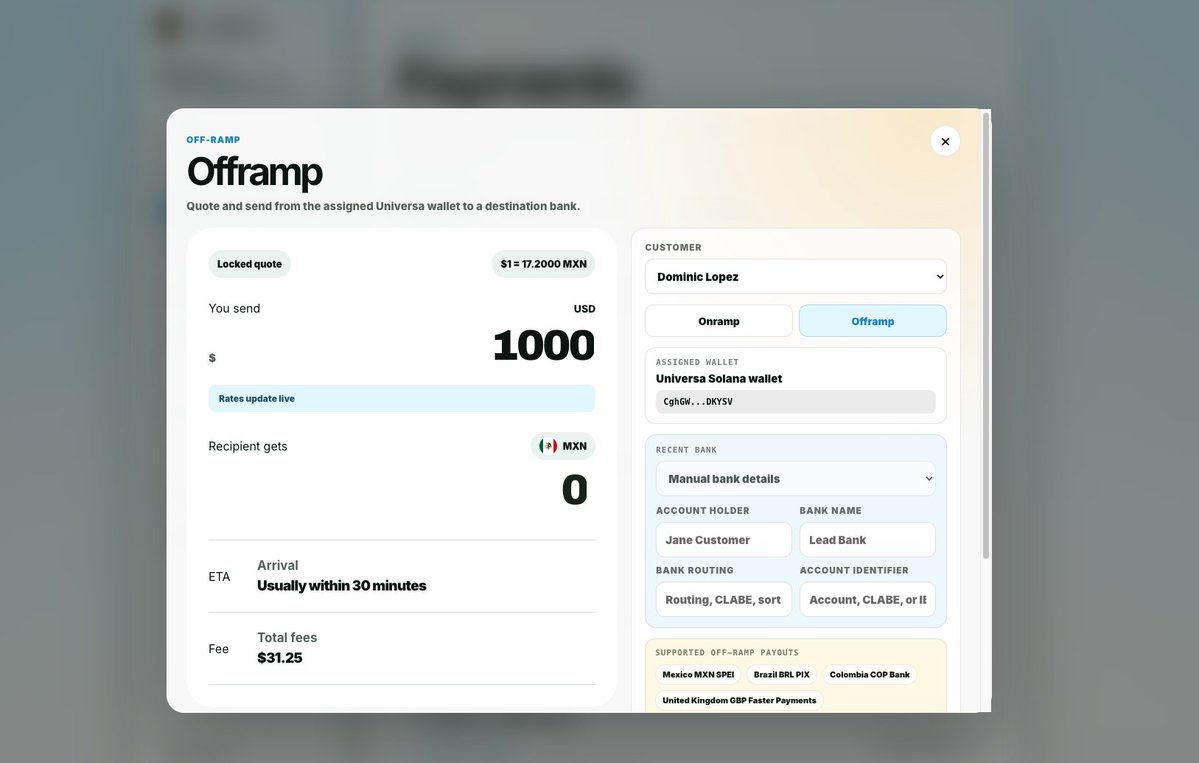
Off-ramp means that same customer can quote a transfer out, review the amount, route, fees, and bank destination, then send to a supported bank account from inside the Universa rails dashboard or through the API. No exchange tab. No manual crypto operations. No separate payout workflow.
For developers, the primitives are straightforward:
- create customers
- run hosted KYC
- read issued virtual accounts
- create quotes
- submit transfers
- manage destination banks
- sign backend API requests
- receive signed webhooks
- inspect customer-level transactions from the dashboard
The benefit is not just fewer endpoints. It is fewer places for money movement state to break.
If you are building a product where users need to move between bank rails and stablecoins, Universa gives you the rail logic, operational visibility, and compliance-aware flow without forcing your team to rebuild an internal payments company first.
Wemby tunnel walkout, Finals lights, Universa across the boards.
The dashboard is live: on-ramp VAs, wallet-to-bank off-ramp quotes, saved banks, review-before-send, customer master
views, API keys, webhooks, fees, and $UNV runway in one console.
Global rails should feel this cinematic.
Dashboard v1 is done.
On-ramp VAs now show routing/account details, supported countries + the KYC-assigned Solana wallet. Off-ramp handles
wallet-to-bank quotes with fees, saved banks and review-before-send.
Customers, wallets, VAs, tx history, API keys, webhooks + $UNV runway now live.
Universa Rails turns payment volume into developer rewards.
After completing the KYC process, we assign each developer a Solana wallet. As volume moves through Universa, their earned fees/rewards settle to that wallet. From the dashboard, they can send payouts to supported bank accounts by bank transfer.
No separate exchange needed.
We're shipping on Universa: tightened the payments dashboard around the real money flow.
On-ramp now shows issued virtual account routing/account details, off-ramp is split into its own payout path, rails + currencies are country-
aware, and settlement accruals now track batch provider payouts correctly.
• Sunrise on Universa.
$UNV is built around a fixed-supply reward vault for developers: rewards tied to real platform volume, released
through reviewed epochs, with buybacks funded separately from net revenue.
A network token for builders using compliant rails.
Universa $UNV emissions model:
10M fixed supply
45% public DBC liquidity
50% capped developer rewards vault
5% team vesting
0% marketing allocation
Rewards are released from a 5M $UNV vault through reviewed epochs tied to settled platform volume.
Target runway: 4-6 years once volume is meaningful.
Spent the last few hours pushing Universa closer to real rails infrastructure:
- dashboard webhooks with signed delivery, retries, event history
- Solana wallet-gated payment flows
- transfer review + confirmation before creation
- API key one-time secret modal
- $UNV dashboard with emissions runway + buyback loop
- live dashboard shipped
Payments should feel boring, observable, and hard to accidentally misuse. That’s the bar.
Hi what’s up man? Yeah I know it’s a lot but bare with us our sponsors banks need to know who you are for what we’re offering. As much as we love the ethos of permissionless finance moving real money through banks is something no one can do anonymously compliantly.
What I can promise is you will never have to get on a sales call with us all emails will be answered within 30 minutes and you’ll never be asked questions about your build.
We’re building Universa slowly and deliberately.
One API for KYC-gated fiat rails, stablecoin settlement, virtual accounts, quotes, transfers, and payouts.
Not trying to make money movement louder.
Just cleaner, safer, and easier for developers to build on.
https://t.co/9SSa59I5i8
Supply is stored away in the vaults forever team allocation is locked in escrow so over 55% of the float is off the market anyone selling is just a trader the team is aligned