NIGERIANS, GO AND VERIFY (2)
Building the Institutions of the State
Peter Obi
In Series 1, I explained the philosophy that guided our administration in Anambra State: governance as a public trust, anchored on character, competence, capacity, and compassion. I also introduced the Anambra Integrated Development Strategy (ANIDS), our comprehensive framework for achieving balanced and sustainable development across all sectors.
But a development vision, however noble, cannot succeed without strong institutions to drive it. Before the government could effectively deliver on its promises in education, healthcare, infrastructure, security, and other sectors, we had to first restore the machinery of government itself. We could not build a prosperous state on a cracked and unstable foundation.
This was why one of our foremost priorities under ANIDS was to rebuild, strengthen, and reposition the institutions of government. When I assumed office, the physical and administrative architecture of governance was in a deplorable condition. Our task was not simply to construct buildings but to restore the institutions, systems, and structures through which government could function effectively.
We therefore began systematically rebuilding the infrastructure of governance across the executive, legislature, judiciary, civil service, and local government system.
Restoring the Seat of Government
The Government House in Awka, the state capital, had been vandalised and burnt by reactionary forces in 2004. We therefore had to rebuild, re-equip, and furnish it, restoring its dignity and functionality as the seat of executive government.
In the same vein, we rehabilitated the Governor’s Lodge in Amawbia and constructed a new Governor’s Lodge in Onitsha. These investments were intended not merely to provide accommodation but to strengthen executive presence and facilitate effective governance across the state’s major administrative and commercial centres.
Strengthening the Legislature and Judiciary
We rehabilitated the Anambra State House of Assembly Complex in Awka, providing our lawmakers with a more conducive and decorous environment in which to discharge their constitutional responsibilities. We also provided legislators with vehicles to facilitate the effective performance of their legislative duties.
We recognised that a functioning democracy requires strong institutions, including an effective legislature and an independent judiciary, each operating within its constitutional mandate.
In strengthening the judiciary, we provided brand-new vehicles to High Court judges. This was the first time such provision had been made for them in the history of the state. We also provided vehicles to magistrates for the first time since the creation of Anambra State.
These interventions were intended to strengthen the administration of justice, improve mobility, and enable judicial officers to discharge their responsibilities more effectively.
Rebuilding the Civil Service: The Chief Jerome Udoji State Secretariat Complex
Before our administration, many Ministries, Departments, and Agencies (MDAs) operated from scattered rented apartments, while civil servants lacked a centralised and decent working environment. This untidy arrangement undermined coordination, efficiency, and the dignity of public service.
We addressed this situation by constructing the two-phase, ultra-modern Chief Jerome Udoji State Secretariat Complex, comprising Blocks 1 and 2. The project brought the MDAs together under one roof, improved administrative coordination, and provided civil servants with a more suitable environment in which to serve the people.
The complex was named after Chief Jerome Udoji, the first indigenous Chief Secretary (the equivalent of today’s Secretary to the State Government) of the Eastern Region during the First Republic. This was also a recognition of his contribution to public administration and the civil service tradition.
I can authoritatively say that once @PeterObi is the President of Nigeria, that will be the end of two most important leeches in Nigerian politics:
1. Patronage and godfatherism
2 . Tribalism, Nepotism and Corruption
We will see and experience
1. Meritocracy
2. Data Driven Democracy.
Good morning Everyone, have a wonderful day and God bless You and Yours, Amen 🙏
WASHINGTON, DC : PRESENTING NIGERIA’S DEVELOPMENT AND DEMOCRATIC FUTURE ON THE GLOBAL STAGE.
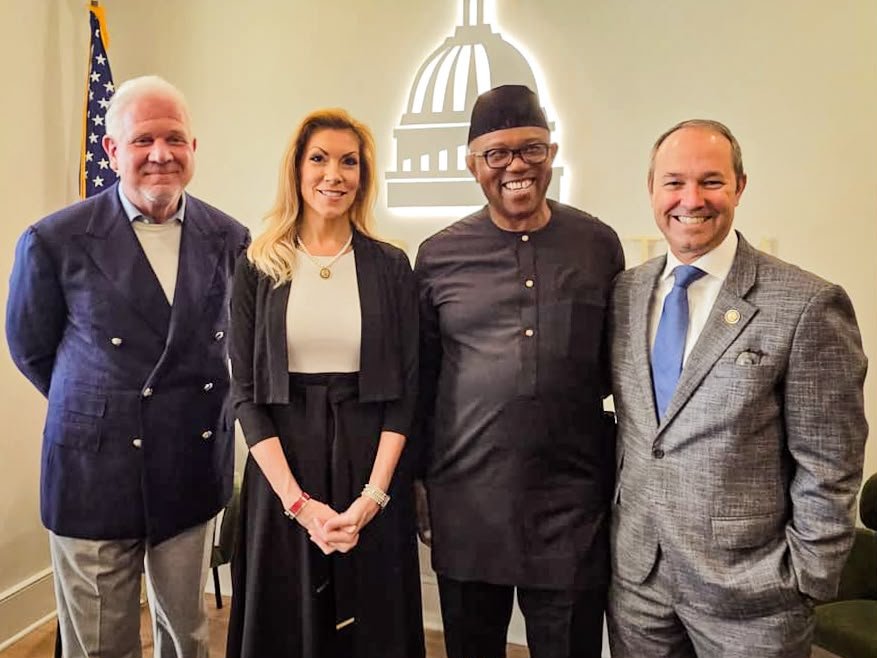
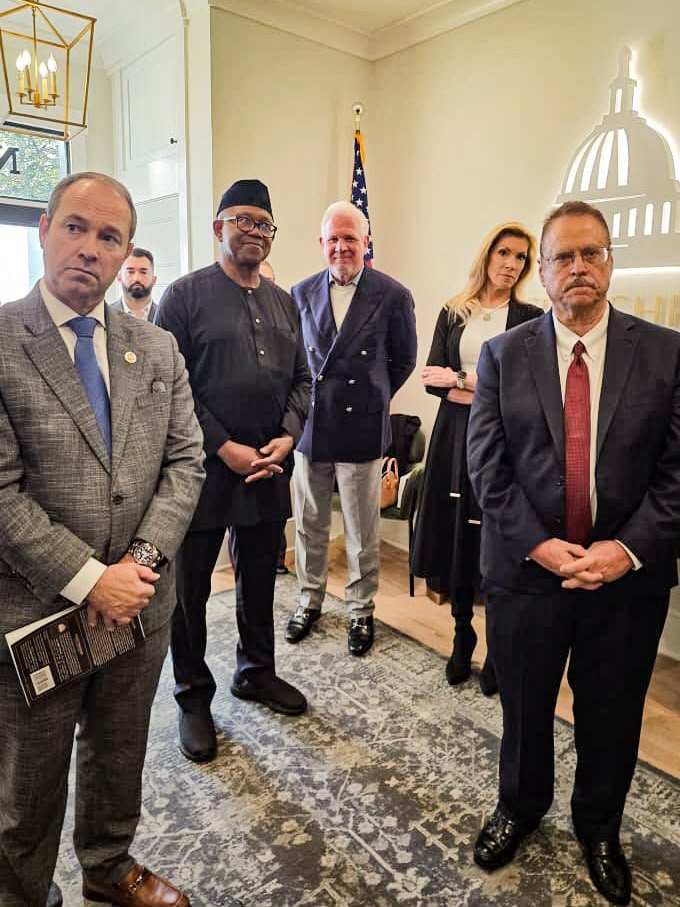
Yesterday, Monday, November 16, I arrived in Washington, DC, for a series of significant meetings and engagements with congressional leaders from both the U.S. House of Representatives and the Senate, as well as other influential American figures. These discussions focused on vital matters affecting Nigeria’s development, the well-being of our people, and the future of our democracy.
I began the day with a substantive interview with renowned American television commentator Glenn Beck. Our conversation addressed Nigeria’s challenges, the pressing need for accountable leadership, the responsible management of our vast human and natural resources, and the opportunities to establish Nigeria among the world’s leading nations.
I also met with prominent American leaders, including Congressman Marlin Stutzman, Congresswoman Beth Van Duyne, Congressman Todd Tiahrt, Suzanne Bock Grisham, retired U.S. Army Colonel Albert V. Short, and other esteemed stakeholders.
One of the day’s principal highlights was my address on Capitol Hill, during which I underscored the urgent importance of international cooperation and support for Nigeria’s advancement, particularly in the areas of national unity, security, economic prosperity, and the welfare of our citizens.
Our conversations also addressed the protection of Nigeria’s emerging democracy and the strengthening of democratic institutions to ensure elections are free, fair, transparent, and credible, accurately reflecting the will of the Nigerian people.
Nigeria has immense potential to emerge as a leading nation within the global community. What is urgently required is accountable leadership, responsible stewardship of our resources, resilient institutions, and an authentic commitment to the security, unity, and well-being of every Nigerian.
Throughout these engagements, my message remained unequivocal: Nigerians must determine Nigeria’s future. Every vote must be counted, the rights of every citizen must be safeguarded, and the people’s will must consistently prevail.
I remain encouraged by these engagements and firmly committed to working with Nigerians at home and in the diaspora, alongside our international partners, to build a peaceful, secure, united, and prosperous Nigeria.
Our journey continues. Our determination remains steadfast.
A New Nigeria is POssible! -PO
I became a fan of Peter Obi when he became Atiku Abubakar's running mate in the 2019 election, and I heard that, as governor, he had refused bribes and was incorruptible. I became a secret supporter when he ran in the 2023 election, even though I was a member of the PDP. Now, I'm a die-hard supporter and fan of his presidential candidacy.
One reason I came to admire him was that he challenged Nigerians to point to any instance in which he had accepted a bribe or acted corruptly—yet, to this day, no one has.
The irony is that Nigeria is perceived as a country with corrupt politicians, yet he spent eight years in office with no record of corruption or bribery.
If you will not vote for Peter Obi, I don't think you love Nigeria.
I don't think Peter Obi even needs to say anything to change my mind about him.
I don't even spend time watching any video of him explaining himself.
I have heard everything I needed to hear in 2023.
He is the right man for the job, simple as ABC
NIGERIANS, GO AND VERIFY (1)
Introduction: Governance as a Public Trust
Peter Obi
When I took office as Governor of Anambra State, our beloved state was at a critical juncture. Leadership had become increasingly disconnected from the people, and many of the essential institutions needed to support a modern society were weak, ineffective, or absent altogether. We understood that governance could not continue according to established habits. It needed to be reconceived as a solemn public trust founded on transparency, prudence, accountability, and demonstrable results.
Our governing philosophy rested on four principles: character, competence, capacity, and compassion. We understood that leadership was not a platform for self-promotion, political slogans, or the pursuit of personal acclaim. Its purpose was to improve the circumstances of ordinary citizens. It meant converting public resources into concrete benefits and ensuring that government’s foremost responsibility was to serve the people. Achieving this demanded more than good intentions; it required a clear vision, careful planning, and disciplined execution.
Among our earliest findings was that the state lacked a unified development plan to direct its priorities and determine how resources should be allocated. We therefore promptly created the Ministry of Economic Planning to establish the institutional foundation for deliberate, coordinated, and sustainable development. After completing the necessary groundwork and consultations, we launched the Anambra Integrated Development Strategy (ANIDS).
At that time, the Millennium Development Goals (MDGs) were being pursued worldwide across eight clearly defined priorities: eliminating extreme poverty and hunger; achieving universal primary education; advancing gender equality and empowering women; reducing child mortality; improving maternal health; combating HIV/AIDS, malaria and other diseases; promoting environmental sustainability; and fostering a global partnership for development.
We adopted ANIDS as our overarching development philosophy and strategic framework for advancing these objectives, tailoring them to the distinctive circumstances, needs and development priorities of Anambra State. Instead of viewing the MDGs as remote international benchmarks, we worked to convert their aims into practical policies, programs and measurable results that would produce tangible improvements in the lives of our people.
We also undertook a deliberate effort to redefine the state’s identity, changing its public image from ‘Home for All’ to ‘The Light of the Nation’. This was not merely a change in slogan; it reflected our resolve to restore public confidence in government, renew civic pride and show that Anambra could serve as a model of purposeful leadership and development.
The ANIDS Blueprint: A Comprehensive Framework for Development
ANIDS served as the foundation for our commitment to broad-based and balanced development. We did not accept the idea that government could focus on a single sector while leaving others behind. We recognized that education, healthcare, infrastructure, security, agriculture and capable public institutions were mutually dependent. Advancement in one area could not be sustained without commensurate progress elsewhere. Accordingly, we pursued development across every sector, guided by defined priorities, disciplined planning and prudent stewardship of public resources.
Central to this vision was the restoration of the dignity of the Anambra person. We understood that dignity could not be restored through rhetoric alone. It was evident in the condition of roads and other infrastructure, the availability of healthcare, the quality of education, the performance of public institutions and the way government treated its workers, pensioners and traditional institutions.
I thought democracy meant that if you want to govern me and I say NO, you respect my decision and move on. Why am I having to fight you to respect my NO?
Prado jeeps for APC youth leaders,
100 million for Portable,
2027 cars for politicians,
But Loan for students, Keke napep for the military.
If you like, don’t vote wisely.
Peter Obi is the ONLY candidate who looks at Nigeria like a business that must WORK, not like a cake to be SHARED. New Nigeria is POssible
Nigeria will be OK!
Nigeria is governed by individuals who have essentially given up on the country and are primarily accumulating wealth for themselves and their families.
@grok@firat_tan12 Frequency of ~130-160/year? This is mostly achievable umder 6months in that country, and more so without Durex and the likes, so relying on reports from Durex may not cpature the truth worldwide. There they enjoy skin to skin, have you heard about that?