*After V23, there is no testnet or experimental ecosystem.*
All ecosystems are released directly as mainnet versions, meaning they will go live officially right after launch. After V23, the test version and the official version are no different — everything is mainnet.
There is no transition period or trial testing. Once you open an ecosystem that can be used, you are directly in the real asset mainnet environment.
*V23 = Ecosystem Mainnet* (Closed Mainnet, with an ecosystem but restricted)
*V26 = Fully Open Mainnet* (Open Mainnet, unrestricted, global commercial use)
*V23 (May 11-15):* Official mainnet launch with smart contracts + DEX + ecosystem.
All DApps are released directly on mainnet, with no testnet. But it’s still a closed mainnet: transfers, monetization, and currency channels are limited.
*V26 (June 22):* The final format of the same mainnet: Open Mainnet
- Remove all restrictions on transfers/monetization
- Payments for global merchants and official fiat currency channels go live
- Full cross-chain version and enterprise-level applications launch
*V23 = Ecosystem Mainnet* (closed, DApps can run)
*V26 = Open Mainnet* (fully open, can be used commercially and monetized)
It’s all the same mainnet, just different versions at different stages. There is no separate "test" version.
*V23:* The community is built, and all stores inside it are open, but the gates are locked.
Only residents of the community can shop and trade; they cannot do business outside or transfer money freely. This is called the ecosystem mainnet.
Closed mainnet starts from V23: all apps, games, and financial ecosystems launch as a real mainnet, with no beta version, using native Pi directly.
*V26:* The community gates open fully to the outside world.
Merchants can log in, and you can transfer and exchange your Pi freely. This is global and universal, and merchants can accept it without restrictions. This is called open mainnet.
*V23:* The chain and ecosystem are formed, but can only be used within the loop and not open to the outside world.
*V26:* Fully unblocked, broadcast across all networks.
Accessible, freely transferable, and operates globally.
---
*Good words build good relationships. Rude words will hurt hearts.*
Stay strong together with the Core Team 💪
*🍀After the Smart Contract is deployed, Pi Bank and Pi Exchange will officially appear.*
*Pioneers will become “Kings”.. In the Web2 era, we need banks.*
*But in the Web3 era, banks will have to borrow Pi from your Web3 wallet. Pi Network is the King of Web3, will dominate the global economy with GCV 1pi = 314,159 usd ⚡🌍💜♊💥*
*Pi POWERED WORLD🌎AND UNIQUELY, FIERCELY & NONCONFORMIST-LY PRODUCES GCV$314,159 ECOSYSTEM*
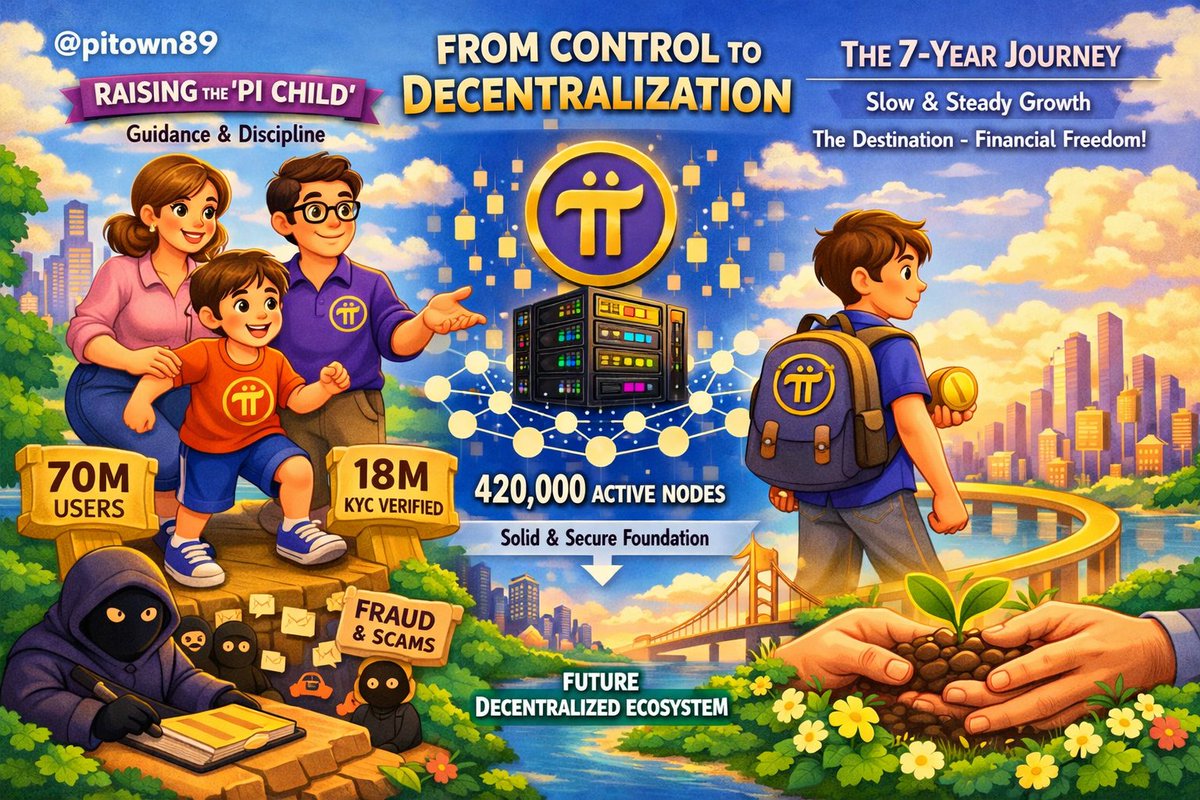
🙇 PI NETWORK: A 7-YEAR-OLD CHILD AND THE DISCIPLINE OF A "STRUCTURED FAMILY" 🧑🍼🤱
Lately, the community has been buzzing with a hot debate: "If Pi Network is decentralized, why does the Pi Core Team (PCT) seem to hold so much control?" 🤨
As a fellow traveler on this journey, I see it exactly like raising a child. But this isn't just any upbringing—it is a journey of "iron discipline." 🛡️
1. A 7-Year-Old Child and the Lesson of Independence 👶
Imagine you have a 7-year-old child. They must learn to crawl, then walk, before they can run. At this stage, the parents (PCT) must "guide" them to instill life skills and discipline.
📊 The numbers speak for themselves:
➤ As of April 2026, the ecosystem has reached a massive scale of over 70 million users.
➤ However, the number of users who have passed KYC and migrated their balance is just over 18 million.
❓ What’s the logic here?
➤ If PCT "opened the floodgates" to all 70 million users at once without strict verification ➔ the 7-year-old "Pi child" would be overwhelmed by fake accounts, fraud, and data clutter.
➤ PCT is choosing to raise each "child" carefully to ensure quality over quantity. ✅
2. Why is "Centralized Control" Necessary Right Now? ⚙️
The recent Protocol 21 upgrade deadline this April is a perfect example. Those who didn't upgrade their Nodes were disconnected immediately.
Sounds "authoritarian," right? But look closer:
➤ There are currently over 420,000 active Nodes worldwide. 🌐
➤ Without a decisive "father figure" to coordinate and synchronize the technology ➔ how could hundreds of thousands of computers across the globe follow a single standard to protect the network?
👉 This is how PCT strengthens the "backbone" of the child. For decentralization to happen (meaning the child moves out and lives independently), the technical foundation must be as solid as a rock first! 💪
3. The Patience of a Sower 🌱
People say 7 years is too long. But look at the reality:
➤ Over 18 million people have successfully migrated their balance to the Mainnet.
➤ This isn't just a number; it is the result of painstaking precision and incredible persistence from both PCT
and the community. 🤝
📌 Don’t just look at the "control" in front of you:
➤ Look at the destination. A child who is well-guided from a young age won't be easily swayed or collapse when facing the "financial storms" of the real world. 🌪️
✨ The Truth: PCT is holding authority only to prepare to hand it over. They are perfecting a validation system owned by the community (with over 1 million human validators). That is the true seed of decentralization—where power doesn't belong to a faceless machine, but to all of us! 👤✨
📢 A Heartfelt Message:
After 7 years of parenting, everyone wants their child to grow up fast so they can rely on them. But it is better to be "slow and steady" than to let a child run into the street before they know how to look both ways. 🚦
Pi Network isn't being "controlled" for exploitation; it is being "protected" for maturity. We’ve come this far and stayed patient for years—let’s keep the faith and guide this child a little longer.
😉 Sweet fruit only comes to those who wait, don't you agree? 🍎💎
Follow @pitown89 now so you never miss important Pi Network updates! 🫡
Turn on the 🔔 bell for new posts! 🤝
If this was helpful, please 💬+👍&🔁
#PiNetwork #Pioneer #Web3 #Blockchain #Mainnet
🔥 STELLAR & PI NETWORK: A RELATIONSHIP MOST PEOPLE MISUNDERSTAND 🤝
In the world of crypto, some names live under the spotlight like Ethereum…
while others operate quietly behind the scenes, like Stellar.
And then there’s Pi Network — a completely different story.
It didn’t start with technology. It started with people.
That’s why, as both projects are expected to move toward version 26 in the near future, many begin to wonder:
👉 Is this just a coincidence… or something deeper?
🧩 NOT THE SAME, BUT NOT COMPLETELY UNRELATED
Pi Network is not Stellar.
They don’t share the same team, and there’s no official partnership.
But saying they’re unrelated wouldn’t be accurate either.
Pi is built on ideas and technical foundations inspired by Stellar, especially its consensus mechanism (SCP). That gives Pi a kind of “technical DNA” from Stellar, even though it has evolved into something quite different.
Think of it this way:
Stellar is the foundation. Pi is the structure rising on top of it.
📱 A SIMPLE WAY TO UNDERSTAND IT
Imagine Android as Stellar,
and Samsung as Pi Network.
Samsung didn’t create Android, but it took it, customized it, added features, and turned it into something uniquely its own.
Pi is doing something similar:
building on Stellar-inspired foundations while adding KYC, trust circles, and an entire user-driven ecosystem.
The key idea is this:
👉 the core may be similar, but the experience is completely different.
⚙️ WHY BOTH ARE HEADING TOWARD “V26”
This is where most confusion comes from.
Stellar is preparing to roll out Protocol 26, a core-level blockchain upgrade.
At the same time, Pi Network is also expected to move toward its own V26 milestone in the near future.
The shared version number doesn’t mean they are the same thing.
It happens because Pi evolved from a foundation related to Stellar, and aligning version progression can sometimes make technical evolution smoother or more compatible.
But beneath that “26,” the stories are very different.
One is upgrading infrastructure.
The other is evolving an entire ecosystem.
⚔️ THREE PATHS, THREE PHILOSOPHIES
Stellar focuses on being a fast, low-cost, and reliable payment network. It’s like a financial highway where money moves across borders in seconds.
Ethereum positions itself as a platform — the foundation of a digital economy where thousands of applications are built and run.
Meanwhile, Pi Network takes a different route:
it builds a massive user base first, then develops technology and ecosystem around it.
Three different paths. Potentially one future intersection.
🧠 THE MOST IMPORTANT QUESTION
What happens if Stellar changes drastically… or even disappears?
The answer depends on how far Pi has evolved.
If Pi still depends heavily on its original foundation, it will be affected.
But if it has customized deeply enough and controls its own core, it can stand independently.
And right now, all signs suggest Pi is moving in that direction.
🚀 CONCLUSION
Stellar is like a technical mentor, laying a solid foundation.
Pi Network is like a fast-growing student, choosing its own path.
At first, it learns.
Eventually, it builds.
🎯 THE TAKEAWAY
As both move toward “version 26,” the number itself isn’t what matters.
What matters is the direction behind it.
👉 One is upgrading the infrastructure of global finance.
👉 The other is attempting to build a real economy powered by its community.
And if those two paths ever intersect…
👉 The question won’t be “who learned from whom” anymore.
It will become:
who is actually reshaping how money moves in the real world 👀
Follow @pitown89 now so you never miss important Pi Network updates! 🫡
Turn on the 🔔 bell for new posts! 🤝
If this was helpful, please 💬+👍&🔁
Witnessing an even grander scale than 2025, Consensus 2026 is set to be a historic gathering of crypto titans, government leaders, and financial powerhouses. All eyes are on Pi Network as our visionary leaders, Dr. Nicolas Kokkalis and Dr. Chengdiao Fan, take the stage once more. We fervently hope their presence will leave an indelible mark, filling the hearts of every Pioneer with boundless pride! 😃��
To my fellow compatriots, behold the prestigious guest list below:"
1. Key Government & Regulatory Figures from the US (Policy Heavy)
Paul Atkins
→ Chairman, U.S. Securities and Exchange Commission (SEC)
→ Head of the U.S. securities regulator, responsible for overseeing token regulations, crypto ETFs, securities laws, and enforcement actions in the crypto industry.
Michael Selig
→ Chairman, U.S. Commodity Futures Trading Commission (CFTC)
→ Head of the agency regulating futures and commodities, responsible for crypto derivatives, futures markets, and assets classified as commodities.
Hester Peirce
→ Commissioner, U.S. Securities and Exchange Commission (SEC)
→ SEC Commissioner, famously known as “Crypto Mom,” widely recognized for her strong support of crypto innovation and frequent opposition to overly strict SEC policies.
Patrick Witt
→ Executive Director, President’s Council of Advisors on Digital Assets (White House)
→ Executive Director of the White House Council of Advisors on Digital Assets, providing direct policy advice to the President on national crypto strategy, stablecoins, and digital assets.
2. Major Crypto & Blockchain Leaders
Eric Trump
→ Co-Founder & Chief Strategy Officer, American Bitcoin
→ Chief strategist for a Bitcoin mining and investment company, bringing significant political influence into the crypto sector.
Michael Saylor
→ Founder & Executive Chairman, MicroStrategy
→ Bitcoin maximalist leader, driving the world’s largest corporate Bitcoin accumulation strategy at MicroStrategy.
Anatoly Yakovenko
→ Co-Founder & CEO, Solana Labs
→ Co-founder and leader of Solana blockchain development — one of the fastest and largest DeFi and NFT ecosystems today.
Brad Garlinghouse
→ CEO, Ripple
→ CEO of Ripple, responsible for the development of XRP and the RippleNet cross-border payment solution.
Vitalik Buterin
→ Founder, Ethereum
→ Founder of Ethereum, the most influential figure shaping the technology and philosophy of the world’s second-largest layer-1 blockchain.
Brian Armstrong
→ Founder & CEO, Coinbase
→ Founder and CEO of the largest cryptocurrency exchange in the United States, serving tens of millions of users.
Arthur Hayes
→ CIO, Maelstrom (former CEO of BitMEX)
→ Legendary trader and Chief Investment Officer of Maelstrom Fund, with massive influence on crypto market sentiment and trends.
Mike Novogratz
→ CEO, Galaxy Digital
→ CEO of Galaxy Digital, one of the largest crypto investment and trading firms in the world.
Bo Hines
→ CEO, Tether USA
→ CEO of Tether’s U.S. operations, overseeing the world’s largest stablecoin (USDT) in the American market.
Raoul Pal
→ CEO & Co-Founder, Real Vision
→ Renowned macro analyst and founder of Real Vision, with strong influence in both crypto and traditional finance communities.
Kevin O’Leary
→ Chairman, O’Leary Ventures (Shark Tank)
→ Chairman of O’Leary Ventures and well-known investor from Shark Tank, providing realistic institutional perspectives on crypto.
3. Pi Network
Chengdiao Fan
→ Founder, Pi Network
→ Co-founder of Pi Network, scheduled to speak about AI + Verified Identity + Pi blockchain on May 6th at Consensus.
Nicolas Kokkalis
→ Co-Founder, Pi Network
→ Co-founder of Pi Network, involved in the technical development and overall strategy of the project.
To all those having house helpers (maids) remember your lives are in her hands since she prepares what you happily eat. It’s easy for her to poi$on you, 😩 treat them like your children. Prioritize humanity 🙏
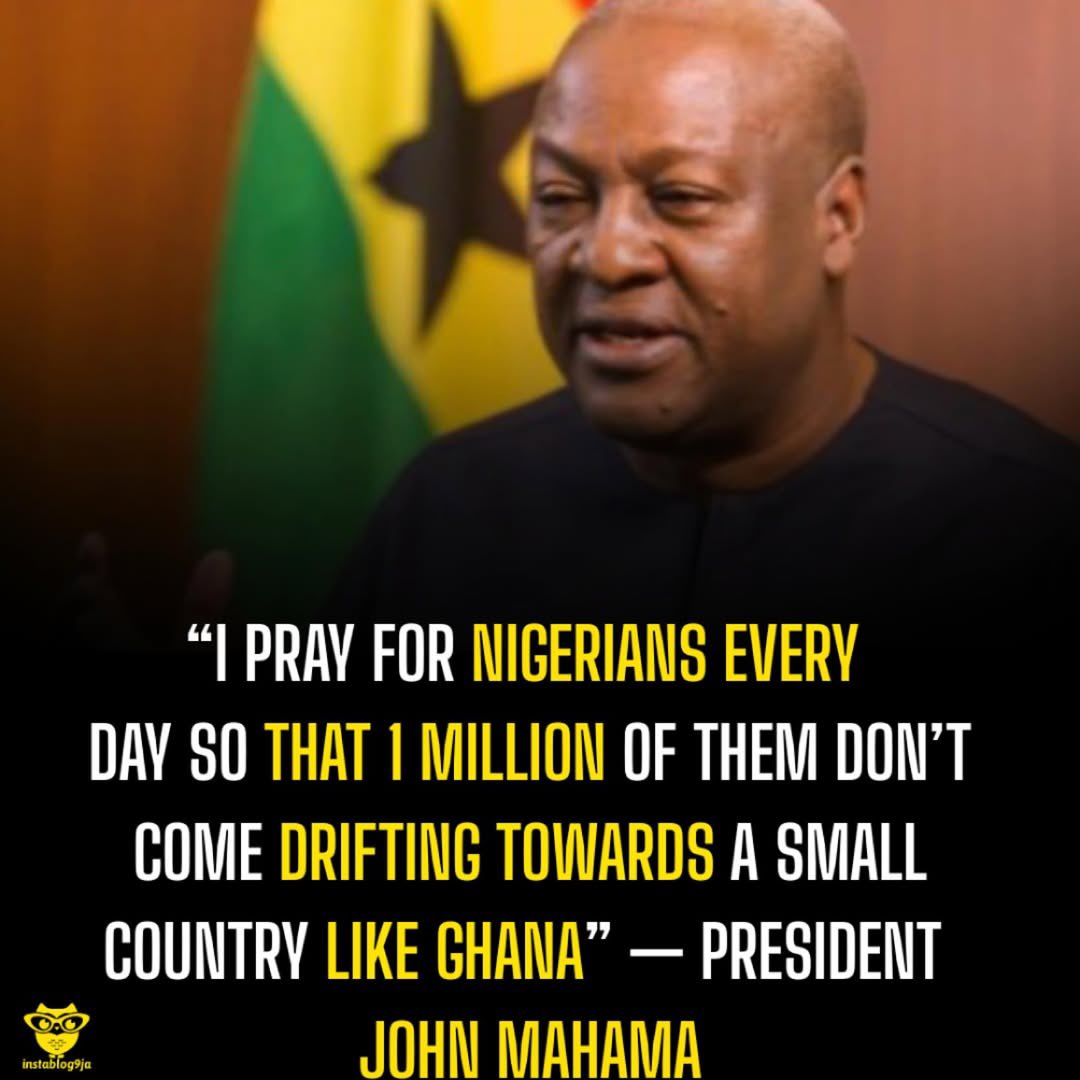
“I Pray For Nigerians Every Day So That 1 Million Of Them Don’t Come Drifting Towards A Small Country Like Ghana” — President John Mahama
Ghana’s President, John Mahama, has said Nigeria’s stability is of key importance to Ghana’s security interests, noting the strong ties between both countries.
Speaking at the African Heritage Awards 2026, Mahama explained that due to Nigeria’s large population and regional influence, instability could have wider consequences across West Africa.
He said: “Nigeria is of key security interests to us. When you have cousins like 250 million of them, you want them to do well so that 1 million of them don’t come drifting towards a small country like Ghana. That’s why every day I wake up and pray for Nigeria that God should help them get their act together.”
He added in another remark: “I wake up to pray every day for Nigerians so that 1 million of them don’t come drifting towards a small country like Ghana.”
The statement has since sparked reactions online, with many highlighting the close demographic and economic relationship between Nigeria and Ghana.